
Quick Take
- Rottweilers were originally used to herd and guard livestock
- Rottweilers have heterodont teeth, including incisors, canines, premolars and molars.
- Misalignment, or malocclusion, is a common dental issue for Rottweiler.
Rottweilers originated from ancient Roman drover dogs that were used to herd and guard livestock. Rottweilers are powerful black-and-tan dogs known for their loyalty, calm demeanor, and confidence. They are popular family guardians who are naturally protective, yet surprisingly gentle and affectionate. Although Rottweilers are susceptible to a host of medical conditions, including cancer and heart disease, they can be prone to dental issues like plaque, tartar, and gum disease. Continue reading to discover everything you need to know about Rottweiler teeth.

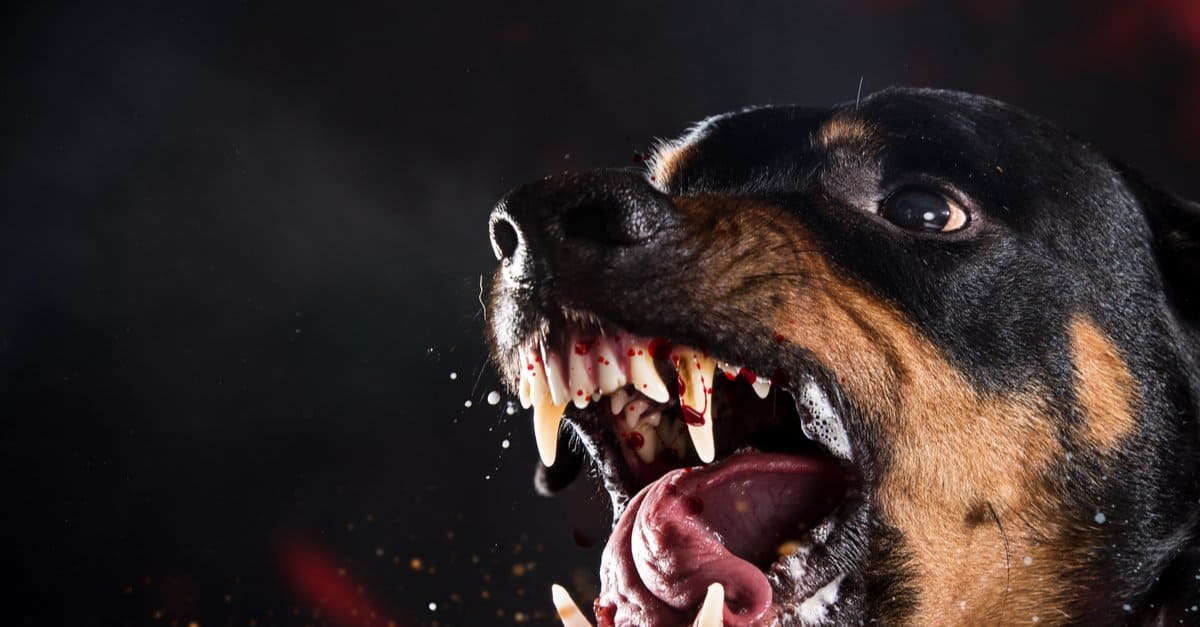
Adult Rottweilers have heterodont teeth that they use to cut and chew food.
©iStock.com/Jana Richter
How Many Teeth Do Rottweilers Have?
Like all dog breeds, Rottweilers have a complete set of heterodont teeth, including incisors, canines, premolars, and molars. Rottweilers are diphyodonts, which means they have two sets of teeth: deciduous (baby) teeth and permanent (adult) teeth. Rottweilers have 28 deciduous teeth and 42 permanent teeth.
Deciduous Teeth
Deciduous teeth start to erupt when the puppies are two to three weeks of age, with the small front teeth (incisors) usually appearing first, followed by canines and premolars. All 28 baby teeth are generally in place by the time the puppy is six to eight weeks old. Molars are notably missing from the deciduous teeth.

Rottweiler puppies have 28 deciduous teeth.
©Donamen/Shutterstock.com
The puppies will start losing their baby teeth when they are three to four months old, beginning with their front incisors. The process continues until they have their full set of adult teeth by six to seven months of age.
Permanent Teeth
Adult Rottweilers have 42 permanent teeth, 20 in their upper jaw and 22 in their lower jaw, including 12 incisors, 4 canines, 16 premolars, and 10 molars. The dental formula is written as: Incisors 3/3, Canines 1/1, Premolars 4/4, Molars 2/3 = 42. Each number in the formula represents the number of teeth located in each quadrant of the Rottweiler’s mouth: left and right, upper and lower.
How Do Rottweilers Use Their Teeth?
Rottweilers use their 12 incisors, or front teeth, for nibbling and cutting food. They are located in the front of the mouth between the two pairs of canines. The incisors are evenly distributed in single rows, six in the upper jaw and six in the lower jaw.
The Rottweiler’s four fang-like canine teeth, located on either side of the upper and lower incisors, are used to grasp and tear food. While domesticated dogs are considered facultative carnivores or omnivores, capable of digesting both animal and plant matter, their ancestors were obligate carnivores that ate only animal flesh. As a result, their canine teeth remain sharp and well-suited for grabbing and holding onto prey.
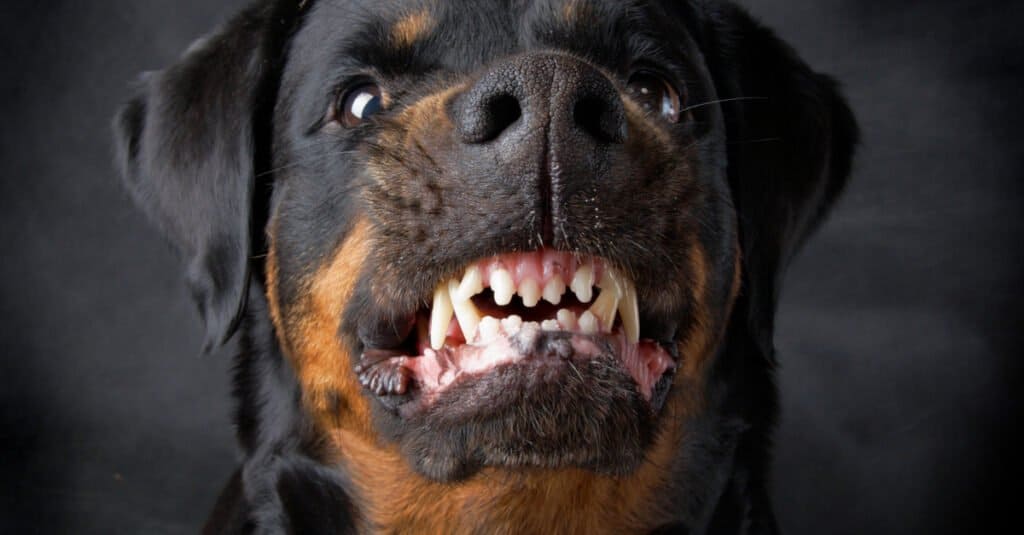
Rottweilers may appear menacing, but are actually gentle and attentive family guardians.
©Tatiana Makotra/Shutterstock.com
The Rottweiler’s 16 evenly distributed premolars have sharp, cutting edges, called cusps, that help them cut and shear their food. Their 10 molars (4 upper, 6 lower) are positioned towards the back of the mouth for further grinding and chewing of food.
A Rottweiler’s upper fourth premolar and lower first molar are carnassial teeth, which work like scissors, slicing meat and crushing bone.
How Strong is a Rottweiler’s Bite?

Rottweilers are one of the most dangerous dog breeds, having a bite force of 328 PSI.
©Jan Mlkvy/Shutterstock.com
Rottweilers can deliver a whopping 328 PSI bite force. Their bite force is strong enough to cause severe injuries like deep puncture wounds, broken bones, nerve damage, and significant tissue tearing.
Common Dental Problems in Rottweilers
Rottweilers are vulnerable to dental problems. They are prone to bad breath, loose teeth, bleeding gums, misalignment, and plaque and tartar build-up.
Misalignment, or malocclusion, is a common issue in Rottweilers that can cause pain, difficulty eating, and severe tartar buildup, which may lead to gum recession and tooth loss. Mild cases should be monitored, but more severe misalignment requires veterinary intervention. To avoid dental issues, it is recommended that Rottweilers be provided with daily brushing and routine dental care.