
J
Species Profile

Jaguar

Panthera onca

Power of the Americas' apex cat
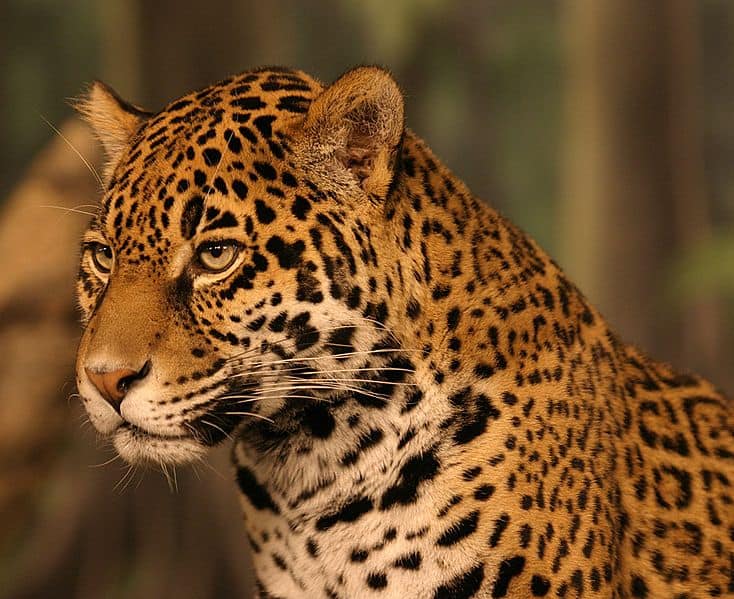
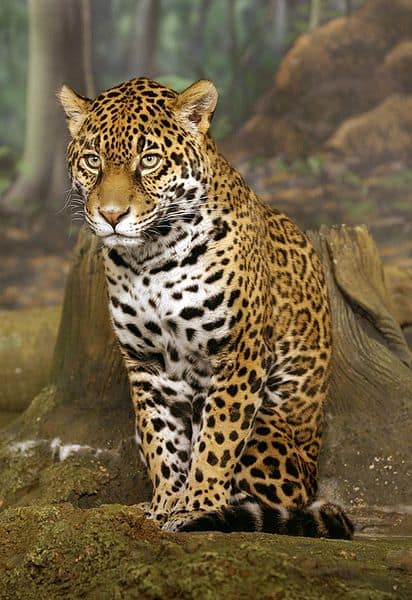
Gary M. Stoltz, Public domain, via Wikimedia Commons

Size Comparison

Human 5'8"
Jaguar 2 ft 4 in

Jaguar stands at 41% of average human height.

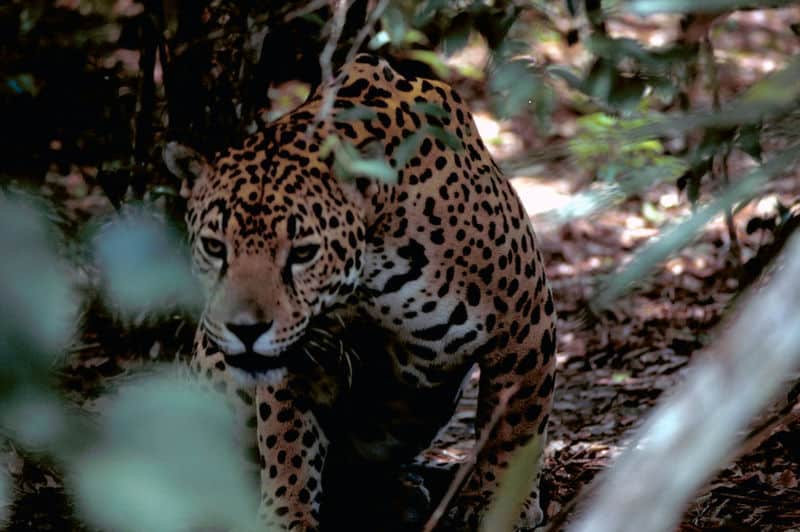
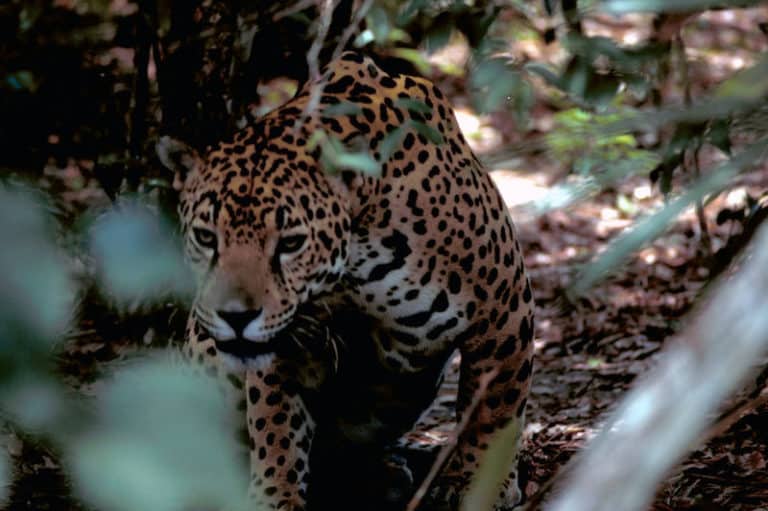
Jaguar, Belize

At a Glance

Wild Species
Also Known As Panther, Black panther, Onça-pintada, Onça, Yaguareté, Tigre
Diet Carnivore
Activity Cathemeral+
Lifespan 12 years
Weight 158 lbs
Did You Know?

Size: head-body length 112-185 cm; tail 45-75 cm; shoulder height ~63-76 cm (species accounts in standard mammal references).

Scientific Classification

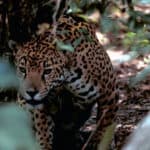
The jaguar is the largest cat in the Americas and a top apex predator, noted for its robust build, powerful bite, and rosette-patterned coat (often with central spots).

Kingdom
Animalia
Phylum
Chordata
Class
Mammalia
Order
Carnivora
Family
Felidae
Genus
Panthera
Species
Panthera onca

Distinguishing Features

  • Stocky, muscular body; broad head and strong jaws
  • Rosettes often with a central spot (more common than in leopards)
  • Excellent swimmer; frequently uses riparian and wetland habitats
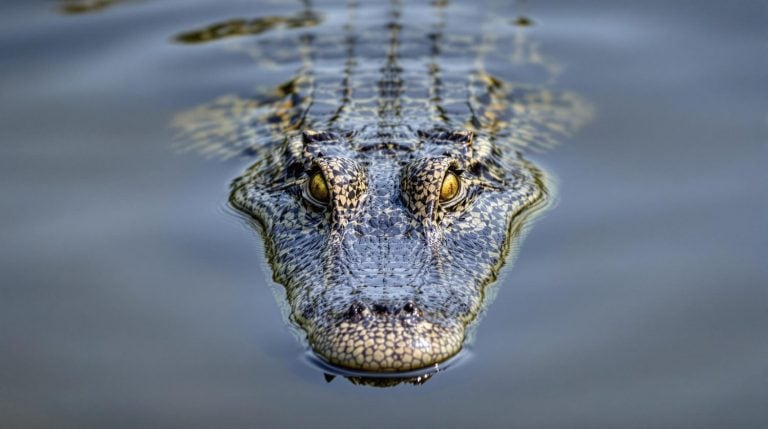
  • Exceptionally powerful bite relative to size; can prey on hard-shelled animals (e.g., turtles/caimans)

Physical Measurements

Males and females differ in size

Height
2 ft 4 in (2 ft 1 in – 2 ft 6 in)
Length
7 ft 3 in (5 ft 2 in – 8 ft 6 in)
6 ft 7 in (5 ft 2 in – 7 ft 8 in)
Weight
209 lbs (123 lbs – 348 lbs)
121 lbs (79 lbs – 168 lbs)
Tail Length
1 ft 12 in (1 ft 6 in – 2 ft 6 in)
Top Speed
50 mph
About 80 km/h in bursts

Appearance

Primary Colors
Secondary Colors
Skin Type Short, dense mammalian fur (guard hairs over underfur), with coarse, robust pelage; thick skin and heavy musculature contribute to stocky appearance.
Distinctive Features
  • Largest extant felid in the Americas (largest New World big cat); robust, compact build typical of genus Panthera.
  • Head-body length: 112-185 cm; tail length: 45-75 cm; shoulder height commonly ~63-76 cm (reported ranges vary by population).
  • Body mass is highly variable by region/sex: females commonly ~41-72 kg; males commonly ~56-96 kg, with exceptionally large males reported >120 kg (regional prey base strongly influences size).
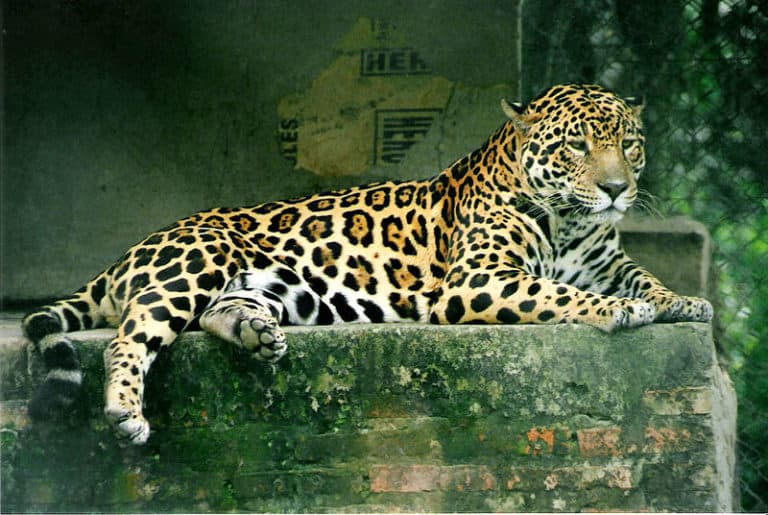
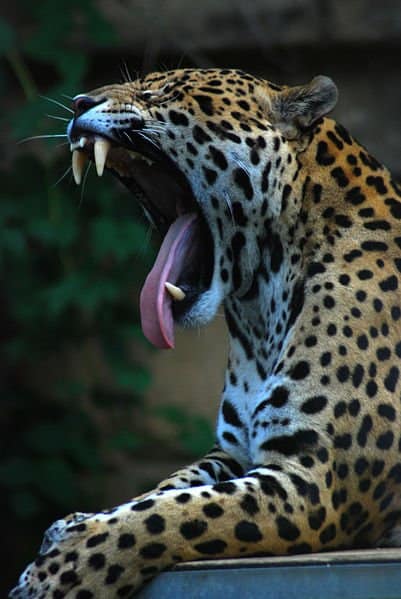
  • Coat pattern diagnostic vs. leopard (Panthera pardus): jaguar rosettes are larger and commonly include central spots; jaguars are stockier with a broader head and relatively shorter tail.
  • Powerful bite and robust skull/jaw musculature (noted in multiple biomechanical studies of Panthera onca) associated with killing prey using a puncture bite (often to skull/neck) and exploiting armored prey (e.g., turtles/caiman) in some regions.
  • Jaguar (Panthera onca): mostly solitary, territorial, and a strong swimmer near waterways and thick cover; an ambush hunter and apex predator in Central and South America, once reaching the southwestern U.S.
  • Common facial markings: bold cheek spots, forehead spotting, and dark lines from eyes toward muzzle; ears short and rounded with dark backs and paler central patches.

Sexual Dimorphism

Sexual size dimorphism is pronounced: males average larger and more robust than females, with heavier mass and larger skull/neck musculature; both sexes share the same basic coat pattern and coloration.

  • Greater average body mass and overall length; more massive forequarters and neck musculature.
  • Broader head and larger skull/jaw dimensions on average (linked to stronger bite mechanics).
  • Rosettes/spotting pattern not sex-specific, but males may appear visually darker/'bolder' due to larger body size and thicker neck fur in some individuals.
  • Smaller average body mass and more slender head/neck profile compared with males.
  • Same rosetted patterning and coloration; no consistent sex-specific coat color differences documented.

Did You Know?

Size: head-body length 112-185 cm; tail 45-75 cm; shoulder height ~63-76 cm (species accounts in standard mammal references).

Mass: adults commonly ~45-113 kg; exceptional males in highly productive habitats (e.g., Pantanal) can exceed 120 kg, making it the heaviest Neotropical cat.

Bite performance: biomechanical estimates show jaguars have one of the highest bite force quotients among big cats, linked to their robust skull and jaw musculature (e.g., Christiansen & Wroe, 2007).

Longevity: ~12-15 years reported in the wild; up to ~20-23 years in captivity (zoo records and husbandry references).

Identification vs. leopard: jaguar rosettes typically contain central spots and the body is stockier with a relatively shorter tail; leopards usually have more open rosettes without central spots.

Swimming specialist: unlike most big cats, jaguars frequently enter water to travel, hunt, and cool off-regularly taking aquatic prey such as caiman and turtles.

Range: today mainly from Mexico through Central America into much of South America; historically reached the U.S. Southwest (Arizona/New Mexico) where rare individuals are still occasionally documented.

Unique Adaptations

  • Robust skull and jaw musculature: a short, deep cranium and powerful temporalis muscles support high bite forces relative to body size (supported by comparative felid cranial biomechanics studies such as Christiansen & Wroe, 2007).
  • 'Central-spot' rosettes: coat pattern breaks up the outline in dappled forest light; rosettes often include one or more central spots-useful for distinguishing from leopards at a glance.
  • Stocky, muscular build: comparatively broad chest and forequarters aid in grappling large prey and dragging carcasses through dense cover.
  • Versatile habitat tolerance: occupies rainforests, seasonally flooded wetlands (e.g., Pantanal), dry forests, and thorn scrub-so long as there is sufficient prey and cover.
  • Aquatic competence: strong swimming and willingness to enter water expands hunting opportunities to semi-aquatic prey and improves movement across fragmented landscapes with rivers.
  • Powerful forelimbs and claws: adapted for holding struggling prey and for pulling down medium-to-large animals in close quarters.
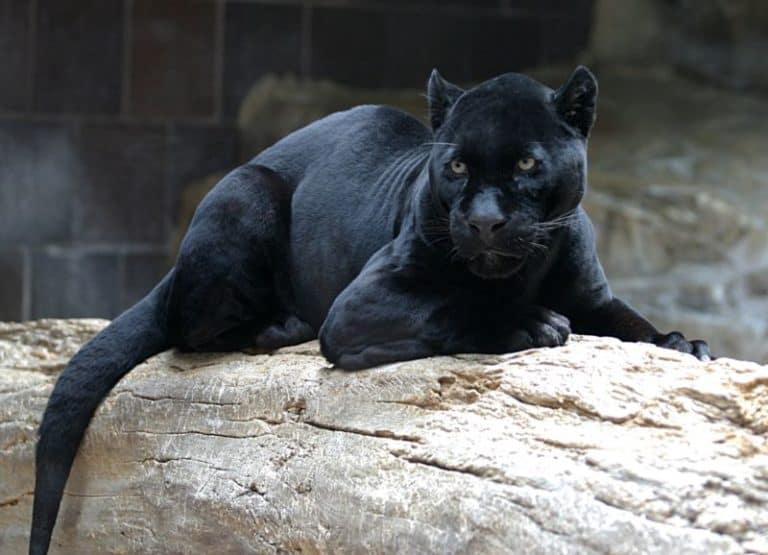
  • Cryptic coloration variants: melanistic jaguars ("black panthers") still show faint rosettes in good light, maintaining camouflage while potentially aiding concealment in darker habitats.

Interesting Behaviors

  • Skull/neck-bite killing style: jaguars often deliver a powerful bite to the back of the skull or through cranial bones of prey (a strategy well documented in field observations), rather than the classic throat suffocation typical of many other big cats.
  • Broad prey spectrum: takes everything from small mammals to large ungulates; commonly targets capybara (Hydrochoerus hydrochaeris) and peccaries (Tayassuidae), and in wetlands may prey on caiman (Caiman spp.).
  • Ambush-and-stalk hunting: uses cover in forest, river edges, and dense vegetation; bursts of speed over short distances rather than long chases.
  • Strong association with waterways: routinely patrols riverbanks, oxbow lakes, and flooded forests; will cross channels and can hunt in shallow water.
  • Mostly solitary: adults typically maintain overlapping but defended home ranges; direct social contact is mainly during mating and between mothers and cubs.
  • Scent marking and scraping: uses urine spraying, feces deposition, and ground scrapes to advertise territory and reproductive status.
  • Flexible activity patterns: can be nocturnal, crepuscular, or diurnal depending on prey, human disturbance, and habitat.

Cultural Significance

Jaguar (Panthera onca) is an important symbol of strength, of rulers, and of shamans across Mesoamerica and Amazonia. Maya art links it to night, the underworld, and the power of leaders. As an apex predator it helps keep prey balanced.

Myths & Legends

Maya tradition: the 'Jaguar Sun' and night/underworld associations-jaguars appear as powerful beings linked to darkness and the underworld, and as emblems of rulers and warriors in Classic Maya iconography.

Aztec mythology: Tezcatlipoca, a major deity, can appear as a jaguar (or jaguar-like form), reflecting night, power, and fate; jaguar symbolism also permeated warrior societies.

Olmec 'were-jaguar' imagery: early Mesoamerican art features human-jaguar transformation motifs, often interpreted as mythic/shamanic beings blending human and jaguar traits.

Guaraní naming heritage: the word 'jaguar' entered English via Indigenous languages of the region (often traced through forms like Guaraní/Portuguese usage), reflecting the animal's longstanding cultural prominence.

Amazonian shamanic narratives (widely documented across multiple peoples): jaguars are frequently portrayed as spirit-beings or master predators associated with transformation, taboo, and the crossing between human and animal worlds.

Conservation Status

NT Near Threatened

Likely to qualify for a threatened category in the near future.

Population Decreasing

Protected Under

  • CITES Appendix I (international commercial trade prohibited, with limited exceptions)
  • Protected under national wildlife laws in most range states (legal status varies by country; generally prohibits hunting/killing except under specific permits/controls)
  • United States: listed under the Endangered Species Act (ESA) as Endangered; critical habitat provisions are limited due to rarity and distribution, but take is prohibited
  • Range-wide conservation frameworks: Jaguar 2030 Roadmap / Jaguar Corridor Initiative (connectivity-focused planning and protected-area/network strengthening; implemented through national and transboundary actions rather than a single binding statute)

Life Cycle

Birth 2 cubs
Lifespan 12 years

Lifespan

In the Wild
10–17 years
In Captivity
16–23 years

Reproduction

Mating System Polygyny
Social Structure Solitary
Breeding Pattern Transient
Fertilization Internal Fertilization
Birth Type Internal_fertilization

Jaguars (Panthera onca) are solitary and mainly polygynous: males hold large territories overlapping several females. No pair bond; mating is brief when females are receptive and jaguars are likely induced ovulators. Gestation ~100 days; 1–4 cubs (usually 2); mother alone cares for cubs.

Behavior & Ecology

Social No specific group name (solitary species) Group: 1
Activity Cathemeral, Crepuscular, Nocturnal
Diet Carnivore Capybara (Hydrochoerus hydrochaeris)

Temperament

Generally secretive and wary of humans; avoids confrontation when not cornered (field observations summarized in Seymour 1989).
Strongly territorial/space-defending via scent marks and patrols; intrasexual aggression can occur, especially among males (Crawshaw & Quigley 1991).
Jaguar (Panthera onca) is an opportunistic, stealthy ambush predator. It often uses the same travel routes and marking sites. Activity times change with prey and human disturbance, often crepuscular or nocturnal.

Communication

roars Jaguar 'roar'/bellow used in spacing and mating contexts
growls
hisses
grunts
mews/calls between mother and cubs
scent marking (urine spraying, feces deposition) to advertise occupancy and reproductive status
scrapes and ground marks (often combined with urine) along travel routes
claw marks on trees and conspicuous substrates Visual + scent from interdigital glands
rubbing/cheek marking and body rubbing on objects
tactile communication during courtship and mother-cub interactions Grooming, nose contact

Habitat

Biomes:
Tropical Rainforest Tropical Dry Forest Savanna Temperate Forest Wetland Freshwater
Terrain:
Mountainous Hilly Plateau Plains Valley Coastal Island Riverine Karst Rocky Sandy Muddy +6
Elevation: Up to 12467 ft 2 in

Ecological Role

Apex predator and keystone carnivore in Neotropical forests, savannas, and wetlands; exerts top-down control on medium-to-large vertebrate prey communities and can suppress/redistribute mesopredators via intraguild predation and competitive pressure.

Regulates populations of large herbivores/omnivores (e.g., capybaras and peccaries), reducing overbrowsing and altering herbivory pressure Structures prey behavior and habitat use (landscape-of-fear effects), influencing riparian and wetland trophic dynamics Provides carrion resources to scavengers and decomposers via kills and leftovers/cached prey Helps maintain trophic balance and biodiversity by preventing single prey taxa from becoming overly dominant

Diet Details

Main Prey:
Capybara Peccaries Deer Lowland tapir Caimans Armadillo Agoutis and pacas Coatis Primates Turtle Fish +5

Human Interaction

Domestication Status

Wild

Jaguar (Panthera onca) has never been domesticated—people never bred it for tameness. Human contact mostly comes from hunting and killing, cultural symbols, zoos or rescue centers, and efforts to reduce conflict. Jaguars are big, solitary cats that sometimes take livestock. They face habitat loss and are protected by CITES Appendix I.

Danger Level

Moderate
  • Physical injury or death from attack (powerful bite; capable of killing large prey).
  • Risk is generally low in frequency but can increase where jaguars are habituated, wounded, cornered, fed/attracted by refuse, or during conflict situations (e.g., at livestock carcasses).
  • Highest risk contexts: close encounters in dense cover near water, handling/trapping, or illegal captivity/private ownership.
  • Zoonotic/parasite considerations exist with any large carnivore handling (risk primarily to handlers in captivity/research).

As a Pet

Not Suitable as Pet

Legality: Jaguar (Panthera onca) is not suitable and is usually illegal or strictly restricted as a private pet. It is CITES Appendix I; many countries and U.S. states allow only licensed zoos, sanctuaries, or research facilities.

Care Level: Expert Only

Purchase Cost: $5,000 - $25,000
Lifetime Cost: $200,000 - $600,000

Economic Value

Uses:
HUBS (Panthera spp. range of human interactions): ecotourism and flagship-species marketing; conflict with livestock and retaliatory killing; illegal trade in skins/teeth/claws; regulated display in zoos; scientific research/monitoring; cultural/spiritual symbolism; conservation payments and corridor/landscape planning; hunting pressures historically (now widely prohibited for jaguar). Ecotourism and conservation finance (flagship apex predator) Ecosystem services (top-down regulation of prey/mesopredators) Cultural value (Indigenous and national symbolism across Mesoamerica/Amazonia) Costs from conflict (livestock depredation; mitigation investments) Captive display/education (zoos, licensed facilities) Illegal wildlife trade (notably teeth/parts in some markets; historic pelt trade)
Products:
  • Wildlife tourism revenue (guided tracking, camera-trap tourism in some regions such as Pantanal)
  • Conservation program funding (payments for coexistence, livestock-guarding, fencing, compensation schemes)
  • Research outputs (telemetry/camera-trap datasets informing land-use planning and corridor design)
  • Educational value via accredited zoos
  • Negative economic impacts: cattle and small-stock losses; veterinary/guarding/fencing costs
  • Illegal products (prohibited): pelts/skins; teeth/claws; decorative items

Relationships

Classification

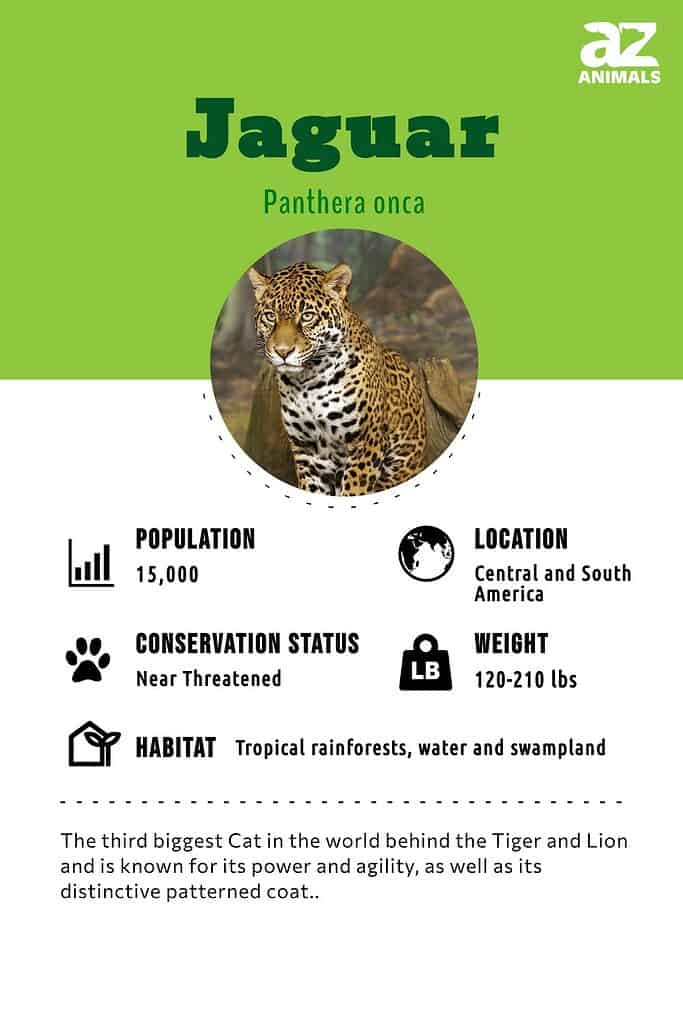
The Jaguar is the largest feline on the American continent, and is the only one of the world’s ‘big’ cats to be found in the New World. Jaguars are close relatives to Leopards and have a number of similar characteristics including the distinctive spotted pattern on their fur. The Jaguar is the third largest cat in the world, only superseded by the Tiger and the Lion. This beautiful cat possesses great power and agility. In fact, the name Jaguar is derived from the Native American word yaguar, defined as “he who kills with one leap”. Despite their incredible power however, Jaguars have been hunted through the ages, mainly for their gorgeous fur. Although hunting for Jaguar fur is now prohibited, population numbers have declined throughout much of their natural range, with Jaguars having completely disappeared from a number of areas.
Types Of Jaguar Animals

While the official taxonomic species of the Jaguar is: Panthera onca, there are many different types of jaguar animals, from the Arizona Jaguar to the Northeastern Jaguar. A complete list of different jaguar types is found below:

  • Panthera onca arizonensis (Arizona jaguar)
  • Panthera onca centralis (Central American jaguar)
  • Panthera onca onca (East Brazilian jaguar)
  • Panthera onca palustris (South American Jaguar)
  • Panthera onca veraecrucis (Northeastern jaguar)
  • Panthera onca paraguensis (Paraguay jaguar)
  • Panthera onca peruviana (Peruvian jaguar)
  • Panthera onca goldmani (Yucatan Peninsula jaguar)
  • Panthera onca hernandesii (West Mexican jaguar)
jaguar

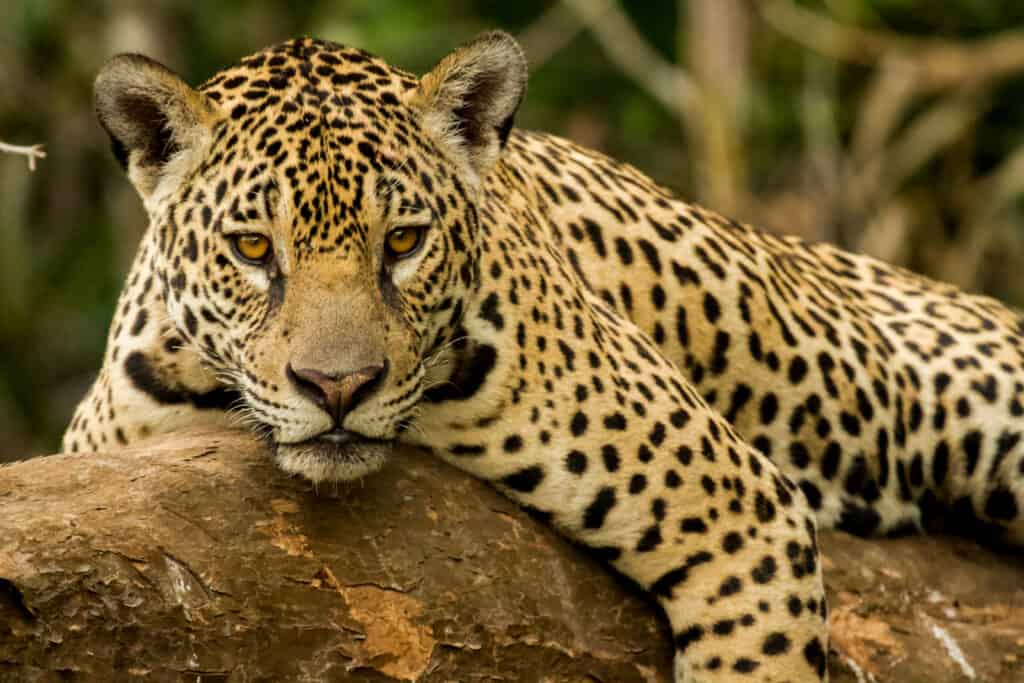
Closely relate to leopards, jaguars have multiple similar characteristics including the distinctive spotted pattern on their fur.

Evolution and History

Jaguars originated in Eurasia around 3 million years ago and slowly spread eastward and westward during the Ice Age, eventually covering areas from southern England to Nebraska to South America. Compared to their predecessors, modern jaguars are 15% smaller in size.

Both jaguars and lions share DNA from the genus Panthera, which dates back further from 6-10 million years ago. Ancestors like the European jaguar suggest it’s most closely related to the leopard.

While equally old cats like sabercats and American lions became extinct, it’s thought that Jaguars survived because of their diet. 16-21% of their diet came from hunting caimans, collared peccary, giant anteaters, wild pigs, nine-banded armadillos, and white-nosed coati. As they migrated, they came to Central America where food was abundant. These ancient, larger jaguars ate the animals aforementioned, as well as many other prey like birds, and somehow survived the Ice Age.

Anatomy and Appearance

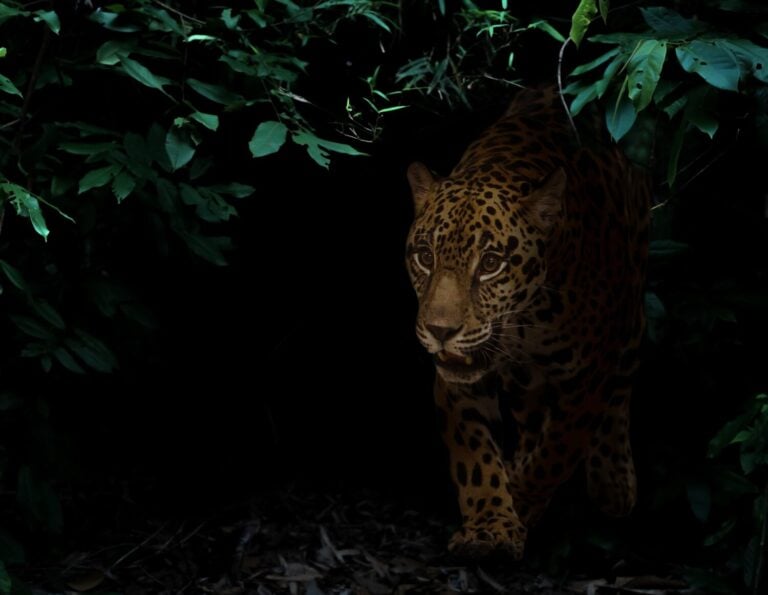
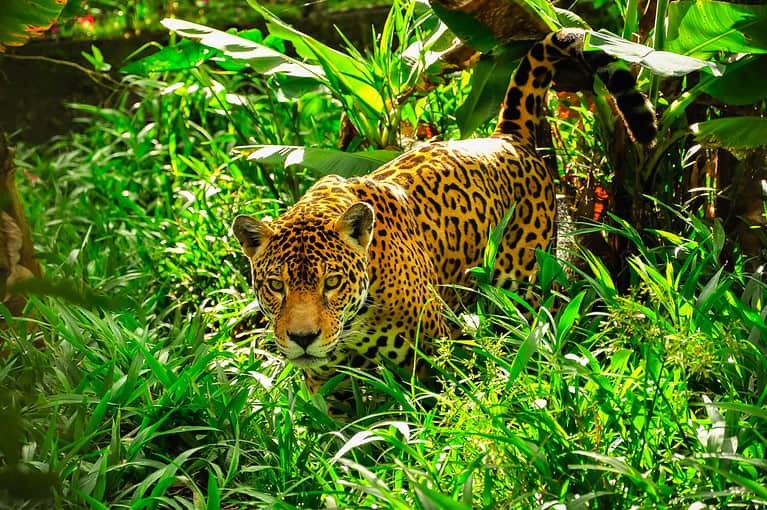
The Jaguar is a large and muscular animal, and while very similar to the Leopard in appearance, its body is more heavy and robust. The jaguar has a large, broad head and its strong jaws earned it the title of “strongest bite” among all the large cats in the world. Jaguars tend to have a cover of either tan or dark yellow fur, dotted with darker rose-like patterns with dark spots in the middles–similar to those of a Leopard. Known as rosetting, the pattern on the Jaguar’s fur is unique to each animal. Despite its beauty, the pattern camouflages this animal in the surrounding jungle. This camouflage is vital to its survival, and Jaguars found in the rainforest are often darker in color and smaller than those found in more open areas.
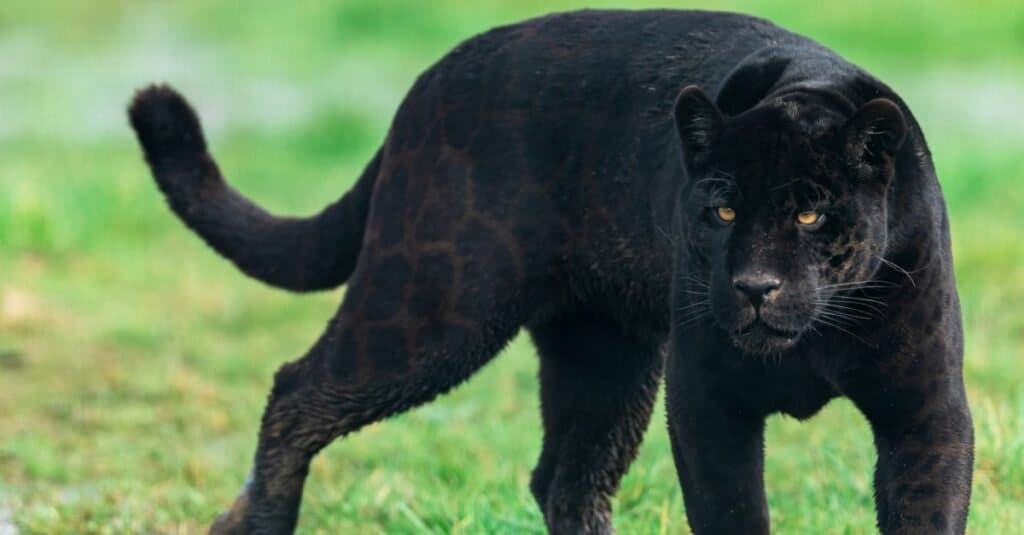
Types of Jaguar - black panther

A black panther is a type of jaguar with a melanism condition.

Distribution and Habitat

The Jaguar is indigenous to the Western Hemisphere, where it primarily inhabits the tropical rainforests of Central and South America. In its history, Jaguars could be found on the entire continent, as well as some of the southern states in North America. Today they stick to remote pockets of rainforest, especially in the Amazon Basin. Jaguars prefer a moist, dense, thick, jungle habitat with plenty of cover in order to successfully hunt and ambush prey. They are nearly always found close to water and prefer either permanent swampland or seasonally flooded forests. The Jaguar has been severely affected by habitat loss throughout much of its natural range along with poachers who shoot them when they get too close to the growing Cattle ranches.
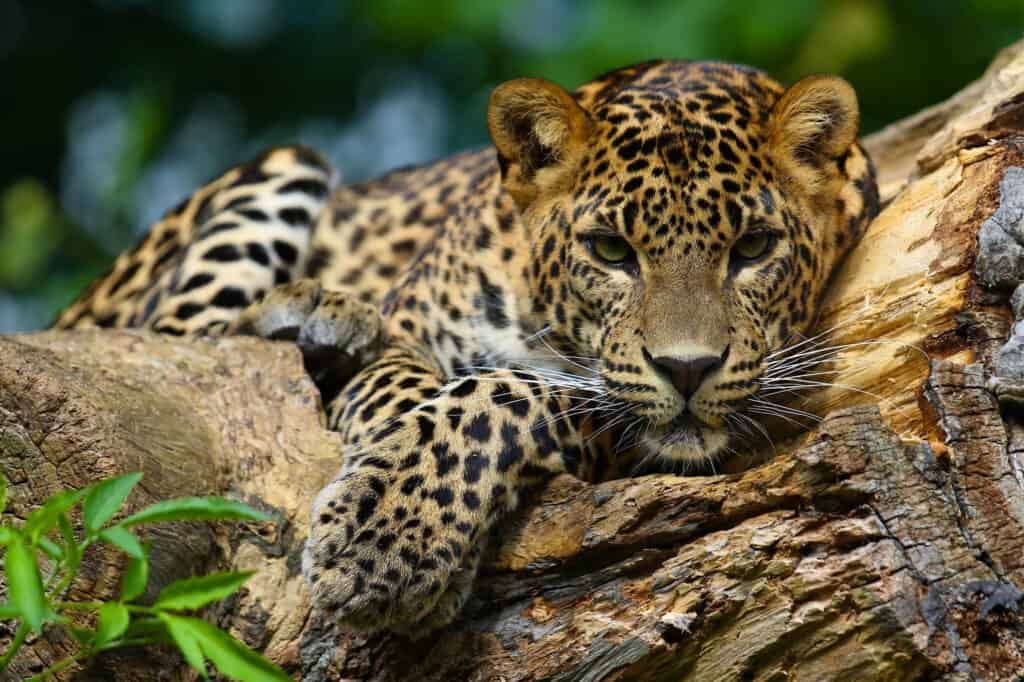
jaguar

Jaguars inhabit the tropical rainforests of Central and South America, preferring thick, moist, dense jungles.

Behavior and Lifestyle

The Jaguar is an elusive creature, spending the majority of its time either resting in the safety of trees or hunting in dense undergrowth. It loves to be near water like floodplains or slow-moving rivers–a behavior that is rare to most members of the cat family. It’s also rare to find a jaguar in dry, desert-like places. This cat is an excellent swimmer and can reach high speeds when maneuvering through the water in pursuit of prey. The Jaguar, like many other cat species, is a solitary animal, save the first couple of years that it spends with its mother. Males are particularly territorial and although their home range will overlap those of a number of females, they will defend their patch fiercely from other males. Jaguars mark their territories with urine by scratching marks onto trees, and asserting themselves with growling vocal calls.

You can check out incredible facts about jaguars.
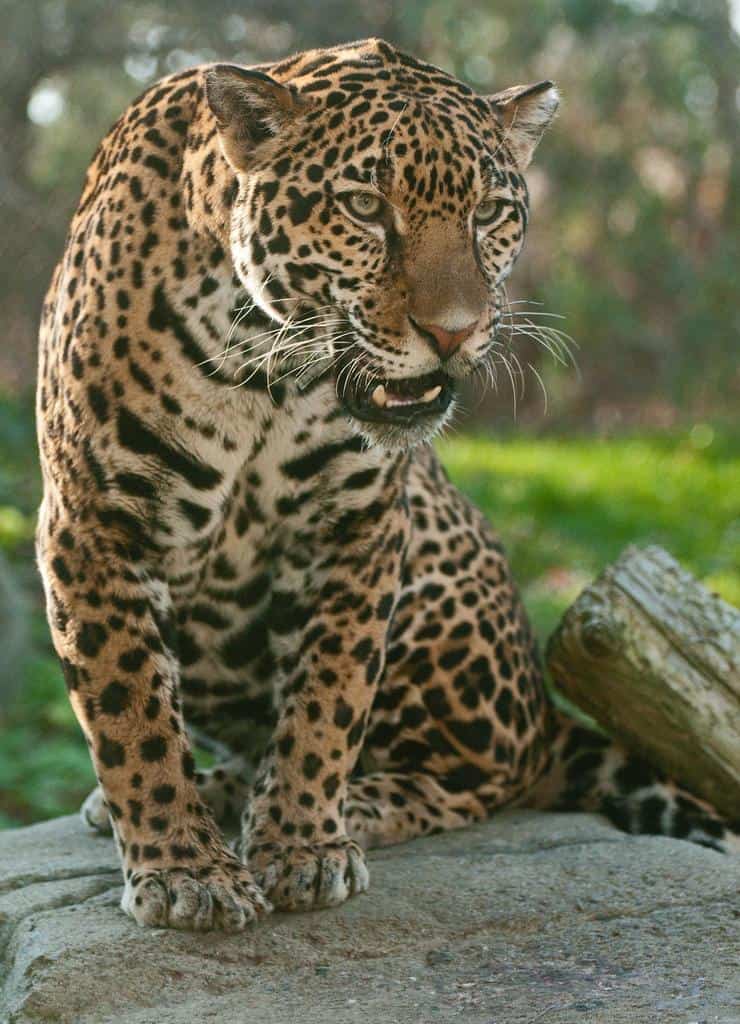
Males jaguars are particularly territorial and will defend their patch of territory fiercely from other males.

Reproduction and Life Cycles

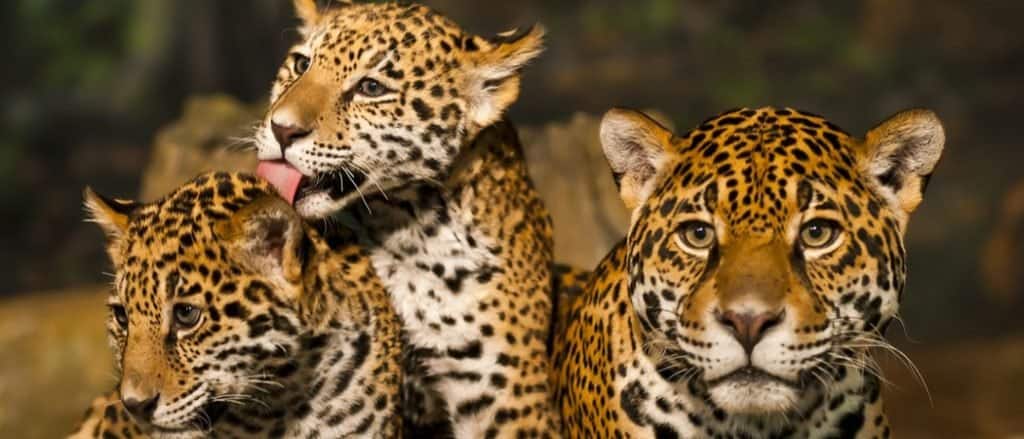
Jaguar cubs are usually born between the months of December and March, but it’s not unusual for some litters to be born at other times of the year. When mating season occurs, the female Jaguar will make loud vocalized cries to attract a male into her territory. Female Jaguars usually give birth to two or three cubs. Once the cubs are born, the female Jaguar becomes highly protective of her young, and expels the male Jaguar from her territory. Jaguar cubs are born blind and gain their sight after about two weeks. They are weaned by their mother at around 3 months old, and will rely on their mother to hunt and provide for them until about 6 months old. At that point, the Jaguar cubs will accompany their mother on hunts, and will eventually hunt alone at and establish their own territories at 1-2 years of age.
Animals in Brazil

Baby jaguars are weaned by their mother around 3 months of age, and will rely on their mother to provide for them until 6 months old.

Diet and Prey

The majority of a Jaguar’s hunting is done down on the ground but they are also known to hunt for prey both in the water and from the trees, from where the Jaguar can easily ambush its prey often killing it with one powerful bite. Learn more about the toughest animals in the world here. Medium sized mammals make up the majority of the Jaguar’s diet including Deer, Capybara, Peccaries and Tapirs, which they stalk in silence through the dense jungle. When in the water, Jaguars hunt Turtles, Fish and even small Caiman when the opportunity presents itself. The Jaguar is known to be a formidable and aggressive hunter and is thought to eat more than 80 different animal species in order to supplement its diet. With growing Human settlements, the Jaguar has also been blamed by ranch owners for stealing their livestock, particularly in areas that encroach on the Jaguar’s territory.

What Do Jaguars Eat
The jaguar’s diet consists of Deer, Capybara, Peccaries and Tapirs.

Predators and Threats

Due to the large size and dominant nature of the Jaguar, there are no other wild animals that are known to actually consider it as prey. Once found throughout the South American continent, they have been hunted by Humans mainly for their fur which has led to drastic declines in Jaguar population numbers everywhere. Despite now having legal protection and a reduction in the hunting of them for their fur, the Jaguar is at increasing risk from loss of habitat mainly in the form of deforestation to make way for agriculture or growing Human settlements, which means these large and majestic animals are being pushed into more remote regions of their native range.
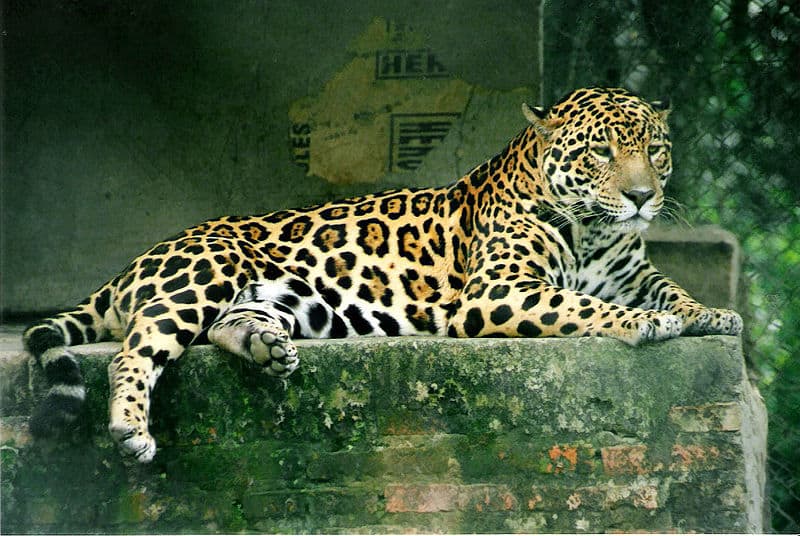
The biggest threat to the jaguar is mankind.

Interesting Facts and Features

Jaguars have the strongest bite force of all Cats (learn about the strongest animals in the world here) and like other ‘big’ Cats they can roar (other Cats cannot). The Jaguar is undoubtedly a strikingly beautiful animal and has naturally caught the attention of both scientists and hunters alike, with many individuals sadly having been poached for their distinctively patterned fur. Although Jaguars usually have yellowish coloured fur, other colours are also known including black and white. As with black Leopards, they are not completely black as you can still see the spotting (although faint) in strong sunlight. Jaguars are said to be able to cross-breed with both Leopards and Lions. A Lepjag was produced by the film industry to produce a Cat that had the appearance of a Jaguar but was easier to handle with the temperament of a Leopard. He lives in retirement now in a Big Cat sanctuary, and like other ‘big’ cat hybrids he is sterile.
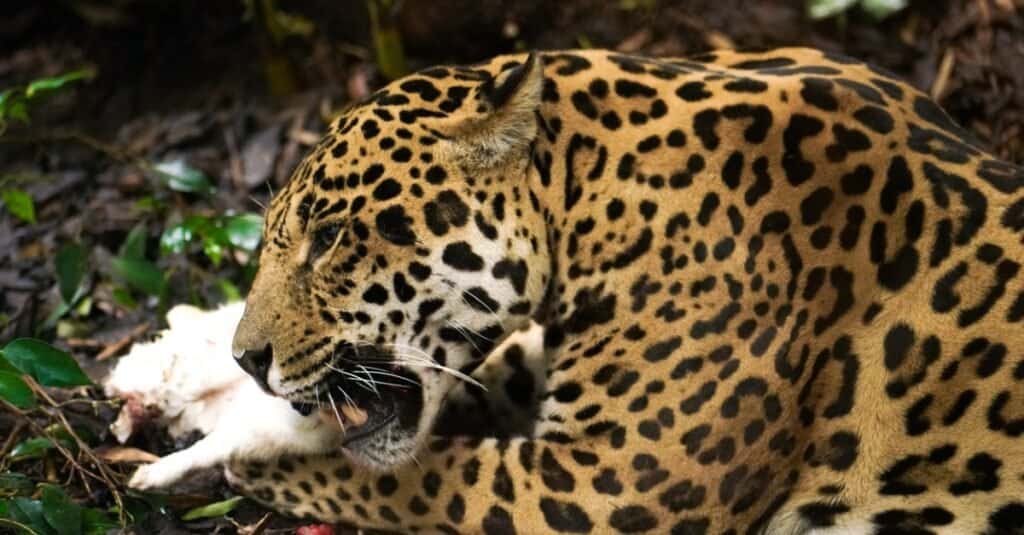
An innumerable amount of jaguars have been poached for their beautiful, distinctive coats.

Relationship with Humans

Historically, Jaguars have featured throughout Native American culture, as these people were well aware of the power of this dominant predator with some believing that the Jaguar was the lord of the underworld. They are feared by Humans who inhabit areas close to the jungle and are also often blamed by ranch owners for their missing livestock. Although Jaguars hold the reputation for being very aggressive, unprovoked attacks on Humans are rare. Jaguars have been severely affected by deforestation throughout much of Central and South America, primarily for agriculture with the highest numbers now found in the Amazon Basin.

Conservation Status and Life Today

The Jaguar was once found from the tip of South America right up to and beyond, the Mexico-USA border but hunting for their fur and habitat loss has led to drastic declines in population numbers. They are today very, very rarely seen in the USA and are considered endangered throughout much of their natural range, although the Jaguar is listed by the IUCN Red List as an animal that is Threatened in its surrounding environment. Although the exact population number is unknown, there are an estimated 15,000 Jaguar individuals left roaming the rainforest today.

View all 52 animals that start with J
How to say Jaguar in ...
Bulgarian
Ягуар
Catalan
Jaguar
Czech
Jaguár
Danish
Jaguar (dyr)
German
Jaguar (Katze)
English
Jaguar
Esperanto
Jaguaro
Spanish
Jaguar
Finnish
Jaguaari
French
Jaguar
Hebrew
יגואר
Croatian
Jaguar (životinja)
Hungarian
Jaguár
Italian
Giaguaro
Japanese
ジャガー
Dutch
Jaguar
English
Jaguar (dyr)
Polish
Jaguar
Portuguese
Onça-pintada
Turkish
Jaguar
Swedish
Jaguar (djur)
Vietnamese
Báo đốm Mỹ
Chinese
美洲豹

Sources

  1. David Burnie, Dorling Kindersley (2011) Animal, The Definitive Visual Guide To The World's Wildlife / Accessed November 10, 2008
  2. Tom Jackson, Lorenz Books (2007) The World Encyclopedia Of Animals / Accessed November 10, 2008
  3. David Burnie, Kingfisher (2011) The Kingfisher Animal Encyclopedia / Accessed November 10, 2008
  4. Richard Mackay, University of California Press (2009) The Atlas Of Endangered Species / Accessed November 10, 2008
  5. David Burnie, Dorling Kindersley (2008) Illustrated Encyclopedia Of Animals / Accessed November 10, 2008
  6. Dorling Kindersley (2006) Dorling Kindersley Encyclopedia Of Animals / Accessed November 10, 2008
  7. David W. Macdonald, Oxford University Press (2010) The Encyclopedia Of Mammals / Accessed November 10, 2008
  8. Jaguar History / Accessed November 10, 2008
  9. Jaguar Information / Accessed November 10, 2008
  10. Jaguar Facts / Accessed November 10, 2008
Abby Parks

About the Author

Abby Parks

Abby Parks has authored a fiction novel, theatrical plays, short stories, poems, and song lyrics. She's recorded two albums of her original songs, and is a multi-instrumentalist. She has managed a website for folk music and written articles on singer-songwriters, folk bands, and other things music-oriented. She's also a radio DJ for a folk music show. As well as having been a pet parent to rabbits, birds, dogs, and cats, Abby loves seeking sightings of animals in the wild and has witnessed some more exotic ones such as Puffins in the Farne Islands, Southern Pudu on the island of Chiloe (Chile), Penguins in the wild, and countless wild animals in the Rocky Mountains (Big Horn Sheep, Mountain Goats, Moose, Elk, Marmots, Beavers).
Connect:

Thank you for reading! Have some feedback for us?


Jaguar FAQs (Frequently Asked Questions)

Jaguars are Carnivores, meaning they eat other animals.