Jellyfish
 Verified by: AZ Animals Staff
Many jellyfish can produce their light.
Advertisement
Jellyfish Scientific Classification
Read our Complete Guide to Classification of Animals.
Jellyfish Conservation Status
Jellyfish Facts
- Prey
- Small fish, plants, fish eggs, larvae, other small marine creatures
- Group Behavior
- Group
- Fun Fact
- Many jellyfish can produce their light.
- Estimated Population Size
- 900 million, as of 1990
- Biggest Threat
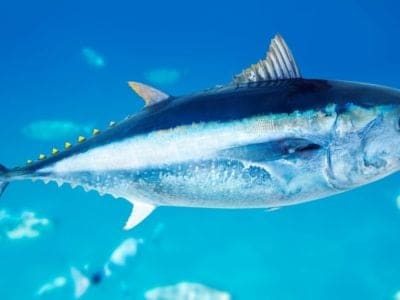
- Sharks, birds, tuna, and sea anemone
- Most Distinctive Feature
- Tentacles hanging from the body that help aid the jellyfish's stinging characteristics
- Gestation Period
- Hatches within one day
- Habitat
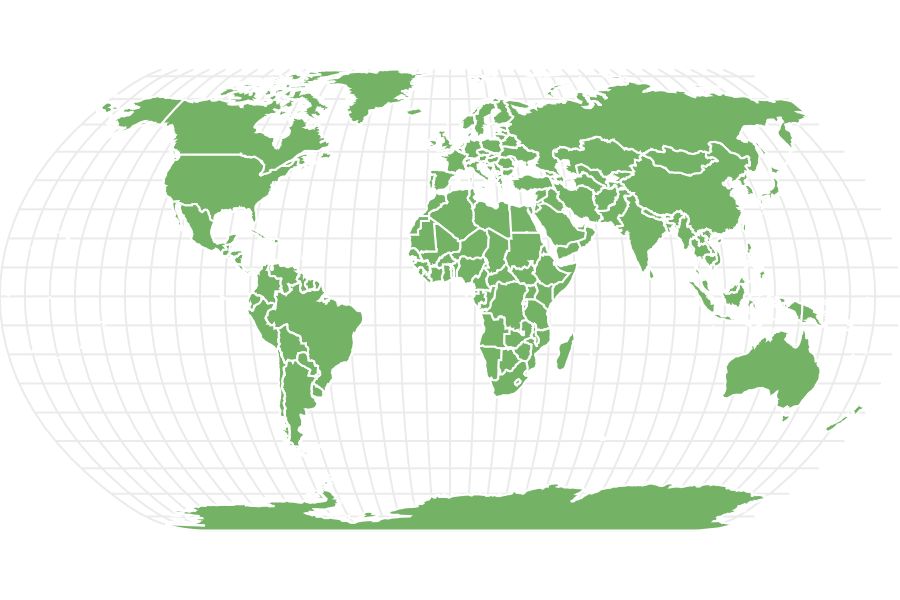
- All oceans on planet earth
- Predators
- Sharks, birds, tuna, and sea anemone
- Diet
- Carnivore
- Average Litter Size
- 100
- Lifestyle
- Group
- Favorite Food
- Small fish, plants, fish eggs, larvae, other small marine creatures
- Type
- Cnidaria
- Common Name
- Jellyfish
- Slogan
- Have tentacles around their mouths!

 © Chai Seamaker/Shutterstock.com
View all of the Jellyfish images!



How to Add Us to Google News


Jellyfish are prehistoric marine creatures and have been known to exist in oceans for the past millions of years.
Though they are not usually aggressive, these fish are famous for their ability to sting, allowing them to defend themselves against any sort of danger.
These fish use their tentacles for hunting. However, they do not have any bones, heart, or most other organs. Interestingly, their bodies are mostly made up of water.
They have a lifespan of about three to six months and can grow up to 7 feet in size.
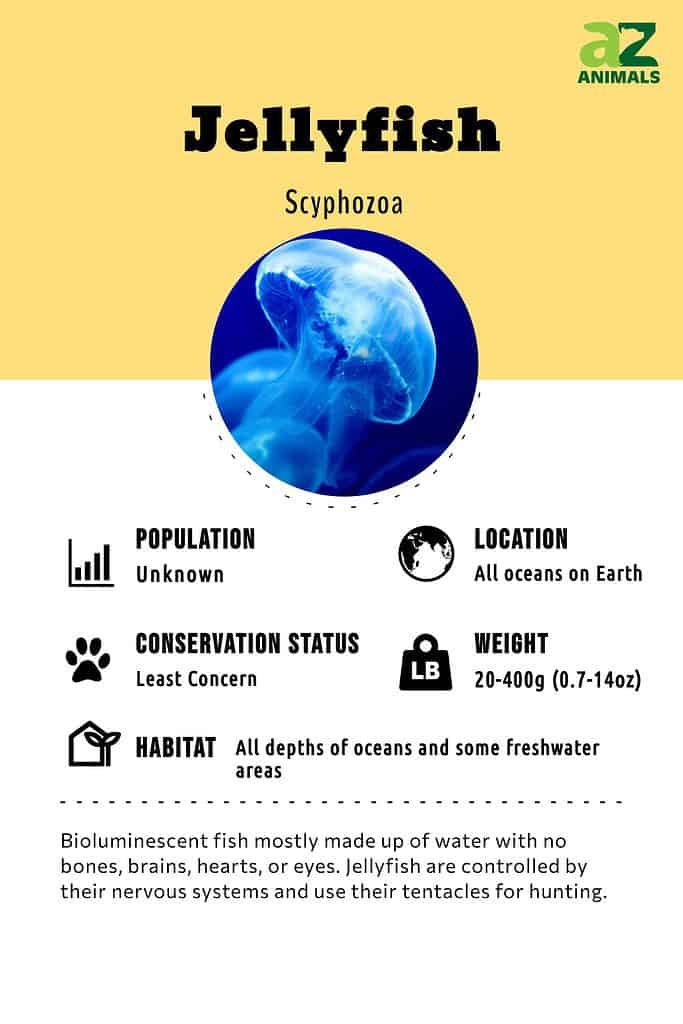
Do Jellyfish Have Brains?
As beautiful as these sea creatures are, they don’t have a brain. Instead, the body is made up of a complex nervous system, which is where all of its motor functions and sensory activity occurs. Through the neurons in this system, the body tells the muscles when to contract, which is how they swim.
Incredible Jellyfish Facts!
- No brains, heart, or eyes: These fish are mostly made up of water. They have no brains, hearts, or eyes. They also have no bones, and their body is primarily controlled by the nervous system.
- Ancient, prehistoric beings: Jellyfish are known to have been around for millions of years – even before dinosaurs!
- Bioluminescent: These fish are bioluminescent – which means that they can produce their light.
- Quick digestion: The digestive process doesn’t take very long when jellyfish eat. This quick process ensures that they can remain afloat in water.
- Worldwide delicacies: Jellyfish are not loved by the predators that feed on them but also by the human population across the globe.
Classification and Scientific Name
These animals go by the scientific name Scyphozoa and belong to the kingdom Animalia and phylum Cnidaria. Scyphozoa comes from two Greek words – skuphos and zōion. While skuphos means “drinking cup,” the word zōion means “animal.” The name is an interpretation to mean that this animal contains water. The phylum cnidaria is interesting as well since it comes from the modern Latin word knidē, which means “nettle.”
As a part of their classification, these fish come from the sub-phylum Medusozoa and class Scyphozoa – which is the same as the jellyfish’s scientific name in the classification. Medusozoa comes from the Ancient Greek Μέδουσα, which comes from the word for “rule over” (μέδω).
Evolution
Jellyfish are believed to have evolved from the phylum Cnidaria, a group that includes anemones and corals. Jellyfish were likely the first swimmers powered by muscles in the ocean. They originated during the Precambrian Era when ecologic and geologic changes were taking place, leading to an explosion of animal life in the later Cambrian Era.
The more accepted theory is that jellyfish transformed from polyps that grew on the ocean floor to swimming medusae with stinging tentacles. It’s likely that their shape-shifting abilities helped them survive multiple mass extinctions over more than 500 million years.
A second explanation from some scientists is that Cnidaria originally had a medusa life stage, differentiating them from sea anemones and corals.
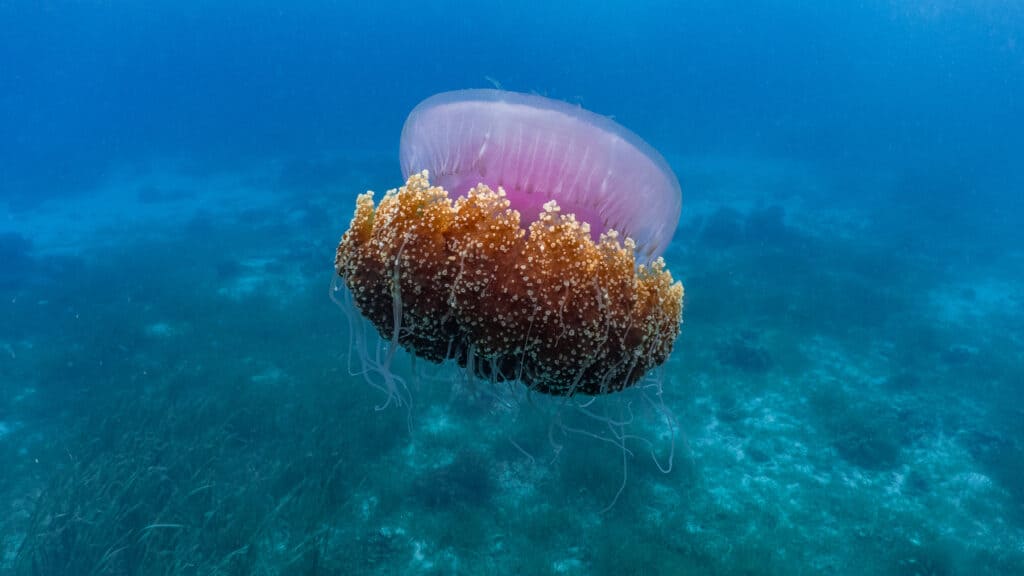
Jellyfish are believed to have originated during the Precambrian Era when ecologic and geologic changes were taking place.
©SaltedLife/Shutterstock.com
Species
Jellyfish form a large family of planktonic creatures, and recent studies show that there are at least 4,000 that have already been discovered. Considering the vastness of the oceans, scientists believe that this number is barely a fraction of what is actually in the sea.
Even with all of these species around the world, only 70 are considered to be a threat to humans. Some of those dangerous species include the Malo kingi and the Chironex fleckeri, which are both in the box jellyfish family. The venom is potent and painful enough to kill.
Some types are even kept as pets, primarily for their inability to sting their owner. The most common jellyfish to keep as a pet is the moon jellyfish, which lives for about 15 months. Other species of jellyfish can live much, much longer.
A group of jellyfish is called a swarm, smack, or bloom. Check out this article to learn more about jellyfish group names and how they function.
Immortal Jellyfish
Turritopsis dohrnii-also called the Immortal jellyfish-is a small and transparent jellyfish and can interestingly reverse to earlier stages of its life. This transition can take the animal back to the state that the jellyfish was in as a fertilized egg when it settles on the seafloor in old age.
Appearance
Some of these animals are transparent while others exist in bright colors like yellow, blue, and pink. These fish are bioluminescent which means that they produce their light.
Their bodies may look complex due to the way they look but they are quite simple. Jellyfish have smooth bodies with tentacles that contain tiny cells that can be used when they use their stinging capabilities.
They have no bones, brains, hearts, or eyes. Their mouths are found in the center of their bodies. They are usually about 0.5 to 16 inches and can grow up to 7 feet and usually weigh around 440 pounds.
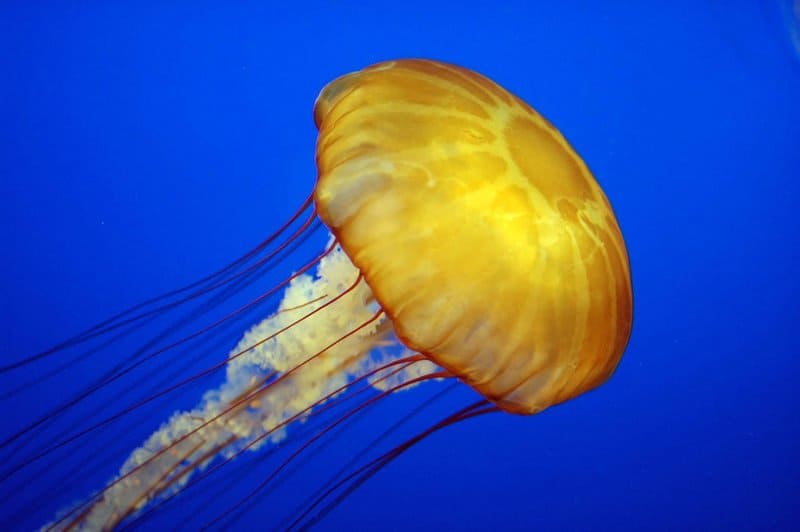
Some jellyfish are transparent while others exist in bright colors like yellow, blue, and pink.
Jellyfish Tentacles
These animals have tentacles that are equipped with tiny stinging cells that are activated when these fish launch a sting attack on their prey. These tentacles are used to paralyze and stun the prey that the jellyfish stings. These tentacles are found hanging from the jellyfish’s body.
Though these tentacles are controlled by the nervous system, the sting is rarely fatal. Most box jellyfish have strong enough venom to execute the victim. The purpose of the tentacles is to stop the movement of its prey, though they are also used as a way to defend the animal.
Deadly Jellyfish
Although some species of jellyfish are pretty harmless, as noted above (such as the moon jelly or Aurelia aurita which is especially common in the United Kingdom), others are far more lethal.
The most dangerous jellyfish are generally found in the Indo-Pacific ocean and also around northern Australia.
The most lethal of them all is the Australian box jellyfish or Chironex fleckeri. The largest variety of all box jellyfish, it is easily recognizable by its tentacles which are reminiscent of shoe laces, capable of growing up to 10 feet long, and a pale blue skull-shaped dome.
Those tentacles like those of all other venomous jellyfish are laden with millions of nematocysts which are responsible for emitting venomous darts when touched. The pain from its venom has been compared to that of a branding iron and the creature can cause death in a matter of minutes.
However, the Chironex fleckeri is a favorite snack of turtles, who are capable of ignoring its stings thanks to all that thick skin, allowing turtles to enjoy a delicious jellyfish lunch.
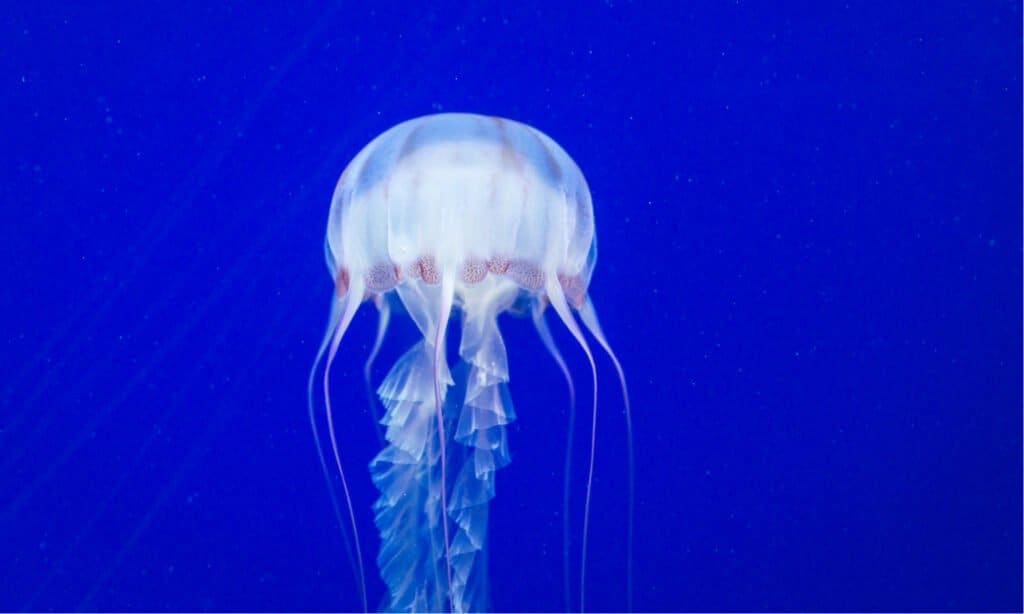
The most dangerous jellyfish are generally found in the Indo-Pacific ocean and also around northern Australia like the Australian box jellyfish.
©Danza/Shutterstock.com
Distribution, Population, and Habitat
They are found across the globe and can be found in every ocean on the planet. Many species choose to live in warm tropical waters or cold Arctic waters. They can exist at the bottom of the oceans as well as on water surfaces, making them incredibly versatile.
Though the specific areas may vary, every species must live in saltwater to thrive. As of 1990, there were 900 million tons of jellyfish in the Black Sea alone.
Even with this ability to survive in so many locations, pollution is a big threat to every species. Oil spills and dumping chemicals in the water can easily absorb into their skin, which makes it impossible for them to reproduce. Though the pollution doesn’t always kill them instantly, most species will not live nearly as long once they are exposed.
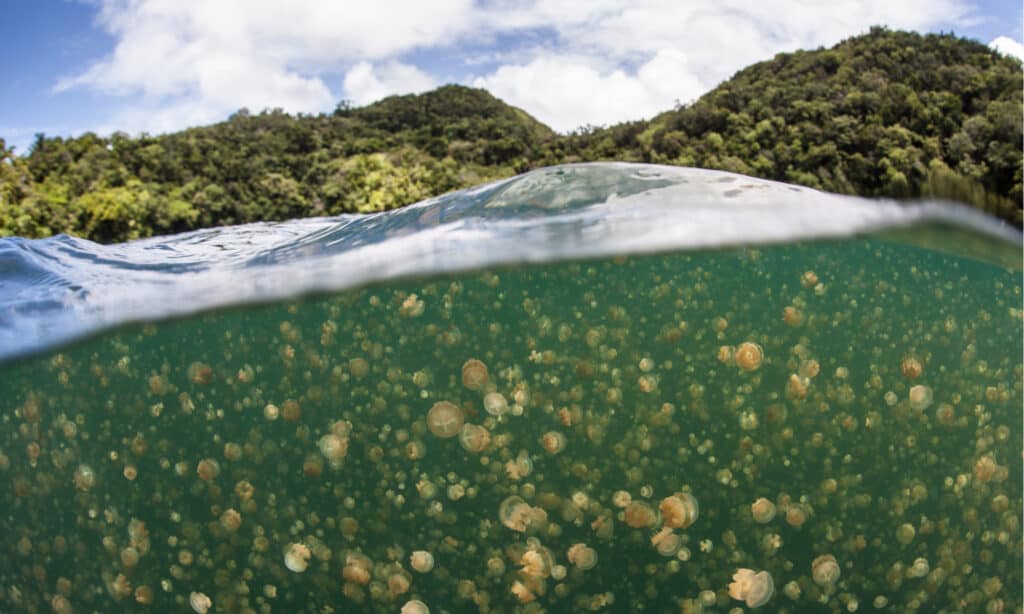
Jellyfish can inhabit the bottom of oceans as well as water surfaces, making them incredibly versatile.
©Ethan Daniels/Shutterstock.com
Predators and Prey
These animals face threats from various sea and land creatures including sea anemones, swordfish, sea turtles, tuna, and penguins. When the jellyfish get washed up on beaches, they are usually found and eaten by foxes and other birds and animals. If humans manage to catch them, it isn’t uncommon to cook them as a delicacy.
These fish in turn feed on many different things like planktonic eggs, small plants, small fish and larvae, fish eggs, and other small marine animals.
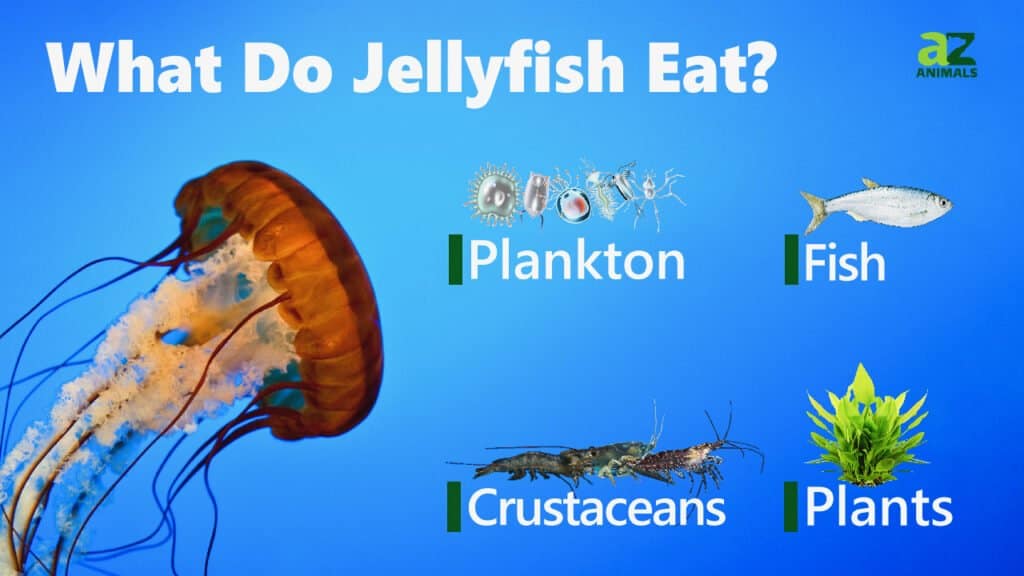
The Sting of the Jellyfish
These animals have tentacles that are armed with tiny sting cells that the fish use on their prey or when they sense danger. They often use their stinging characteristics to defend themselves and use their tentacles to inject venom into other creatures.
The stings can cause pain and irritation and can sometimes also result in whole-body illness. Some stings can even be life-threatening. The most severe sting comes from Australian box jellyfish, which is the most deadly jellyfish in the world. Their venom can be so painful it often leads to drowning from victims who go into shock.
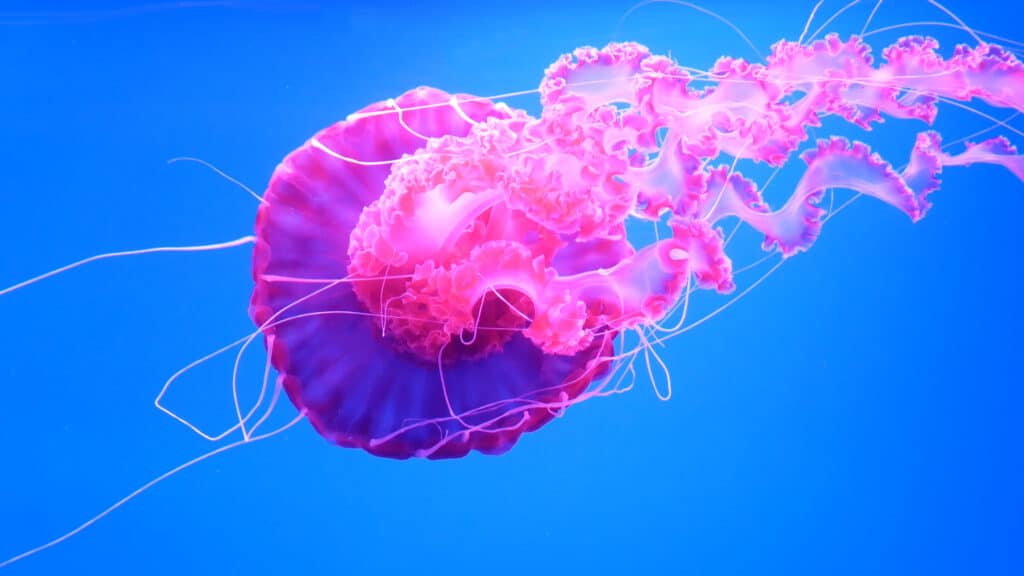
Jellyfish use their stinging characteristics to defend themselves and their tentacles to inject venom into other creatures.
©LanKS/Shutterstock.com
Reproduction and Lifespan
These animals are known to reproduce both sexually and asexually. While one of the species reproduces sexually, some other types reproduce asexually. However, for both processes, the fertilized eggs settle on the seafloor after developing into a multi-cellular planula.
The average jellyfish lives three to six months, but some can survive as much as two to three years. Jellyfish never technically die. They eventually settle on the seafloor and contribute to the birth of younger jellyfish from their DNA. In essence, the jellyfish clones itself without ever technically “dying.”
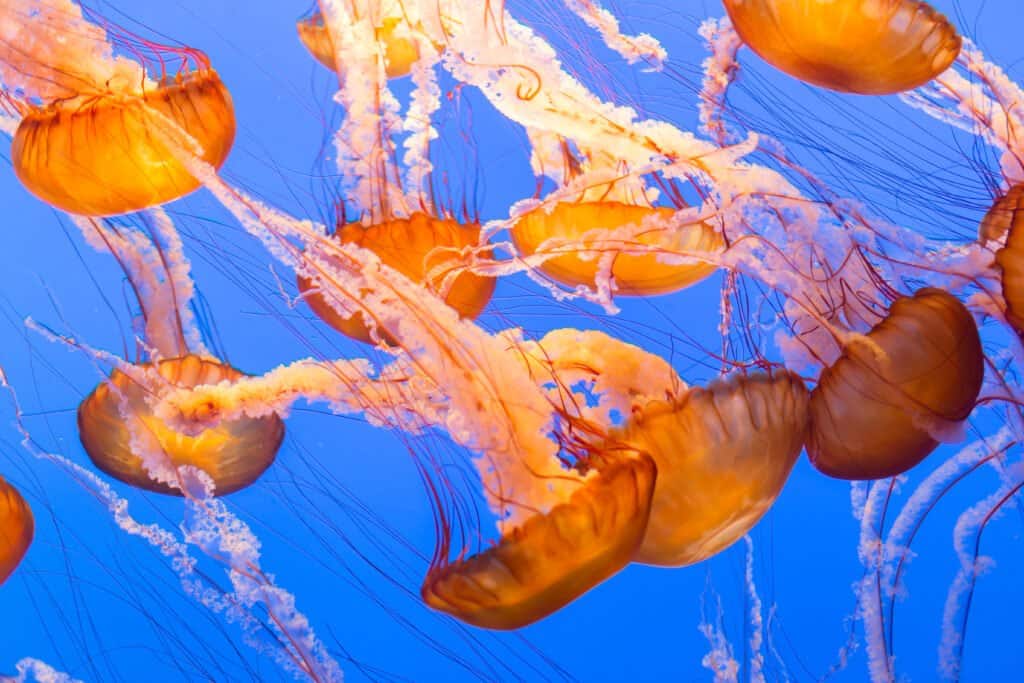
Jellyfish generally live 3-6 months, though some can live from 2-3 years.
©Ken Wolter/Shutterstock.com
Jellyfish in Fishing and Cooking
Jellyfish can be caught and eaten. More than twelve species are edible and are savored around the globe as delicacies. These fish are a rich source of protein and fatty acids.
One popular recipe is sesame jellyfish, which pairs the fish with soy sauce, vinegar, sesame oil, and sometimes chili oil.
Classifications of Cnidaria
There are numerous species of jellyfish which fall into four classes of cnidaria. We’ve left out the fifth, Anthozoa, which includes sea anemones and corals:
- Scyphozoa – There are 200 of marine Scyphozoa, known as “true jellyfish.” This description refers to jellyfish with a cup shape. These jellyfish swim freely. Some of the individual species in this group include: Moon Jelly, Barrel jellyfish, Cannonball jellyfish, Cassiopea andromeda, Aurelia coerulea, Helmet jellyfish, and Lion’s Mane jellyfish.
- Hydrozoa – Hydrozoa is a classification that houses 700 unique jellyfish species. They are small, either transparent or pigmented, and mostly found seasonally in coastal habitats from late spring to early fall, as well as in freshwater. Some the freshwater jelly (Craspedacusta sowerbyi), freshwater polyps (Hydra), Obelia, Portuguese man o’ war (Physalia physalis), chondrophores (Porpitidae), “air fern” (Sertularia argentea), and pink-hearted hydroids (Tubularia).
- Cubozoa – There are 50 species of Cubozoa, or box jellyfish, characterized by their box-like shape when viewed from overhead. They sport well-developed eyes and either four evenly spaced tentacles or tentcles in bunches. The stings from multiple types of box jellyfish are extremely painful. Examples include: Australian sea wasp (Chironex fleckeri), Carukia barnesi, and Malo kingi.
- Staurozoa – Staurozoa jellyfish are known as “stalked jellyfish.” They have trumpet-shaped bodies, and grow upside-down when compared to, so that their tentacles project upwards, with the stalk situated in the center of its umbrella. Some species include. Haliclystus antarcticus, Manania handi, Lucernaria quadricornis, and Haliclystus octoradiatus.
Types of True Jellyfish (Scyphozoa)
- Moon jelly
- Cannonball jellyfish
- Rhopilema esculentum
- Barrel jellyfish
- Lion’s mane jellyfish
- Cassiopea
- Phacellophora camtschatica
- Blue jellyfish
- Pelagia noctiluca
- Nomura’s jellyfish
- Cotylorhiza tuberculata
- Chrysaora hysoscella
- Jelly blubber
- Crown jellyfish
- Chrysaora
- Rhizostomae
- Helmet jellyfish
- Stygiomedusa
- Semaeostomeae
- Spotted jelly
- Chrysaora melanaster
- Chrysaora quinquecirrha
- Chrysaora fuscescens
- Deepstaria
- Mawsonite
- Coronamedusae
How to Add Us to Google News


Jellyfish FAQs (Frequently Asked Questions)
Where are jellyfish found?
Jellyfish are found in the warm tropical and cold Arctic waters around the globe.
Do jellyfish have brains?
One of the most interesting characteristics of the jellyfish is that the animal does not have a brain. Besides that, they do not have a heart, bones, and eyes too.
What do jellyfish eat?
Jellyfish eat small plants, small fish, fish eggs, larvae, and other small marine creatures.
What is a group of jellyfish called?
The group of jellyfish is called a smack.
How do jellyfish reproduce?
Some species of jellyfish reproduce sexually while others reproduce asexually.
How long do jellyfish live?
Jellyfish usually live for only about three to six months. However, some types can live for two to three years and some others are even immortal.
What Kingdom do Jellyfish belong to?
Jellyfish belong to the Kingdom Animalia.
What class do Jellyfish belong to?
Jellyfish belong to the class Scyphozoa.
What phylum to Jellyfish belong to?
Jellyfish belong to the phylum Cnidaria.
What family do Jellyfish belong to?
Jellyfish belong to the family Cyaneidae.
What order do Jellyfish belong to?
Jellyfish belong to the order Semaeostomeae.
What type of covering do Jellyfish have?
Jellyfish are covered in Smooth skin.
What are some predators of Jellyfish?
Predators of Jellyfish include sharks, birds, tuna, and sea anemone.
How many babies do Jellyfish have?
The average number of babies a Jellyfish has is 100.
What is an interesting fact about Jellyfish?
Jellyfish have tentacles around their mouths!
What is a distinguishing feature of the Jellyfish?
Jellyfish have tentacles hanging from their bodies.
What is the biggest threat to the Jellyfish?
The biggest threats to the Jellyfish are sharks, birds, tuna, and sea anemone.
How many Jellyfish are left in the world?
There were 900 million Jellyfish left in the world in 1990.
How fast is a Jellyfish?
A Jellyfish can travel at speeds of up to 5 miles per hour.
What are the differences between Jellyfish and Portuguese Man o' War?
The key differences between a jellyfish and a Portuguese man o’ war are size, appearance, physical features, lifespan, habits, habitats, and diet.
Thank you for reading! Have some feedback for us? Contact the AZ Animals editorial team.
Sources
- David Burnie, Dorling Kindersley (2011) Animal, The Definitive Visual Guide To The World's Wildlife
- Tom Jackson, Lorenz Books (2007) The World Encyclopedia Of Animals
- David Burnie, Kingfisher (2011) The Kingfisher Animal Encyclopedia
- Richard Mackay, University of California Press (2009) The Atlas Of Endangered Species
- David Burnie, Dorling Kindersley (2008) Illustrated Encyclopedia Of Animals
- Dorling Kindersley (2006) Dorling Kindersley Encyclopedia Of Animals
- How Stuff Works, Available here: https://animals.howstuffworks.com/marine-life/jellyfish.htm
- Virginia Institute of Marine Science, Available here: https://www.vims.edu/bayinfo/jellyfish/lifecycle/index.php
- National Geographic Kids, Available here: https://www.natgeokids.com/nz/discover/animals/sea-life/jellyfish-facts/
- Wikipedia, Available here: https://en.wikipedia.org/wiki/Scyphozoa
- Fact Retriever, Available here: https://www.factretriever.com/jellyfish-facts
- Ocean Scubadive, Available here: https://oceanscubadive.com/types-of-jellyfish/
- Oceana, Available here: https://europe.oceana.org/en/feature-about-jellyfish-0
- BioExpedition, Available here: https://www.bioexpedition.com/jellyfish-habitat-and-distribution/
- Jelly Watch, Available here: https://www.jellywatch.org/blooms/facts
- Seattle Aquarium, Available here: https://www.seattleaquarium.org/blog/facts-jellyfish-life