Millipede
 Verified by: AZ Animals Staff
Some species have a poisonous bite!
Advertisement
Millipede Scientific Classification
Read our Complete Guide to Classification of Animals.
Millipede Conservation Status

Millipede Facts
- Favorite Food
- Decaying plant material
- Common Name
- Millipede
- Number Of Species
- 10000
- Location
- Worldwide
- Slogan
- Some species have a poisonous bite!

 © TopFotography/Shutterstock.com
View all of the Millipede images!



How to Add Us to Google News


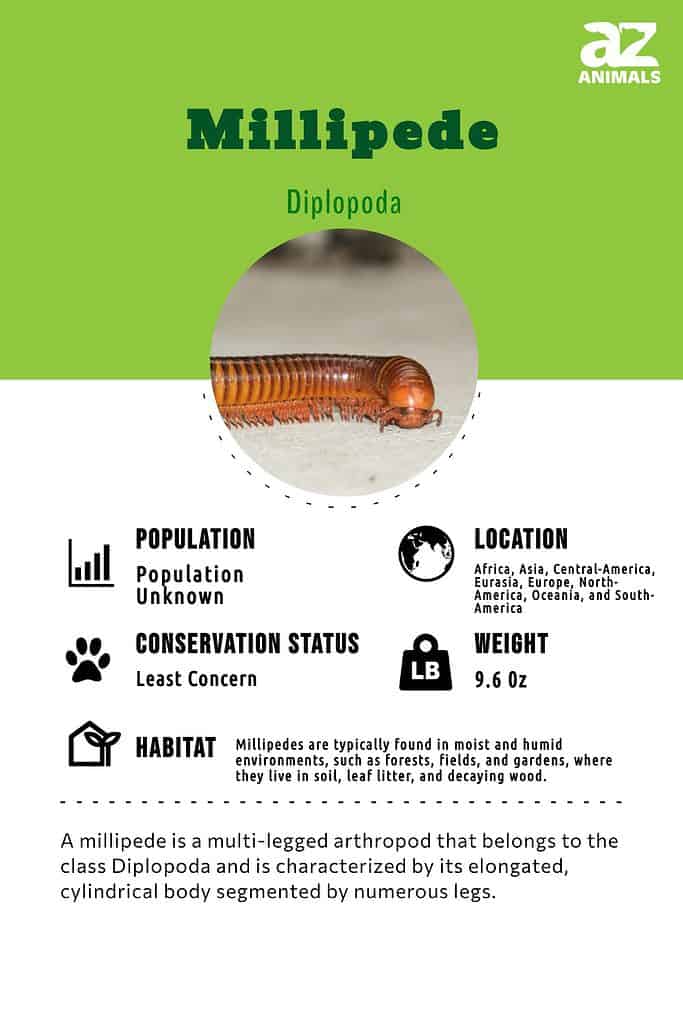
The millipede belongs to the phylum of arthropods, falling under the same family as spiders and butterflies.
They aren’t considered to be insects, though they have a hard exoskeleton that protects their body.
Though some species of millipede are poisonous, they are largely without defense against natural predators. They have no pinchers, stingers, or claws to deter the animals that hunt them, and they don’t even bite.
At the most, they’ll release a toxin that creates an effect that is similar to an allergic reaction.
Centipede vs. Millipede
©TopFotography/Shutterstock.com
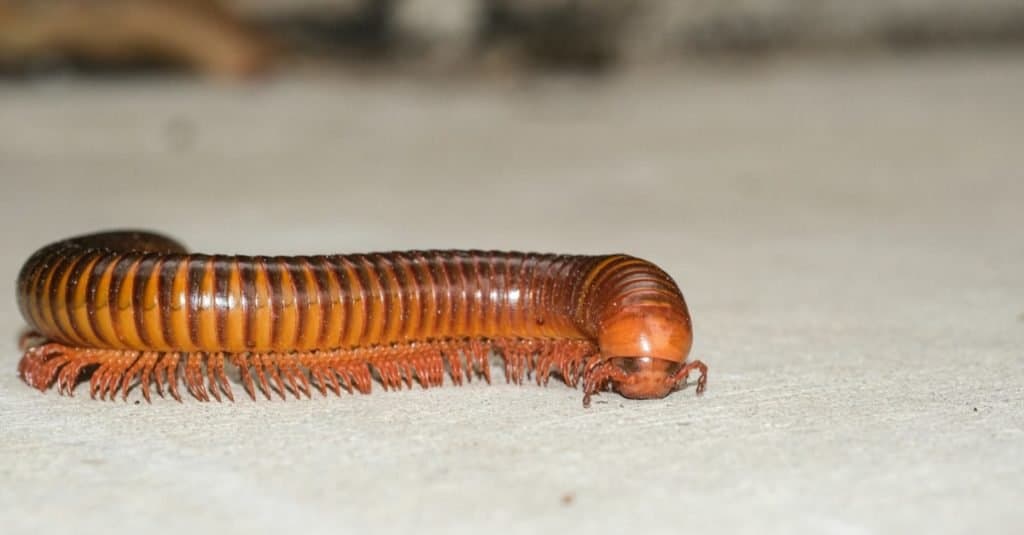
Though the millipede and the centipede are easy to confuse, there are a few major differences between them, starting with their classification.
While both the centipede and the millipede are arthropods, only the millipede belongs to the Diplopoda class. The centipede, on the other hand, belongs to the Chilopoda class.
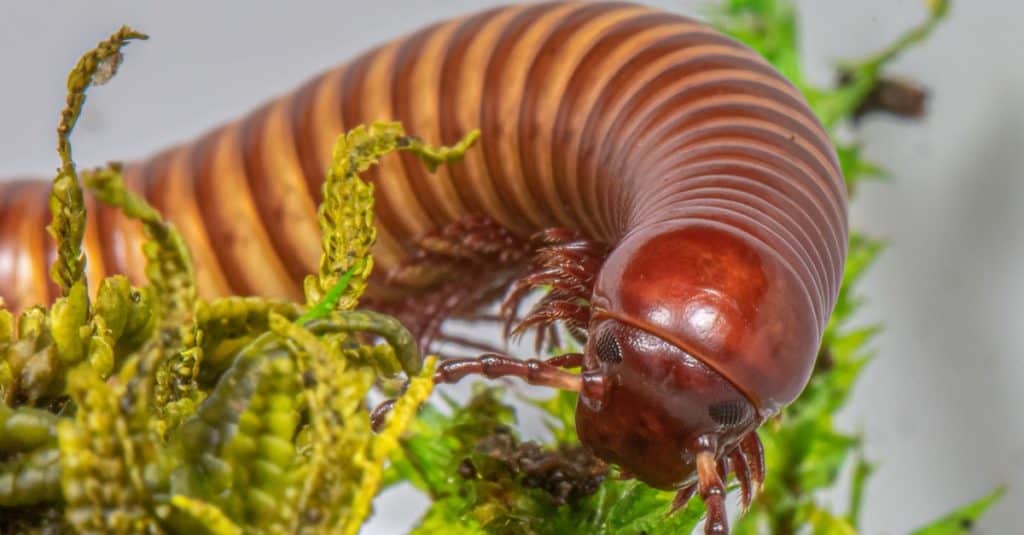
The way that the legs are sectioned along the body differs as well, since millipedes have two pairs per fragment, while centipedes only have one pair. Additionally, the antennae make them easy to differentiate, since millipedes have short antennae (and centipedes have long).
Millipedes prefer the vegetation that they find underground, while some centipedes are so ravenous that they’ve been known to consume whole frogs. While centipedes bite, millipedes do not.
5 Incredible Millipede Facts!
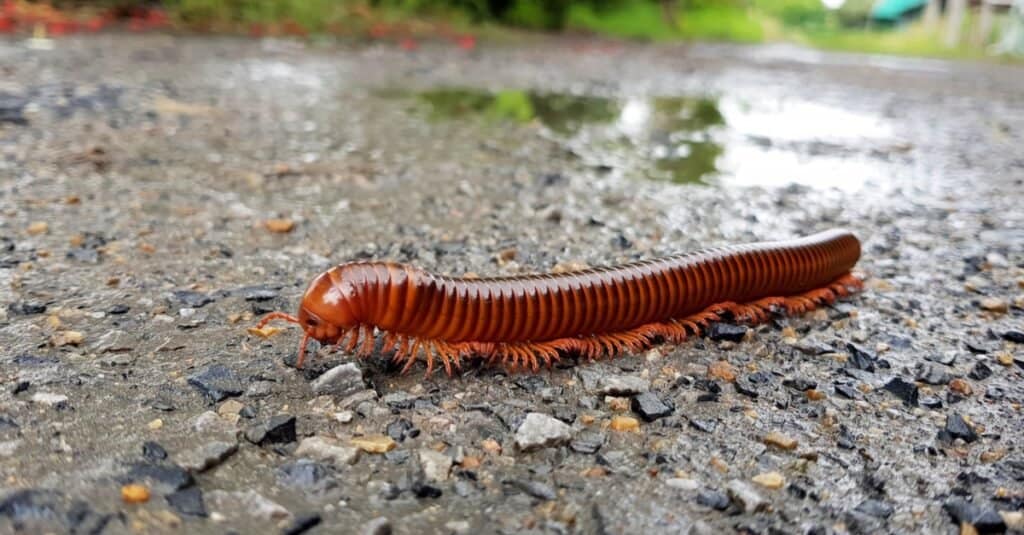
Millipede walking on the ground in the rainy season of Thailand.
©Sawangkaew/Shutterstock.com
- Despite their name, millipedes don’t have anywhere close to 1,000 feet. Instead, they have 100 legs or less on average, though it can have up to 750 legs at the most.
- Archaeological findings suggest that the millipede was the first animal to walk on land, dating the species back 400 million years. One ancient relative of millipedes grew to 7 feet in length!
- As the millipede grows, it molts. When they are still young, these molting sessions allow them to grow additional legs each time.
- Potentially 80,000 species of these animals are alive in the world today, even though researchers and scientists have only identified 12,000.
- The entire body of the millipede houses the heart of the millipede, and the aorta is located at the head.
Species, Types, and Scientific Name
©WildPx LLC/Shutterstock.com
These animals are part of the Animalia kingdom classification, falling under the Anthropoda phylum. They don’t quite meet the standards for insect classification, due to the sectioning of their body.
They are much more closely related to the spider, though the millipede’s class is Diplopoda. Their scientific name is the same as their class – Diplopoda.
Even though the word “millipede” comes from a prefix that suggests that they have 1,000 legs, no recorded millipede has ever had this many.
Their scientific name is much more accurate in the description. “Diplopoda” comes from New Latin’s word “diplopodus,” which literally translates to “double foot.” This interpretation is likely due to the two pairs of legs that each fragment of their body has.
In total, scientists have discovered 12,000 different species, divided amongst 2 subclasses, which are:
- Penicillata, which has a soft body with bristles along their sides (1 order)
- Arthropleuridea, which is now extinct and is believed to have breathed through gills (3 orders)
- Chilognatha, which is divided into two infraclasses that included short-bodied millipedes and millipedes that look fairly similar to the worm
- Scientists believe that there are as many as 80,000 species of these animals in the world today.
Here is a full list of biological species:
- Archispirostreptus gigas
- Polydesmus angustus
- Greenhouse millipede
- Eumillipes persephone
- Pneumodesmus newmani
- American giant millipede
- Orthomorpha dentata
- House Centipede
- Pseudopolydesmus pinetorum
- Anoplodesmus cylindricus
- Apheloria virginiensis
- Orthomorpha coarctata
- Yellow-spotted millipede
- Nannaria swiftae
- Trichopetalum uncum
- Brachycybe producta
- Brachycybe rosea
- Gosodesmus
- Rudiloria trimaculata
- Brachoria dentata
- Desert millipede
- Lithobius forficatus
- Narceus annularis
- Cylindroiulus latestriatus
- Cylindroiulus britannicus
- Polyxenus lagurus
- Cylindroiulus vulnerarius
- Trigoniulus corallinus
- Ophistreptus guineensis
- Scolopendra dehaani
- Narceus gordanus
- Thereuopoda clunifera
- Scolopendra subspinipes
- Amazonian giant centipede
- Scolopendra cingulata
- Scolopendra morsitans
- Siphonethus enotatus
- Motyxia sequoiae
- Ancistroxenus comans
- Gyrodrepanum lamprum
- Brachyiulus lusitanus
- Paraspirobolus lucifugus
- Nopoiulus kochii
- Oriulus venustus
- Aniulus garius
- Leptoiulus belgicus
- Archiboreoiulus pallidus
- Anoplodesmus saussurii
Evolution and Origins
Millipedes are ancient arthropods that have existed on earth for over 400 million years, long before the dinosaurs. They belong to the class Diplopoda and are known for their long and cylindrical body segmented by multiple legs.
Despite their name, millipedes do not have a thousand legs, with the number of legs varying from species to species, but usually, they have between 30 and 90 legs. Over the course of time, millipedes have undergone evolution to adapt to their environment, and in this article, we will discuss their evolution and origins.
The earliest millipedes were thought to have evolved from a group of ancient arthropods known as the myriapods, which included centipedes, millipedes, and other multi-legged creatures.
These ancient myriapods were believed to have lived in the soil, where they fed on decaying vegetation and dead insects. As they evolved, millipedes developed a thicker and tougher exoskeleton to protect themselves from predators, and their legs grew in number to help them burrow deeper into the soil and avoid danger.
Over time, millipedes continued to evolve, adapting to different environments and ecological niches. Some millipedes developed the ability to produce defensive chemicals, such as hydrogen cyanide, to deter predators, while others evolved a more symbiotic relationship with plants, acting as pollinators and seed dispersers.
Appearance
©Travel Telly/Shutterstock.com
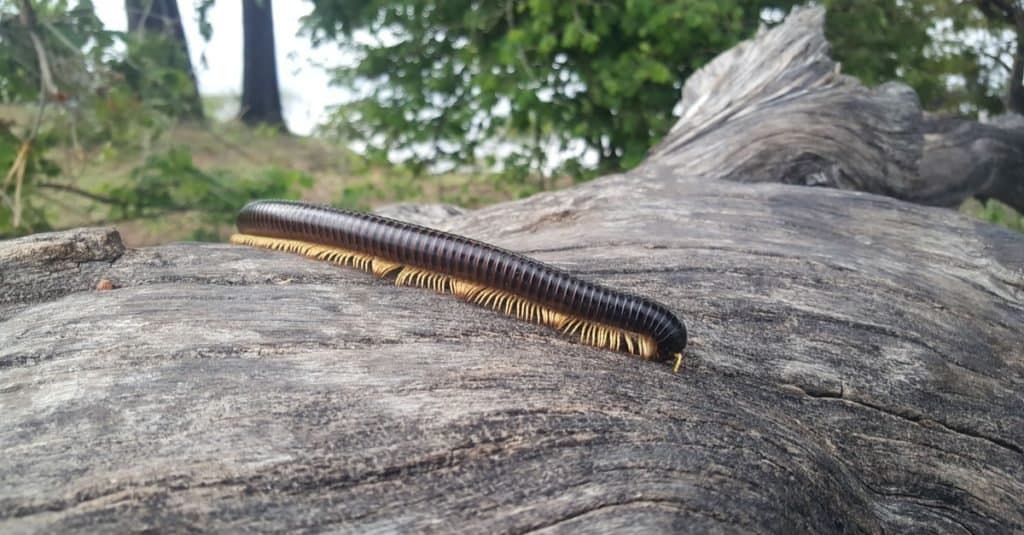
Much like other arthropods, the animal has an exoskeleton, though there is a species of extinct millipedes that have had a soft exterior. As small as 2 mm (or as giant as 35 cm), they are typically either brown or black, broken up by bright colors to indicate that a certain species is poisonous.
Certain species of millipedes can also grow quite large. For example, the African giant black millipede is the largest millipede in the world and can reach up to 15 inches in length! Millipedes also have only a single pair of antennae, its use is unknown.
The legs are an easy way to tell what kind of animal you see. These animals have an average of 100 legs, but there are some giant variations that can have upwards of 750 legs. The legs are jointed, and each section of the animal’s exoskeleton has two pairs.
Habitat
©Alex Stemmers/Shutterstock.com
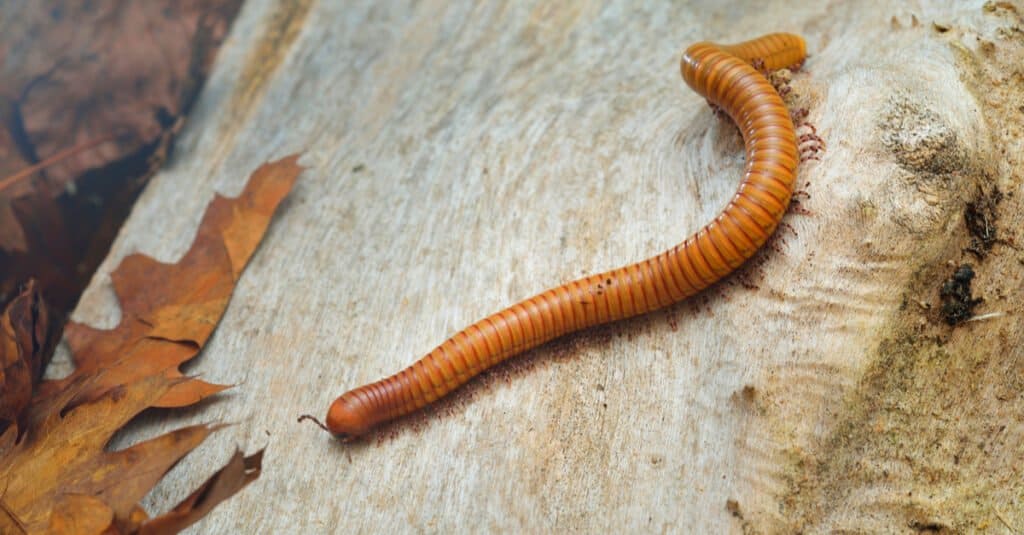
Considering how many different species there are, they are found on nearly every continent. They prefer to burrow in their natural habitat, which often consists of warm and moist soil.
Millipedes rarely survive in the house. However, sometimes, garden millipedes become house millipedes after infiltrating the home, especially in extreme weather conditions. Regardless, they cannot survive in the home for long.
Millipedes’ environment must be humid, even if they are kept as a pet in an artificial habitat. The only area that has yet to become the habitat of the millipede is Antarctica.
Diet
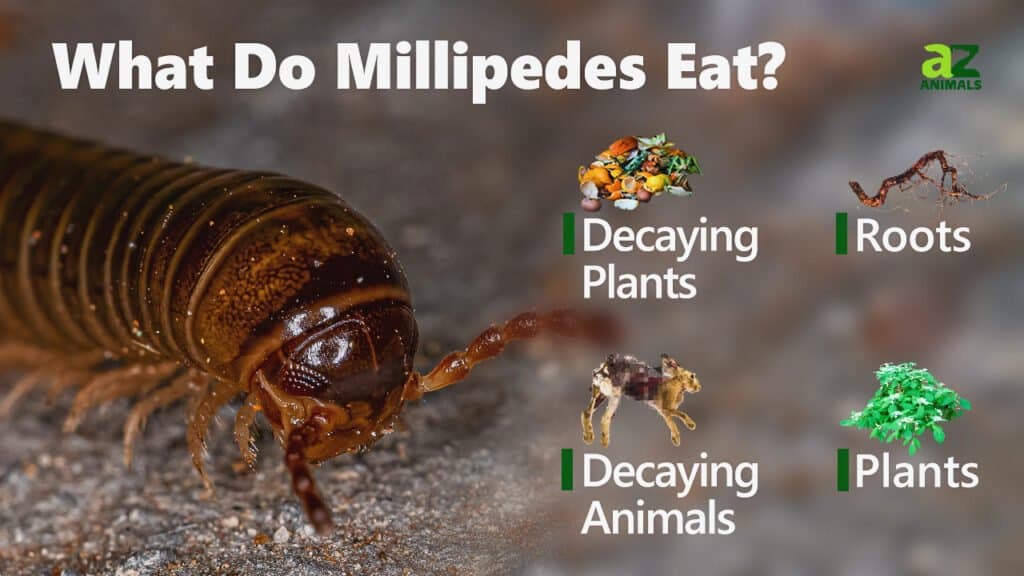
This animal is a detritivore, which means that it eats dead organic matter in the earth like damp wood pieces, decayed leaves, and other materials that naturally exists in their moist habitat underground.
However, these potential scavengers won’t allow themselves to go hungry. If the land becomes overly dry or they are unable to consume the detritus that they normally eat, they’ll go after living plant life to satisfy their appetite.
Fun fact: Did you know that millipedes aredetritivores, which means they mostly eat things that have died? Discover more about their diet by reading “What Do Millipedes Eat? 9 Surprising Meals!“
Prevention
These animals are rather easy to eliminate from the home with either defensive insect sprays or simply picking them up to remove them from the home. They are not dangerous, but they can be quite a pest for a healthy garden.
View all 164 animals that start with M How to Add Us to Google News


Millipede FAQs (Frequently Asked Questions)
Are Millipedes herbivores, carnivores, or omnivores?
Millipedes are Omnivores, meaning they eat both plants and other animals.
What Kingdom do Millipedes belong to?
Millipedes belong to the Kingdom Animalia.
What phylum do Millipedes belong to?
Millipedes belong to the phylum Arthropoda.
What order do Millipedes belong to?
Millipedes belong to the order Diplopoda.
What type of covering do Millipedes have?
Millipedes are covered in Shells.
Where do Millipedes live?
Millipedes are found worldwide.
In what type of habitat do Millipedes live?
Millipedes live in moist micro-habitats.
What is the main prey for Millipedes?
Millipedes prey on decaying plant material, plants, and insects.
What are some predators of Millipedes?
Predators of Millipedes include birds, badgers, and rodents.
What is the average litter size for a Millipede?
The average litter size for a Millipede is 500.
What is an interesting fact about Millipedes?
Some Millipede species have a poisonous bite!
What is the scientific name for the Millipede?
The scientific name for the Millipede is Diplopoda.
How many species of Millipede are there?
There are 10,000 species of Millipede.
Are millipedes dangerous?
No. While there are some millipede species that release a toxin that causes itchiness and irritation, they have no venom or poison to threaten other animals.
How many legs does a millipede have?
The total number of legs on the millipede varies. There are some species that have as little as 40 legs, while some grow long enough to have 750 legs. In general, most species have about 100 legs or less, and they are broken into two pairs per segment.
What does a millipede look like?
A millipede is usually brown or black, and they have a strong exoskeleton to protect them. They have short antennae, two pairs of legs in each segment of the body, and a flat head. If the species is poisonous, the arthropod will have bright colors along its sides as a way to warn others.
How do you identify a millipede?
Millipedes have two pairs of legs for each segment of their body. They also have a pair of short antennae and are often found in humid areas with moist soil.
Are millipedes bad to have in the house?
A few millipedes won’t be more than a nuisance. However, if too many are present in outdoor soil, they can cause damage to plant life.
How do you get rid of millipedes?
Millipedes are easy to pick up by hand, moving them outside the home. They can also be sprayed with typical insect repellant products, but they aren’t harmful. Defending a home from millipedes by repairing leaks and eliminating debris is much safer.
Can millipedes kill you?
No. Millipedes lack the venom required to kill a human.
Thank you for reading! Have some feedback for us? Contact the AZ Animals editorial team.
Sources
- Thought Co, Available here: https://www.thoughtco.com/fascinating-facts-about-millipedes-4172482
- How Stuff Works, Available here: https://animals.howstuffworks.com/arachnids/millipede-legs.htm
- Wikipedia, Available here: https://en.wikipedia.org/wiki/Millipede
- Library of Congress, Available here: https://www.loc.gov/everyday-mysteries/zoology/item/how-are-millipedes-and-centipedes-alike-and-how-do-they-differ/
- Orkin, Available here: https://www.orkin.com/other/millipedes/what-do-millipedes-eat
- Merck Manual, Available here: https://www.merckmanuals.com/home/injuries-and-poisoning/bites-and-stings/centipede-and-millipede-bites