




P
Species Profile

Pygmy Marmoset (Finger Monkey)

Cebuella pygmaea

Tiny monkey, mighty gum-grazer
RegBarc / Creative Commons

Pygmy Marmoset (Finger Monkey) Distribution

Click a location to explore more animals from that region

Loading map...
Pygmy Marmoset on a branch

At a Glance

Wild Species
Also Known As Pygmy monkey, Dwarf marmoset, Dwarf monkey, Finger monkey, Pocket monkey, Sagui, Tití pigmeo
Diet Omnivore
Activity Diurnal+
Lifespan 10 years
Weight 0.14 lbs
Status Least Concern
Did You Know?

Adult size: head-body length ~11.7-15.2 cm; tail ~17.2-22.9 cm (tail longer than body).

Scientific Classification

The pygmy marmoset is the world’s smallest monkey, a tiny New World primate specialized for feeding on tree exudates (sap/gum) and living in small social groups in Amazonian forests.

Kingdom
Animalia
Phylum
Chordata
Class
Mammalia
Order
Primates
Family
Callitrichidae
Genus
Cebuella
Species
Cebuella pygmaea

Distinguishing Features

  • Extremely small body size (the smallest true monkey)
  • Claw-like nails (tegulae) on most digits aiding vertical clinging
  • Specialized lower incisors used to gouge bark to stimulate gum flow
  • Often shows subtle ear/face and ventral coloration differences from C. niveiventris depending on population

Physical Measurements

Length
1 ft 1 in (11 in – 1 ft 3 in)
Weight
0 lbs (0 lbs – 0 lbs)
Tail Length
8 in (7 in – 9 in)
Top Speed
7 mph
running

Appearance

Primary Colors
Secondary Colors
Skin Type Dense fur over most body; bare dark skin on nose, palms, soles, and inner ears
Distinctive Features
  • World's smallest New World monkey (Callitrichidae, platyrrhine).
  • Head-body length 11.7-15.2 cm; tail length 17.2-22.9 cm (Nowak, 1999).
  • Typical adult mass ~0.10 kg (often reported ~0.08-0.12 kg; Nowak, 1999; IUCN accounts).
  • Long, banded tail used for balance; not prehensile.
  • Claw-like tegulae on digits (except big toe has a flat nail), aiding vertical clinging.
  • Enlarged, forward-angled lower incisors and robust jaw for bark-gouging exudates (gum/sap).
  • Scent-marking adaptations: prominent anogenital and sternal scent glands typical of callitrichids.
  • Riverine and seasonally flooded Amazonian forests; frequently uses lower trunks and lianas.
  • Small social groups with cooperative infant care; groups commonly ~2-9 individuals (field reports summarized in IUCN).
  • Longevity: up to ~11-12 years in captivity; shorter in the wild (commonly cited in primate references).

Did You Know?

Adult size: head-body length ~11.7-15.2 cm; tail ~17.2-22.9 cm (tail longer than body).

Typical adult mass is about 0.10 kg (often reported ~0.08-0.12 kg), making it the smallest living monkey species.

Diet is strongly exudativorous: tree gums/sap can dominate feeding time/energy intake, supplemented with insects, fruit, and nectar.

Reproduction is fast for a primate: gestation ~140 days; twins are the norm in Callitrichidae (including this species).

Social system is cooperative: usually one dominant breeding female; fathers and helpers carry infants much of the time.

Habitat association is "riverine": commonly found in seasonally flooded forests and edges/secondary growth along streams in the western Amazon Basin.

Taxonomy is in flux: many authorities recognize two species, Cebuella pygmaea and the white-bellied pygmy marmoset Cebuella niveiventris, split largely by geography and genetics.

Unique Adaptations

  • Specialized lower incisors and jaw mechanics for gouging bark to access tree exudates (a rare primate specialization).
  • Claw-like nails (tegulae) on most digits (rather than flat primate nails) improve grip for vertical clinging on bark; the big toe retains a flatter nail for grasping.
  • Enlarged caecum/large-intestine capacity relative to body size supports fermentation and digestion of complex plant gums.
  • Small body and rapid life history (frequent twinning) align with callitrichid cooperative breeding and high caregiver investment.
  • Cryptic coloration and tiny size help it exploit dense vine tangles and thin branches that larger monkeys avoid.

Interesting Behaviors

  • Bark-gouging: repeatedly bites small holes in bark to stimulate gum flow, then returns to feed from "gum trees" on a schedule.
  • Trap-lining: individuals often visit a circuit of known exudate sources (productive trees) rather than foraging randomly.
  • Cooperative infant care: non-breeding adults and older siblings frequently carry twins, hand them off, and help provision the nursing female.
  • Sentinel-like vigilance: while some feed at gum sites, others scan for raptors/snakes; alarm calls can trigger freezing or rapid cover-seeking.
  • Vertical clinging and leaping: commonly forages on narrow trunks and vines, clinging upright and making short, quick leaps between stems.
  • Territorial scent marking: uses scent glands/urine marking along routes and around key feeding trees to communicate presence to neighbors.

Cultural Significance

Across Amazon countries (Peru, Ecuador, Colombia, Brazil), pygmy marmosets (Cebuella pygmaea) are used in nature education as rainforest mini-fauna and gum-feeding primate icons. They appear in the wild pet trade and are used to show harms of capture and loss of flooded and edge forests in western Amazon.

Myths & Legends

Cebuella pygmaea was named for Western science in the 19th century, often linked to J.B. von Spix’s Amazon trips. Its English name, “pygmy marmoset,” shows how amazed early naturalists were by its tiny size.

For decades pygmy marmosets were treated as one species, but river barriers and genetic studies led to splitting them into Cebuella pygmaea and Cebuella niveiventris, often used to show rivers drive speciation in the Amazon.

In parts of the western Amazon, tiny monkeys, including pygmy marmosets (Cebuella pygmaea), were kept as novelty pets; local stories and public talks use this as a warning against taking social animals from their families.

Conservation Status

LC Least Concern

Widespread and abundant in the wild.

Population Decreasing

Protected Under

  • CITES Appendix II (international trade regulated)
  • National wildlife protection frameworks in range states (e.g., Brazil: Environmental Crimes Law, Federal Law 9,605/1998; Peru: Forestry and Wildlife Law)
  • Occurs in multiple protected areas within the Amazon basin (site-specific protection varies by country and management effectiveness)

Life Cycle

Birth 2 infants
Lifespan 10 years

Lifespan

In the Wild
6–12 years
In Captivity
12–18 years

Reproduction

Mating System Polyandry
Social Structure Cooperative Breeder
Breeding Pattern Long Term
Fertilization Internal Fertilization
Birth Type Internal_fertilization

Groups of ~2-9 typically contain one breeding female that mates with one to two adult males (polyandry), while nonbreeding helpers provide intensive infant care (notably carrying of usually twins); breeding associations can persist for multiple seasons/years (Soini 1988; Porter 2001).

Behavior & Ecology

Social Troop Group: 6
Activity Diurnal, Matutinal, Vespertine
Diet Omnivore tree gums/exudates (often reported as the primary staple; commonly from Parkia spp. and Inga spp. where available)

Temperament

Strongly cooperative breeders; extensive alloparental care, with males frequently carrying infants (Soini 1988; Digby et al. 2007).
Territorial around exudate trees; intergroup encounters can include chasing and vocal displays (Soini 1988).
Group cohesion is high; most time spent within a few meters, especially during foraging.
Dominance is typically centered on a primary breeding female; subordinates show reproductive suppression (Digby et al. 2007).
Risk-sensitive and vigilant; rapid retreat to cover and clustering during disturbances is common (Soini 1988).
Tolerance is higher within groups than between groups; aggression increases near key sap sites (Soini 1988).

Communication

high-pitched trills Contact calls
twitters Social cohesion/coordination
alarm calls Rapid, sharp notes
long-distance calls for spacing between groups
infant distress calls eliciting carrying/approach
scent marking with anogenital/suprapubic glands on branches and trunks Soini 1988
urine-washing and urine marking on substrates Callitrichidae-wide; Digby et al. 2007
visual signals: piloerection, posture, and approach/avoidance displays during encounters
tactile grooming and huddling for bonding and tension reduction
site fidelity to feeding scars (gouged holes) that act as social/foraging cues

Habitat

Biomes:
Tropical Rainforest Wetland Freshwater Savanna
Terrain:
Plains Valley Riverine
Elevation: Up to 3280 ft 10 in

Ecological Role

Exudate-feeding insect predator and microhabitat modifier in Amazonian floodplain and terra firme forests.

regulates arboreal insect populations through predation on ants/termites and other arthropods creates and maintains bark wounds used for exudate feeding, which can increase localized sap/gum flow and provide feeding sites later used by other animals (facilitation) minor seed dispersal when fruit is eaten (opportunistic frugivory) serves as prey for raptors, snakes, and small felids, transferring energy from plant exudates and insects to higher trophic levels

Diet Details

Other Foods:
Tree exudates Gum from leguminous trees Nectar and flowers Ripe fruits

Human Interaction

Domestication Status

Wild

Pygmy marmoset (Cebuella pygmaea) is not domesticated and has no history of being bred for pets. People affect it by cutting habitat, taking individuals for the pet trade, and holding them in research or zoos. As a gum-feeding Callitrichid that lives in small family groups, its behavior and body make it unsuited to life as a pet.

Danger Level

Low
  • Bites/scratches (small but can break skin; risk increases under stress, handling, or poor socialization)
  • Zoonotic and reverse-zoonotic disease transmission risk typical of nonhuman primates (enteric bacteria such as Salmonella/Shigella, respiratory viruses, parasites); risk is elevated with close contact and poor hygiene
  • Allergic reactions/asthma triggers from dander/urine in indoor settings
  • Injuries to the animal and handler during capture/transport due to high stress and escape behavior

As a Pet

Not Suitable as Pet

Legality: Pygmy marmoset (Cebuella pygmaea) is often illegal or tightly controlled as a pet. International trade needs CITES permits, and local laws may ban ownership or require permits, cages, and vet plans.

Care Level: Expert Only

Purchase Cost: $1,500 - $4,000
Lifetime Cost: $20,000 - $60,000

Economic Value

Uses:
Ecotourism/wildlife viewing (Amazonian forest tourism) Zoo and conservation education value Biomedical/behavioral research relevance (New World primate model; ethically and legally controlled) Illegal/regulated live-animal trade (pet market)
Products:
  • Non-consumptive tourism services (guided viewing/photography)
  • Education/exhibit value in accredited zoological institutions
  • Research data (behavior, social systems, primate ecology)-not a commercial commodity in itself
  • Live-animal trade value (where illegally captured/sold)

Relationships

Related Species 5

Western pygmy marmoset Cebuella niveiventris Shared Genus
Common marmoset Callithrix jacchus Shared Family
Emperor tamarin
Emperor tamarin Saguinus imperator Shared Family
Golden lion tamarin
Golden lion tamarin Leontopithecus rosalia Shared Family
Goeldi's monkey Callimico goeldii Shared Family

Ecological Equivalents 5

Animals that fill a similar ecological role in their ecosystem

Common marmoset Callithrix jacchus Common marmosets and pygmy marmosets share a tree‑gouging, gum/sap diet and a small, cooperative‑breeding callitrichid social system. Pygmy marmosets (Cebuella pygmaea) are specialists on tree gum and sap; they measure about 11–15 cm body length, 17–23 cm tail length, and weigh 85–140 g.
Western pygmy marmoset Cebuella niveiventris Occupies essentially the same ecological niche as Cebuella pygmaea (when treated as a separate species): tiny-bodied, bark-gouging exudativore-insectivore that forages in small family groups in Amazonian floodplain and terra firme forests; exhibits similar vertical-clinging and rapid trunk-foraging behavior.
Emperor tamarin
Emperor tamarin Saguinus imperator Sympatric or near-sympatric small callitrichid in western Amazonia that overlaps in foraging strata (lower to mid-canopy and forest edge) and in diet breadth (arthropods and fruit), and exhibits similar group living with cooperative care, although it is less specialized for gum feeding than Cebuella.
Saddleback tamarin Leontocebus fuscicollis A small Amazonian tamarin that often uses similar forest-edge and secondary-growth habitats and overlaps in insect-foraging microhabitats. Exhibits comparable predator-avoidance strategies (alarm calls, rapid retreat to cover) and a multi-male/multi-female group structure typical of callitrichids.
Golden lion tamarin
Golden lion tamarin Leontopithecus rosalia Ecological analogue outside Amazonia. Small-bodied callitrichid that relies heavily on arthropods and uses tree-hole and epiphyte microhabitats for foraging; exhibits similar cooperative breeding and intensive parental and alloparental care, though it occurs in the Atlantic Forest rather than the Amazon.

“Also known as a finger monkey, a pygmy marmoset can leap a distance of 16 feet to get from one tree branch to another.”


Pygmy marmosets (also called pigmy monkeys) live in the Amazon forests of South America. These cute creatures are the world’s tiniest monkeys weighing about 4 ounces in adulthood. Finger monkeys are omnivores that really like to eat tree sap! These monkeys live to be about 12 years old in the wild.
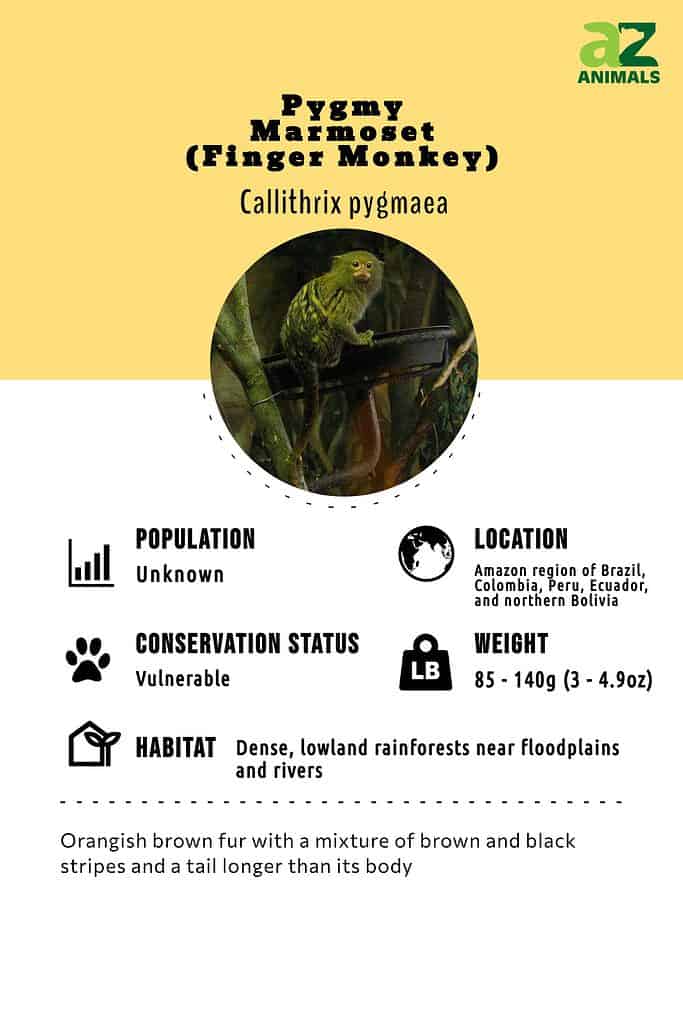
5 Amazing Pygmy Marmoset Facts

  • Pygmy marmosets (also called finger monkeys and pigmy monkeys) live in the tops of trees in the rainforests of South America.
  • Finger monkeys have fingernails they use as claws to climb trees.
  • Butterflies, fruits, berries, and tree sap are all favorite foods of this small omnivore.
  • One male and one female pygmy marmoset breed and live together for a lifetime.
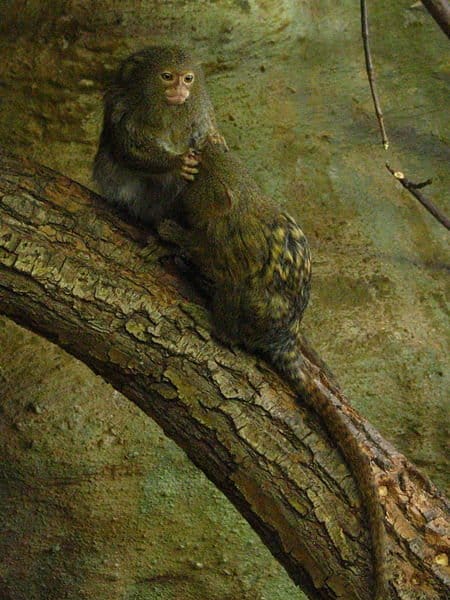
  • Pygmy marmosets groom each other’s fur just like other monkeys.
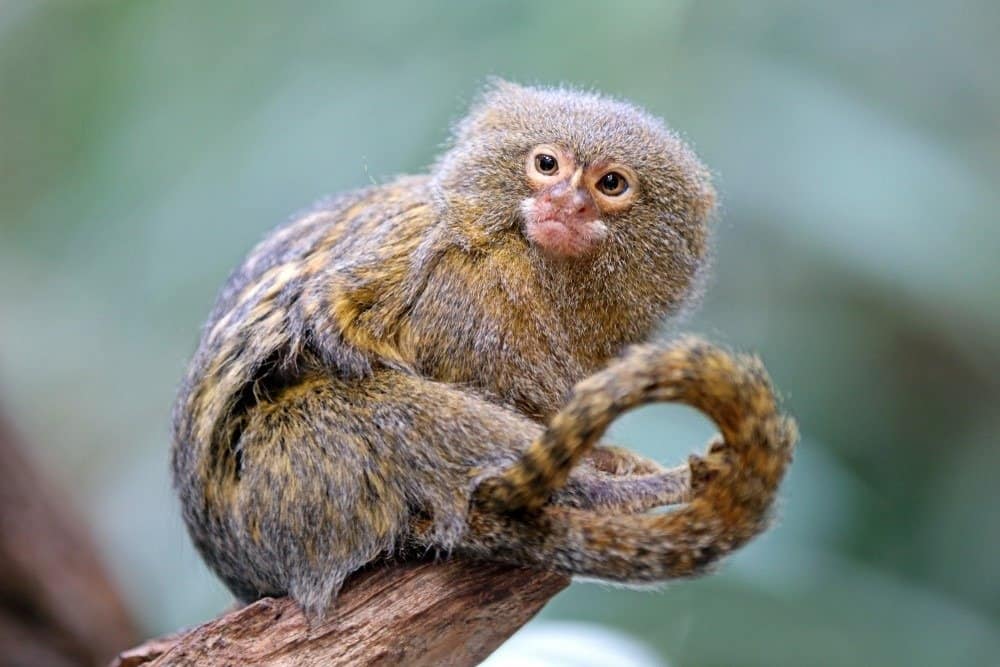
Pygmy marmosets live in the tops of trees in the rainforests of South America.

Scientific Name

While pygmy monkey or pygmy marmoset is this animal’s common name, its scientific name is Cebuella pygmaea. It belongs to the Callitrichidae family, and its class is Mammalia. Marmoset comes from the French word marmouset.

2 Kinds of Pygmy Marmosets

The pygmy marmoset has two subspecies that are mostly divided by natural terrain barriers. They both prefer lowland forests within floodplains of rivers.

  • Eastern pygmy marmoset – The Eastern pygmy marmoset can be found in Amazona (the Brazilian state) and surrounding areas, including north Bolivia, and eastern Peru.
  • Western pygmy marmoset – The Western pygmy marmoset is located in an area that covers northern Ecuador and Bolivia, parts of southern Columbia, the eastern part of Peru, and in Brazil north of Rio Solimões.

Appearance and Behavior

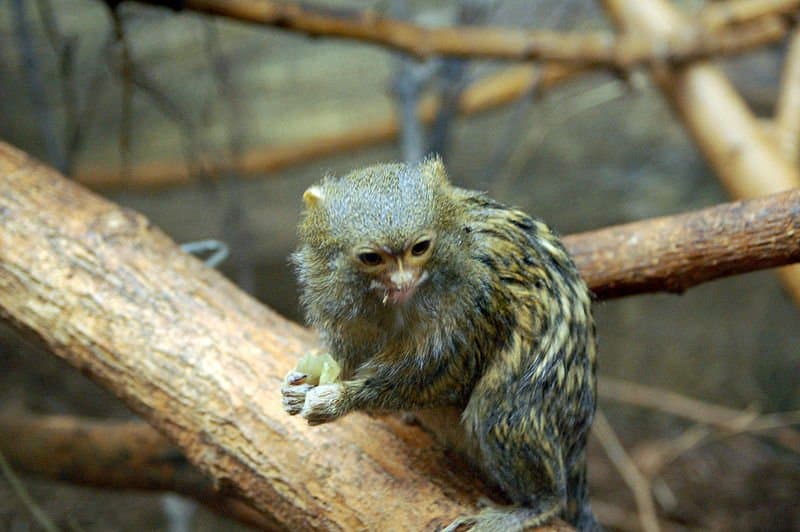
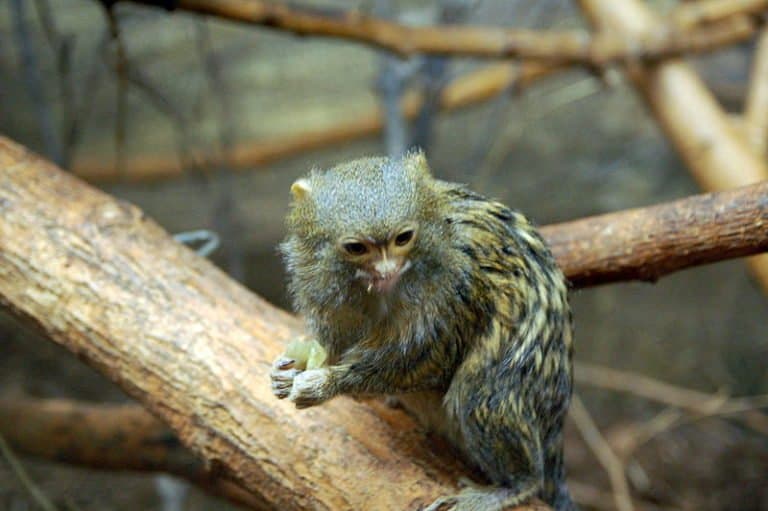
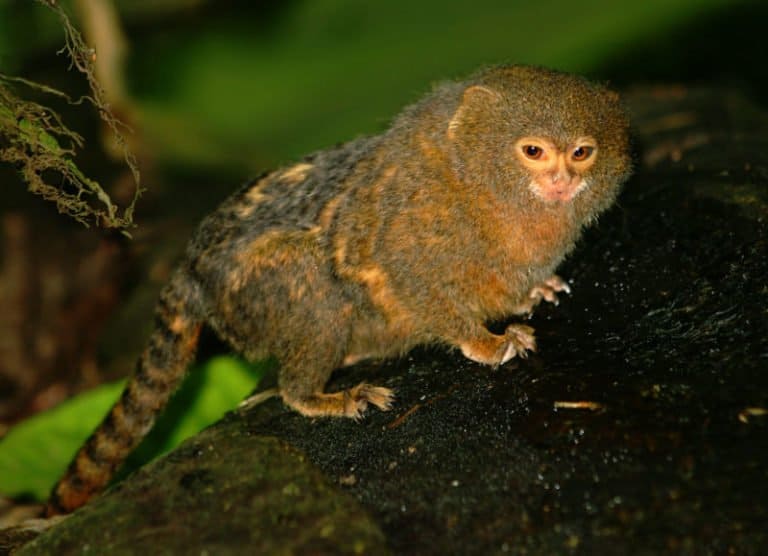
These marmosets have a coat of orangish brown fur with a mixture of brown and black stripes. The dark fur of this small animal helps to hide it as it moves across tree branches. The fingernails of this monkey serve as claws that can grasp the bark of a tree as it climbs. The way this marmoset moves and climbs is similar to that of a squirrel you might see in your local park.

It has a small nose, small eyes, and an ear on each side of the top of its head. These marmosets have extra flexibility in its neck allowing them to turn its head to look backward. This helps the animal to be on high alert for predators in the area.

A pygmy marmoset’s tail is longer than its body. It uses its tail for balance as it moves along tree limbs high up in the Amazon forest.

The body of an adult pygmy marmoset measures about 4 to 6 inches long. Plus, its squirrel-like tail is 6 to 9 inches long. A pygmy marmoset’s 9-inch tail is equal in length to an average size fork in a silverware drawer. An adult weighs a little over 4 ounces. This means it weighs about the same as one stick of butter from your fridge at home.

This marmoset claims the title of the smallest monkey in the world. But, it’s not the smallest primate in the world. That title belongs to a pygmy mouse lemur that weighs around 1.1 ounces! Learn more about the world’s smallest animals here.

These marmosets live in groups called troops, with about 5 to 9 members. Living in groups provides these small animals with some level of protection against predators. If one member spots an ocelot, it would alert the rest of the troop to take cover in the trees. These marmosets are shy animals that stay with their own troop while remaining hidden in the trees much of the time.

The members of the marmoset troop communicate with one another using squeaks and chirps that only they can understand. One sound may mean there is danger near, while another may be a male calling a female. The sounds these animals make are somewhat similar to the sounds made by brown and gray squirrels.
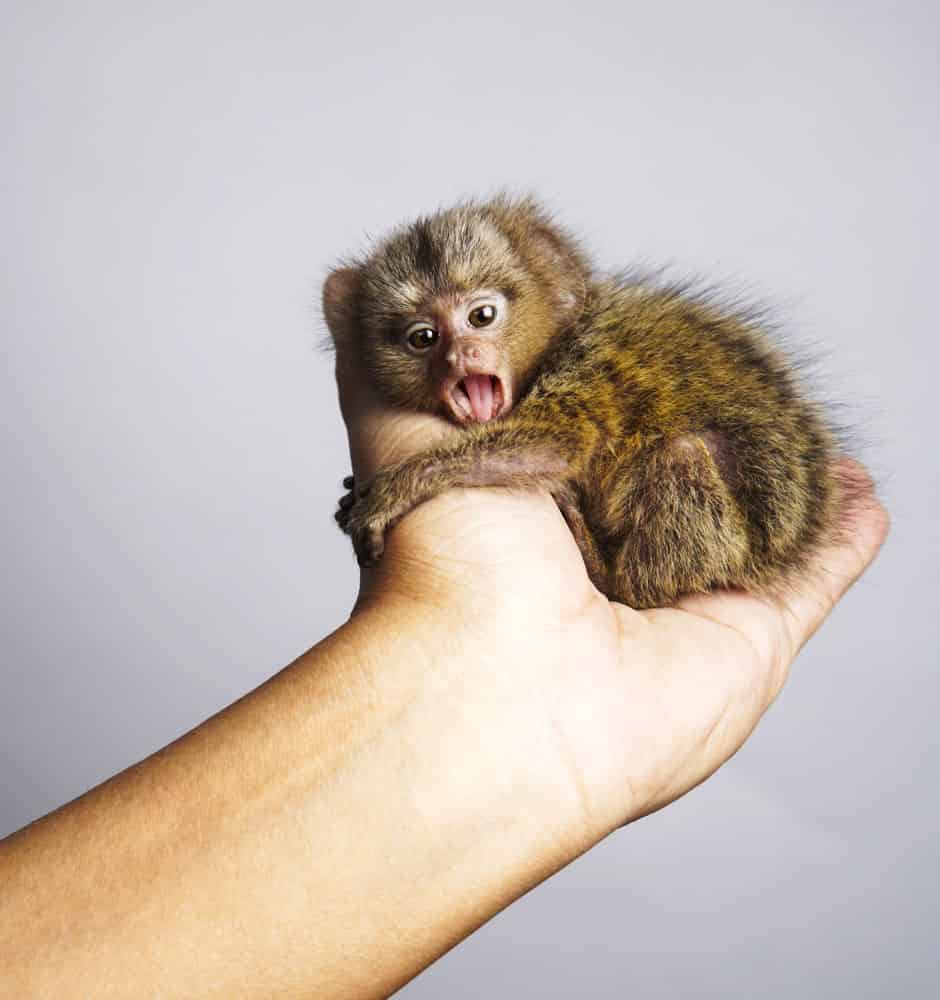
Smallest Animals: Monkeys

The Pygmy marmoset has fingernails that are like claws to help them climb up and down trees.

Evolution and History

This diminutive monkey evolved from larger ancestors to allow it to flourish in the canopies of trees and move about the thin and weakest of branches with ease, much like a squirrel does. Unlike other primates with flat nails, the pygmy marmoset developed long, very sharp nails over time that allowed it to grasp trees and branches. They essentially function as claws for climbing purposes.

Furthermore, this tiny primate adapted to life in the trees by evolving bottom teeth that are exceptional at penetrating bark and accessing tree sap. Their digestive systems have also developed in such a way as to break down tree gum and sap.

Habitat

These marmosets live in Peru, Ecuador, Brazil, and Columbia in South America. They live in the Amazon rainforests or in thickets growing near rivers. These animals live in a tropical climate that’s humid and rainy. Pygmy marmosets live in the rainforests of South America throughout the year.

You’ll find these marmosets living in forests where trees grow close together. This allows them to jump easily to the branches of different trees. Plus, it’s easy to stay hidden from predators when the branches of trees are crisscrossing one another. The marmoset’s orange/brown fur also helps it stay hidden among the rainforest’s dark branches and tree trunks. Generally, these marmosets remain in a territory of less than an acre of forest.
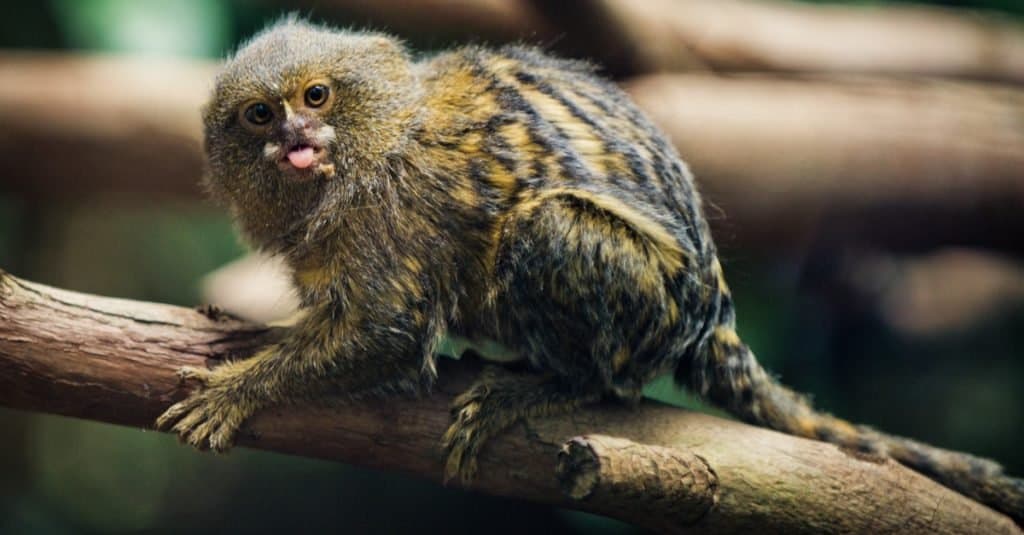
Cutest Animals: Pygmy Marmoset

The marmoset’s orange/brown fur also helps it stay hidden among the rainforest’s dark branches and tree trunks.

Diet

What do pygmy marmosets eat? The main food source of this animal is tree sap. These marmosets use their bottom row of sharp teeth to dig holes into the bark of a tree. They dig until they find sap, then drink it like a dog drinks water from its bowl.

Oftentimes, a pygmy marmoset chooses just one tree to dig into for sap every time it wants food. This tree is located somewhere in the specific territory of the monkey. Some trees can have up to 1300 holes made over time by one hungry marmoset!

These animals are omnivores, so they certainly eat more than tree sap. They eat fruit, butterflies, leaves, small spiders, and nectar. They are quick and can grab insects that live on the branches around them. The type of food these monkeys eat depends on what is most plentiful in the area.

Since these marmosets are so little, they don’t need to eat very much to survive. They may drink as much as a tablespoon of tree sap at one time. These monkeys like to look for food in the morning and late afternoon.

Pygmy marmosets that are kept in zoos are fed vegetables and fruits along with a special food mixture that’s easy for them to digest. The amount and type of food they are given are carefully monitored. Feeding this marmoset processed food would be harmful to this little animal.

Predators and Threats

As you may have guessed, these marmosets have many predators due to the fact that these monkeys are so small. Some of their predators include hawks, snakes, ocelots, and eagles, specifically the harpy eagle.

Since these marmosets stay high up in the trees, they are especially vulnerable to eagles, hawks, and other birds. Plus, there are many snakes that climb trees such as the pit viper. The pygmy marmoset’s speed and ability to hide are its only defenses against these predators.

The habitat of these marmosets is threatened when trees in the rainforest are cut down and cleared. This takes away their home as well as their food source.

Humans are a threat to these animals in another way. Sometimes these animals are caught and sold as exotic pets throughout the world. This is another thing that reduces their population.

The official conservation status of the pygmy marmoset is Threatened. Their habitat is threatened when trees are cleared, but if this could be slowed it would help increase the population of this monkey.

There are laws against buying and selling wild animals as pets. This includes the pygmy marmoset. Enforcement of these laws can contribute to keeping the pygmy marmosets safe in their natural habitat.
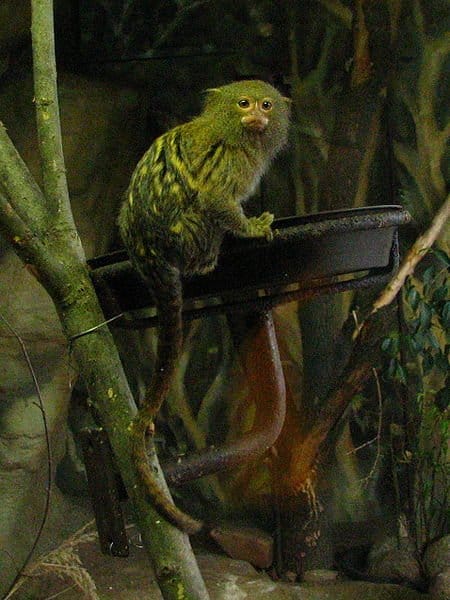
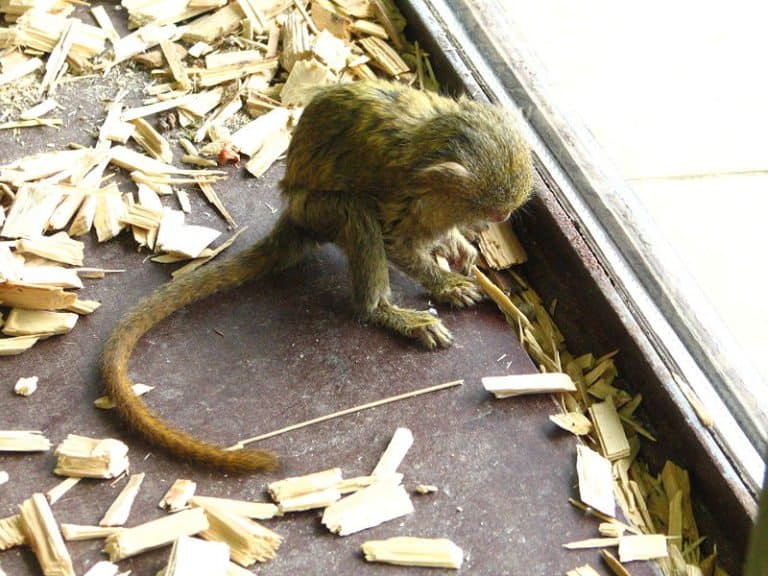
Pygmy Marmoset in a zoo

Their habitat is threatened when trees are cleared, but if this could be slowed it would help increase the population of this monkey.

Reproduction, Babies, and Lifespan

Breeding season for these marmosets happens throughout the year. While looking for a mate, a male will mark the area with his scent and follow one female around the territory. One male and one female in a troop breed and the rest of the members of the group help to take care of the young. This male and female stay together for their lifetime. The gestation period of a pygmy marmoset is about 20 weeks. Generally, there are two live babies in a litter. More rarely, a female will have one or three babies.

A newborn pygmy marmoset weighs .4 ounces. Imagine a newborn pygmy as being about the size of an adult human’s thumb!

During the first couple weeks of a newborn pygmy marmoset’s life, it rides around on the back of its father. It’s the father who is the main caretaker of pygmy marmoset babies. When it’s time to eat, the father takes the babies to their mother so she can nurse them.

Baby pygmy marmosets start to eat insects and tree sap at about 3 months old. Others in the troop teach the babies how to find food. Once a baby pygmy marmoset is about 1 and a half or 2 years old, it may strike out on its own as an adult. But, in some cases, the young stay with the troop to help raise other babies. This means there may be several siblings in a troop.

The average lifespan of a pygmy marmoset is 12 years. Of course, the number of predators in the area where a pygmy marmoset lives can definitely have an effect on its lifespan. These small monkeys can suffer from malnutrition as they age if there is a decrease in the foods they eat in their environment.
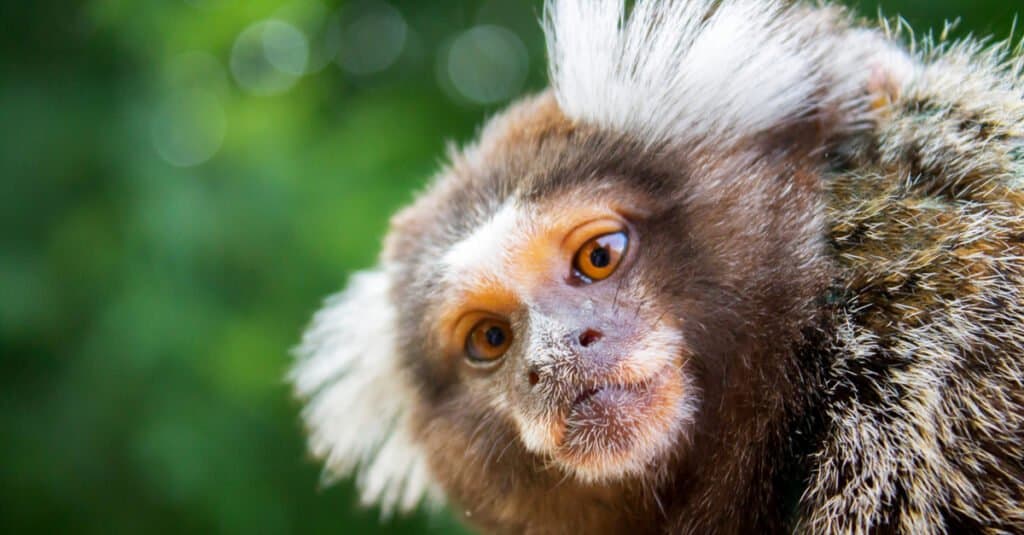
Animals with large eyes – Pygmy marmoset monkey

The pygmy marmoset is the smallest marmoset, but its eyes certainly aren’t small!

Population

The conservation status of the pygmy marmoset is Threatened. The exact population of pygmy marmosets is unclear due to their size and ability to hide in inaccessible areas. But, scientists believe the largest concentration of these animals lives near the Amazon and Rio Negro Rivers in South America. Their population seems to be holding steady as some efforts are being made to reduce the clearing of the Amazon rainforest.

View all 247 animals that start with P

Sources

  1. David Burnie, Dorling Kindersley (2011) Animal, The Definitive Visual Guide To The World's Wildlife / Accessed November 10, 2008
  2. Tom Jackson, Lorenz Books (2007) The World Encyclopedia Of Animals / Accessed November 10, 2008
  3. David Burnie, Kingfisher (2011) The Kingfisher Animal Encyclopedia / Accessed November 10, 2008
  4. Richard Mackay, University of California Press (2009) The Atlas Of Endangered Species / Accessed November 10, 2008
  5. David Burnie, Dorling Kindersley (2008) Illustrated Encyclopedia Of Animals / Accessed November 10, 2008
  6. Dorling Kindersley (2006) Dorling Kindersley Encyclopedia Of Animals / Accessed November 10, 2008
  7. David W. Macdonald, Oxford University Press (2010) The Encyclopedia Of Mammals / Accessed November 10, 2008
Heather Ross

About the Author

Heather Ross

Heather Ross is a secondary English teacher and mother of 2 humans, 2 tuxedo cats, and a golden doodle. In between taking the kids to soccer practice and grading papers, she enjoys reading and writing about all the animals!

Thank you for reading! Have some feedback for us?


Pygmy Marmoset (Finger Monkey) FAQs (Frequently Asked Questions)

Pygmy marmosets are omnivores. They eat insects as well as fruits. But, if they have access to tree sap in their territory, they will look for that before practically any other food source. As a note, when pygmy marmosets dig holes in trees to get tree sap, they are also attracting insects into their territory. Butterflies are likely to be attracted to the tree sap and may fall victim to a pygmy marmoset when they land on a branch to drink the sap.