Q
Species Profile

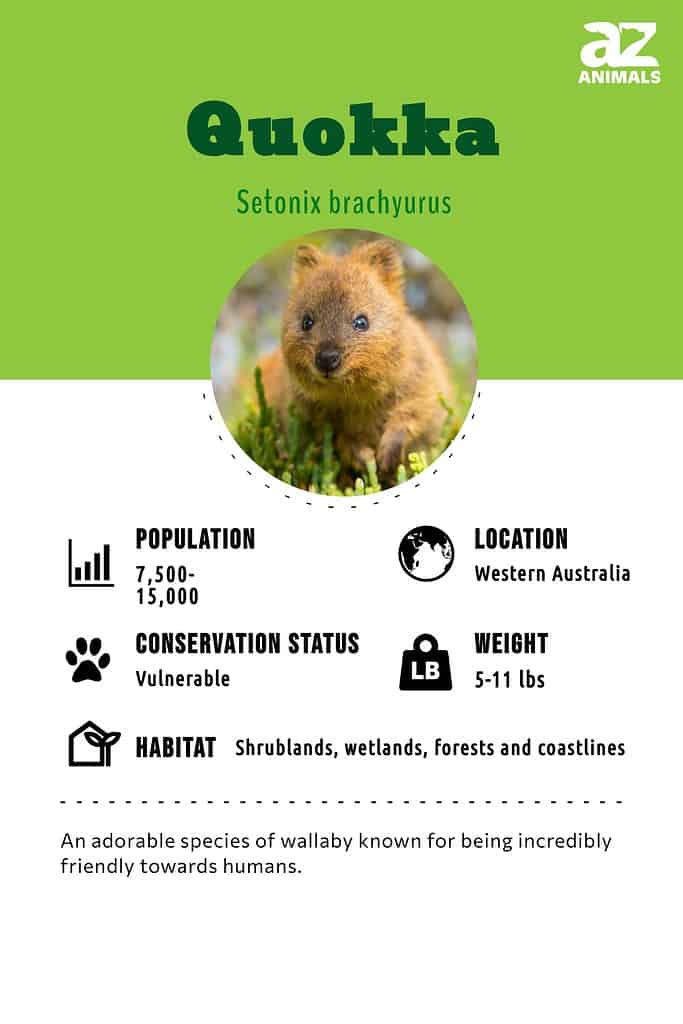
Quokka

Setonix brachyurus

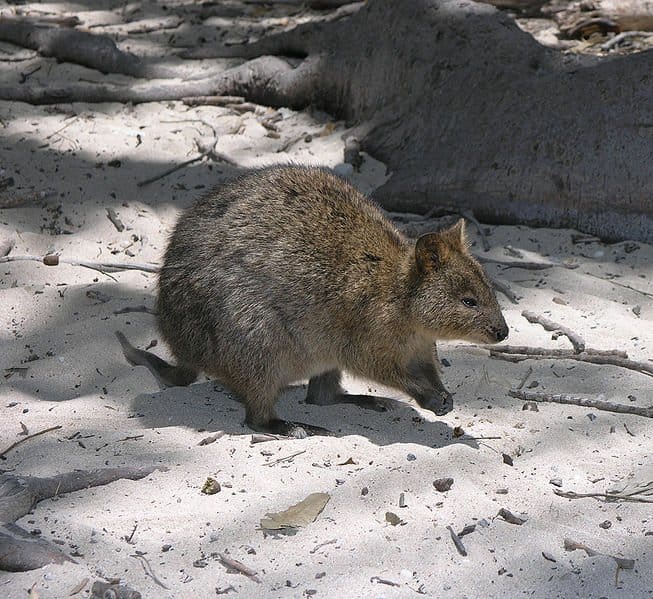
Small kangaroo, big island icon
SeanMack, CC BY-SA 3.0, via Wikimedia Commons

Quokka Distribution

Click a location to explore more animals from that region

Endemic Species
Loading map...
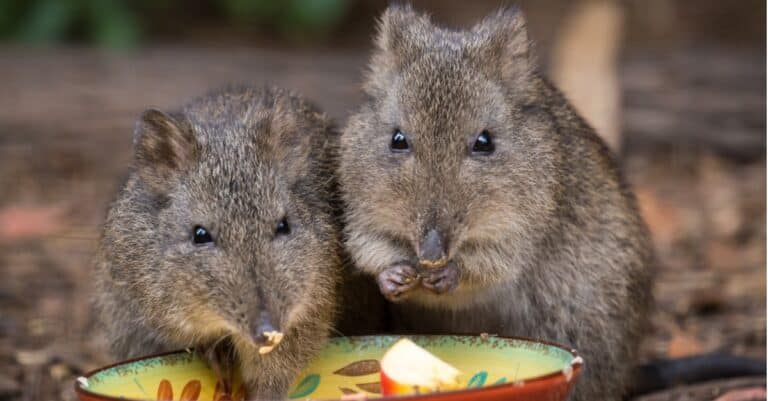
Quokka on Rottnest Island.

At a Glance

Wild Species
Also Known As Short-tailed scrub-wallaby, Short-tailed wallaby
Diet Herbivore
Activity Nocturnal+
Lifespan 8 years
Weight 4.2 lbs
Status Vulnerable
Did You Know?

Adult size: head-body 40-54 cm; tail 25-30 cm; mass typically 2.5-5.0 kg (Australian Museum; IUCN Red List).

Scientific Classification

The quokka is a small macropod (kangaroo family) endemic to southwestern Australia, best known from island populations (notably Rottnest Island) and some mainland remnants. It is a herbivorous, mostly nocturnal marsupial with a compact build and short tail.

Kingdom
Animalia
Phylum
Chordata
Class
Mammalia
Order
Diprotodontia
Family
Macropodidae
Genus
Setonix
Species
brachyurus

Distinguishing Features

  • Small, stocky macropod with rounded face and relatively short tail
  • Marsupial herbivore; nocturnal/crepuscular activity common
  • Endemic to southwestern Australia, with iconic island populations (Rottnest Island)

Physical Measurements

Males and females differ in size

Length
♂ 2 ft 6 in (2 ft 2 in – 2 ft 9 in)
Weight
♂ 7 lbs (6 lbs – 9 lbs)
♀ 7 lbs (6 lbs – 8 lbs)
Tail Length
♂ 11 in (10 in – 12 in)
♀ 11 in (10 in – 12 in)
Top Speed
12 mph
running

Appearance

Primary Colors
Secondary Colors
Skin Type Furred mammalian (marsupial) skin with dense coarse coat; sparsely furred nose and paws.
Distinctive Features
  • Compact macropod (Family Macropodidae) with rounded face and short muzzle.
  • Adult head-body length 40-54 cm; tail length 25-30 cm (reported in field guides/Australian Museum summaries).
  • Adult mass typically 2.7-4.2 kg; males generally heavier than females (IUCN/Australian fauna references).
  • Short, thick tail with limited prehensility; carried low and not used as strong support like larger kangaroos.
  • Small rounded ears; large dark eyes; black rhinarium (nose) contrasts with lighter facial fur.
  • Powerful hind limbs with elongated feet; forelimbs shorter for browsing and handling vegetation.
  • Diprotodont dentition typical of Diprotodontia (two large lower incisors for cropping plants).
  • Mostly nocturnal/crepuscular; shelters by day in dense vegetation (heath, scrub, thickets) in southwestern Australia.
  • Endemic to southwestern Australia, especially Rottnest and Bald Islands plus mainland remnants; coat tone varies with habitat.
  • Longevity commonly ~10 years in the wild; captive individuals may reach ~14-15 years (zoo/managed-care reports).
  • Conservation status widely listed as Vulnerable; major threats include introduced predators (foxes/cats), habitat loss, altered fire regimes (IUCN account).

Sexual Dimorphism

Sexual dimorphism is modest. Adult males are typically larger and heavier with broader heads and forequarters, while females are slightly smaller and defined by the presence of a forward-opening pouch for young.

♂
  • Slightly greater average body mass and head-body length than females.
  • Broader head and more robust shoulder/forequarter musculature in adults.
♀
  • Slightly smaller overall size on average.
  • Forward-opening marsupial pouch (external opening visible only when inspected closely).

Did You Know?

Adult size: head-body 40-54 cm; tail 25-30 cm; mass typically 2.5-5.0 kg (Australian Museum; IUCN Red List).

A true macropod (kangaroo family): it hops efficiently but is small, stocky, and short-tailed compared with many wallabies (Macropodidae).

Reproduction is fast: gestation ~27 days, and the joey stays in the pouch about 6 months; weaning ~8-10 months (species accounts in Australian/WA wildlife references).

Lifespan: commonly up to ~10 years in the wild; longer records in captivity (often reported ~14+ years) (IUCN; zoo husbandry reports).

Most famous population is on Rottnest Island, where introduced foxes are absent-helping survival compared with many mainland sites (WA DBCA/IUCN).

Its "smile" is largely facial anatomy and relaxed posture-rounded face and mouth shape can look grin-like in photos.

Conservation status: Vulnerable (IUCN). Biggest threats on the mainland include introduced predators (red fox, feral cat) and habitat loss/fragmentation.

Unique Adaptations

  • Compact macropod build: powerful hindlimbs for rapid hopping and a short tail (25-30 cm) used more for balance than the heavy "tripod" support typical of large kangaroos (morphology descriptions).
  • Digestive specialization: a multi-chambered macropod stomach enables fermentation of tough, fibrous plant foods-supporting survival on nutrient-poor coastal and woodland vegetation (macropod digestive physiology).
  • Water economy: can meet much of its water needs from food plants and metabolic water, aiding survival on islands and in seasonally dry habitats (island ecology/physiology summaries).
  • Reproductive strategy: postpartum estrus with the capacity for embryonic diapause (delayed development) as in many macropods-helping time young to favorable conditions (marsupial reproductive biology references).
  • Cover-dependent ecology: strong association with dense shrubs/sedges provides a behavioral 'adaptation' against heat and predation; loss of understory sharply reduces suitability on the mainland (habitat studies; IUCN).

Interesting Behaviors

  • Mostly nocturnal: rests by day in dense cover (thickets/sedges/shrubland) and forages at night on grasses, leaves, and succulent plants (field ecology studies; IUCN).
  • Shelter-seeking: during hot/dry conditions, individuals concentrate in the densest vegetation to reduce heat stress and water loss-key habitat feature for persistence on the mainland.
  • Trail use: regularly moves along well-worn runways through dense vegetation, improving travel efficiency and predator avoidance in thick cover (observed in field studies).
  • Flexible breeding timing: island populations can breed across much of the year when conditions allow, while mainland breeding is more seasonal with rainfall/food availability (regional ecology summaries).
  • Social tolerance: can feed in loose groups at productive patches, with short interactions rather than stable large mobs typical of some larger macropods.
  • Vigilance and freeze response: like many macropods, relies on stillness, cover, and sudden bounding escape when threatened-especially important where predators occur.

Cultural Significance

Quokka (Setonix brachyurus) is a native marsupial of southwestern Australia and a symbol of Western Australia. Linked to Rottnest Island tourism, the popular "quokka selfie" helps raise awareness of threats like introduced predators and habitat loss.

Myths & Legends

"Rottnest" naming story (1696): Dutch captain Willem de Vlamingh described the island as a 'rat's nest' after mistaking quokkas for large rats-an enduring historical tale behind the place name.

Early colonial natural-history anecdotes: 19th-century settlers and naturalists often described quokkas as unusually tame on predator-free islands, feeding into a long-running local narrative of the island's 'friendly little wallabies.'

Modern cultural lore: the 'smiling quokka' became a 21st-century internet-era legend through viral photographs on Rottnest Island, turning a real species into a global symbol of cheerfulness and approachable wildlife.

Conservation Status

VU Vulnerable

Facing a high risk of extinction in the wild.

Population Decreasing

Protected Under

  • Environment Protection and Biodiversity Conservation Act 1999 (Australia) - listed as Vulnerable
  • Western Australia Biodiversity Conservation Act 2016 - protected fauna
  • Occurs in multiple protected areas (e.g., Rottnest Island Reserve; selected national parks and nature reserves in southwestern WA)

Life Cycle

Birth 1 joey
Lifespan 8 years

Lifespan

In the Wild
6–10 years
In Captivity
10–15 years

Reproduction

Mating System Polygyny
Social Structure Aggregation Group
Breeding Pattern Transient
Fertilization Internal Fertilization
Birth Type Internal_fertilization

During the main breeding peak (Rottnest Island: Jan-Mar), dominant males court and mate with multiple females; no pair bond forms. Copulation is internal; gestation ~27 days. Females rear a single joey in the pouch ~6-7 months.

Behavior & Ecology

Social Mob Group: 6
Activity Nocturnal, Crepuscular, Cathemeral
Diet Herbivore Moist, green new growth (young leaves and shoots), especially grasses/sedges and other soft herbaceous vegetation (noted as core foods in quokka diet descriptions for island and mainland populations; e.g., WA DBCA species information and IUCN Red List account for Setonix brachyurus).

Temperament

Generally shy and cover-seeking; rapidly habituates to benign humans on Rottnest Island (Kitchener 1972; Hayward et al. 2004).
Most populations show nocturnal foraging with daytime sheltering; island groups may be more diurnal where food is predictable (Hayward et al. 2004).
Intrasexual male competition includes chasing and boxing-like sparring; bites and clawing occur during breeding (Shields 1968).
Strong refuge dependence: selects dense vegetation and retreats quickly when disturbed; mainland animals are typically more wary (Van Dyck & Strahan 2008).
Longevity reported up to ~10 years in the wild; up to ~14 years in captivity (Van Dyck & Strahan 2008; Nowak 1999).

Communication

Soft clucking/grunting contact calls between mother and young Shields 1968
Harsh coughs, hisses, and squeals during aggression or handling/distress Kitchener 1972
Olfactory communication via urine/feces and glandular scent cues, especially in reproductive contexts Van Dyck & Strahan 2008
Postural signals Upright stance, lunges) and physical sparring communicate dominance between males (Shields 1968
Hind-foot thumping as an alarm signal has been observed in macropodids, including quokkas Nowak 1999

Habitat

Biomes:
Mediterranean Temperate Forest Wetland
Terrain:
Coastal Island Plains Hilly Riverine
Elevation: Up to 1312 ft 4 in

Ecological Role

Mid-sized herbivorous grazer-browser in southwestern Australian island and remnant mainland ecosystems, influencing understorey structure and plant community composition through selective feeding.

Regulates understorey biomass and plant recruitment via grazing/browsing pressure Nutrient cycling through dung deposition and decomposition Potential seed movement/redistribution via endozoochory and epizoochory (limited but plausible for small seeds associated with consumed vegetation) Supports food webs as prey (historically for native predators; currently also for introduced predators where present)

Diet Details

Other Foods:
Grasses sedges Herbaceous forbs and low herbs Young leaves and shoots Coastal succulents and fleshy-leaved plants bark and stems

Human Interaction

Domestication Status

Wild

Quokka (Setonix brachyurus) is a wild, not domesticated macropod from southwestern Western Australia (Rottnest Island, Bald Island, mainland fragments). There is no history of breeding for domestication; they are managed by conservation programs and captive care. Quokkas often get used to people, causing photos, feeding problems, stress, road deaths, habitat loss, introduced predators, and research and protection efforts.

Danger Level

Low
  • Bites or scratches if approached closely, cornered, or habituated to food handouts (most incidents are minor but can break skin).
  • Zoonotic/enteric disease risk from contact with feces or contaminated surfaces (general wildlife hygiene concern; risk increases with feeding/handling).
  • Allergic reactions or secondary infection from wounds if not cleaned.

As a Pet

Not Suitable as Pet

Legality: Quokka (Setonix brachyurus) are not legal household pets. In Australia they are protected and need government permits, usually kept only in zoos, wildlife parks, or by licensed carers or researchers; export is restricted.

Care Level: Expert Only

Purchase Cost:
Lifetime Cost:

Economic Value

Uses:
Wildlife tourism (non-consumptive) Conservation funding and education Scientific research value
Products:
  • Tourism services/visitor spending associated with quokka viewing (e.g., Rottnest Island ecotourism)
  • Educational programming and conservation outreach
  • Research outputs (ecology, disease surveillance, population management)

Relationships

Predators 5

Red fox
Red fox Vulpes vulpes
Feral cat
Feral cat Felis catus
Dog
Dog Canis lupus familiaris
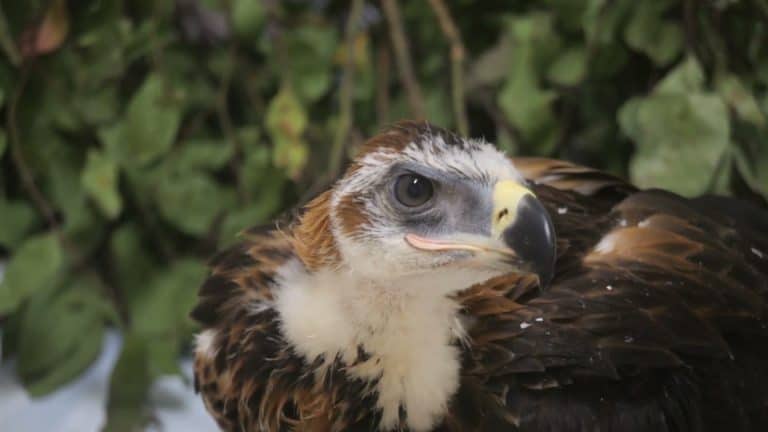
Wedge-tailed eagle Aquila audax
Southern carpet python Morelia spilota imbricata

Related Species 5

Tammar wallaby Notamacropus eugenii Shared Family
Tasmanian pademelon Thylogale billardierii Shared Family
Eastern grey kangaroo Macropus giganteus Shared Family
Western grey kangaroo Macropus fuliginosus Shared Family
Swamp wallaby Wallabia bicolor Shared Family

Ecological Equivalents 4

Animals that fill a similar ecological role in their ecosystem

Tammar wallaby Notamacropus eugenii Small-to-medium macropod herbivore of woodland and scrub mosaics. Mostly active at night and at dawn or dusk, sheltering by day. Body size similar to quokka (≈2.7–4.2 kg; 40–54 cm body; 25–30 cm tail).
Tasmanian pademelon Thylogale billardierii Fills a similar niche as a compact, cover-dependent macropod that feeds on grasses, forbs, and browse at forest-edge interfaces. Shows similar anti-predator reliance on dense vegetation and primarily nocturnal activity patterns.
Brush-tailed bettong Bettongia penicillata A potoroid (family Potoroidae) rather than a macropodid, but a similarly sized nocturnal marsupial herbivore/omnivore in southwestern Australia. Overlaps in predator guild (foxes and cats), depends on dense refuges, and historically co-occurred with the focal species in parts of southwest Australian ecosystems.
Common brushtail possum Trichosurus vulpecula Nocturnal marsupial herbivore in southwestern Australia that uses similar shelter resources (dense vegetation and tree hollows where available), forages on leaves and shoots, and overlaps as prey for raptors and introduced carnivores where present.

Classification and Evolution
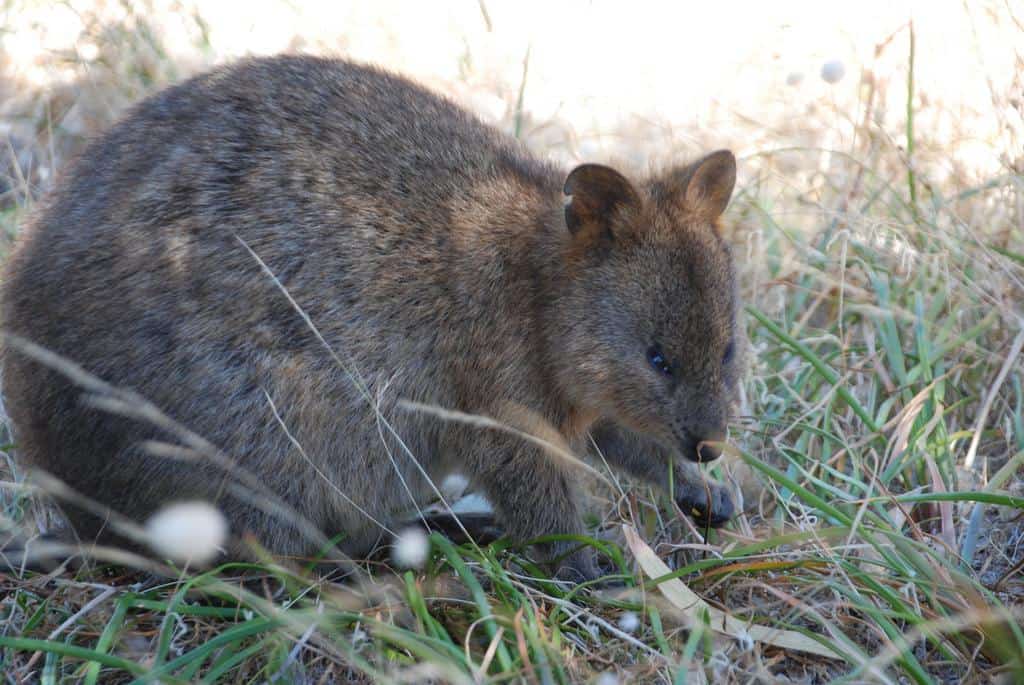
Quokkas are a type of wallaby.

Quokkas are tiny marsupials that live in parts of southwest Australia and on two nearby islands in the Indian Ocean. The Quokka is one of the smallest types of wallabies in the world, and most distinctively differs from other members of its family with their short and scarcely-furred tail and small hind legs. Out of the roughly 50 known Australian marsupials, the Quokka is one of a handful whose ancestry is still difficult for scientists to trace. The fact that the Quokka scavenges for food rather than grazing makes it quite different from other wallabies, but despite all this, many agree that they are most likely relatives of the Rock Wallaby.

Anatomy and Appearance
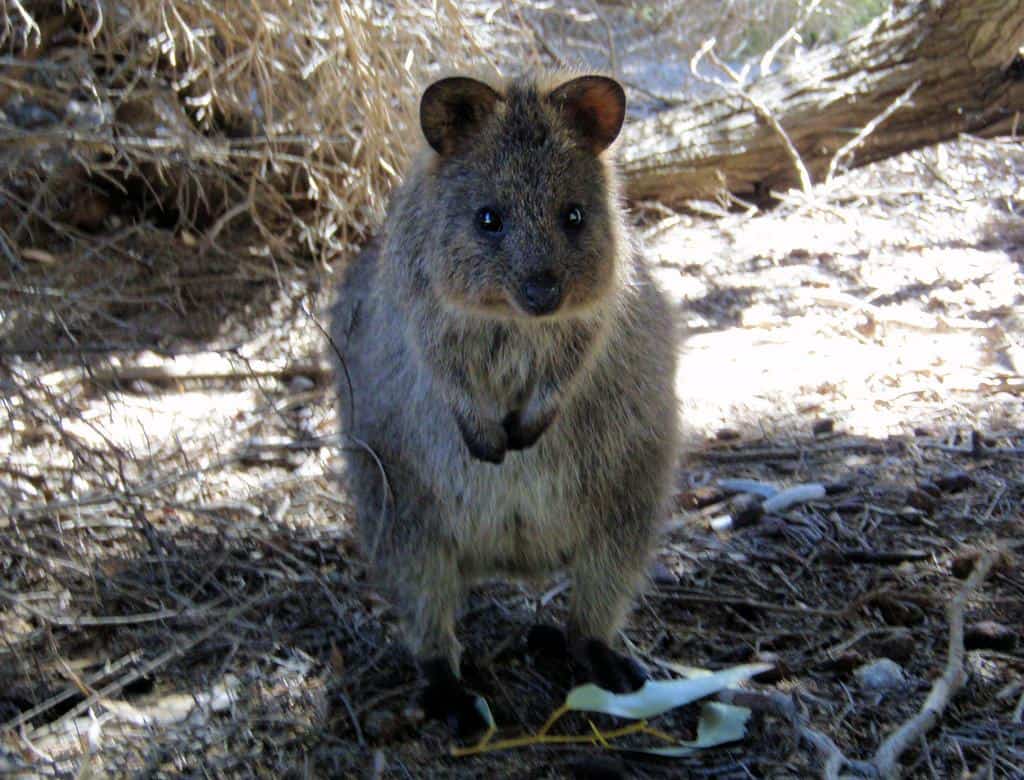
Quokkas are known for their cute, expressive faces.

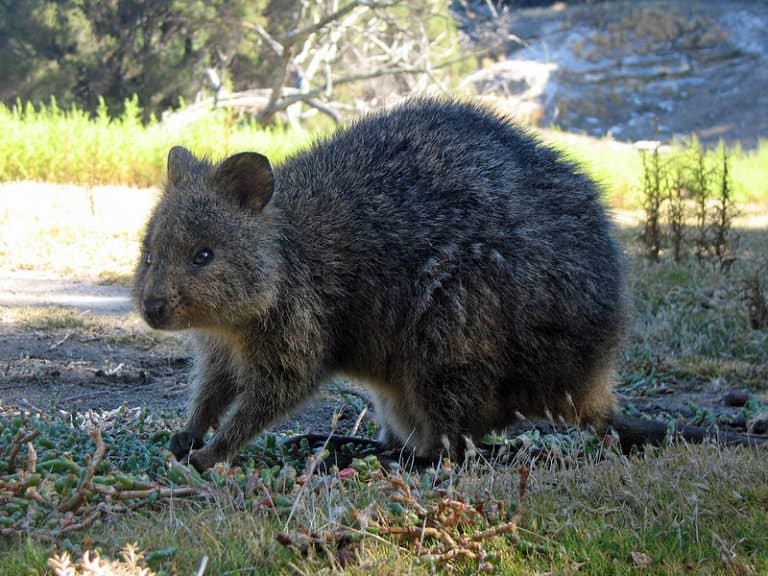
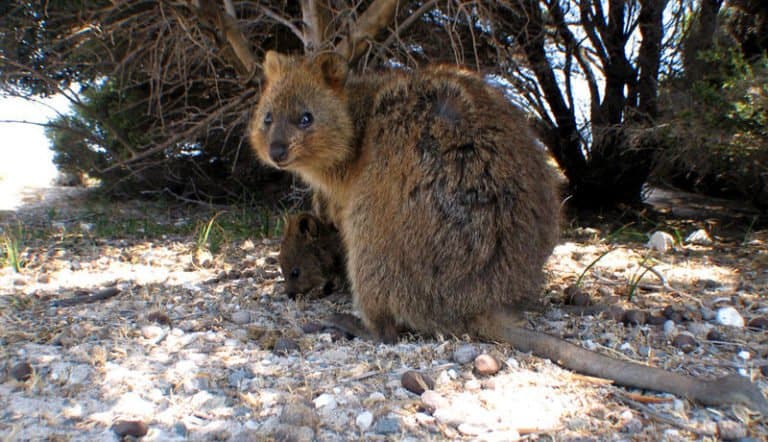
The Quokka has a compact, rounded body. Their hind legs and tail are much shorter than those of many Wallaby species, but instead of disadvantaging the marsupial, their tiny limbs allow the Quokka to hop through dense foliage and tall grasses with great agility. The Quokka’s thick, layered fur is relatively coarse and typically a brownish-grey color with red flourishes around the head, with lighter in color on the underside. Along with its rounded body, the Quokka also has small and rounded ears and a rounded snout that comes to a point with a black nose. Unlike other Wallaby species, the tail of the Quokka has hardly any fur on it at all and they also don’t need it to balance whilst they are hopping along.

Distribution and Habitat
Rottnest Island is home to one of the largest quokka populations.

Historically, the Quokka was an animal that had quite a wide distribution and was once found throughout the coastal regions of southwestern Australia. Today, however, the Quokka has been restricted to three remote regions, only one of which is actually on the Australian mainland. The most numerous populations of Quokka are found on Rottnest Island and on neighboring Bald Island, with a few isolated groups also inhabiting the bushland that surrounds the city of Perth on the mainland. In these island environments, Quokkas are most commonly found in thick forests, open woodland, and areas of scrub that are close to fresh water. Their preferred habitats are always close to water, and the Quokka can also be found along the edges of swamps.

Behavior and Lifestyle
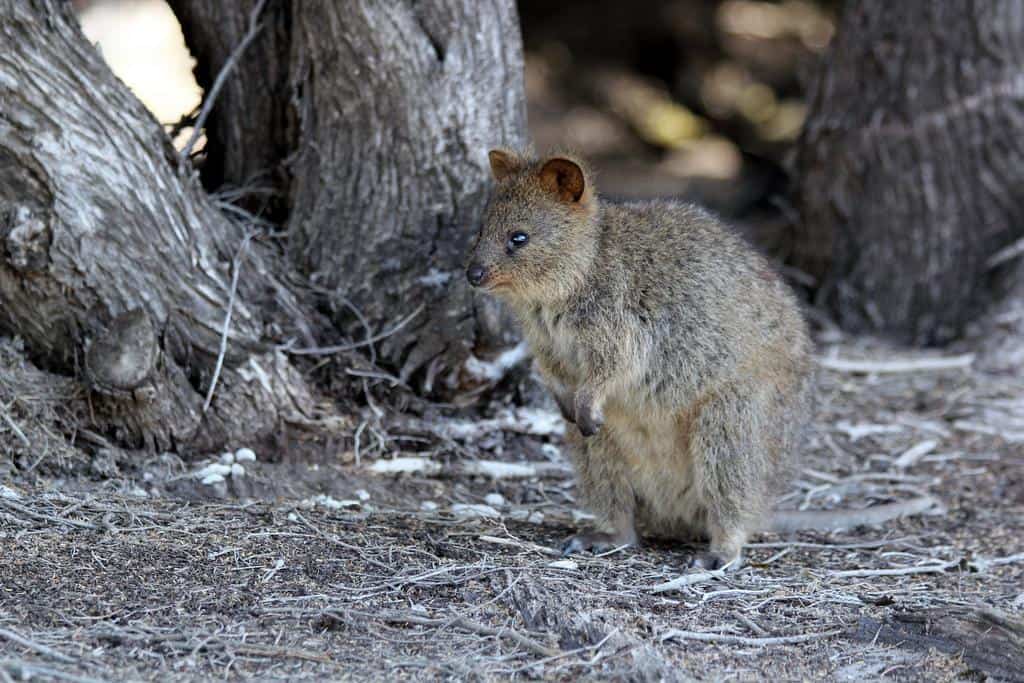
Quokkas are typically incredibly friendly toward humans.

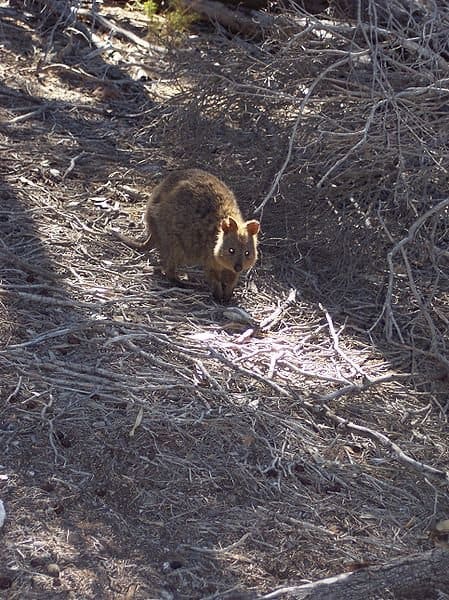
The Quokka is a very sociable and friendly animal that inhabits southwestern Australia in small family groups, which are dominated by males. Despite this though, the Quokka is not known to be territorial with up to 150 individuals known to have over-lapping home ranges. Although they are known to share these habitats peacefully most of the time, fights between males are not unheard of, particularly on a hot day when they compete for the most sheltered spots. The Quokka is a nocturnal animal that spends most of the hot day, resting in the shade of the trees and will often return to the same spot every day. At night, the Quokka then begins to browse for food using tunnels through the long, grasses to move about unseen.

Reproduction and Life Cycles
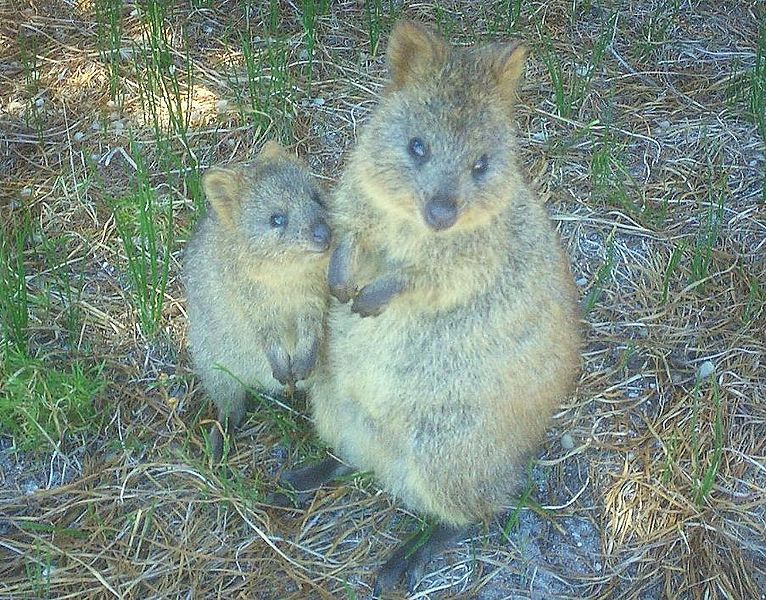
Quokkas are marsupials, meaning their babies spend the first few months after their birth inside the mother’s pouch.

The breeding season for the Quokka tends to occur in the cooler months between January and March when a single joey is born after a gestation period of just a month. Like all other marsupial babies, the joey manages to crawl into its mother’s pouch completely unaided, when it then attaches itself to one of the female’s teats. The Quokka babies suckle from their mother in the pouch for around 6 months whilst they continue to develop. At this time, the joey emerges for the first time and begins to explore its surroundings but remains close to the female, continuing to suckle on her milk for at least another couple of months. In captivity though, breeding can take place all year round once the individual is mature enough to mate at about a year old.

Diet and Prey

Like other Wallaby species, the Quokka is a vegetarian, meaning that its herbivorous diet is solely comprised of the surrounding plant material. The Quokka is an animal that most commonly feeds on different grasses that line that tunnels that they make through the dense vegetation. They are also known to eat leaves, fruits, and berries when they are available. Although the Quokka mainly browses for food on the ground, they are also known to climb about a meter or so up into the trees, and also swallow their food without chewing it. The Quokka then regurgitates the undigested material in the form of a cud, which is also eaten. They have no need to drink vast amounts of water and are said to be able to go for months without drinking at all.

Predators and Threats

A pack of dingoes under a tree
Dingos are one of the quokka’s most common predators.

Before European colonists reached the coastal regions of southwest Australia, the Quokka populations were thriving and were widespread throughout the area. With people, however, came domesticated predators like Cats, Foxes, and Dogs, and their settlements also attracted wilder animals including Birds of Prey and Dingoes. Since the introduction of these predators to the Quokka’s habitat, their population numbers have dropped considerably. They are also now restricted to small pockets of their natural habitat on mainland Australia due to the loss of habitat to growing Human settlements, as the demise of their daytime resting sites is thought to be linked to the declining population numbers.

Interesting Facts and Features
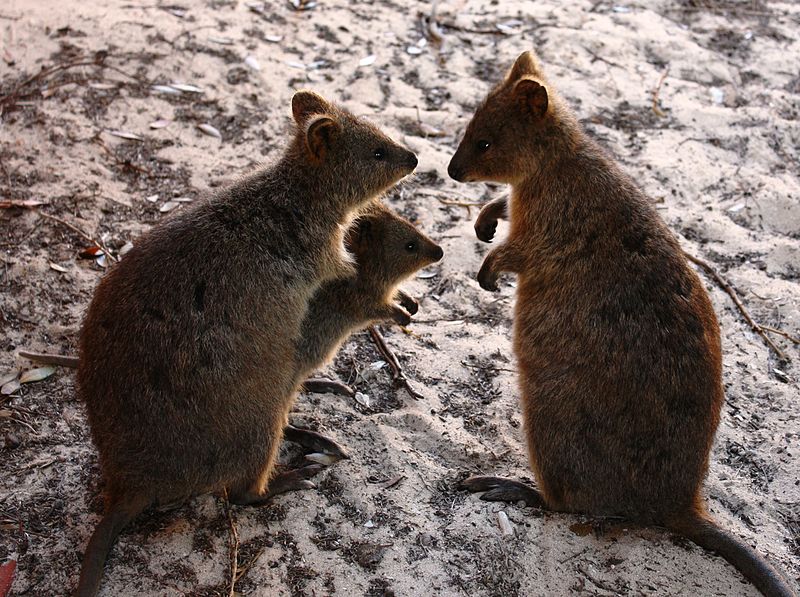
Quokkas live in family units located nearby other quokkas.

Quokka family units are most commonly found in areas close to one another, where there is a decent source of fresh water. Even though they prefer these moist environments however, Quokka’s are known to actually gather most of their moisture from the vegetation that they eat, meaning that they can also be found in regions that are actually quite far from the nearest river or stream. Despite the obvious differences between the Quokka and other Wallaby species, their small size has enabled them to become masters of the undergrowth. The Quokka creates tunnels that they use as runways through the dense vegetation, which they are then able to hop extremely fast along when threatened by a predator.

Relationship with Humans
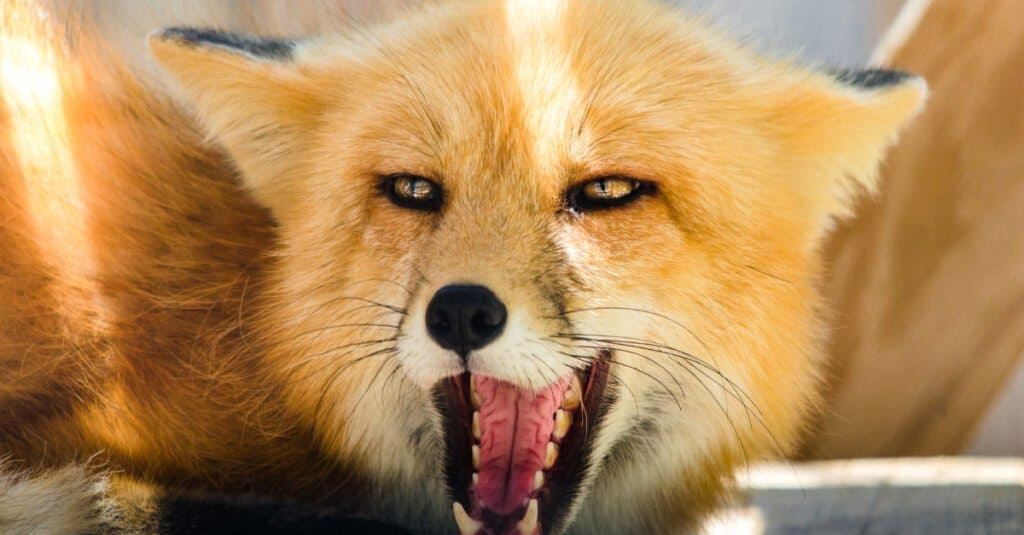
Fox Teeth- Barking Red Fox

The introduction of the red fox to Australia has been a huge detriment to the livelihood of quokkas.

Since the 1930s, the Quokka populations have been isolated in three remaining areas (two of which are on islands) because of the introduction of foreign predators. The Red Fox that came to Australia with European settlers has actually caused the most damage to this ground-dwelling marsupial, as they were eaten on both the mainland and on the islands that the Quokka inhabited along the southwest coast. Now however, the Quokka populations on Rottnest Island in particular, attract numerous tourists every year and although the Quokka is very friendly towards these people, foods like biscuits that are fed to them, often upset their stomachs.

Conservation Status and Life Today
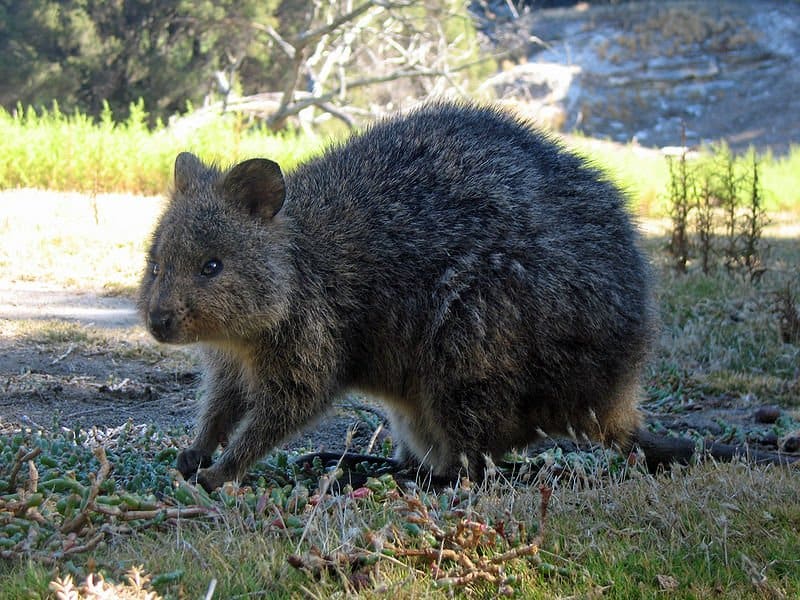
Quokkas are considered to be a Vulnerable species.

Today, the Quokka has been listed by the IUCN on their Red List as an animal that is Vulnerable in its surrounding environment. The highest populations are today found on Rottnest Island, along with Bald Island, where they are thought to be happily sustained due to the lack of Red Foxes. There are growing concerns over the Rottnest Island population due to increasing development on the island, mainly for recreational purposes.

More on Quokkas

  • 10 Incredible Quokka Facts
  • Quokka Poop: Everything You’ve Ever Wanted to Know
View all 9 animals that start with Q
How to say Quokka in ...
Catalan
Quoca
Czech
Klokan quokka
German
Quokka
English
Quokka
Esperanto
Kvokao
Finnish
Lyhythäntäkenguru
French
Quokka
Galician
Quokka
Hungarian
Kurtafarkú kenguru
Italian
Setonix brachyurus
Japanese
クアッカワラビー属
Latin
Setonix
Dutch
Quokka
Polish
Kuoka
Portuguese
Setonix brachyurus

Sources

  1. David Burnie, Dorling Kindersley (2011) Animal, The Definitive Visual Guide To The World's Wildlife / Accessed April 27, 2011
  2. Tom Jackson, Lorenz Books (2007) The World Encyclopedia Of Animals / Accessed April 27, 2011
  3. David Burnie, Kingfisher (2011) The Kingfisher Animal Encyclopedia / Accessed April 27, 2011
  4. Richard Mackay, University of California Press (2009) The Atlas Of Endangered Species / Accessed April 27, 2011
  5. David Burnie, Dorling Kindersley (2008) Illustrated Encyclopedia Of Animals / Accessed April 27, 2011
  6. Dorling Kindersley (2006) Dorling Kindersley Encyclopedia Of Animals / Accessed April 27, 2011
  7. David W. Macdonald, Oxford University Press (2010) The Encyclopedia Of Mammals / Accessed April 27, 2011
  8. Quokka Information Centre / Accessed April 27, 2011
  9. Quokkas / Accessed April 27, 2011
  10. Quokka Tourism / Accessed April 27, 2011
  11. Quokka Information / Accessed April 27, 2011
  12. Quokka Facts / Accessed April 27, 2011
Corinna Cybele

About the Author

Corinna Cybele

My name is Corinna! In my profile photo you can see me with one of my two cats, Bisky! The other's name is Yma and she's a beautiful black Bombay kitty. I'm 24 years old and I live in Birmingham, AL with my partner Anastasia and like to spend my free time making music, collecting records and reading. Some other animals I've owned were a hamster, 2 chihuahuas and many different kinds of fish.

Thank you for reading! Have some feedback for us?


Quokka FAQs (Frequently Asked Questions)

While quokkas might seem like they’d make good pets – they are often known as the happiest animals in the world – the reality is it’s illegal to own them. Australian law has a fine of up to $50,000 for interfering with quokkas. In addition, quokkas aren’t domesticated and are very social animals.