
R
Species Profile

Rock Hyrax

Procavia capensis

Built for cliffs, wired for teamwork
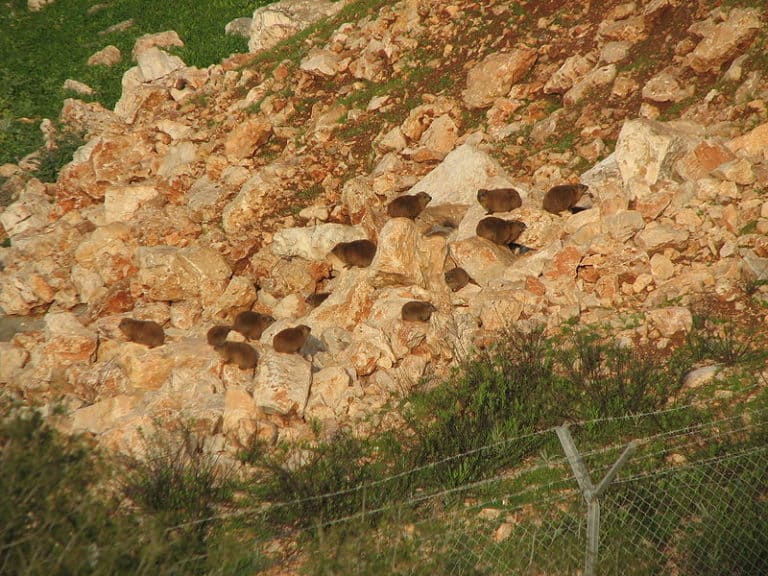
Yael & Amihay / Creative Commons

Rock Hyrax Distribution

Click a location to explore more animals from that region

Loading map...

Size Comparison

Human 5'8"
Rock Hyrax 10 in

Rock Hyrax stands at 14% of average human height.

At a Glance

Wild Species
Also Known As Rock hyrax, Dassie, Rock dassie, Rock rabbit, Coney, Hyrax
Diet Herbivore
Activity Diurnal+
Lifespan 10 years
Weight 5.5 lbs
Status Least Concern
Did You Know?

Despite looking rodent-like, Procavia capensis is in Hyracoidea and is closer (evolutionarily) to elephants and sirenians than to rodents (Afrotheria).

Scientific Classification

The Cape rock hyrax is a small, social, rock-dwelling mammal native to much of sub-Saharan Africa and parts of the Middle East. Despite its rodent-like appearance, it is a hyrax (order Hyracoidea) and is evolutionarily closer to elephants and sirenians than to rodents.

Kingdom
Animalia
Phylum
Chordata
Class
Mammalia
Order
Hyracoidea
Family
Procaviidae
Genus
Procavia
Species
Procavia capensis

Distinguishing Features

  • Compact body with short tail and rounded ears; grizzled brown-gray coat
  • Rubbery, moist foot pads that aid climbing on rock surfaces
  • Dorsal scent gland patch used in social communication
  • Characteristic sun-basking behavior near refuge crevices
  • Complex vocalizations and highly social colony structure

Physical Measurements

Height
10 in (8 in – 12 in)
Length
1 ft 8 in (1 ft – 2 ft 1 in)
Weight
7 lbs (5 lbs – 8 lbs)
Tail Length
1 in (0 in – 1 in)
Top Speed
11 mph
running

Appearance

Primary Colors
Secondary Colors
Skin Type Dense fur over tough skin; specialized rubbery, moist foot pads with glandular secretions for grip
Distinctive Features
  • Adult head-body length typically 30-60 cm; tail vestigial ~1-3 cm (Nowak 1999; Kingdon 2015).
  • Adult mass commonly ~2-5.5 kg, varying by locality and season (Nowak 1999; Kingdon 2015).
  • Short, rounded ears and blunt muzzle; compact body suited to crevice retreat in rocky outcrops.
  • Distinct dorsal scent gland on mid-back; surrounded by a pale/yellowish patch of longer erectile hairs used in communication.
  • Feet have bare, rubbery pads kept moist by glands, improving adhesion on smooth rock surfaces (rock-climbing specialization).
  • Toes bear flattened, nail-like hooves (not claws); inner hind toe has a grooming claw.
  • Large, continuously growing upper incisors (tusk-like), with a chewing apparatus adapted to tough browse and grasses.
  • Behaviorally, frequent sun-basking on rocks for thermoregulation; rapid retreat to crevices when alarmed.
  • Highly social: lives in colonies (often dozens of individuals) with sentinel/vigilance behavior and loud alarm calls.
  • Key predators near rocky habitats include Verreaux's eagle (a major specialist), leopards, caracal, and large pythons; defense relies on vigilance and immediate refuge in crevices (regional accounts summarized in Kingdon 2015).
  • Longevity reported ~10-12 years in the wild and up to ~14 years in captivity (Nowak 1999).
  • Taxonomically Order Hyracoidea (Afrotheria); closer to elephants and sirenians than to rodents (phylogenetic consensus, e.g., Kingdon 2015).

Sexual Dimorphism

Sexual dimorphism is weak. Males average slightly larger in some populations and may show more prominent scent-marking behavior; both sexes share similar coat coloration and the dorsal gland patch.

  • Slightly larger average body mass in some populations (population-dependent).
  • May show more frequent/territorial scent marking using dorsal gland.
  • Typically similar size and coat to males; dimorphism minimal in external appearance.
  • Mammary nipples (3 pairs/6) present; otherwise externally similar.

Did You Know?

Despite looking rodent-like, Procavia capensis is in Hyracoidea and is closer (evolutionarily) to elephants and sirenians than to rodents (Afrotheria).

Adult size: head-body length ~30-60 cm; mass commonly ~2-5 kg; tail is vestigial (Skinner & Chimimba, 2005; Kingdon, 2015).

Feet are built for rock: rubbery pads kept moist by abundant sweat glands create strong friction on smooth stone (Nowak, 1999).

Reproduction is slow for a small mammal: gestation ~7-8 months (≈210-240 days), with litters typically 1-4 (often 2-3) (Kingdon, 2015; Nowak, 1999).

Colonies use communal latrines ("middens") that can build up over long periods and preserve layered dung/urine deposits used in ecological research.

Typical longevity is about a decade in the wild; in captivity individuals can reach ~12-15 years (reported maxima vary by source) (Nowak, 1999; zoo husbandry reports).

Rock hyraxes sun-bask to warm up-then retreat to cool crevices-because their temperature regulation is less flexible than many similarly sized mammals (Nowak, 1999).

Unique Adaptations

  • Specialized foot pads: thick, rubbery soles with moist, glandular skin increase friction on bare rock, enabling confident climbing on steep slabs (Nowak, 1999).
  • Dorsal gland and hair "erectile" patch: a scent gland on the back used in social signaling; surrounding hairs can be raised during display.
  • Efficient kidneys: strong urine concentration ability supports life in rocky, sometimes arid habitats where free water can be limited (general hyrax physiology; Nowak, 1999).
  • Skull and dentition suited to tough browse: ever-growing upper incisors function like tusk-like cutting teeth; grinding cheek teeth handle fibrous leaves.
  • Rock-habitat specialization: compact body, low center of gravity, and behavior tightly tied to crevices that function as refuges and microclimate buffers.

Interesting Behaviors

  • Basking-and-retreat thermoregulation: groups warm up in the sun, then shuttle between shade and crevices to avoid overheating or chilling.
  • Sentinel vigilance: one or more individuals often watch from a high rock while others feed; alarms trigger rapid dives into crevices.
  • Crevice-first defense: when threatened they sprint to nearest crack/hole; their climbing grip and knowledge of escape routes are key anti-predator tactics.
  • Complex vocal communication: sharp alarm calls plus more elaborate male "songs" used in social spacing and reproduction (documented in hyrax acoustic studies).
  • Social living: stable colonies with frequent proximity, allogrooming, and dominance interactions; males may maintain territories overlapping female groups.
  • Communal middens: repeated defecation/urination at the same sites, likely for chemical communication and site signaling.

Cultural Significance

The Cape rock hyrax (Procavia capensis) is seen as the Biblical "coney" in the Levant and is named in diet laws. In southern Africa it is called rock hyrax or "rock rabbit" and lives on cliffs near people.

Myths & Legends

Biblical wisdom tradition: Proverbs 30:26 describes the conies/hyraxes as "a feeble folk, yet make their houses in the rocks," turning the animal into a symbol of prudent refuge-seeking and humble survival.

Biblical nature poetry: Psalms 104:18 ("the rocks are a refuge for the conies") places the hyrax among emblematic creatures each fitted to its habitat-hyrax as the spirit of rocky sanctuaries.

Dietary-law lore: in Leviticus 11:5 and Deuteronomy 14:7, the "coney" is listed among animals considered ritually unclean-an enduring cultural association that influenced how communities talked about and categorized the species.

Naming-as-legend: English speakers have long called the Cape rock hyrax a "rock rabbit," a misleading folk nickname that persists despite hyraxes being only distantly related to rabbits (their closest living relatives are elephants and manatees).

In Middle Eastern and older Bible accounts, the hyrax (coney, Procavia capensis) is a small, vulnerable animal that 'makes its home in the rocks,' a saying about being careful and seeking rocky shelter.

Conservation Status

LC Least Concern

Widespread and abundant in the wild.

Population Stable

Protected Under

  • Not listed on the CITES Appendices.
  • Occurs in numerous protected areas (national parks and reserves) across its broad African and Middle Eastern range; management typically falls under general wildlife/protected-area legislation in range states.

Life Cycle

Birth 2 pups
Lifespan 10 years

Lifespan

In the Wild
6–12 years
In Captivity
10–14 years

Reproduction

Mating System Polygyny
Social Structure Harem Based
Breeding Pattern Long Term
Fertilization Internal Fertilization
Birth Type Internal_fertilization

Colonies typically include one dominant territorial male that monopolizes mating with several adult females; subordinate males are largely excluded. Breeding is seasonal in many populations; gestation is ~230 days and litters are usually 2-3 young, reared primarily by the mother.

Behavior & Ecology

Social Colony Group: 12
Activity Diurnal, Matutinal, Vespertine
Diet Herbivore Tender grasses and broadleaf forbs (young, high-moisture growth)

Temperament

Highly social and tolerant within colonies; strong site fidelity to specific rock refuges.
Dominance-structured: resident male(s) defend access to females; aggression peaks during takeovers (Hoeck 1989).
Colonies show coordinated vigilance; sentinel-like scanning increases with perceived risk and varies with habitat exposure.
Communal basking and thermoregulation are common; timing shifts with temperature and shade availability (Kingdon 2013).
Risk-averse and refuge-dependent; rapid retreat into crevices on alarm, especially juveniles.
Territorial tendencies around core rocks/latrines; peripheral males show more roaming and conflict (Hoeck 1989).

Communication

Sharp alarm call/bark triggering immediate retreat and group freezing.
Contact calls (soft grunts/trills) maintaining cohesion during foraging and basking.
Agonistic vocalizations (growls/squeals) during male-male contests and dominance interactions.
Complex male "songs" advertising status/identity and used in social/sexual contexts Koren et al. 2006; Koren et al. 2008
Scent marking via dorsal gland secretion on rocks; used in social/sexual signaling Kingdon 2013
Communal latrines/middens (feces/urine) act as long-term site/territory markers and information hubs.
Tactile interactions including allogrooming and huddling; reinforce bonds and reduce tension within colonies.
Visual signals: upright postures, head orientation, and rapid dashes to cover function as alarm cues.

Habitat

Biomes:
Savanna Mediterranean Desert Hot Desert Cold Temperate Grassland Alpine
Terrain:
Mountainous Hilly Plateau Valley Coastal Rocky
Elevation: Up to 14107 ft 7 in

Ecological Role

Medium-sized social folivorous/grazing primary consumer in rocky savanna/montane ecosystems; an important prey base for large raptors and mammalian predators and a localized modifier of vegetation around colony refuges.

herbivory shaping plant community structure near rocky refugia (selective grazing/browsing) nutrient cycling and localized soil enrichment via communal latrines/middens seed dispersal for some ingested fruits (where fruit is eaten) supporting predator populations (key prey for raptors and carnivores in rocky habitats)

Diet Details

Other Foods:
Grasses Broadleaf herbs and forbs Leaves Young shoots and buds Flowers Fruits Bark and twigs +1

Human Interaction

Domestication Status

Wild

Procavia capensis (Cape rock hyrax) is not domesticated and has no history of selective breeding. It is a wild, rock-dwelling mammal that lives in colonies and may become used to tourists but remains wild. Adults are 30-60 cm and 2.3-4 kg. Humans hunt, feed, view, or treat them as pests; hyraceum is used, and hyraxes can carry parasites or disease.

Danger Level

Low
  • Bites/scratches if handled, cornered, or habituated animals are fed at close range (small mammal bites can become infected).
  • Zoonotic/parasite exposure risk is mainly indirect: ectoparasites (ticks/fleas) associated with colonies can bite humans in shared habitats.
  • Vector-borne disease ecology: in parts of the Middle East, rock hyraxes (P. capensis) have been implicated as a reservoir host in the transmission cycle of cutaneous leishmaniasis caused by Leishmania tropica (e.g., documented infection/reservoir investigations in Israel; Talmi-Frank et al., 2010, PLoS Neglected Tropical Diseases).
  • Allergy/irritation risk from dust/aerosols around long-term latrine sites in enclosed/poorly ventilated settings (rare; mostly a nuisance rather than an acute hazard).

As a Pet

Not Suitable as Pet

Legality: Cape Rock Hyrax (Procavia capensis) is often not a suitable or legal pet. Many places ban or require permits for keeping wildlife; check national, state, or provincial and import rules first.

Care Level: Expert Only

Purchase Cost: Up to $1,500
Lifetime Cost: $10,000 - $30,000

Economic Value

Uses:
Subsistence meat (localized) Traditional medicine / perfumery ingredient (hyraceum) Ecotourism/wildlife viewing Human-wildlife conflict/pest management (localized) Public health / research interest (reservoir ecology in some regions)
Products:
  • Meat (localized hunting/consumption in parts of Africa)
  • Hyraceum (hardened hyrax urine/feces deposits) used in some traditional remedies and niche perfumery markets
  • Tourism value where colonies are easily viewed at rocky outcrops and parks

Relationships

Predators 11

Verreaux's eagle Aquila verreauxii
Martial eagle Polemaetus bellicosus
Crowned eagle Stephanoaetus coronatus
Leopard
Leopard Panthera pardus
Caracal
Caracal Caracal caracal
Serval
Serval Leptailurus serval
African wildcat Felis lybica
Black-backed jackal
Black-backed jackal Lupulella mesomelas
Side-striped jackal
Side-striped jackal Lupulella adusta
Spotted hyena Crocuta crocuta
Honey badger
Honey badger Mellivora capensis

Related Species 3

Bush hyrax Heterohyrax brucei Shared Family
Southern tree hyrax Dendrohyrax arboreus Shared Family
Western tree hyrax Dendrohyrax dorsalis Shared Family

Ecological Equivalents 4

Animals that fill a similar ecological role in their ecosystem

Klipspringer
Klipspringer Oreotragus oreotragus Both use rocky outcrops and cliffs to avoid predators and stay warm. Both are small, plant-eating, agile animals that shelter in rock crevices. The Cape rock hyrax lives in groups by day on rocks; the klipspringer lives in pairs and is an antelope.
Dassie rat Petromus typicus Another African rock-crevice specialist with colony tendencies; uses rocky outcrops for shelter and escape routes and feeds primarily on plant material. Shows similar day-active basking and retreat cycles in sun-exposed boulder habitats, though it is a rodent (not a hyracoid).
Rock cavy Kerodon rupestris Strong ecological convergence: a small, social, rock-dwelling herbivore that lives among boulders and crevices and uses communal refuges. Not sympatric (South America) but often used as a functional analog to rock hyraxes in niche comparisons.
Pika
Pika Ochotona spp. Talus and rock-slope specialists that rely on crevices for thermal buffering and predator escape; herbivorous and exhibiting strong site fidelity. Not closely related and largely outside Africa, but similar in microhabitat dependence and anti-predator strategy to Procavia capensis colonies.

Classification and Evolution

The Rock Hyrax is a large species of Hyrax, most commonly found in Eastern Africa. They are also known as the Rock Dassie or the Rock Rabbit, due to their rodent-like appearance but despite this, they are thought to be most closely related to much larger animals including the Elephant and the Manatee. Although obviously much smaller than their distant ancestors, it is the teeth and bone structure of these animals that relates them to one another. The Rock Hyrax though, is such a unique mammal that it is classified in an order of its own, along with its subspecies known as the Yellow-Spotted Hyrax, and the two Tree Hyrax species, which although are very similar in appearance, spend most of their time in the trees rather than on the ground.

Anatomy and Appearance
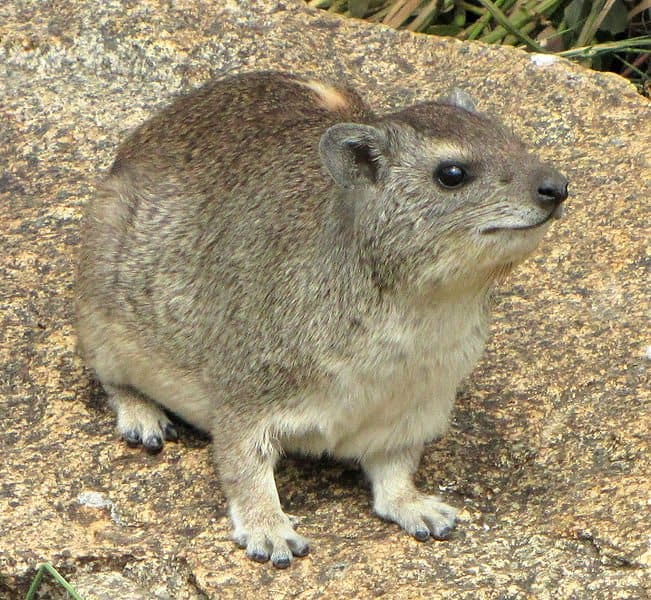
Rock hyraxes are especially agile and skilled at climbing thanks to their unique soles

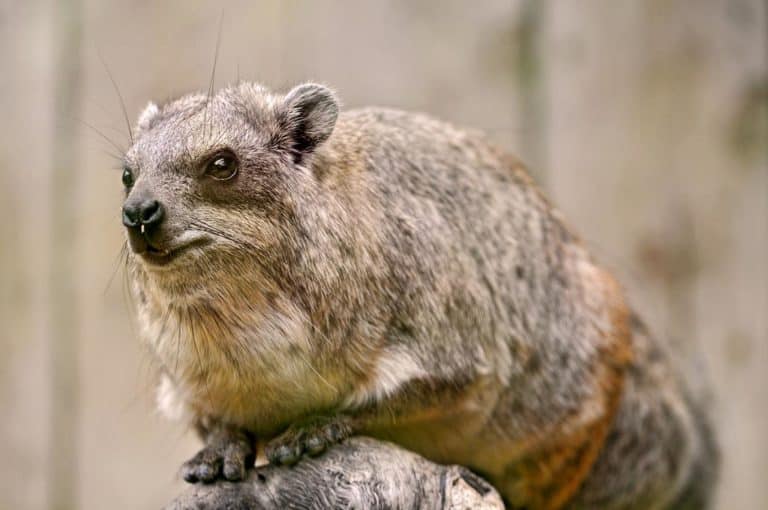
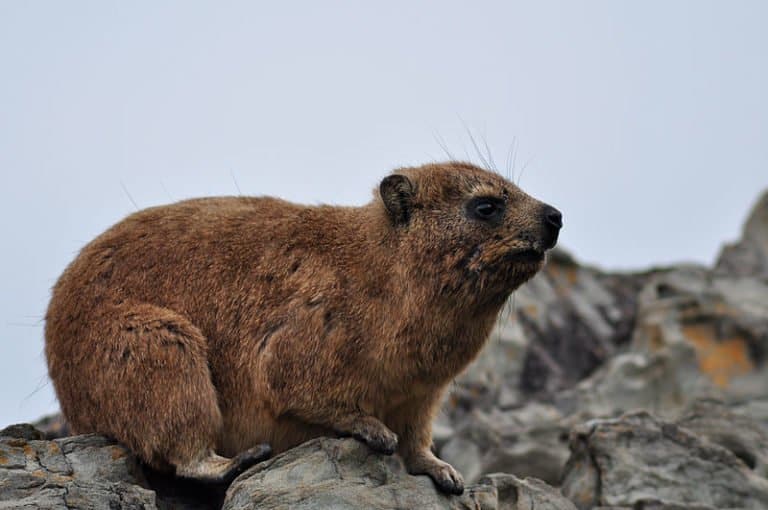
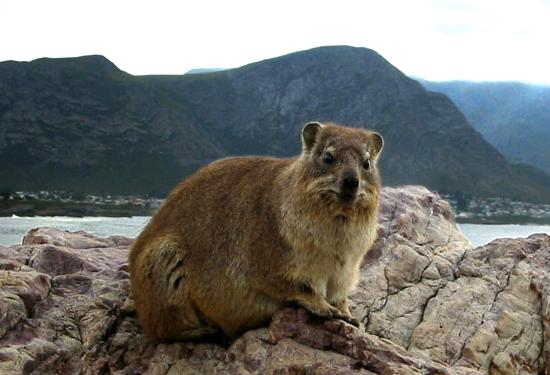
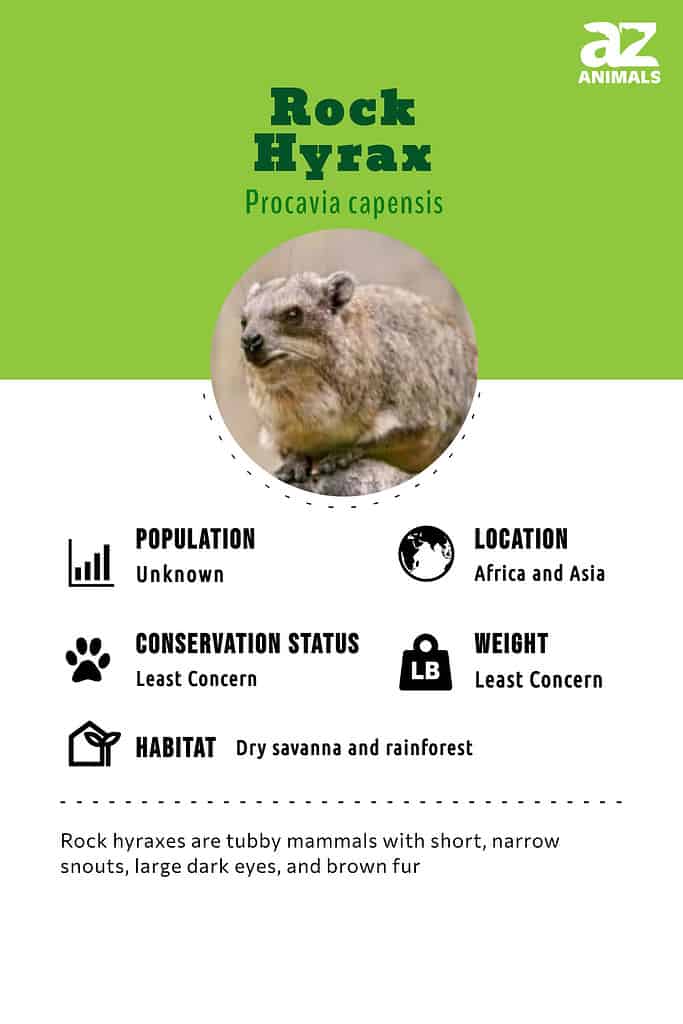
Rock hyraxes resemble large, tubby rodents, covered in medium-length fur which has a brindle pattern. Their key distinguishing features include large dark eyes, round ears, and a short narrow snout tipped by a prominent black nose. Their mouths also open to reveal the surprising presence of two sharp incisors reminiscent of fangs.

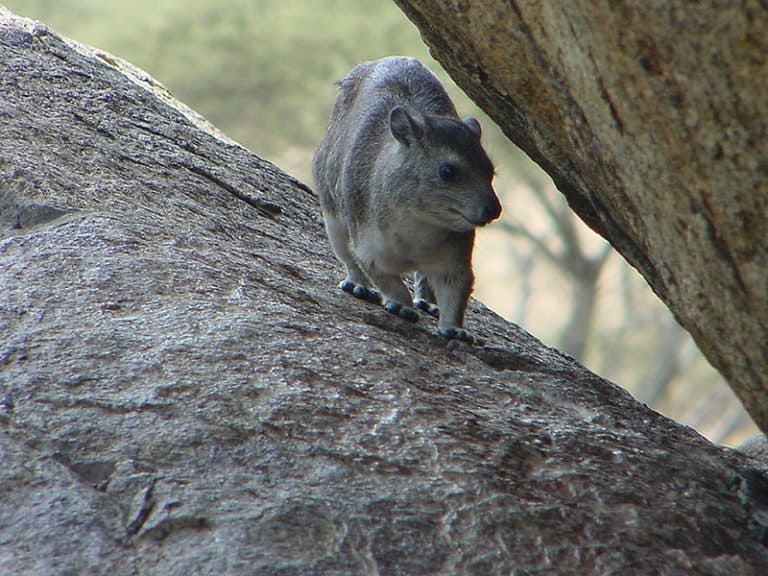
Rock hyraxes also have a special gland on their backs covered in dark fur which stands upright when they are startled or frightened. Their rubbery soles, with a dented center reminiscent of a suction pad make them excellent climbers capable of navigating treacherous ledges and rock surfaces with ease.

Distribution and Habitat
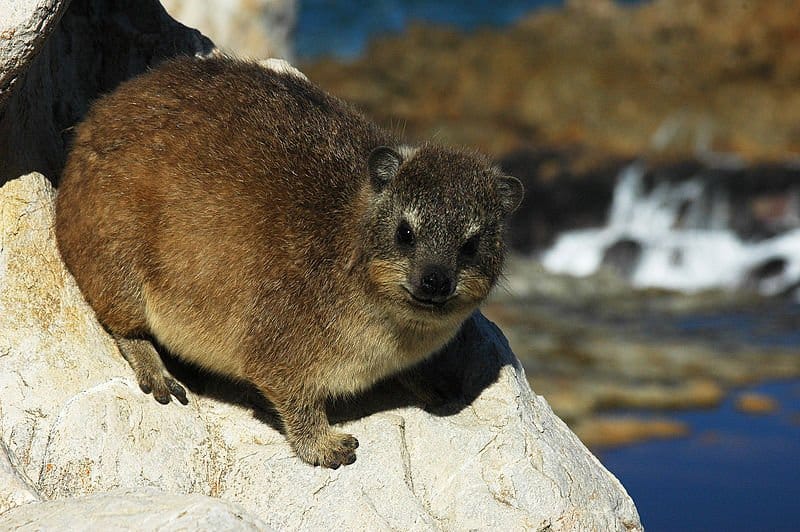
Rocky hyraxes are capable of living in a variety of habitats including arid regions, rain forest, and plains

Rock hyraxes’ range extends in a broad swathe from western to eastern Africa, an unevenly shaped ledge cupping the southern protuberance of the continent, pockets of northern Africa, and the Middle East. They do not occur in Madagascar or the Congo Basin.

As their names suggest, they prefer to shelter in rocks, since they are not burrowers by nature. They are pretty versatile in terms of their habitat and can be found in tropical rainforest, arid areas, and rolling grasslands. They can even be found in mountainous regions such Mount Kenya’s alpine zone,  and have been known to live at elevations of approximately 14,000 feet.

Behavior and Lifestyle
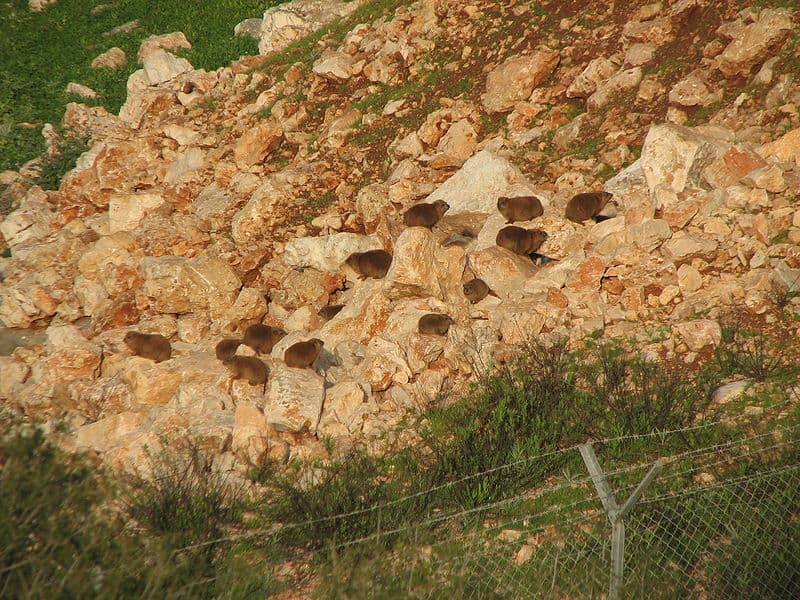
Rock hyraxes are sociable animals and live in large colonies consisting of a male, several, females, and their young

The Rock Hyrax is a very sociable animal, living together in colonies of up to 50 individuals. Rock Hyrax colonies are headed by a territorial male and consist of females and their young, with the male keeping watch for predators and protecting the group’s patch from other males looking to move in on their shelter. Rock Hyraxes make a variety of noises including whistles and shrieks to communicate both within the group and with other colonies in the area, with the male sounding the specific alarm call if a predator is spotted nearby. They spend the majority of their lives sunbathing on the rocks to warm up, before going off on short foraging trips, rarely far from the entrance to their home.

Reproduction and Life Cycles
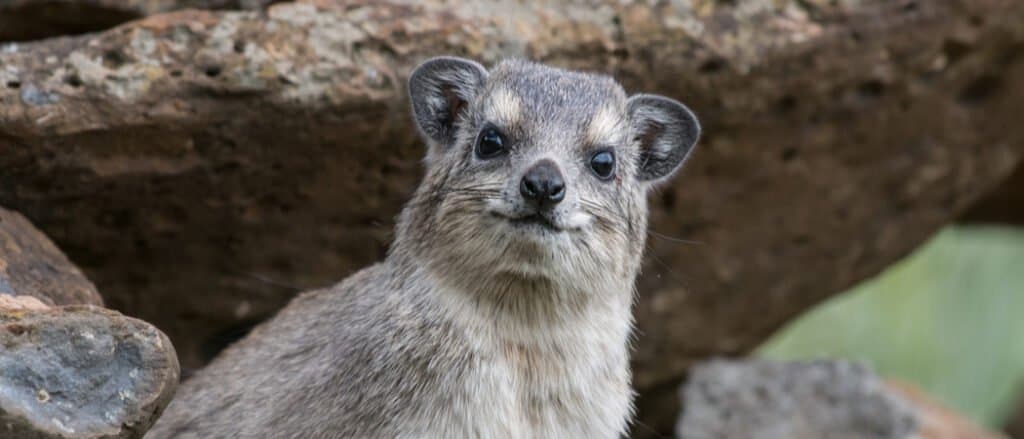
Rock hyraxes develop pretty quickly and are able to run and leap a few hours after they are born

The male Rock Hyrax has the privilege of breeding with the females in his colony, which after a gestation period that can last for up to eight months, generally give birth to two or three young. The Rock Hyrax babies develop remarkably quickly, being able to run and jump just hours after birth and even starting to nibble on vegetation after 72 hours. They do however still suckle from their mother, feeding on her milk until they are a few months old. The young Rock Hyraxes often gather together in small nursery groups, possibly as a form of protection whilst their mothers are out foraging for food. The Rock Hyrax reaches an average age of seven years old in the wild but some have been known to live for up to 12 years in captivity.

Diet and Prey
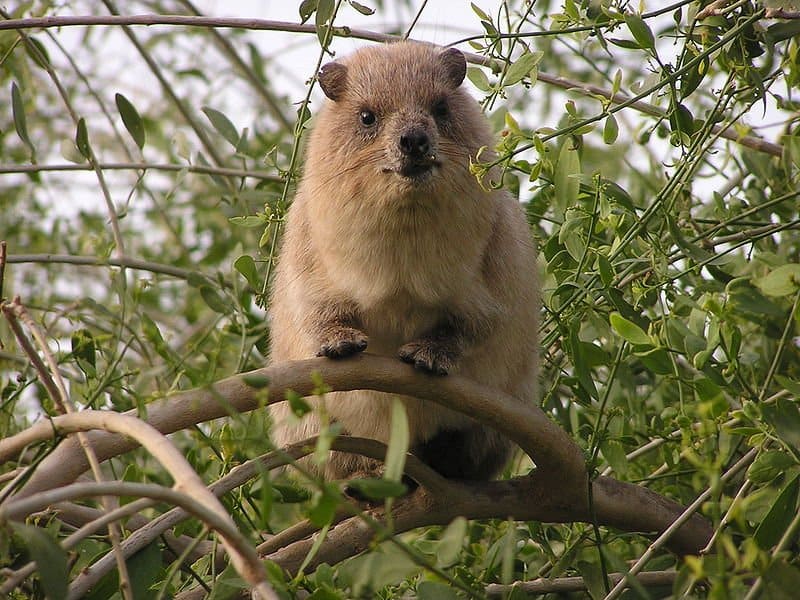
Rock hyraxes often survey their surroundings while eating and listen closely for the lookout’s alarm

The Rock Hyrax is an omnivorous animal, feeding on nearly everything it can find close to the colony’s base. Rock Hyraxes feed on herbs, grasses, fruit, and leaves, along with Bird eggs, Insects, and small Lizards that are sleepily sunbathing on the nearby rocks. The Rock Hyrax is a very cautious feeder, stopping after every mouthful to quickly survey its surroundings and to keep an ear out for the male’s alarm call. When feeding as a family group, the Rock Hyrax has been observed facing outwards so that a watchful eye may be kept on the lookout whilst they are eating. They tend to eat quickly, with their foraging trips only lasting for short periods of time and they generally occur very close to their family base.

Predators and Threats
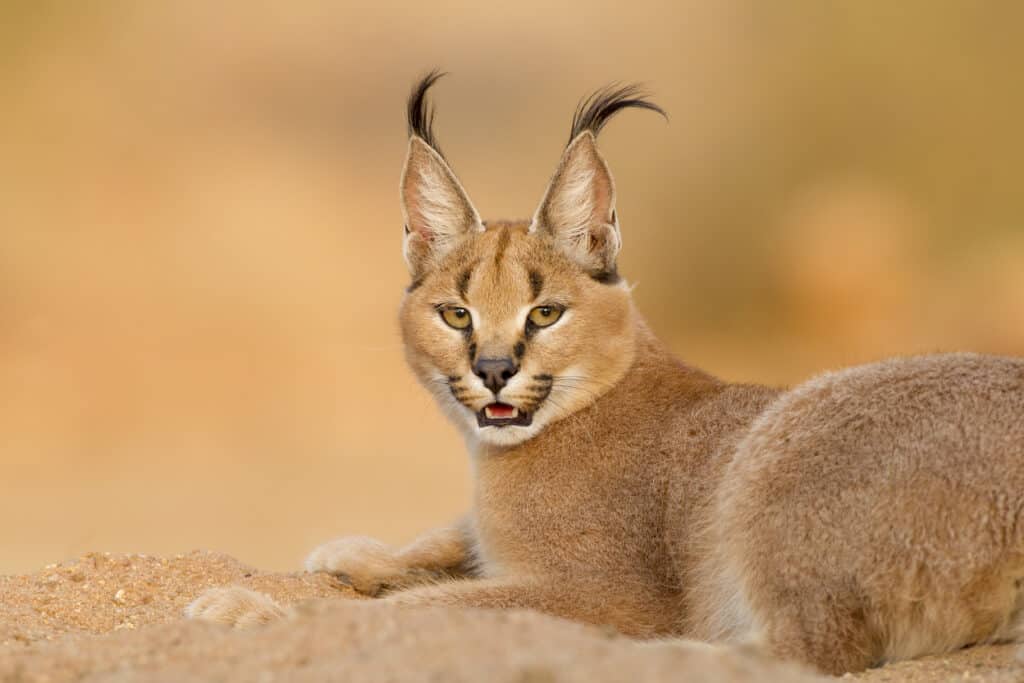
Caracals are just one of many species which prey on rocky hyraxes

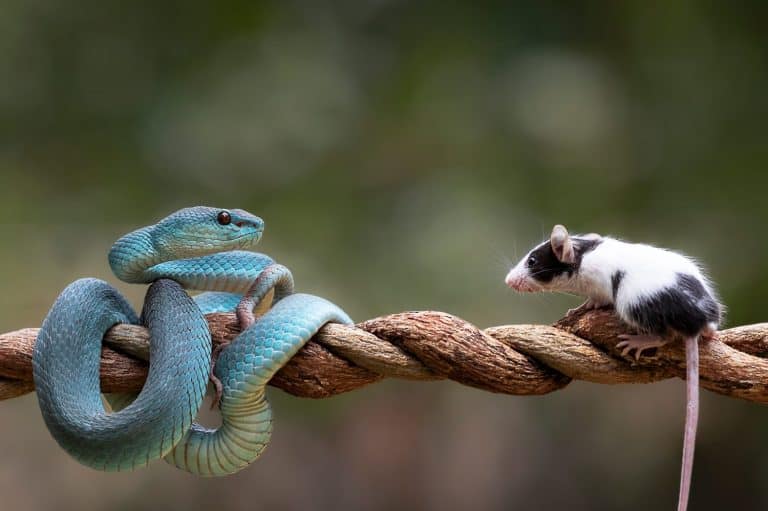
The small size of the Rock Hyrax makes it popular prey for numerous predators that inhabit similar environments. Large felines such as Leopards, Servals, and Caracals are the primary predators of the Rock Hyrax along with Civets, large Birds, and Snakes like Pythons. On having spotted the approaching danger, the male Rock Hyrax sounds the alarm call to tell the other members of his group that a predator is close. The Rock Hyrax then runs to hide in the safety of the gaps between the rocks but will try to intimidate smaller predators by biting and snapping at them. Habitat loss mainly caused by deforestation, is one of the biggest threats to the Rock Hyrax, along with the hunting of them by Humans.

Interesting Facts and Features
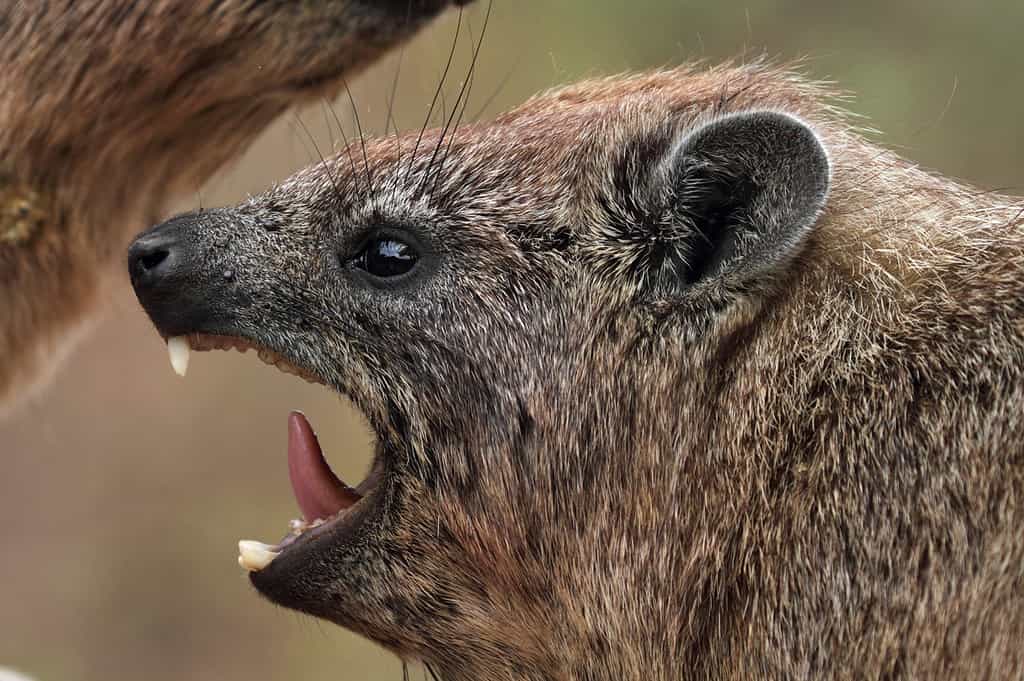
Rock hyrax male showing its tusks, Serengeti, Tanzania. The hyrax is in profile, having left. Its mouth is open.

Hyraxes are capable of going for long periods without water

The Rock Hyrax lives in large colonies and although is not related to them, does exhibit some similar behaviors to the world’s larger rodents, as they are known to use latrines which are the sole areas that they use to go to the toilet, in order to keep the rest of their territory clean. The Rock Hyrax can go for long periods of time without drinking as they are thought to obtain most of the moisture that they need from their food. Fossil remains show that the Rock Hyrax could have once been much bigger in size, which may explain why they have such a long gestation period for an animal of their size.

Relationship with Humans

Although it poses no threat to people living in the same area, the Rock Hyrax has been hunted in the past, mainly for its thick and soft fur but also for its meat. One of the biggest threats to the Rock Hyrax today though is the loss of their natural habitats throughout much of their historical range, with growing Human settlements and the clearing of land, generally for agriculture. However, the areas that the Rock Hyraxes use as toilets are actually common places to find Humans, who are said to collect the deposits left by these animals, to use in traditional medicines.

Conservation Status and Life Today

Today, the Rock Hyrax has been listed by the IUCN as an animal that is of Least Concern of becoming extinct in the wild in the immediate future. The Rock Hyrax is still fairly widespread with high population numbers in certain areas. However, Rock Hyrax populations are under threat throughout much of eastern and southern Africa, mainly due to habitat loss.

View all 181 animals that start with R
How to say Rock Hyrax in ...
Catalan
Damà roquer del Cap
Czech
Daman skalní
German
Klippschliefer
English
Cape Hyrax
Spanish
Procavia capensis
French
Procavia capensis
Croatian
Daman kamenjar
Italian
Procavia capensis
Hebrew
שפן סלע
Hungarian
Fokföldi szirtiborz
Dutch
Kaapse klipdas
Japanese
ケープハイラックス
Polish
Góralek przylądkowy
Portuguese
Procavia capensis
Finnish
Kalliotamaani
Chinese
蹄兔

Sources

  1. David Burnie, Dorling Kindersley (2011) Animal, The Definitive Visual Guide To The World's Wildlife / Accessed April 7, 2011
  2. Tom Jackson, Lorenz Books (2007) The World Encyclopedia Of Animals / Accessed April 7, 2011
  3. David Burnie, Kingfisher (2011) The Kingfisher Animal Encyclopedia / Accessed April 7, 2011
  4. Richard Mackay, University of California Press (2009) The Atlas Of Endangered Species / Accessed April 7, 2011
  5. David Burnie, Dorling Kindersley (2008) Illustrated Encyclopedia Of Animals / Accessed April 7, 2011
  6. Dorling Kindersley (2006) Dorling Kindersley Encyclopedia Of Animals / Accessed April 7, 2011
  7. David W. Macdonald, Oxford University Press (2010) The Encyclopedia Of Mammals / Accessed April 7, 2011
  8. Rock Hyrax Facts / Accessed April 7, 2011
  9. Rock Hyrax Habitat / Accessed April 7, 2011
  10. About Rock Hyraxes / Accessed April 7, 2011
Dana Mayor

About the Author

Dana Mayor

I love good books and the occasional cartoon. I am also endlessly intrigued with the beauty of nature and find hummingbirds, puppies, and marine wildlife to be the most magical creatures of all.
Connect:

Thank you for reading! Have some feedback for us?


Rock Hyrax FAQs (Frequently Asked Questions)

Rock Hyraxes are Omnivores, meaning they eat both plants and other animals.