
Quick Take
- Barred owls look completely earless, but their hidden ears work in a way that gives them a hunting superpower most birds don't have. Discover the ear superpower →
- There's a strange reason why a barred owl's call can sound less like a bird and more like something you'd hear at a zoo. Hear about their wild calls →
- Barred owls have a bathing habit so intense it surprises even birders, and this behavior does not stop in winter. See their bathing habits →
- Barred owl parents break a rule nearly every other owl species follows when it comes to raising their young. Explore their parenting behavior →
Since owls are typically nocturnal, we see them much less often than other birds. While the barred owl (Strix varia) is also primarily nocturnal, it is not strictly nocturnal. These birds are primarily nocturnal but are also often active at dawn and dusk, and may hunt at other times as well. They can also be seen during the daytime on cloudy or overcast days. They are among the most likely owl species to be seen in the daylight. Are you ready to learn more about these unique owls? Read on to learn 10 incredible barred owl facts.
1. Barred Owls Get Their Name from Their Color Pattern
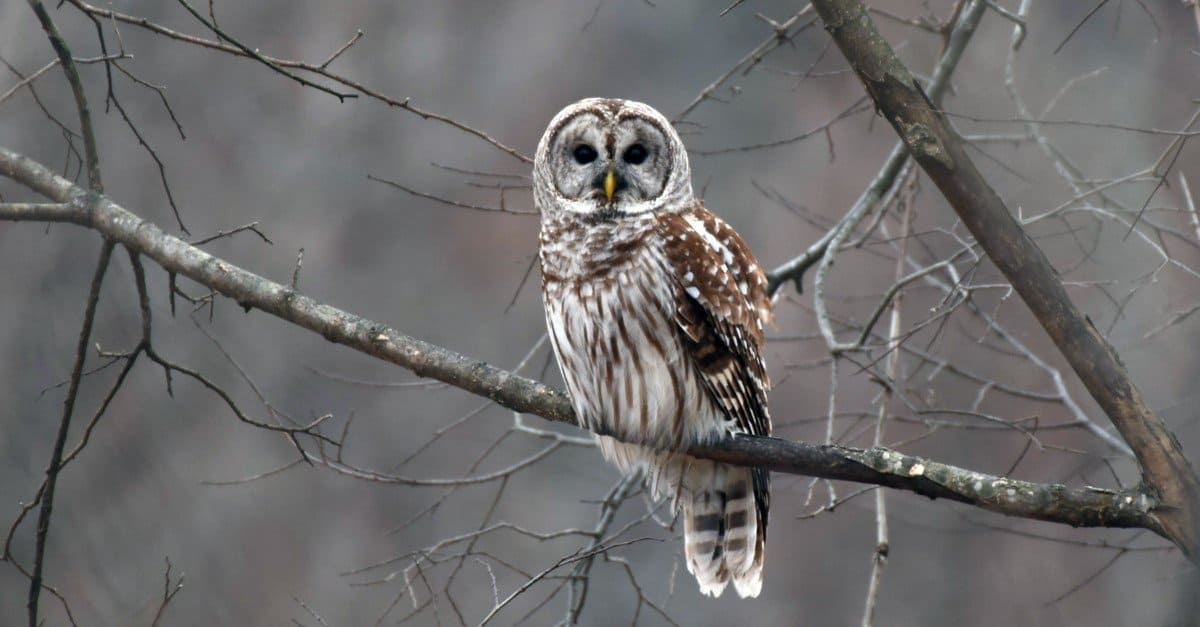
Barred owls get their name from the dark bars on their chests and abdomens. Their heads, backs, and upper wings are a brownish-grey color with pale spots and horizontal cross-bars. Their upper breasts have brown and white horizontal bars. Barred owls’ lower breasts and bellies transition from the bars to dark, vertical streaks on a light-colored background.
Barred owls get their name from the bars on their chests and abdomens.
©Lynn_Bystrom/Shutterstock.com
2. Barred Owls Can Sound Like Monkeys and Dogs
The barred owl is one of the most vocal birds in North America with a huge range of calls. They are well known for their call, “Who cooks for you? Who cooks for you all?” However, barred owls also shriek, trill, cry, scream, grumble, and squeak, plus bark and bay like a hound dog, as well as hoot like a monkey. During courtship, barred owls’ vocalizations sound like maniacal cackling. The barred owl’s calls can be heard for nearly a mile in good conditions.
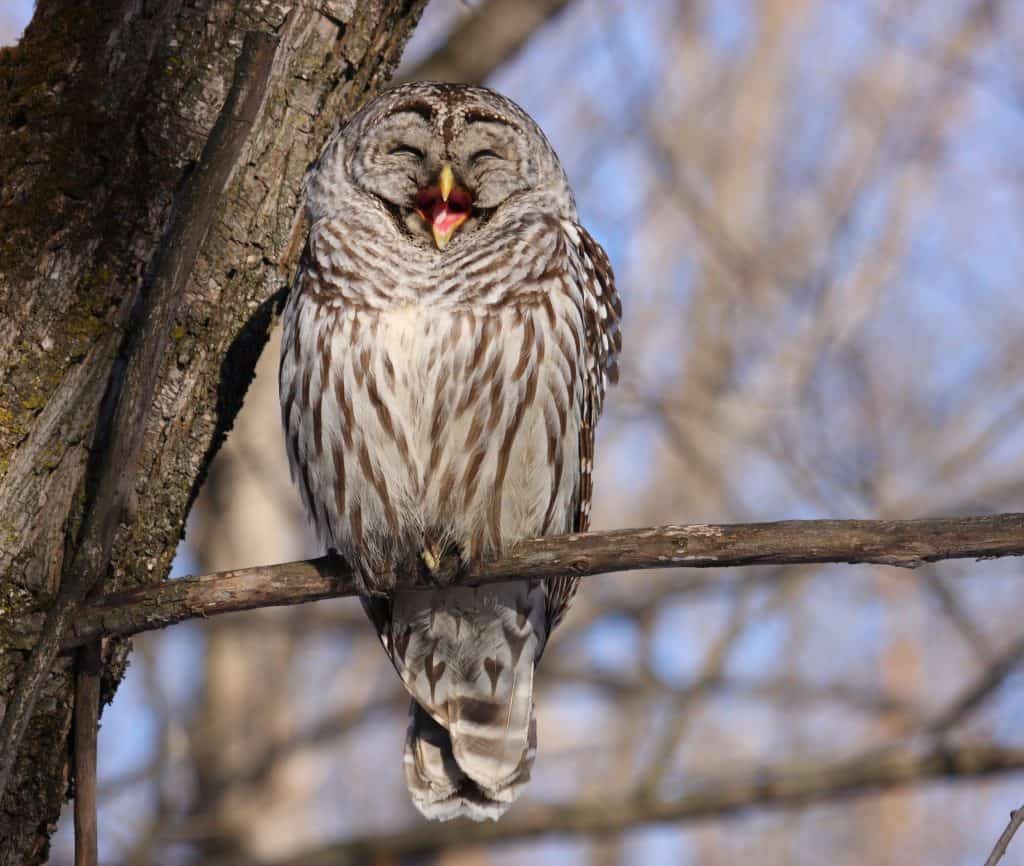
Barred owls have a wide variety of vocalizations from hoots to shrieks and even maniacal cackling.
3. There Are Three Subspecies of Barred Owls
There are three barred owl subspecies that vary by region. The northern barred owl (Strix varia varia) is the most common type and is found across eastern North America and Canada. The Florida-barred owl (Strix varia georgica) inhabits coastal southern regions in Georgia and Florida. It looks like the northern type but is slightly smaller, with a few differences in plumage. The Texas-barred owl (Strix varia helveola) lives in eastern, coastal, and central wooded regions of Texas. They tend to have lighter brown upperparts with brighter white barring.
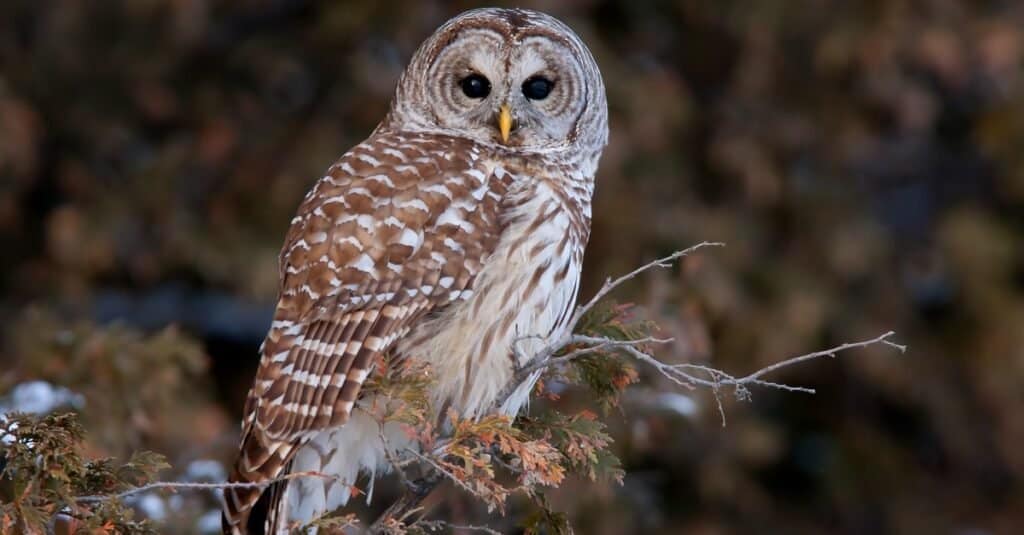
There is one species of barred owl but three subspecies varying by region.
©Jim Cumming/Shutterstock.com
4. Barred Owls Appear Earless
Some owls have little tufts on their head that resemble ears. However, the northern barred owl appears to be earless. Even though the owl has ears on either side of its head, its plumage completely conceals them. The large, earless head contributes to the barred owl’s puffy appearance. Underneath the plumage, barred owls have large ear cavities that can detect the slightest sounds.
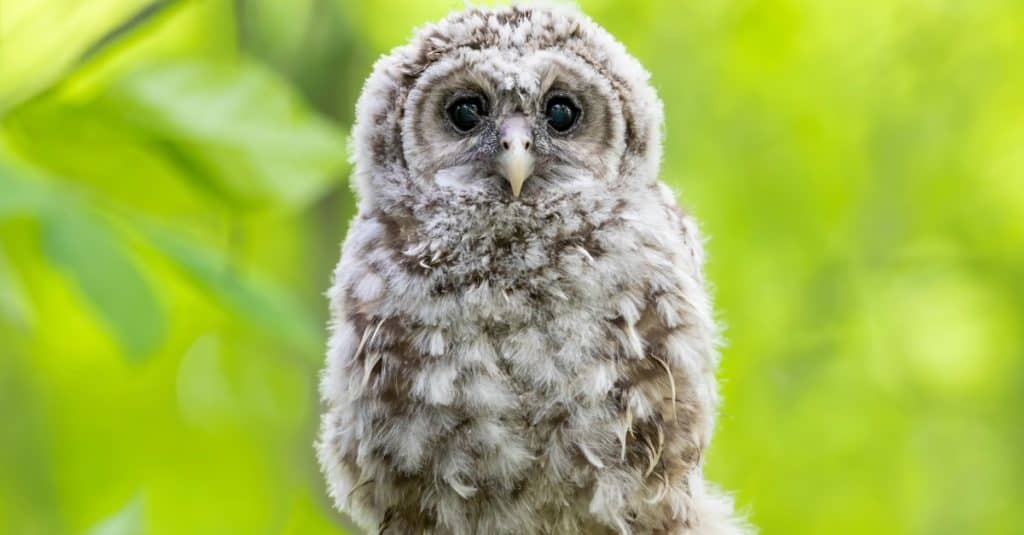
Barred owls appear earless, even though they have large ear cavities.
©Jim Cumming/Shutterstock.com
5. They Actually Have Asymmetrical Ears
Barred owls’ ears are asymmetrical. One ear is bigger than the other, and they are at different positions on the head. Hearing from two different positions aids in pinpointing the location of their prey. Their brains compare the timing differences to determine whether a sound originates from the right, left, above, or below.
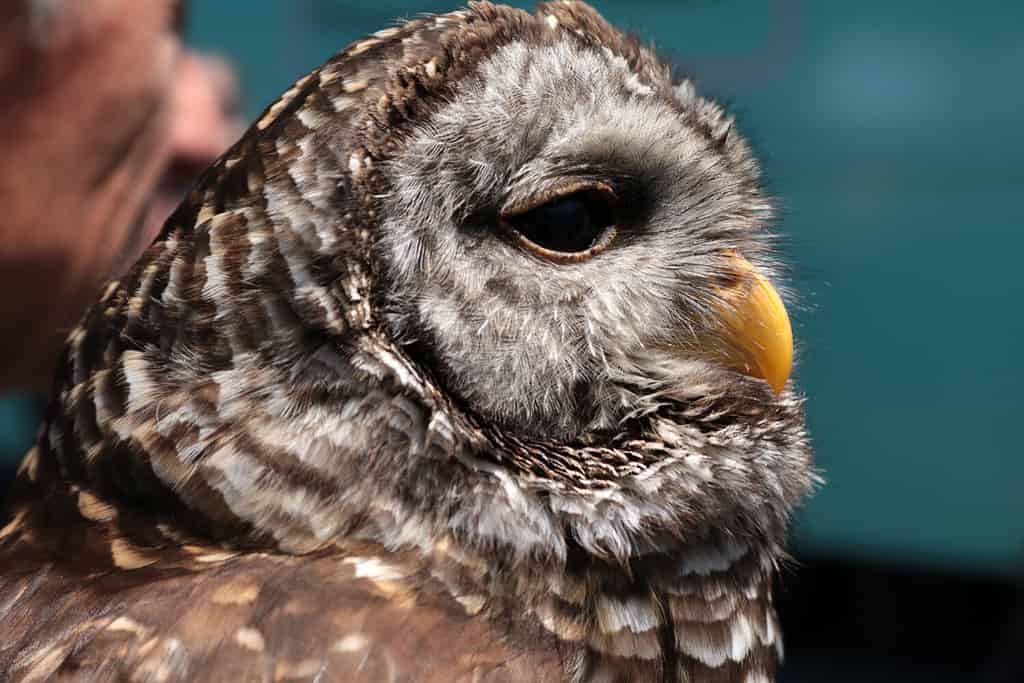
The barred owl has asymmetrical ears to help pinpoint the location of prey.
©Daniel J. H. McDonald/Shutterstock.com
6. They Love Taking Baths
Barred owls drink water frequently and bathe often, even in the middle of winter. Barred owls bathe in shallow puddles, streams, and even large backyard birdbaths. Some people use birdbaths to attract barred owls to their yards. Bathing frequently helps them cool down in summer, remove dirt and parasites from their plumage, realign their feathers, and redistribute the oils that aid insulation. They submerge most of their bodies, spin around, lift their tails, and flap their wings, flinging water everywhere.
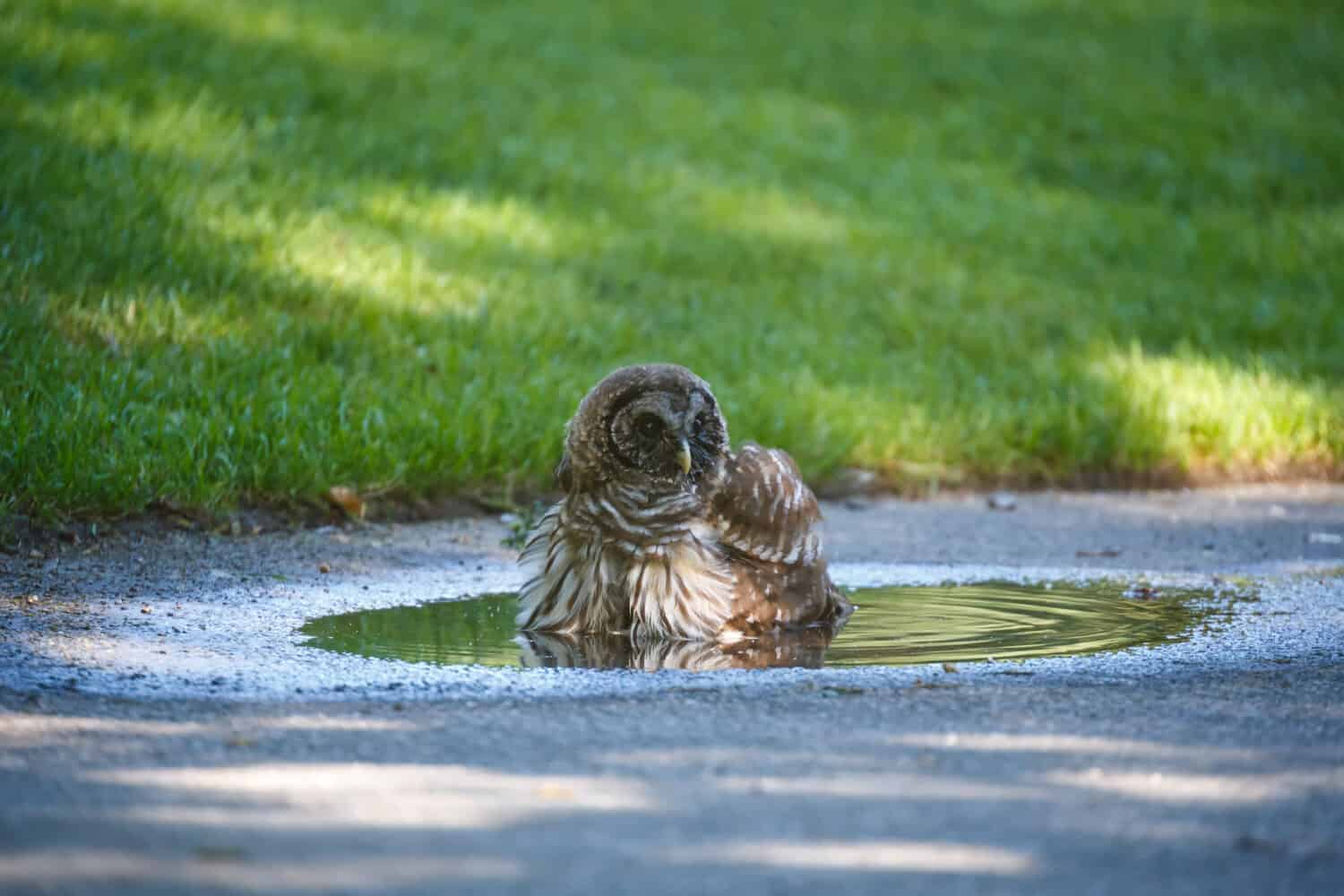
Barred owls love baths so much that even a puddle will do.
©Feng Yu/Shutterstock.com
7. Barred Owls Glide More than Flap When They Fly
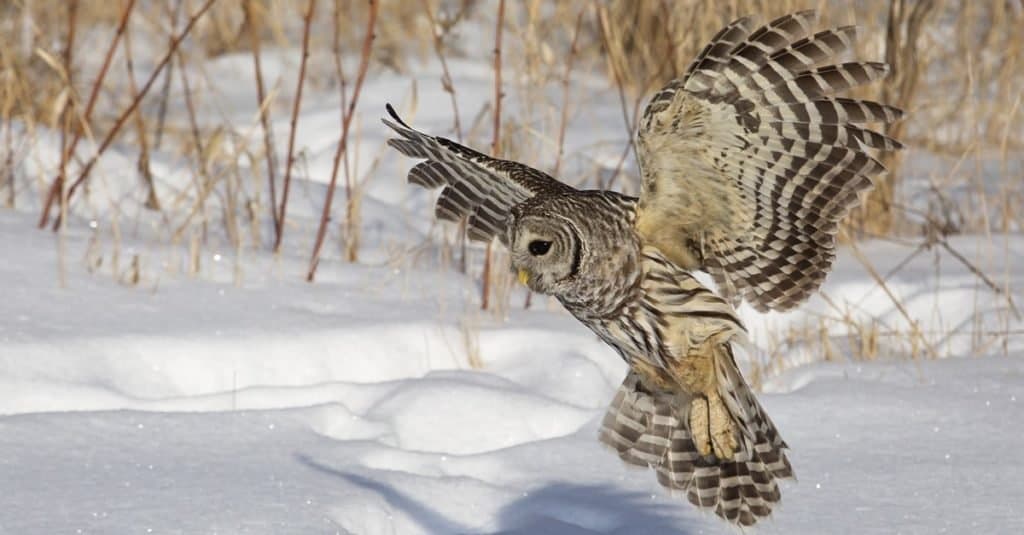
Barred owls have broad wings with a wingspan of approximately 40 to 50 inches. These wide wings allow them to easily glide long distances after flapping just a few times. They also have a special feather structure that dampens air turbulence so they make very little sound. Their quiet flight enables them to hunt small animals without being heard.
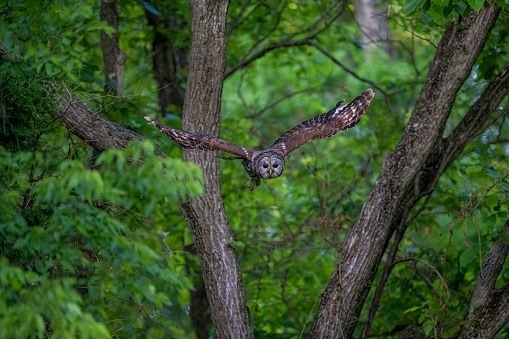
A barred owl can glide swiftly through the woods.
©Wirestock/iStock via Getty Images
8. Barred Owls Are Among the Largest in North America
Among the 19 North American owl species, the barred owl ranks sixth in size. The northern barred owl is the largest subspecies, measuring 16 to 25 inches tall. As noted above, they have a wingspan of up to 50 inches. They typically weigh from 1 to 2.3 pounds, with females typically being larger than males.
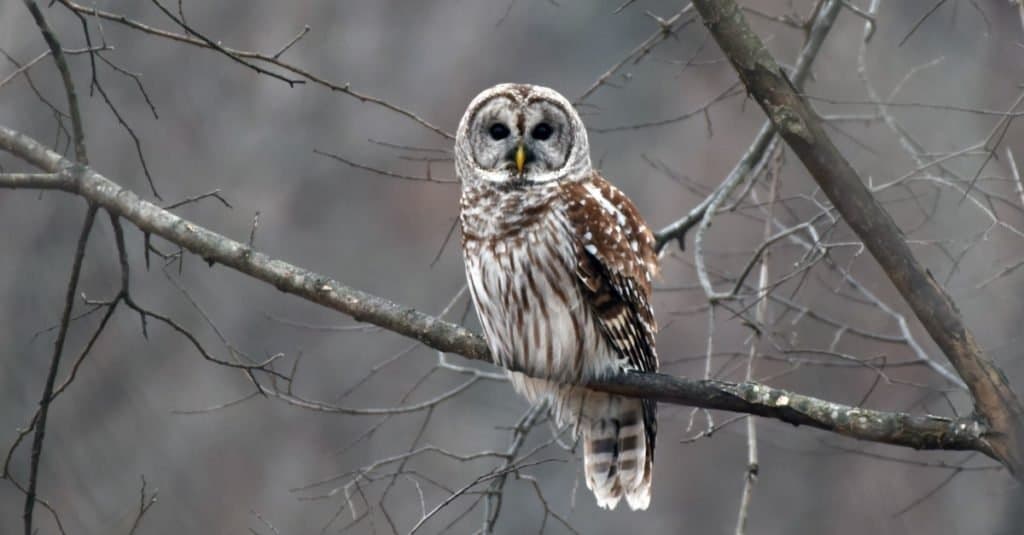
Barred owls are the sixth largest owl species in North America.
©Malachi Ives/Shutterstock.com
9. Barred Owls Nest in Tree Cavities
Barred owls favor tree cavities for their nests. However, they will also use nests abandoned by other animals, such as hawks, ravens, crows, or squirrels. Barred owls will also make their nests in man-made nest boxes.
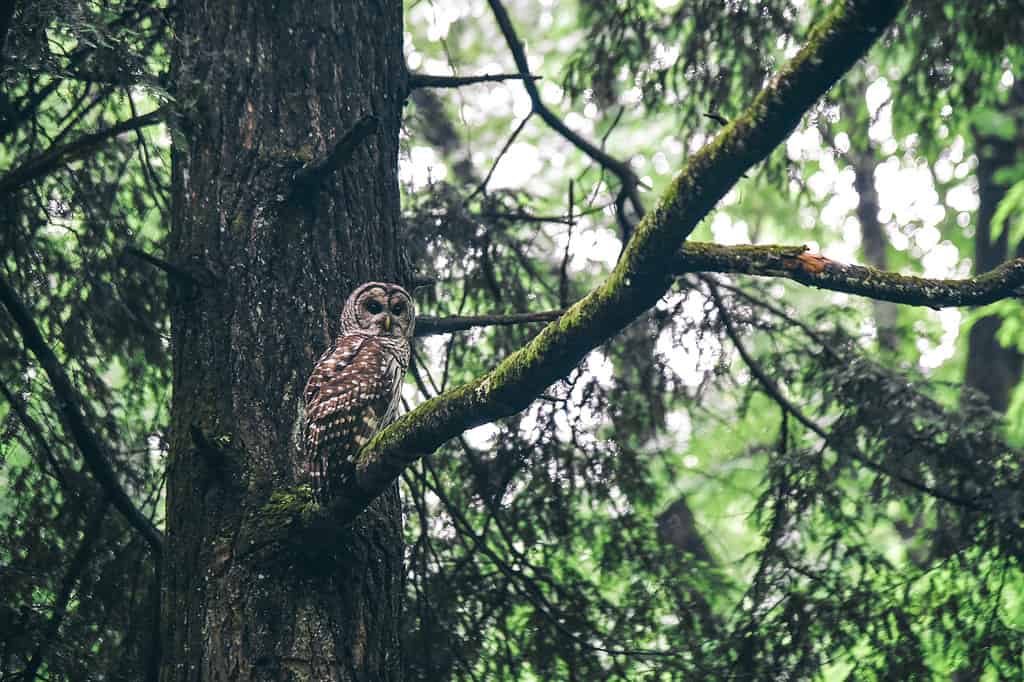
Barred owls favor tree cavities for their nests.
© Alisha Bube/ via Getty Images
10. Barred Owl Parents Care for Their Offspring Longer Than Most
Barred owls are monogamous. Females lay between 1 and 5 eggs, typically 2 or 3. The eggs are incubated for 28–33 days. Males provide food while the females incubate and brood the young for the first few weeks after their offspring hatch. The young can leave the nest around 4 to 5 weeks old, although they cannot yet fly. The parents continue feeding and protecting the juveniles, who follow them to learn hunting skills. Barred owl parents care for their young for up to four to six months, far longer than most other owl species.
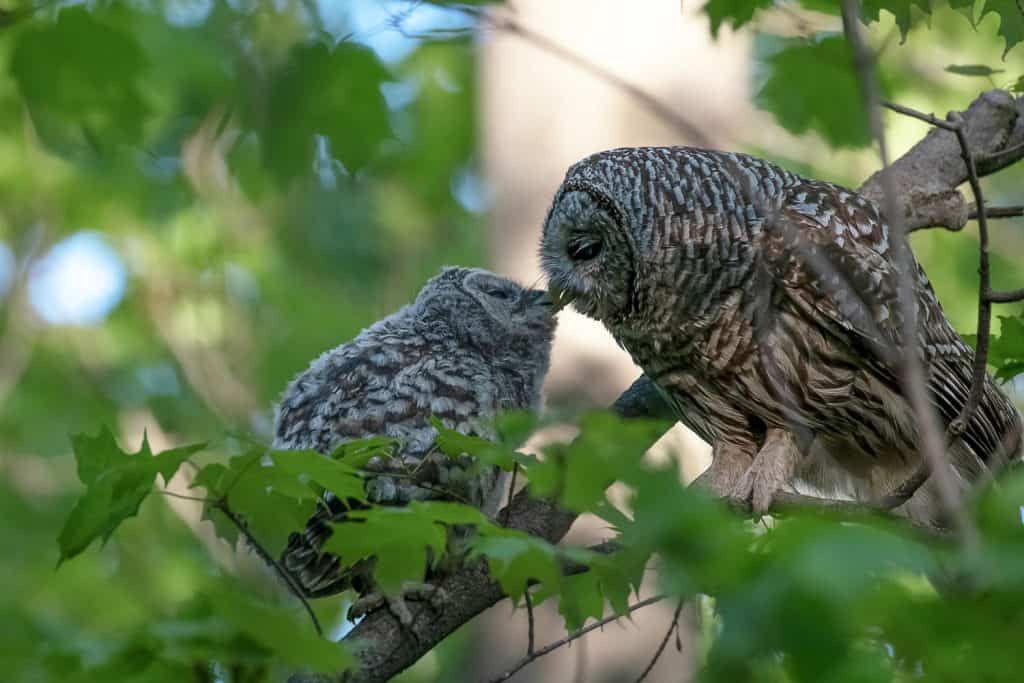
Barred owls care for their young for up to four to six months.
©Karen Hogan/Shutterstock.com