
Owls are some of the best-known predatory birds, famous for their nocturnal tendencies and their ability to rotate their heads up to 270 degrees in either direction. There are around 250 species of owls in the world, and they vary widely in size, with the smallest being the elf owl at approximately 5.5 inches long. But which is the largest owl in the world, and how big does it really get? Let’s find out!
What Is the Largest Owl in the World?
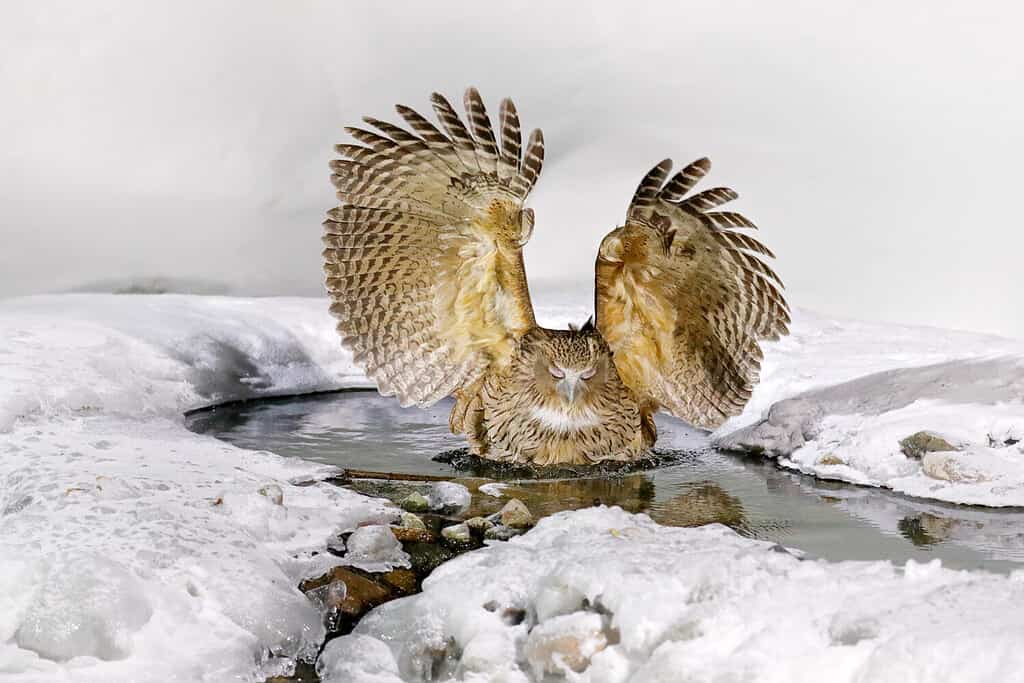
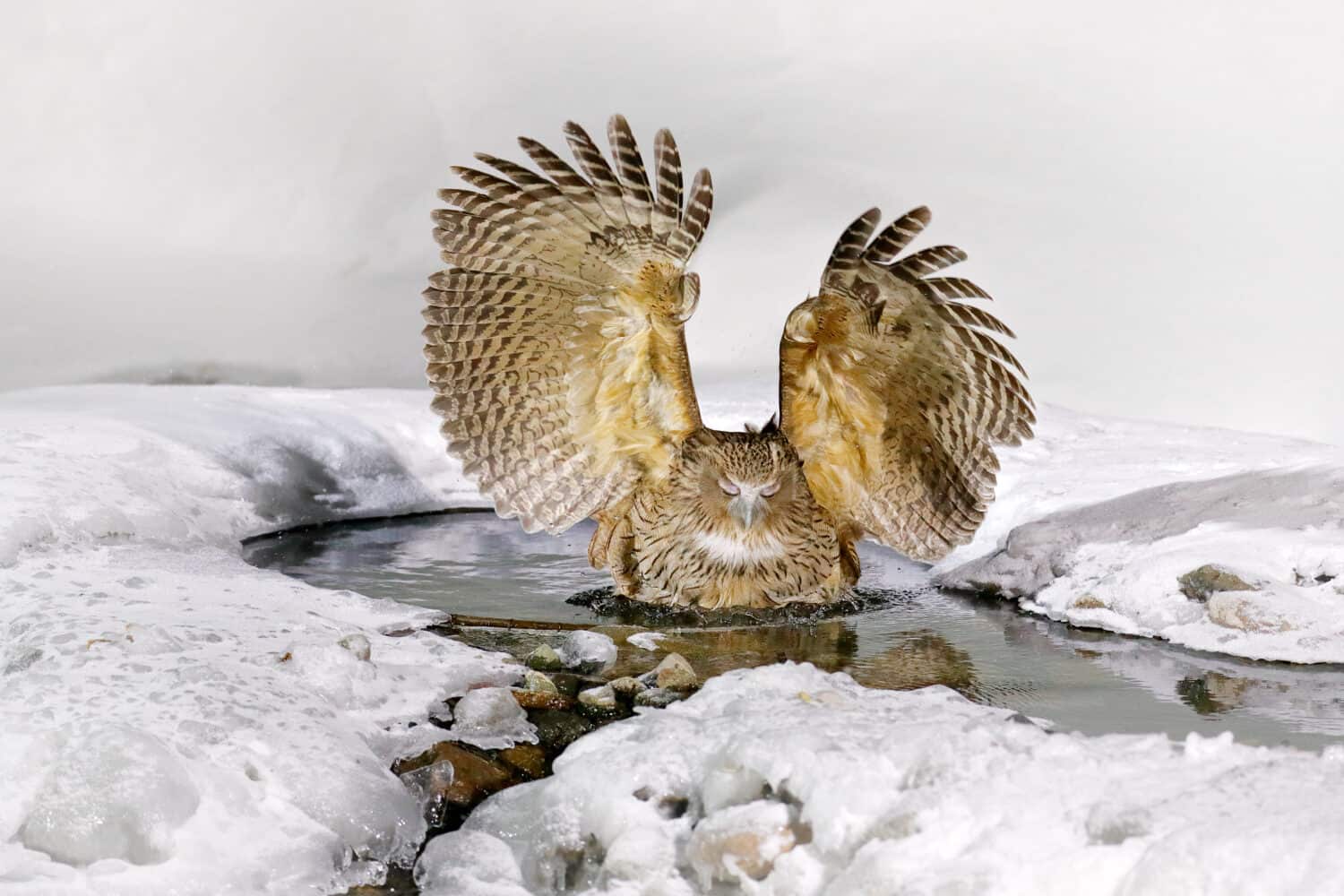
Blakiston’s fish owls have a massive wingspan of around six feet.
©Ondrej Prosicky/Shutterstock.com
The largest owl in the world is the Blakiston’s fish owl (Ketupa blakistoni), which has a massive wingspan of approximately 5ft 10in to 6ft 3in. For context, that’s approximately the same as the length of a standard double bed. The females are a little heavier than the males, weighing up to ten pounds, compared to a maximum of eight pounds for the males. Blakiston’s fish owls are also 24 to 28 inches long.
Interestingly, the great grey owl can reach 33 inches long, which is longer than Blakiston’s fish owl. However, their wingspan is only around five feet, and they are significantly lighter, weighing a little over four pounds. Therefore, Blakiston’s fish owl still takes the position as the largest owl due to its larger wingspan and greater weight.
Blakiston’s fish owls are mainly light brown with dark barring on their underparts, while their upperparts are a darker brown with less barring. Their throat is white, which is particularly noticeable against their brown bodies. They also have large ear tufts and feathered legs, although their feet are bare.
Where Can You Find Blakiston’s Fish Owl?
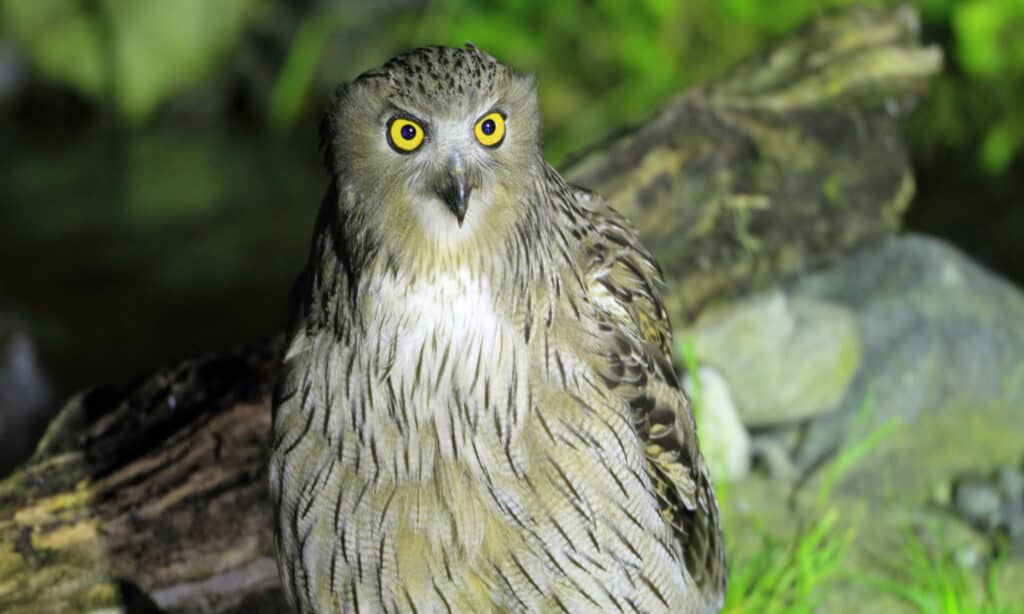
Blakiston’s fish owls can be found in forests close to water.
©feathercollector/Shutterstock.com
Blakiston’s fish owls are native to Asia, and they can be found in China, Japan, and parts of the Russian Far East, where they are year-round residents. Their preferred habitat is old-growth forests, particularly those close to lakes, rivers, and coastlines that don’t freeze during the winter. Despite their large size, Blakiston’s fish owls nest in tree cavities. This is one of the reasons that they prefer large, old trees — so that there are hollows large enough to accommodate them.
Unfortunately, their population is decreasing, and they are classified as a vulnerable species by the IUCN. It’s estimated that there are between 900 and 1,700 mature birds left. It’s estimated that only 160 to 185 of them live in Japan, while the mainland population, consisting of birds in Russia and China, is estimated at 750 to 1,500.
There are several reasons for the decline in population, but the most significant is habitat loss. Deforestation significantly reduces their viable habitat. However, land development and the construction of dams along rivers also affect their hunting grounds. Other threats include hunting, capture by fur trappers, and drowning in salmon nets.
Reproduction
Blakiston’s fish owls also have a slow reproductive rate, which can significantly impact their population. Rather than breeding every year, these owls only reproduce every two to three years. However, they are sexually mature by the age of three.
Clutches of between one and three eggs are laid in the tree cavity around mid-March. The females incubate the eggs, although both parents take on the task of caring for the chicks after they have hatched. The eggs hatch after an incubation period of around 35 days, and the chicks fledge after a further 35 to 40 days. Once fledged, the young owls can stay with their parents for up to two years before becoming independent.
Diet
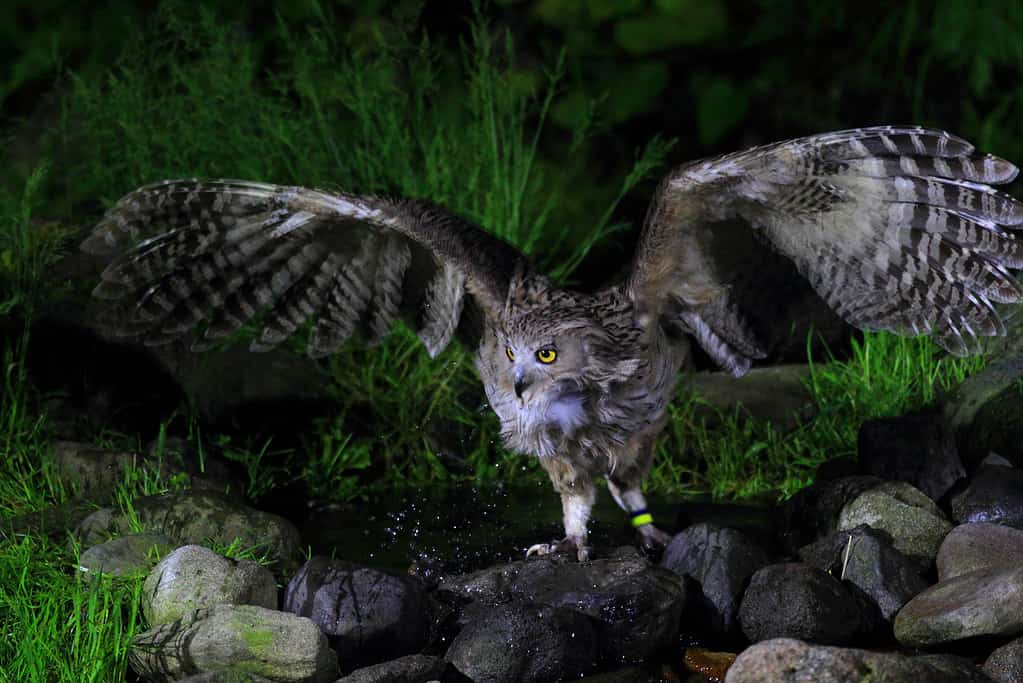
Blakiston’s fish owls mainly prey on fish, although they may also eat amphibians and mammals.
©feathercollector/iStock via Getty Images
As we’ve mentioned, Blakiston’s fish owls can be found in habitats close to water, and the reason for this is their diet. Blakiston’s fish owls predominantly eat aquatic animals, including fish such as pike, salmon, and trout. Seasonal variations in their diet do occur, with the preference switching to amphibians if fish are scarce. However, they will also prey on small to medium-sized mammals when the need arises. These include rodents, rabbits, hares, and even foxes.
Blakiston’s fish owls are mainly active at dusk or during the night. In many cases, they hunt their prey directly from the water, swooping down to clasp it in their talons. However, they’re also known to exhibit great patience by standing in the shallows or perching close to the water and waiting — sometimes for hours — for the perfect moment to strike. Rather than flying off with their prey, Blakiston’s fish owls typically drag their prey onto the shore for consumption.