
Little did Dr. Elliot Ladd Coues—a man who would become “America’s most well-known ornithologist”— know, but when he headed west from Washington D.C. in the mid-1800s, he would describe a subspecies of whitetail deer that would one day bear his name. This medical officer-turned-naturalist resigned from his post at Fort Whipple, Arizona, to focus on his scientific studies, particularly those related to natural history, a few years after Theodore Roosevelt had founded the Boone and Crockett Club for the purposes of conservation and wildlife management.
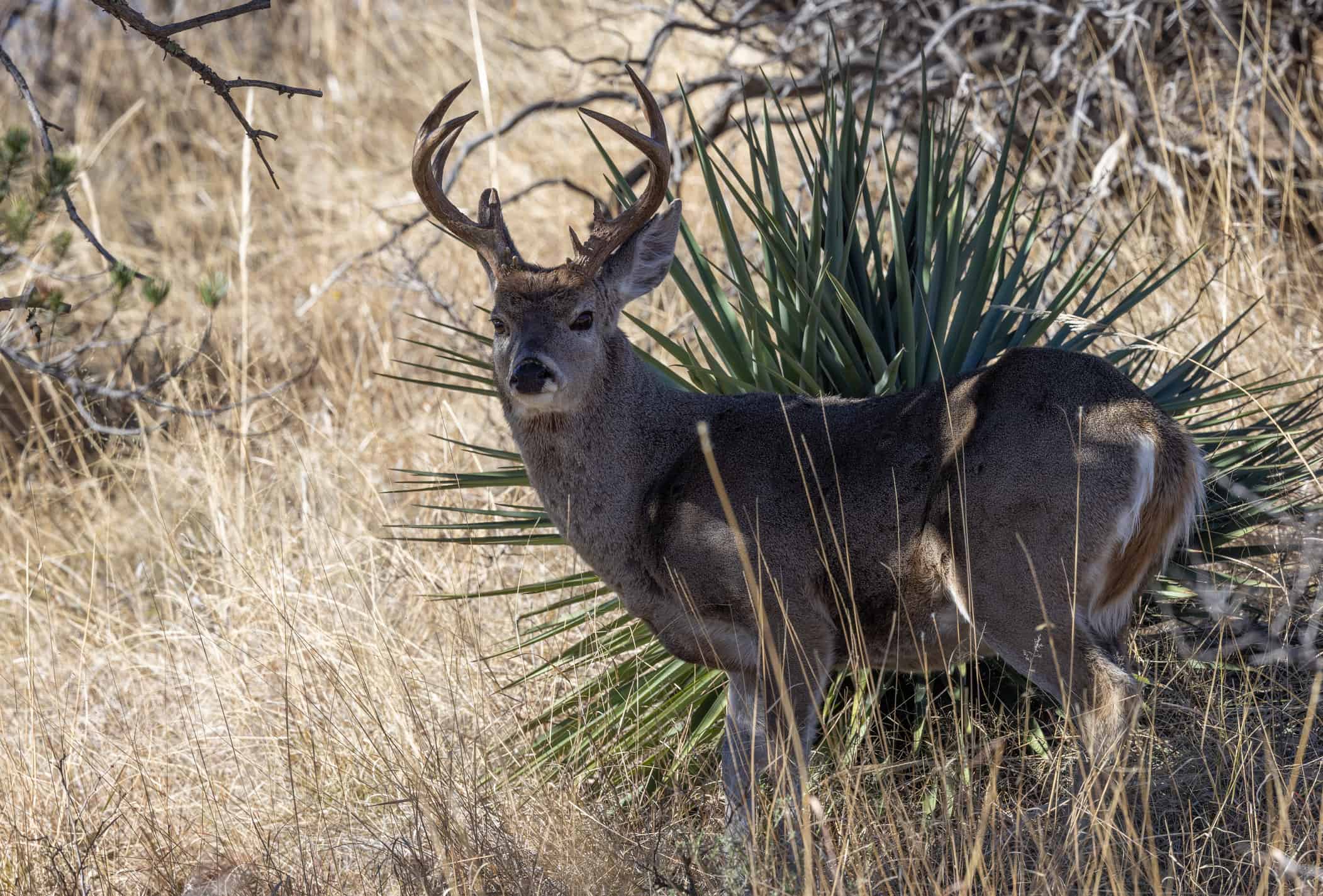
The Boone and Crockett Club also sets guidelines for and maintains trophy hunting records for big game animals, including the subspecies of whitetail deer named for Dr. Coues—Odocoileus virginianus couesi. The Coues deer lives in two U.S. states, Arizona and New Mexico, and Mexico. Smaller than its cousins, Odocoileus virginianus, the Coues (pronounced “cows”) whitetail deer also have larger ears and tails and is notoriously skittish, even by deer standards.
And their ability to elude hunters may explain, in part, why the Arizona state and world records for the biggest Coues whitetail deer ever harvested in Arizona in both categories, typical and non-typical, have stood for more than 70 and 50 years, respectively.
The terms “typical” and “non-typical” refer to the growth pattern of antlered animals. Typical antlers follow a standard pattern defined by symmetrical tines and evenly spaced points whereas a non-typical set of antlers deviates from the standard in quite unusual ways, although they do have their own sense of symmetry.
Antlers are scored using a measuring system. Measurements and counts of the individual elements on the antlers—the number of points on the antlers, the width of the main beam spread of the antlers from tip to tip, the inside spread, the length of the main beam, the length of the points, and the circumference between points—are taken. These measurements are calculated according to a formula outlined on a score chart to provide a final score. Typical and non-typical scores above 110 and 120, respectively, are in all-time record territory.
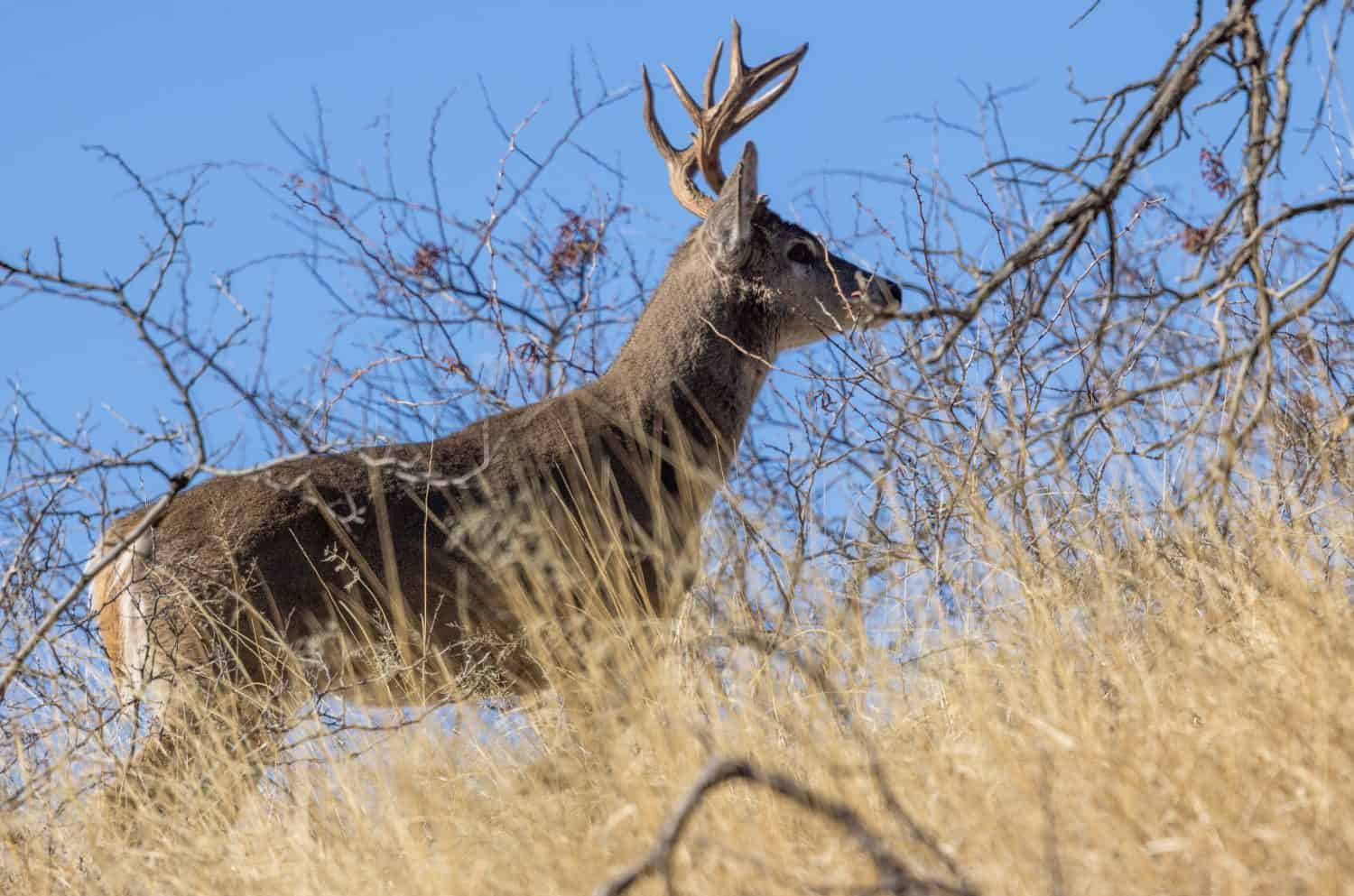
The Coues whitetail deer, a subspecies of whitetail deer, was named after Dr. Elliott Ladd Coues, a medical officer-turned-naturalist, who first described the desert ungulate.
©Tom Tietz/Shutterstock.com
Arizona’s Bucks Take On the World
So much doubt surrounded hunter Ed Stockwell‘s typical Coues buck, it was examined and then re-examined and re-examined before finally (and fairly quickly) being verified as the correct species, as many thought it was perhaps another subspecies of whitetail deer, although there is no overlap between the habitats of Coues deer and its many cousins.
Shot with a .300 Savage rifle from 60 yards away in Pima County, Arizona, in 1953, the buck scored 144-1/8 after an initial and unofficial measurement of 143. And it bumped a nearly two-decade-old record set in 1935 by George W. Kouts; his buck scored 131-7/8. Stockwell’s buck nabbed not just the state’s record but also the world’s, and it has held both for eight decades and counting.
The Boone and Crockett Club has recognized the Arizona state and world non-typical Coues whitetail deer record since 1971. Little is known of the hunt, but according to the organization, the non-typical Coues record buck “was taken in the late 1960s on the San Carlos Indian Reservation by a tribal member. Details of the hunt are limited, but we know it was taken south of Highway 70, possibly in the Mount Turnbull area. Additional details of the hunt were lost when the hunter died. We know this: when he walked up on the animal the hunter must have been in awe of his tremendous trophy.”
The rack was sold to an antler dealer long ago and now belongs to Dana J. Hollinger and Bob Howard. One side features 11 points, the other 15. With a 152-3/8-inch typical frame, the rack sports an additional 43-7/8 inches of non-typical growth to give it a final score of 196-2/8.
A fairly impressive non-typical rack was picked up in 1988 in Arizona. That rack scored 158-4/8, but it’s still a far cry from the Indian’s record.