
Quick Take
- One popular catfish sold as a harmless 2-inch juvenile secretly grows into a tank-busting monster most home aquariums can't contain. See the tank-busting species →
- One catfish on this list moves in a way that no other fish on the planet does, and watching it swim changes how you think about setting up a tank. Watch the upside-down swimmer →
- Some of these catfish actually make your aquarium cleaner, though this is only true if you keep the right number of them together. Meet the group algae eaters →
- The most visually striking catfish here can't share a tank with its own kind, which is something most beginners don't find out until it's too late. Discover the solitary showpiece →
The vast majority of catfish species available in pet stores are small or medium-sized and native to South America or Africa, as retailers stock fish that fit standard 10-to-55-gallon home aquariums. This includes peaceful South American schooling fish like Corydoras and Otocinclus, active medium-sized species like the South American pictus catfish or African upside-down catfish, and smaller algae-eaters like bristlenose plecos. The single exception to this retail rule is the Common Pleco; though sold as a cute 2-inch juvenile, this South American native is a monster fish that routinely grows up to 24 inches long and outgrows standard home tanks. Continue reading to learn more about small and medium freshwater catfish to liven up your aquarium.
Pygmy Corydoras
Corydoras is a genus consisting of more than 160 recognized species of catfish native to freshwater rivers and streams in South America. The pygmy (or dwarf) Corydoras have the same fascinating qualities as standard-sized ones, except they don’t grow as big. This makes them the perfect addition to smaller aquariums. Pygmy catfish grow to a maximum size of around 0.75 to 1.3 inches. The females are typically larger than the males, although their adult sizes are similar. Although it’s uncommon, some pygmy Corydoras can reach 1.5 inches in size.

As its name suggests, pygmy Corydoras is the smallest cory catfish, measuring only 1 inch long.
©Pavaphon Supanantananont/Shutterstock.com
Pygmy Corydoras are peaceful fish originating from the tropical waters of South America. They have a dark stripe that runs from their snout to their caudal fin, with small barbels underneath their mouths. These small catfish usually have a slightly transparent tan coloration with their dark stripe being their most distinctive feature. Pygmy Corydoras are highly social and benefit from being kept in groups of six or more.
They spend most of their time at the bottom of the aquarium, foraging for food and socializing with each other. In the right conditions, pygmy catfish are active and rarely spend their time hiding. This makes them fun to watch and liven up the bottom area of tropical freshwater aquariums.
Albino Corydoras
A Corydoras that has a light coloration is the albino corydoras (Corydoras aeneus). They reach an adult size of 2.5 inches, although males are smaller at around 2.0 inches in length. Their bodies lack the typical color pigment found in other varieties of Corydoras, allowing them to stand out against dark substrates.
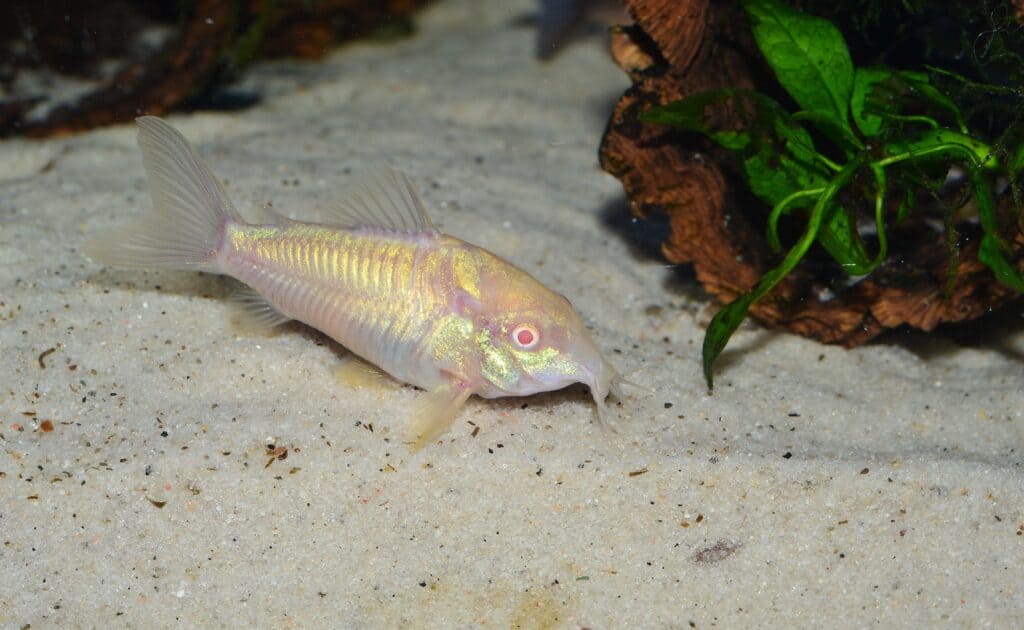
All Cory catfish should have smooth sand or gravel for substrate, so they don’t damage their barbels.
©JuanCarlosPalauDiaz/Shutterstock.com
Their bodies are a creamy tan color with red eyes and gills. Like most Corydoras, the albino Corydoras is a social fish that enjoys being kept in groups of six or more. Keeping them together in medium-sized freshwater aquariums allows them to be active and spend most of their time interacting and foraging for food. Albino corydoras can form part of the aquarium clean-up crew, and they help retrieve leftover fish food from the substrate that would otherwise cause water quality issues.
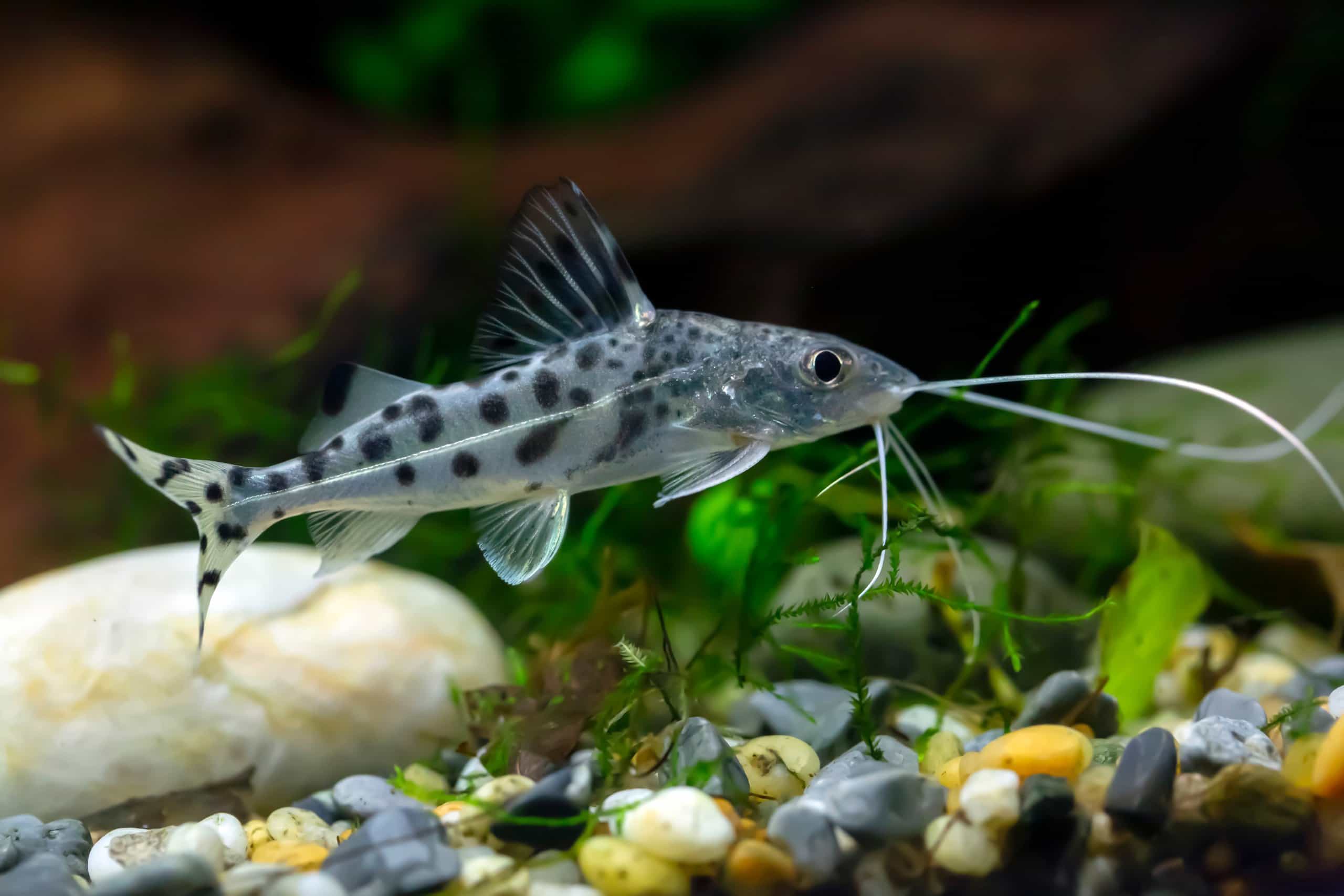
Pictus Catfish
Pictus catfish (Pimelodus pictus) are peaceful, timid fish, which makes them ideal for community aquariums. They originate from the Orinoco and Amazon River Basins in South America. These freshwater catfish typically grow to an adult size of around 4.5 to 5 inches, and it is uncommon for them to grow any larger. Pictus catfish have a silverish color with uneven spotting. They have long barbels that frame their face and a black or striped dorsal fin.

The pictus catfish are peaceful and medium-sized catfish.
©boban_nz/Shutterstock.com
Pictus catfish should be housed in schools of 4-6 individuals since they are naturally social fish. Due to their size, they should be housed in larger tropical aquariums than some of the smaller species of catfish. When kept in a proper setup and in groups, they rarely hide and interact at the bottom of the aquarium. They have a lifespan of four to eight years in captivity, though given optimum care and stable water parameters, pictus catfish can live for a decade or longer.
Gold Nugget Plecostomus
If you are looking for a beautifully colored pleco to add to your freshwater aquarium, gold nugget plecos (Baryancistrus xanthellus) are an excellent choice. These plecos have a vivid yellow coloration at the ends of their fins, while their bodies are dark black with striking gold spots. Gold nugget plecos can grow between 9 and 10 inches in captivity, so they are better suited for larger aquariums. They should also be housed alone since they are solitary fish.

The pleco has a suckermouth that allows it to attach itself to surfaces in aquariums.
©Podolnaya Elena/Shutterstock.com
Gold nugget plecos usually inhabit the bottom of the aquarium, but they will attach themselves to the glass, plant leaves, rocks, wood, and filters using their suckermouth.
Plecostomi, commonly called plecos, belong to the armored catfish family Loricariidae and are defined by their ventral suckermouths. In the wild, they use this adaptation to secure themselves to rocks to keep from being swept away by strong currents. In captivity, plecos may attach to the aquarium glass. Gold nugget plecos are mostly active at night and enjoy searching for food on various surfaces in the aquarium.
Bristlenose Plecostomus
If you don’t have the space for larger species of pleco but you enjoy the species, then the bristlenose pleco (Ancistrus cirrhosus) is a good choice. Bristlenose plecos are medium-sized catfish that typically reach a size of around 4.7 inches (12 cm). They are native to South American freshwater rivers and streams.
The bristlenose pleco is popular among the smallest pleco fish.
©iStock.com/Mirko_Rosenau
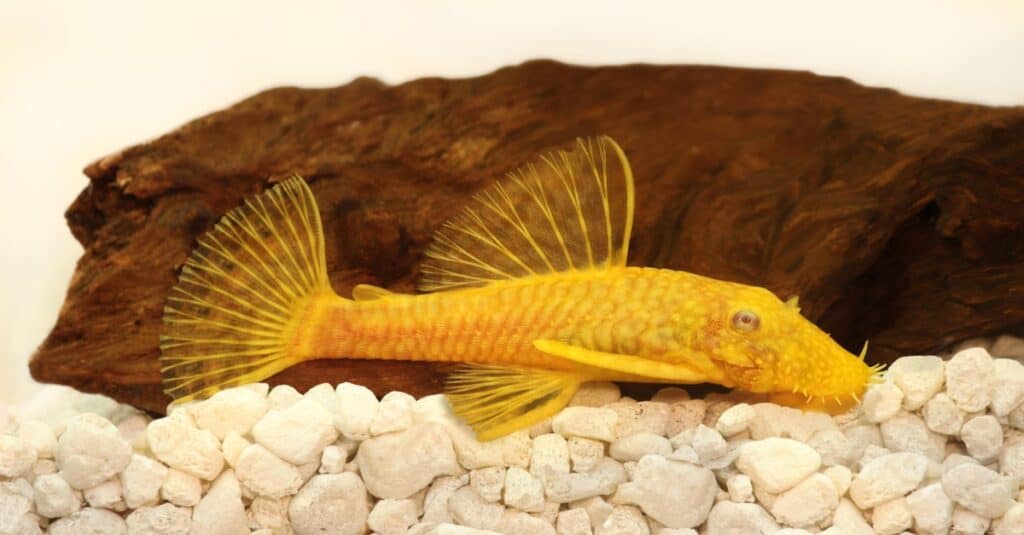
One of the bristlenose pleco’s most defining features is its cluster of bushy tentacles around its head. These tentacles are most visible in older males and look striking with their dark coloration. However, bristlenose plecos are available in lighter color forms such as yellow or orange.
Unlike many other types of catfish, bristlenose plecos can be housed alone, and males become territorial when they are older. They don’t crave companionship and generally keep to themselves in community tanks. With proper care, bristlenose plecos have an average lifespan of 10 to 12 years.
Otocinclus
A small species of catfish that is ideal for small freshwater aquariums is the Otocinclus (or “oto” for short). They originate from tropical South American waters and are social fish that like to be kept in groups. It is recommended to keep five to six Oto catfish together to encourage social behaviors and activity in an aquarium.
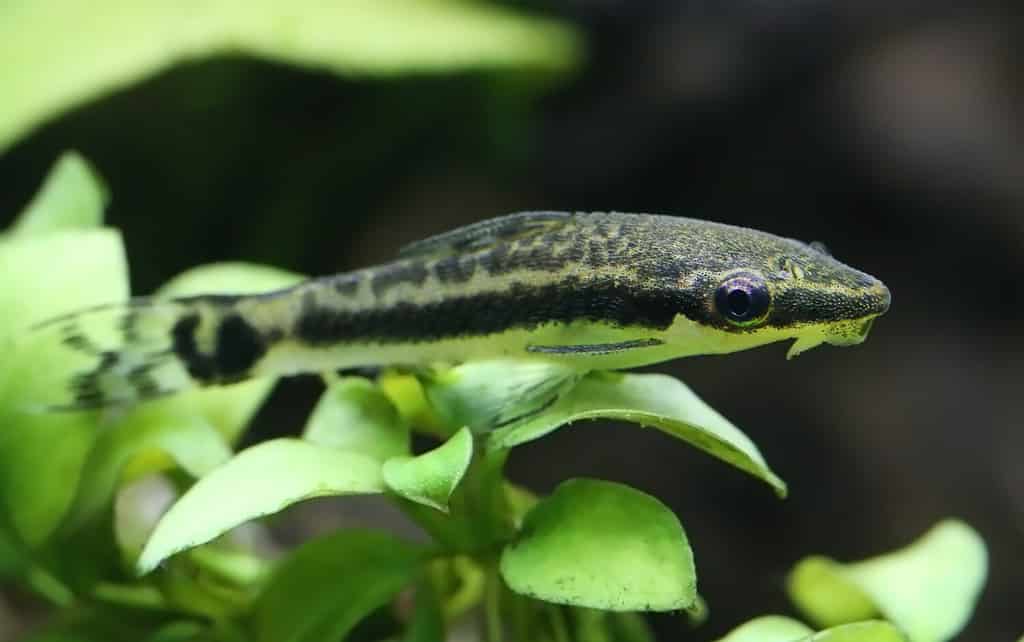
Oto catfish are small and can be kept in small to medium-sized aquariums.
©Swapan Photography/Shutterstock.com
Oto catfish only grow to a maximum of 2 inches in size. Their slender bodies have a standard brown or grey color with dark stripes, and their fins can sometimes appear semi-transparent. Oto catfish are great algae eaters, so their peaceful temperaments and cleanup abilities make them a vital part of a tank’s cleanup crew.
Although Oto catfish can be active, they may spend a bit more time hiding amongst the aquarium’s rocks and plants. With proper care, Oto catfish can live for around three to five years, which isn’t as long as many other catfish.
Banjo Catfish
An interesting species of catfish is the banjo catfish (Bunocephalus coracoideus) from South America. Banjo catfish have long and slender tails and typically grow to around 3–5 inches in captivity. These catfish are primarily solitary fish as adults, so you only need to keep one of them in a medium- to large-sized aquarium.

Thanks to their peaceful temperaments, banjo catfish can be kept in tropical community aquariums or alone. They rarely interact with other fish and prefer to keep to themselves. Banjo catfish can be found in various color forms, such as black, brown, yellow, and grey, or a combination of these colors.
Banjo catfish can blend into aquarium substrate quite well and usually become most active during feeding time. With proper care, banjo catfish can live for up to ten years. These catfish are relatively simple to feed, as they are omnivorous bottom feeders that scavenge for leftovers.
Striped Raphael Catfish
Striped Raphael catfish (Platydoras armatulus) are large, freshwater catfish that are known for their peaceful temperaments. They originate from the Amazon and Orinoco River Basins in South America where they inhabit freshwater rivers and streams. The striped Raphael catfish generally grows between 8 and 9 inches in size and has a black or dark brown body.

The striped Raphael catfish has a thick body with yellowish stripes on either side.
©chonlasub woravichan/Shutterstock.com
As its name reflects, the striped Raphael catfish has thick yellow or white stripes on either side of its body. They also have barbels underneath their mouths, which become more prominent as they age. These catfish are relatively hardy and easy to care for. However, it is important that their aquarium water be kept filtered and free of ammonia and nitrites. Striped Raphael catfish enjoy foraging in aquariums for leftover food and decaying plants, although they aren’t the most active catfish.
They are relatively social fish and can be kept in small groups. Due to their large size, most striped Raphael catfish require a large fish tank when they are kept together.
Asian Bumblebee Catfish
If you are looking for a unique-looking catfish that is entertaining to watch, then the Asian bumblebee catfish (Pseudomystus siamensis) is a top choice. These catfish can grow up to 7–8 inches in size, making them ideal for medium to large tanks. Asian bumblebee catfish are considered easy to care for and thrive in tropical freshwater tanks.
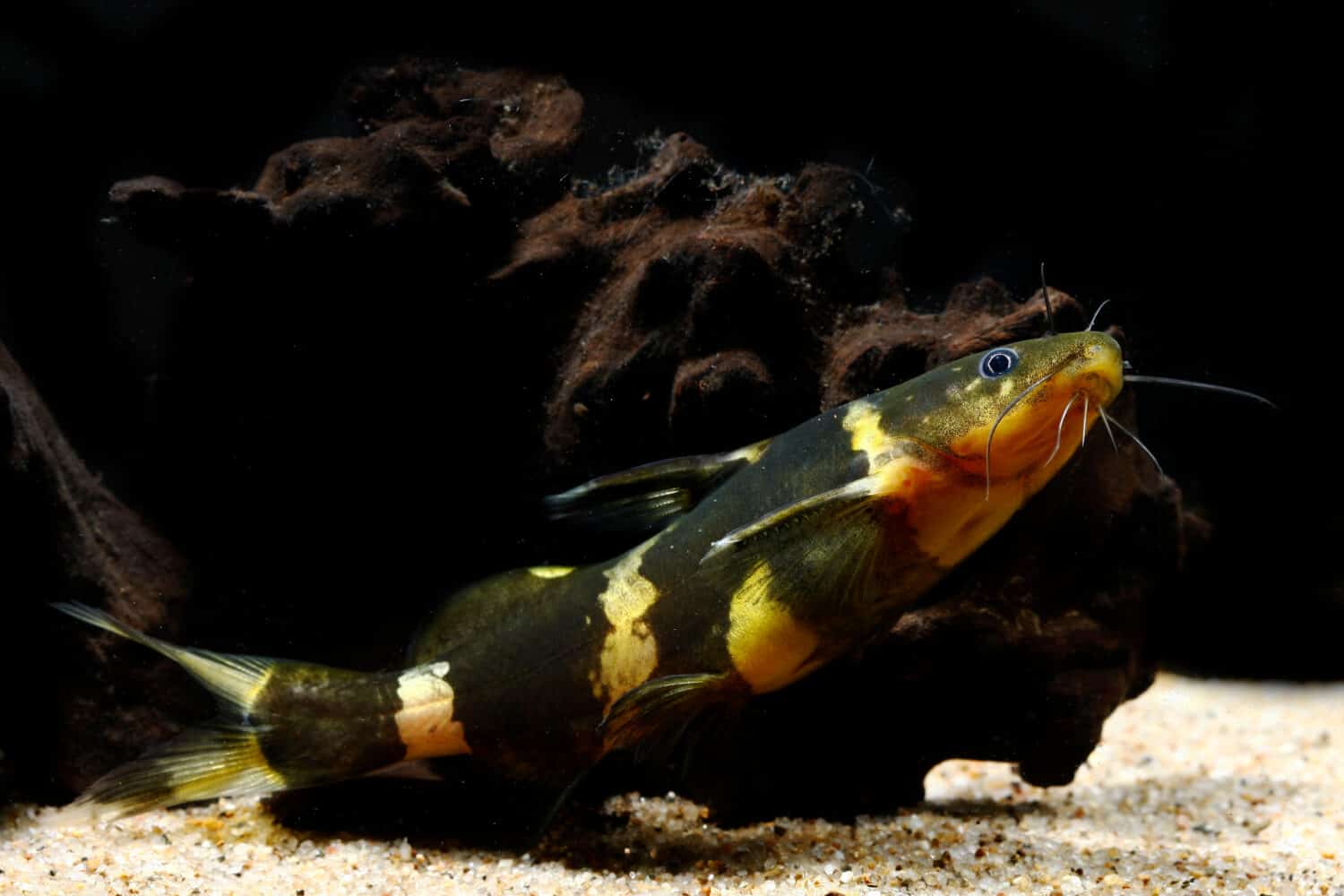
The bumblebee catfish is social and should be kept in groups.
©Pavaphon Supanantananont/Shutterstock.com
Asian bumblebee catfish have a slender-shaped body with distinctive yellow and dark brown or black banding that makes them look like bumblebees. Asian bumblebee catfish are mostly active during the night, but low-lit aquariums can sometimes encourage them to be more active during the early mornings and evenings. Their temperament is often described as timid yet peaceful. The bumblebee catfish is an omnivore and should be fed a staple pelleted or commercial food, but they will eat any leftover food in the substrate from other fish.
As naturally social fish, the Asian bumblebee catfish should be kept in same-species groups. Keeping them in groups seems to amplify their activity levels in the aquarium. When cared for properly, bumblebee catfish can live for around five years.
Upside Down Catfish
Our last highly recommended freshwater catfish to liven up your aquarium is the upside-down catfish (Synodontis nigriventris). Upside-down catfish have an unusual swimming posture that allows them to feed from the surface of the water. They swim with their bellies up, which is quite interesting to watch. The upside-down catfish reaches an adult size of 3 to 4 inches in captivity and can be found in several different color forms.

These fish don’t just look upside down. They actually swim upside down!
©Pavaphon Supanantananont/Shutterstock.com
Most upside-down catfish are muddy brown or tan with dark bellies. However, they can have a splotchy yellow and dark brown color or appear as if they have tiger-like markings. Some upside-down catfish can also be a light tan color with striking spots.
The upside-down catfish is generally peaceful and suitable for communities, but they can be difficult to spot during the day. Upside-down catfish usually spend most of their time hiding until their activity levels spike at night. As a social catfish, the upside-down catfish should be kept in groups of four or more. In some cases, they can become territorial as they mature, so they benefit from having enough space to retreat from the group.