
Quick Take
- One popular beginner fish actually becomes prey for adult angelfish, so pairing them wrong is a costly mistake. Zebra danios age risk →
- Not every angelfish tank mate needs to be a fish, and one invertebrate option surprises most aquarium beginners. Mystery snails as companions →
- Some tank mates coexist with angelfish precisely because they never share the same water level, and that separation changes everything about compatibility. Bottom-dwellers that coexist →
- Tank size isn't just a guideline. The difference between a peaceful tank and a disaster can come down to a single gallon threshold. 75-gallon tank requirement →
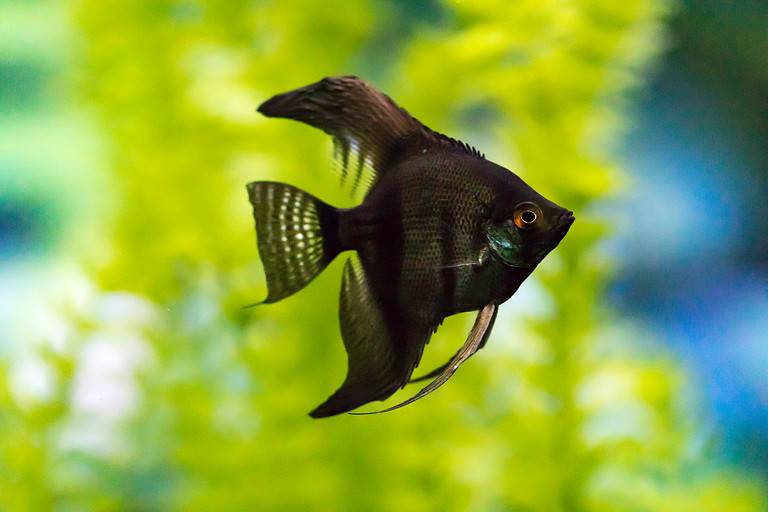
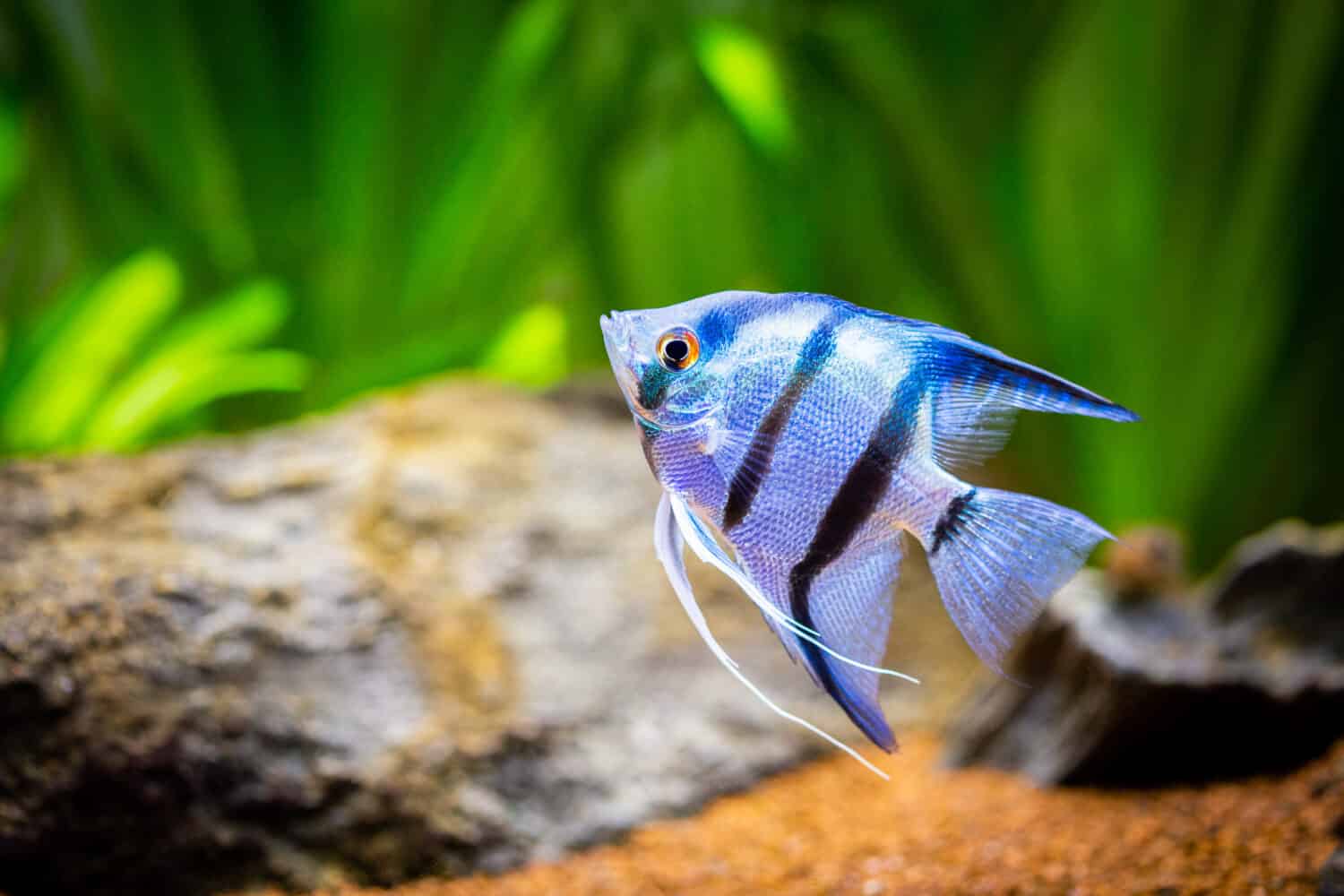
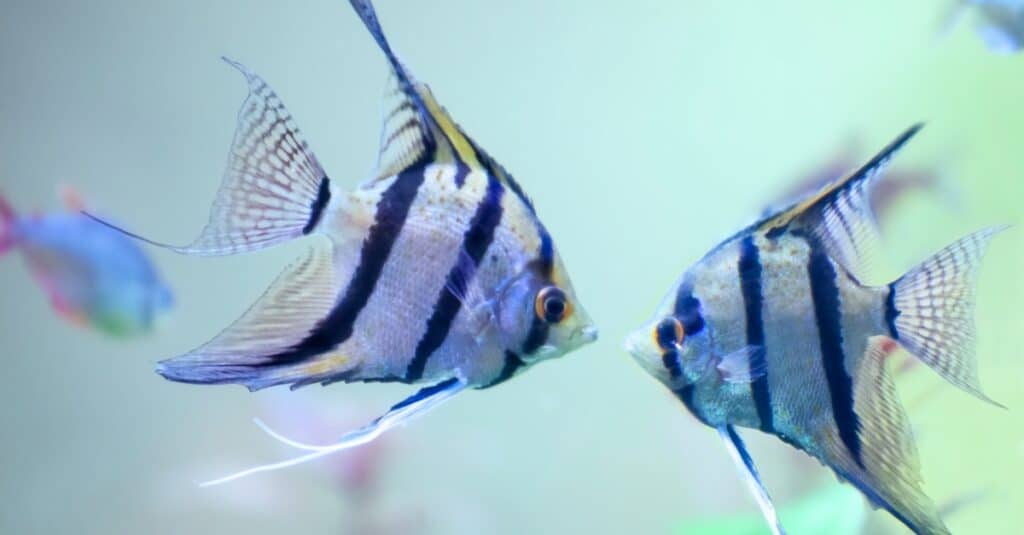
Freshwater angelfish (Pterophyllum) are flat, disc-shaped cichlids native to the tropical river basins of South America. There are currently three officially recognized species: the zebra angelfish (Pterophyllum scalare), the altum angelfish (P. altum), and the teardrop angelfish (P. leopoldi). Due to their elegant, wing-like fins and majestic swimming behavior, they are popular as aquarium pets, though they require specific care. They thrive in warm, slightly acidic water with plenty of vertical space and plants. While they are peaceful compared to other cichlids, they can become territorial during breeding and tend to view tiny tankmates (like neon tetras) as a food source. However, there is a wide variety of suitable tank mates for angelfish. Continue reading to learn more.
Zebra angelfish tend to be the most popular aquarium pets.
©iStock.com/TatianaMironenko
Molly
One of the most peaceful fish you can keep with angelfish are mollies (Poecilia sphenops), a live-bearing fish. Mollies are freshwater fish that are native to Mexico and Central America, with some sources extending their native range as far south as Colombia, and have been introduced to various parts of the world. They come in a wide range of colors and patterns and reach an adult size of 3 to 4 inches. Like the angelfish, mollies are incredibly social and need to be kept in groups of five or more to form a shoal.
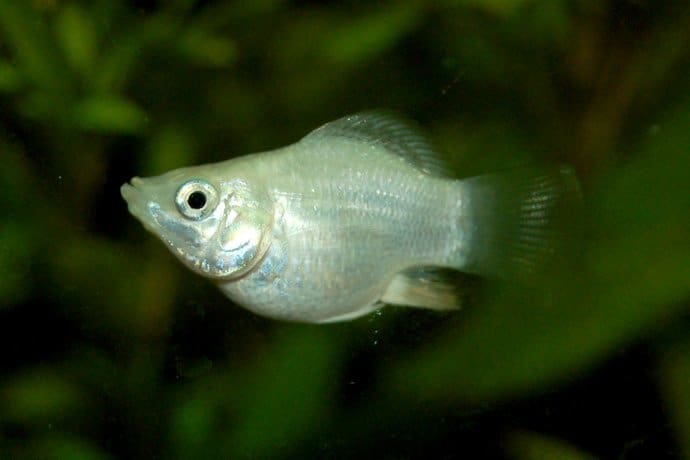
Mollies do not lay eggs but rather give birth to free-swimming fry.
©Marrabbio2 / Creative Commons – Original
Mollies are suitable for beginners and their care is relatively simple because they are hardy and adaptable fish. You can easily pair adult mollies with juvenile angelfish, although the tank needs to be over 55 gallons in size. Mollies are not very fussy about their tank setup but appreciate a few live plants and pieces of driftwood.
Dwarf Gourami
The dwarf gourami (Trichogaster lalius) is a small fish of between 2 and 3.5 inches long. They are native to Pakistan, India, and Bangladesh. Dwarf gouramis make popular additions to aquariums thanks to their fascinating colors, including neon blue, sunset orange, flame, and rainbow. They belong to the same family, Osphronemidae, as betta fish.
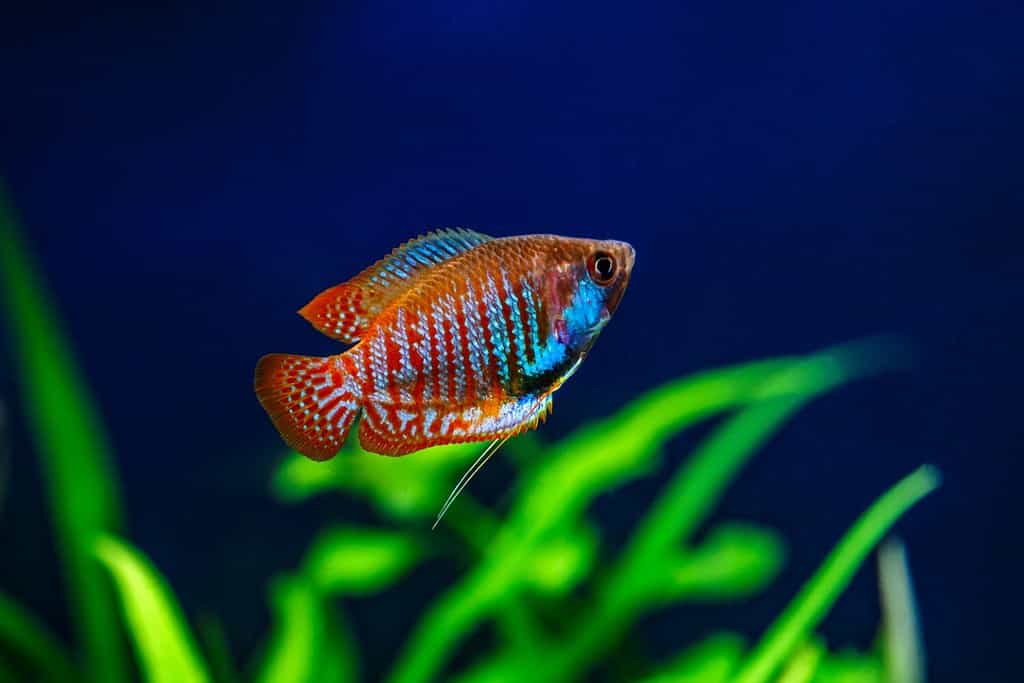
Dwarf gourami can be found in a range of different colors.
©Bukhta Yurii/Shutterstock.com
As social fish, dwarf gourami should be kept in groups of five or more. They do not form tight schools but do enjoy interacting with one another.
Both dwarf gourami and angelfish can be kept in the same tank, as their water conditions are similar in many ways. Dwarf gourami are tropical freshwater fish that thrive at temperatures around 72 to 82 degrees Fahrenheit. However, the temperature will need to be kept above 74 degrees Fahrenheit when housing them with angelfish.
Bronze Corydoras
A group of five bronze corydoras (Corydoras aeneus) can be a great addition to angelfish aquariums. Bronze corydoras are small bottom-dwelling catfish that originate from South America. They are relatively small, typically reaching 2.5 to 3 inches in length, and have a bronze coloration with dark markings on the sides of their bodies. Bronze corydoras have small barbels that they use to forage for food in the substrate. They will rarely interact with the angelfish because they do not swim at the same level in an aquarium.

Like many catfish, the bronze cory females are larger than the males.
©Geza Farkas/Shutterstock.com
It is important to keep bronze corydoras in groups of five or more because they form loose shoals in the wild. Bronze corydoras are quite active fish and help liven up the bottom of angelfish aquariums.
Bristlenose Plecostomus
The bristlenose pleco (Ancistrus cirrhosus) is one of the smaller plecos that can be kept in freshwater aquariums. They are native to South America, where they inhabit freshwater river basins including the Amazon, Essequibo, and Paraguay Rivers. Bristlenose plecos typically reach a maximum length of around 6 inches in captivity, though some specimens have been reported to grow even larger, and most only grow to about 5 inches.
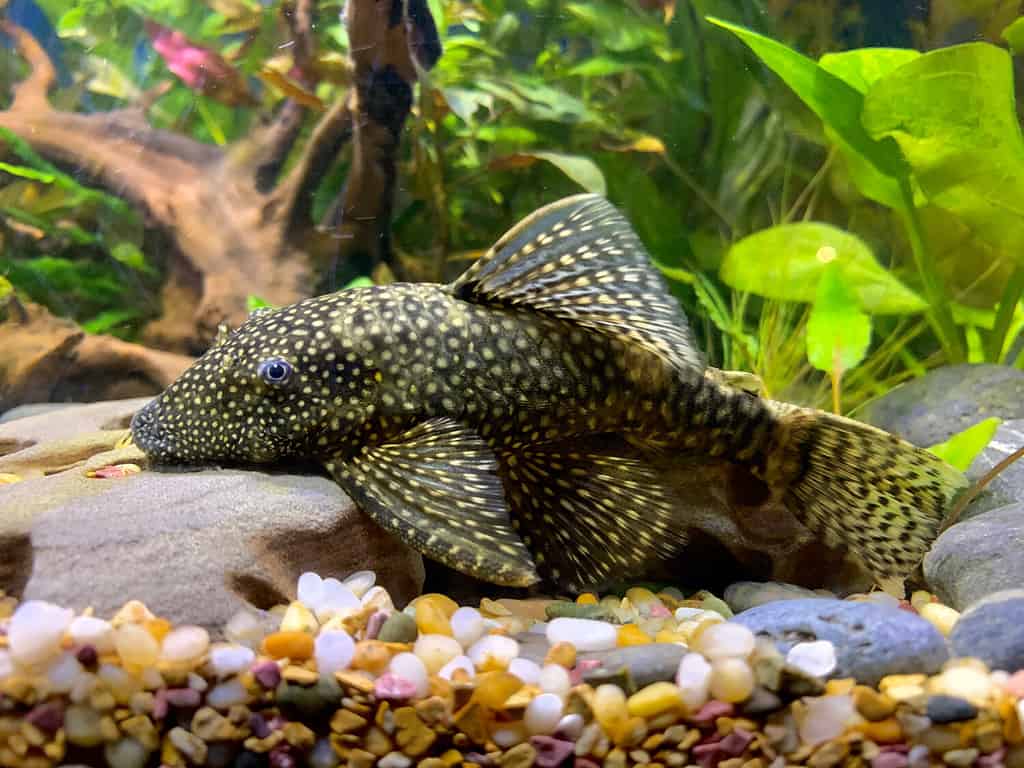
Adding driftwood to the aquarium can hep the Bristlenose pleco’s digestion.
©TTONN/Shutterstock.com
Bristlenose plecos are distinguished by their tentacle-like growths on their faces, which are more elaborate in males, who develop bristles across the whole face, while females have smaller bristles limited to the mouth area and a more rounded snout. They can be found in different varieties, such as albino, green, longfins, and red.
Bristlenose plecos do not need to be kept in groups, as they are not social fish. Bristlenose plecos are bottom-dwellers that will not interact with angelfish.
Rummy Nose Tetras
Rummy nose tetras (Hemigrammus bleheri) are popular aquarium fish that originate from the rivers and streams of the Amazon Basin, primarily in Brazil, Peru, and Colombia.

The rummy nose tetra has a red face and zebra-striped caudal fin.
©Ian Grainger/Shutterstock.com
Rummy nose tetras have a fascinating appearance with distinctive red blotches on their face. Their caudal (tail) fin has a zebra-like pattern, which makes them stand out. Rummy nose tetras typically grow to 2–2.5 inches long, making them too large to be eaten by angelfish.
An advantage of housing rummy nose tetras with angelfish is that the tank does not need to be very large. Rummy nose tetras are nano fish and do not require much space. However, you will need to keep them in groups of six or more so that they can school together.
Mystery Snail
If you do not want to keep other fish with your angelfish, then the mystery snail (Pomacea bridgesii) might be a good choice for you. Mystery or apple snails are freshwater invertebrates that originate from South America. They are a popular freshwater snail kept as pets, typically reaching a shell diameter of around 2 inches. They are peaceful tank mates who will get along well with angelfish while being easy to care for.
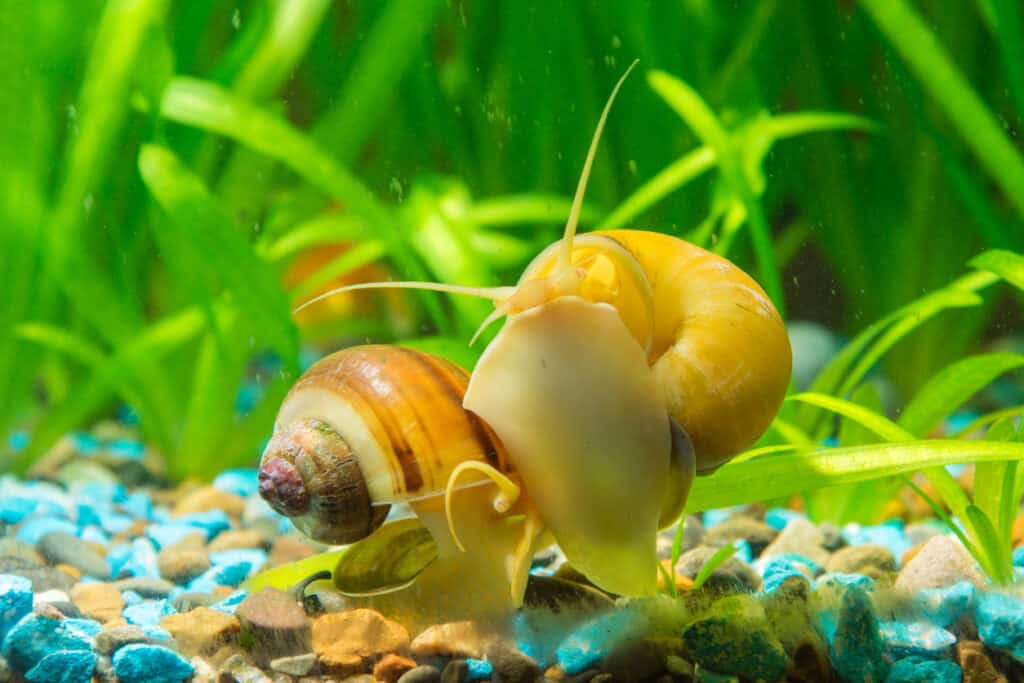
The mystery snail is a large snail found in a range of different shell colors.
©iStock.com/Madhourse
Mystery snails do not have to be kept in groups, so the number of mystery snails you keep with your angelfish is up to you. You can find mystery snails in an assortment of shell colors, like chestnut, gold, and purple. They do not have any special care requirements, aside from needing to be kept in freshwater.
Swordtails
Swordtails (Xiphophorus helleri), like mollies, are live-bearing fish that can be kept with angelfish. The swordtail is named after its elongated caudal fin, which looks like a sword. This sword extension is only seen in males, and the females look similar to mollies. Swordtails grow to a length of up to 5 to 6 inches, with females being slightly larger.

Only male swordtails have the distinctive sword extension.
©topimages/Shutterstock.com
Angelfish and swordtails can be kept together, although you should keep the swordtails in groups of five or six because they are social. They are found in various colors and patterns, including orange, black, blue, green, and silver.
Blue Acara
The blue acara (Andinoacara pulcher) is a type of cichlid that originates from South and Central America. Their striking iridescent blue coloration draws many fishkeepers to the blue acara. They are medium-sized fish at only 6 inches long and pair well with adult angelfish. However, you will need to ensure that the tank is large enough to support both fish.

Blue acara has a striking neon blue coloration and elongated fins.
©tetiana_u/Shutterstock.com
A 75-gallon tank can comfortably house a group of angelfish and a small group of blue acara. Keep in mind that the larger the fish are, the larger the tank needs to be. They share the same temperature range as angelfish, with 75 degrees being ideal.
Bleeding Heart Tetra
As the name suggests, bleeding heart tetras (Hyphessobrycon erythrostigma) have a distinctive red marking near their gills that fades across their bodies. They originate from the upper section of the Amazon River Basin in South America.

Bleeding heart tetras are named after the heart-shaped marking near their gills.
©Aleron Val/Shutterstock.com
Bleeding heart tetras are not very large at 2 to 3 inches long, but are still big enough to be left alone by adult angelfish. They are equally social and peaceful fish that need to be kept in groups of six or more. Bleeding heart tetras are strictly tropical fish and tolerate the same water parameters as angelfish. Their lifespan is quite short at only 3 to 5 years, but it can be improved with proper care.