
Quick Take
- Not all neon tetra tank mates need to be fish. Some of the most compatible companions belong to an entirely different animal group. Discover invertebrate companions →
- One popular aquarium fish grows large enough to seem like a threat to neon tetras, though there is a specific reason it actually isn't. See why mollies are safe →
- The best tank mate for a neon tetra might be one that never shares the same water level with them at all. Meet the bottom dwellers →
- One snail earns its place in neon tetra tanks not just for peace but also for solving a problem most aquarists actively dread. Explore algae-eating snails →
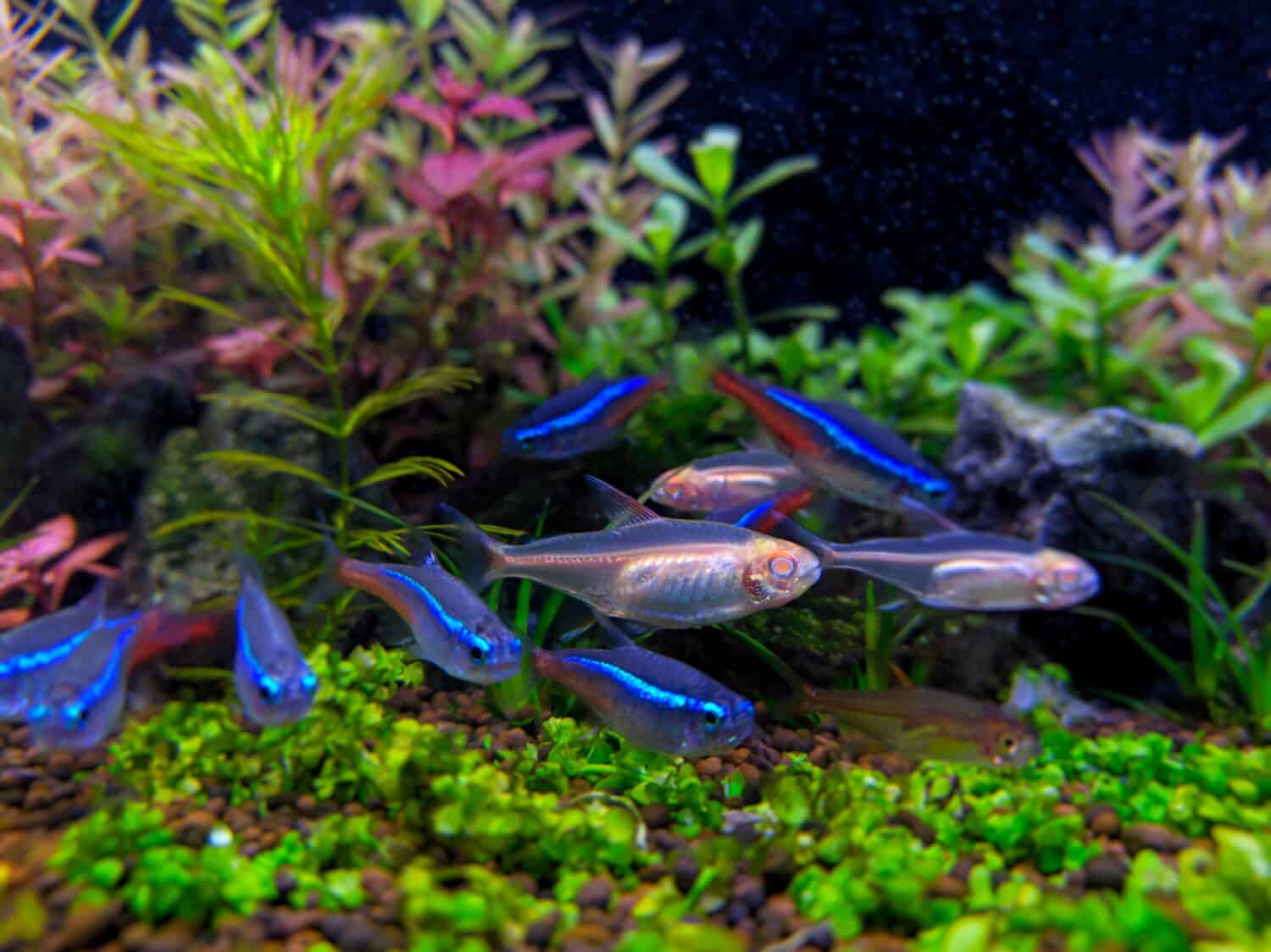
The neon tetra (Paracheirodon innesi) is a small, colorful freshwater fish native to the clear and blackwater streams of the Amazon basin in South America. Neon tetras have an iridescent light-blue horizontal stripe along each side of their body that shimmers under light, sharply contrasted by a vivid red stripe that runs from the middle of their body to the tail. These vivid colors made neon tetras an immediate sensation in the fishkeeping hobby after their discovery in 1934 by French adventurer Auguste Rabaut, and they became popular aquarium fish by the late 1930s. Neon tetras remain one of the most recognizable and widely kept tropical fish in the world as of 2026. Continue reading to learn about 16 ideal tank mates to pair with neon tetras.
| Scientific name: | Paracheirodon innesi |
| Origins: | South America |
| Size: | 1 to 1.5 inches |
| Lifespan: | 5 to 8 years |
| Diet: | Omnivores |
| Temperature: | 72° to 78° Fahrenheit (22° to 26° Celsius) |
| PH range: | 5.0 to 7.5 |
| Tank size (minimum): | 10 gallons (45 litres) |
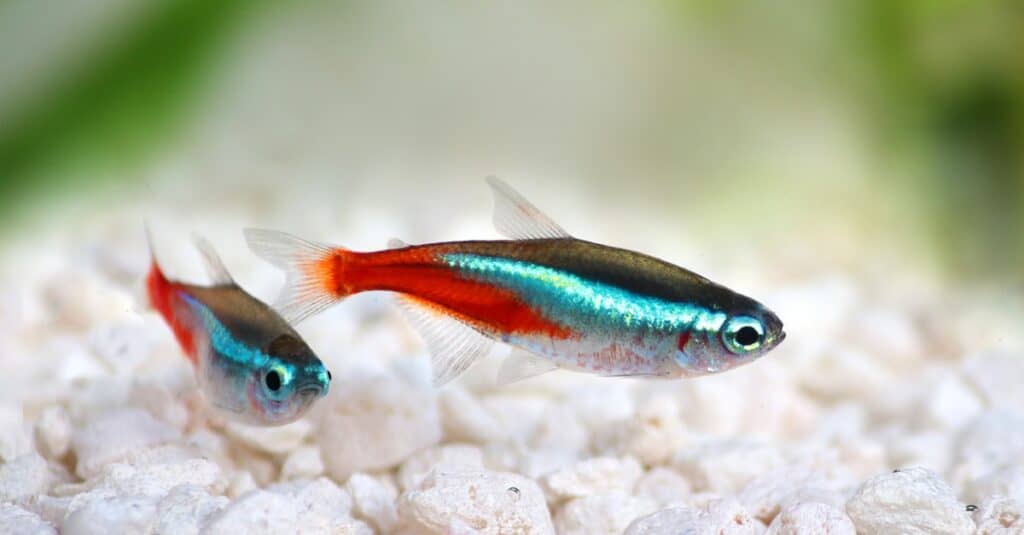
Neon tetras are one of the most vibrant tetra species.
©iStock.com/Mirko_Rosenau
Zebra Danios (Brachydanio rerio)
One of the most common fish species paired with neon tetras is the zebra danio (Danio rerio). Zebra danios are approximately the same size as neon tetras, growing to 1 to 1.5 inches long.
Zebra danios stand out with their colorful striped bodies.
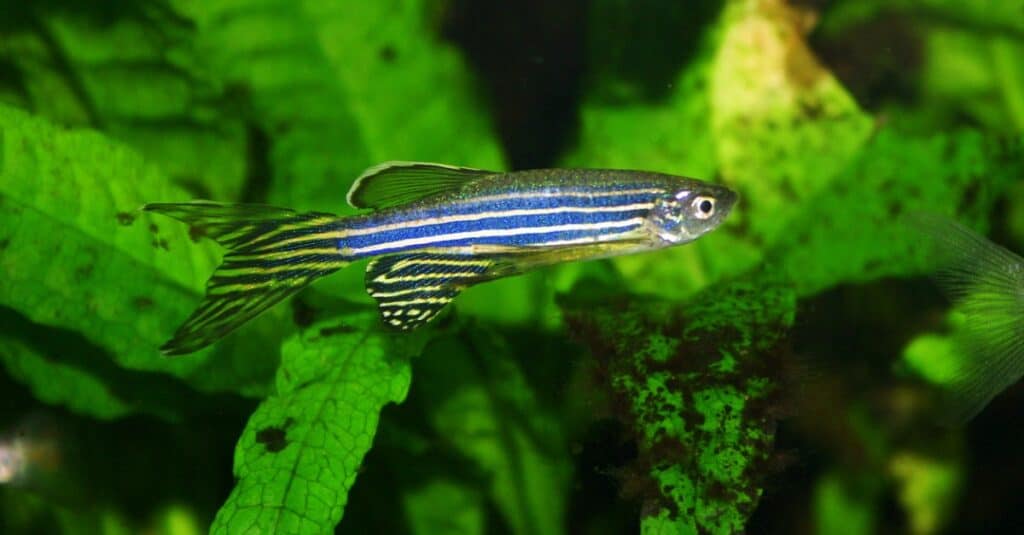
The zebra danio’s stripes make it stand out despite its small size.
©iStock.com/MATTHIASRABBIONE
Zebra danios are relatively peaceful fish that need to be kept in groups of six or more because they are schooling fish.
Harlequin Rasboras
Harlequin rasboras (Trigonostigma heteromorpha) are freshwater fish native to the freshwater streams and rivers of Southern Thailand, Singapore, and Sumatra. They are small fish, only 2 inches long, and are recognized for their reddish-orange bodies.
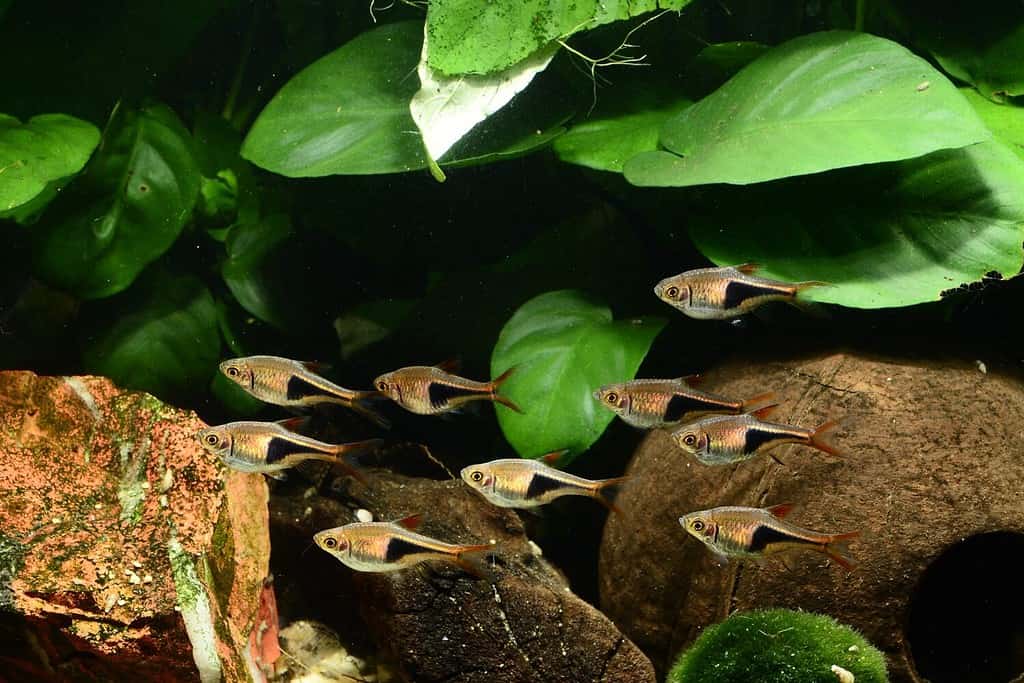
Harlequin rasboras have a black triangular marking on the lower half of their body.
©JuanCarlosPalauDiaz/Shutterstock.com
Harlequin rasboras have a distinctive triangular marking near their caudal fin that makes them stand out against other rasbora fish. In an aquarium, harlequin rasboras will form schools so they should be kept in groups of six to eight.
Lemon Tetras
Lemon tetras (Hyphessobrycon pulchripinnis) are one of the most colorful tank mates you can keep with neon tetras. Their bodies are a striking yellow, in contrast to the blue and red seen on neons. Lemon tetras typically grow to around 2 inches in size and live for approximately five years. They are easy to care for and can live in the same water conditions and temperature as neon tetras.
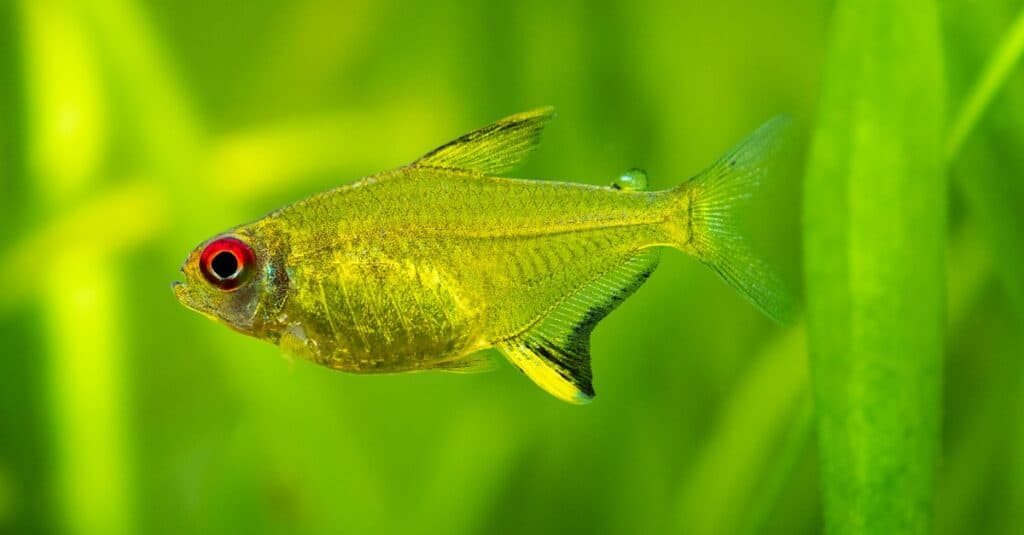
Known for their neon yellow coloration and mild translucency, the lemon tetra is a vibrantly colored tank mate.
©iStock.com/Juan Carlos Juarez Jaramillo
Much like neon tetras, lemon tetras are a social species that should be kept in groups. Lemon tetras are generally more active and lively in an aquarium with live plants and driftwood, especially when they can form schools.
White Cloud Mountain Minnows
White cloud mountain minnows (Tanichthys albonubes) are great tank mates for neon tetras. White cloud mountain minnows are native to China and can adapt to both cold and warm water, including the neon tetras’ tropical conditions.
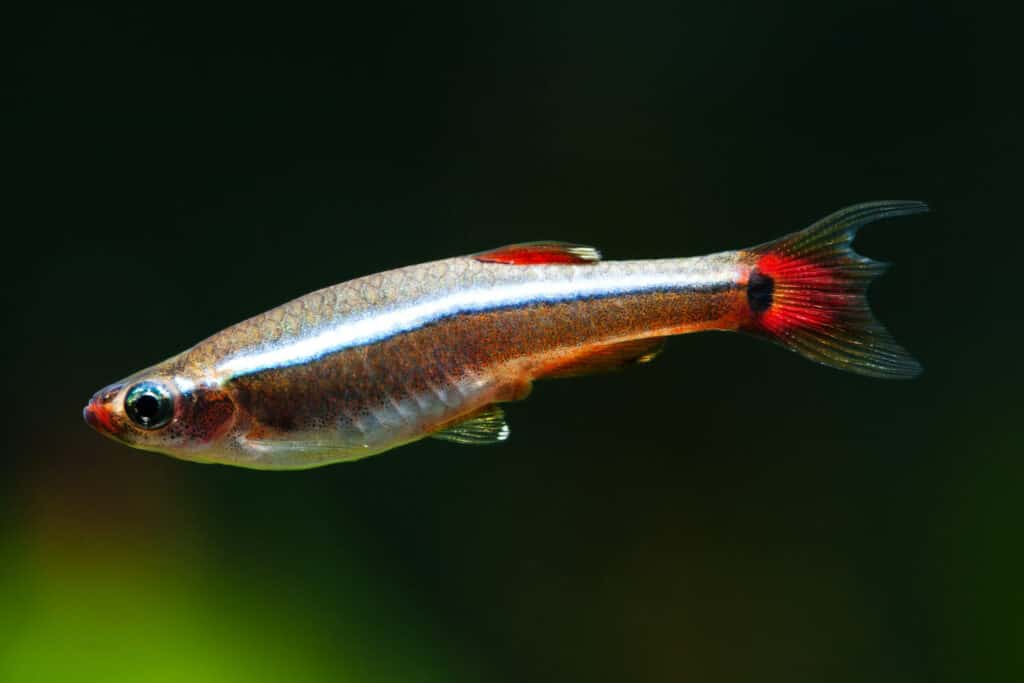
White cloud mountain minnows can tolerate cold water temperatures down to 60 degrees Fahrenheit.
©Besjunior/Shutterstock.com
White cloud mountain minnows have a similar size and body shape to neon tetras, usually growing 1.5 inches long. Their bodies are an iridescent, silvery blue, with a distinctive horizontal stripe. White cloud mountain minnows have reddish-orange fins and a black dot at the base of their caudal fin.
Common Molly
Common Mollies (Poecilia sphenops) are live-bearing fish native to Mexico, Guatemala, and Honduras. They are peaceful omnivores that feed on algae, worms, brine shrimp, and various commercial fish food.
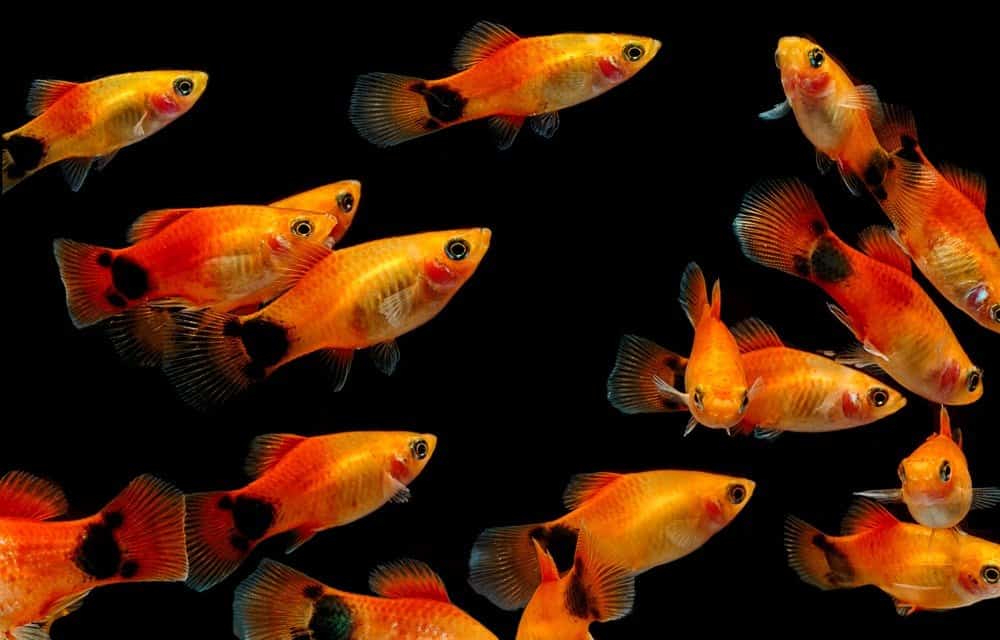
There are more than 40 species of wild mollies.
©Praisaeng/Shutterstock.com
Common mollies are mostly gold, with a splotch of black on the caudal peduncle. Mollies can reach up to 5 inches long as adults, but their mouths are too small to eat neon tetras.
Mollies do not actively hunt other fish and keep to themselves in aquariums. Due to the molly’s size and their schooling requirement of five or more, a tank over 25 gallons is recommended if you keep them with neon tetras.
Guppies
Guppies (Poecilia reticulata) are incredibly popular aquarium fish that have been kept as pets for more than a century. They are live-bearing fish that are characterized by their small bodies and wide range of colors, patterns, and fin shapes.
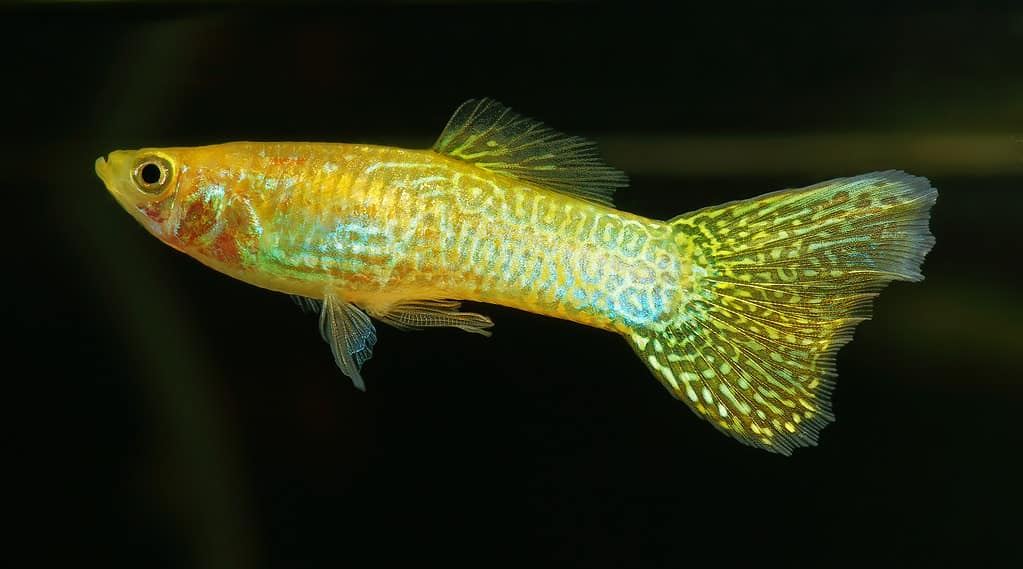
Cobra guppies are a type of fancy guppy with heavy spots throughout their bodies, resembling snakeskin.
©Grigorev Mikhail/Shutterstock.com
Most guppies grow between 1.5 and 2 inches long, with females being slightly smaller than males. They are easy to care for and recommended for beginner aquarists because of their hardiness and adaptability. A group of five to eight guppies can comfortably live with neon tetras in a 25-gallon aquarium with a filter, heater, and live plants.
Swordtails
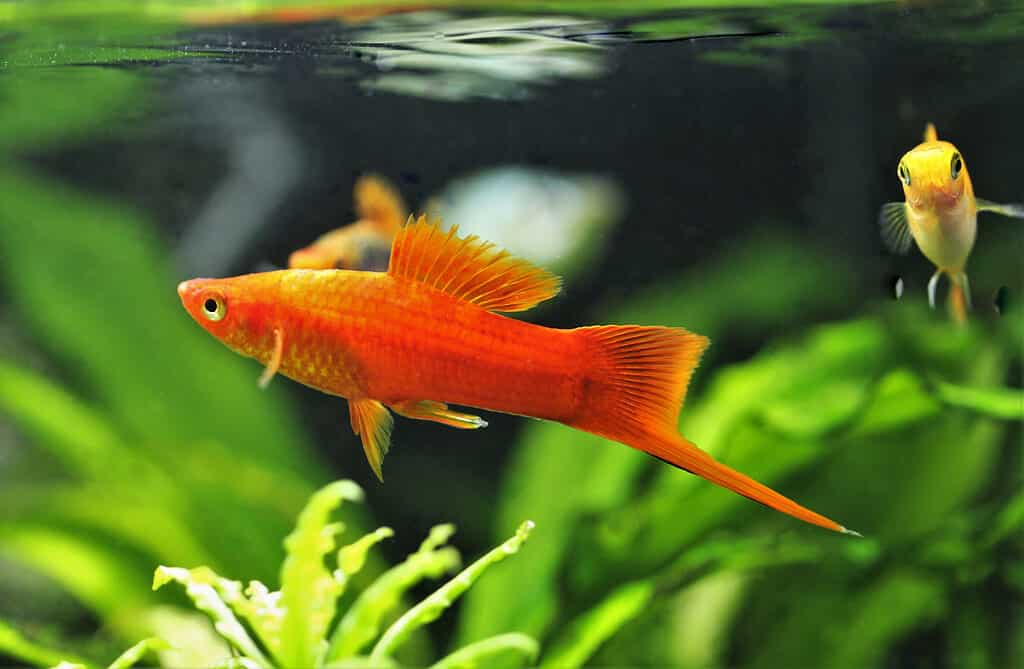
Only male swordtails have the sword-like extension of their caudal fin.
©Arunee Rodloy/Shutterstock.com
Swordtails (Xiphophorus helleri) are live-bearing fish like mollies and guppies, but they stand out with their elongated caudal fins. Their caudal fin resembles a sword, as their name suggests, although it is only seen in males. Swordtails are peaceful freshwater fish that grow to around 5 inches long.
These peaceful fish adapt well to the same water conditions as neon tetras, although swordtails can be sensitive to water quality. Swordtails should only be kept in groups of five or more.
Cory Catfish
The popular bottom-dwelling cory catfish (Corydoras) make perfect tank mates for neon tetras. Cory catfish are native to South America, where they spend most of their time foraging for food along the substrate of slow-moving rivers and streams. There are numerous species of cory catfish, such as the bronze, peppered, and bandit. Most species of cory catfish can coexist with neon tetras, as the catfish will keep to the bottom of the tank, whereas tetras are mid-range feeders.
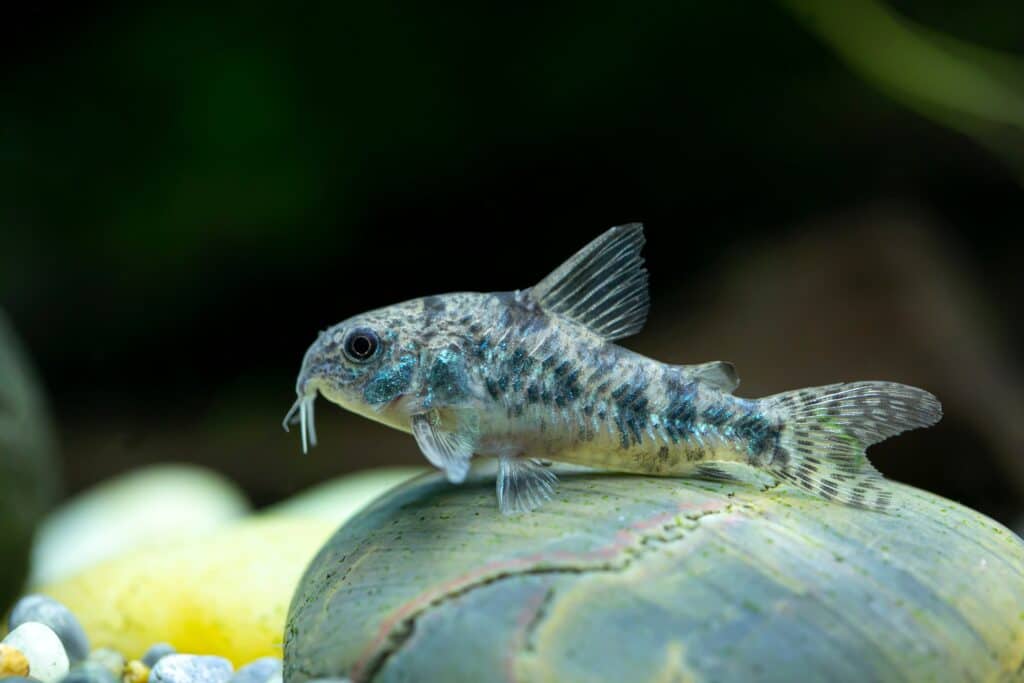
All cory catfish, including this pepper variety, prefer to be kept in small schools, not alone.
©boban_nz/Shutterstock.com
As adults, cory catfish usually reach 2 inches in size, although some species are smaller. Cory catfish are social fish, so you cannot keep them alone or in pairs. They need to be kept in groups of five or more so that they can interact together and socialize.
Bristlenose Plecostomus
Another peaceful bottom-dwelling fish that can be kept with neon tetras is the bristlenose pleco (Ancistrus cirrhosus). They are freshwater catfish native to South America that grow to between 5 and 6 inches long. Male bristlenose plecos have multiple tentacle-like growths on their face, whereas females only have a few short ones. Bristlenose plecos are bottom-dwelling fish that do not need to be kept in large groups. They can be kept in pairs or groups of three or four if the tank space allows it.
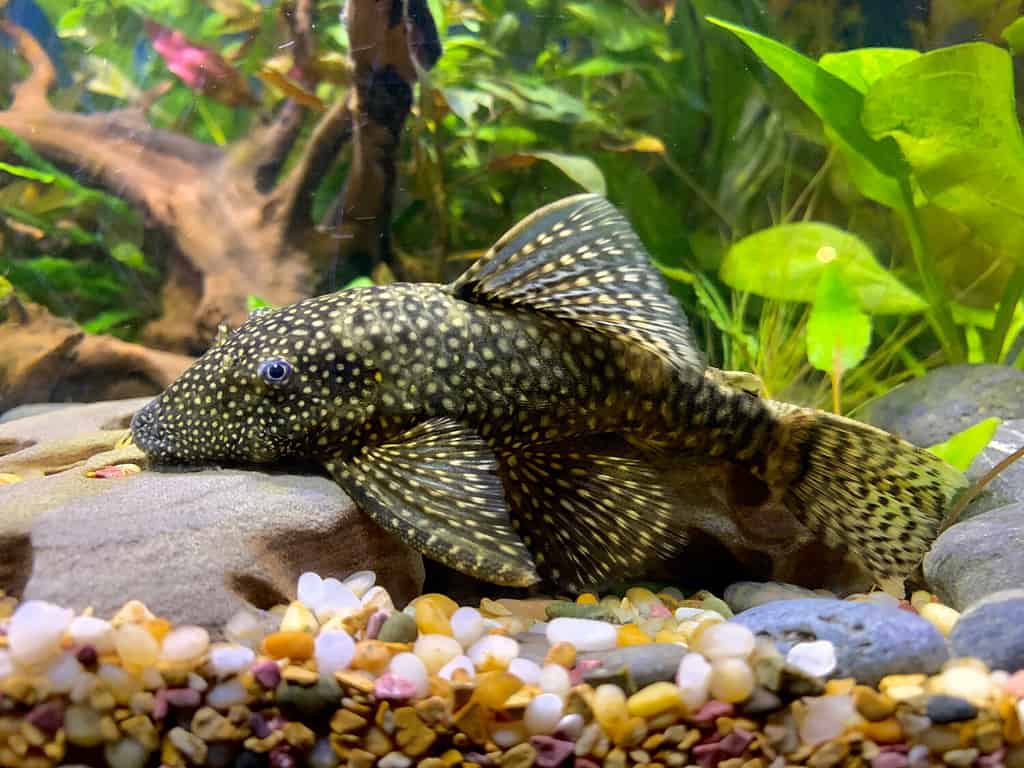
Bristlenose plecos are sometimes referred to as bushynose plecos.
©TTONN/Shutterstock.com
Plecos are easy to care for, which is why they are recommended for beginner fish keepers. If you keep them with neon tetras, be sure to add driftwood to the aquarium. Bristlenose plecos eat driftwood as part of their diet.
Mystery Snails
Fish are not the only tank mates known to get along with neon tetras. Invertebrates like snails and shrimp can be some of the best tank mates for neon tetras.
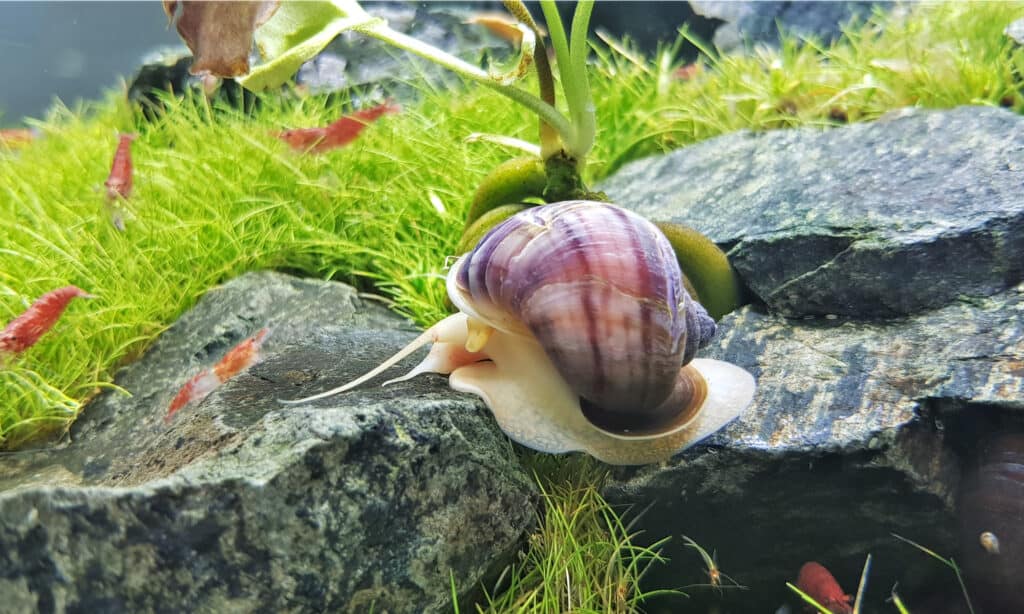
Mystery snails are native to Asia and North America.
©Arunee Rodloy/Shutterstock.com
Mystery snails (Pomacea diffusa) are large aquarium snails that generally grow to around 2 inches in size. These peaceful and active snails are known for their fascinating behaviors, prolific breeding habits, and undemanding care requirements. Mystery snails can also be found in numerous shell colorations, including standard gold or chestnut, or more unusual colors like purple and blue.
You do not have to keep mystery snails in groups, nor do you have to upgrade your neon tetras aquarium to keep them as tank mates. A single mystery snail can thrive in a 10-to-20-gallon neon tetra aquarium as long as the water is kept heated and filtered.
A bonus to keeping mystery snails over other species of snails as tank mates is that rarely eat live aquarium plants.
Nerite Snails
An excellent tank cleaner for neon tetra aquariums is the zebra or spotted nerite snail (Neritina natalensis), which is easy to maintain in aquariums. Nerite snails are small freshwater and brackish water snails that only grow an inch long. They are preferred over other aquarium snails because their eggs can only hatch in brackish water, making it unlikely to overpopulate your aquarium. Nerite snails eat green algae, and they will clean up any leftover fish food that the neon tetras miss. They can be kept alone or in groups and do not take up much space.
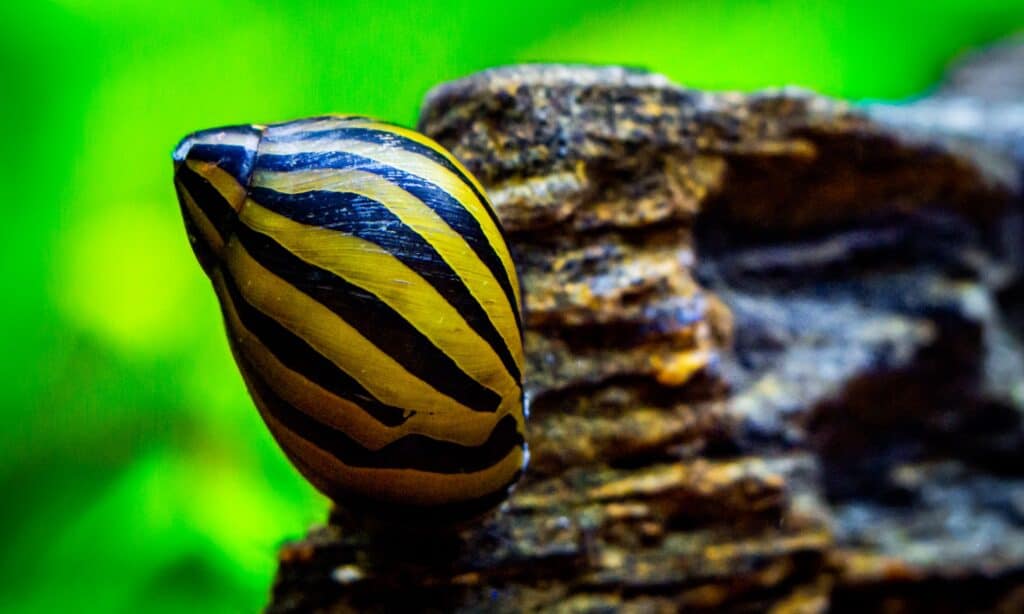
Nerite snails help keep the aquarium clean by feeding on algae and leftover fish food.
©iStock.com/Juan Carlos Juarez Jaramillo