
Quick Take
- African dwarf frogs are carnivores, and that fact changes everything about who can safely share their tank. See tank mate considerations →
- One tank mate isn't a fish at all, and it might be the smartest choice you haven't considered. Meet the invertebrate option →
- Getting the tank size wrong doesn't just stress your fish. It can also turn your frog into a predator. Check the tank size requirements →
- Two of these six tank mates look almost identical, but one is far more forgiving when water conditions slip. Compare swordtail water sensitivity →
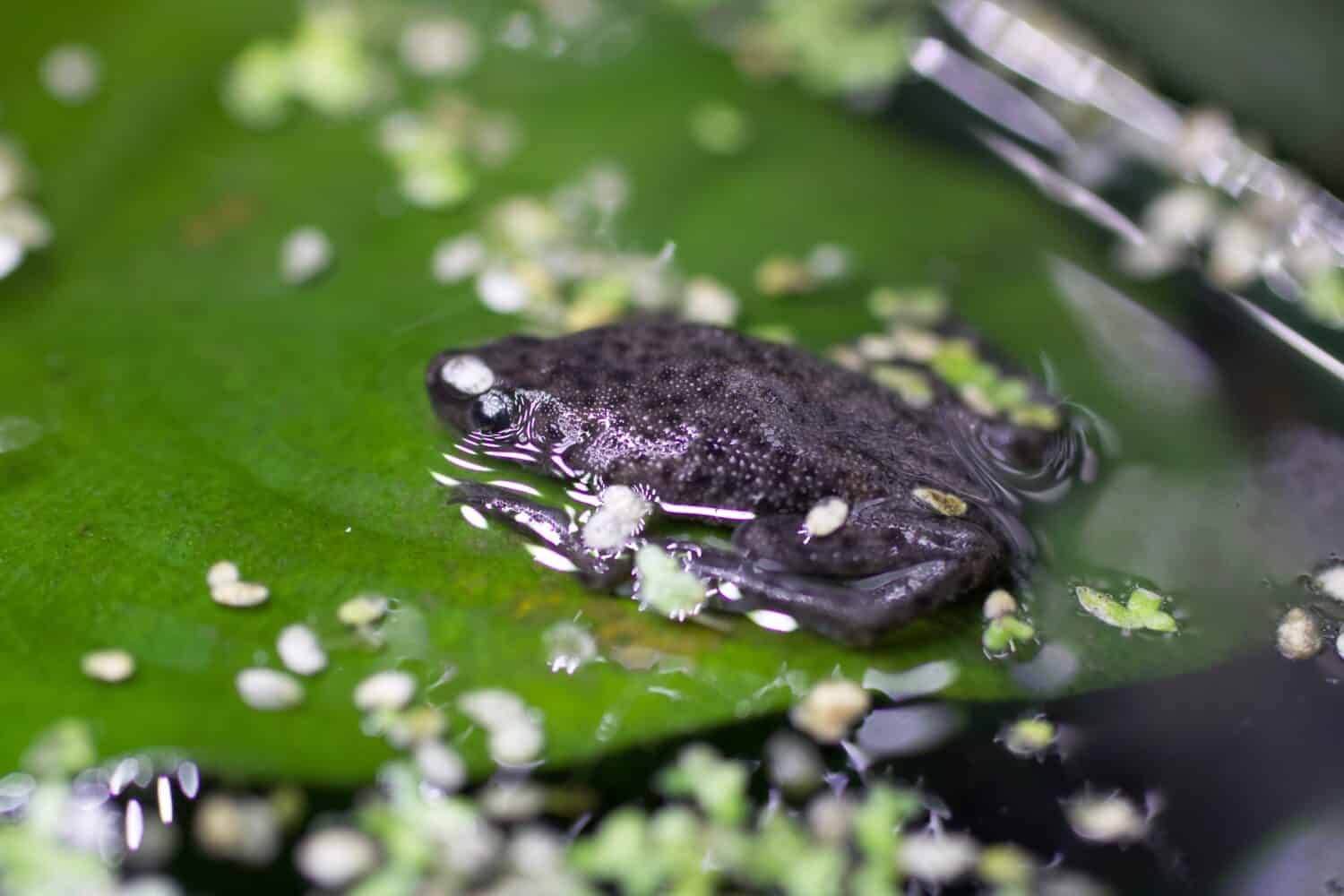
African dwarf frogs (Hymenochirus boettgeri) are small, fully aquatic amphibians that make splendid pets. They originate from Africa, where they inhabit shallow freshwater ponds, rivers, streams, and swamps. These frogs rarely exceed 2.5 inches in size and can live for up to five years with proper care.
Tank mates are one of the most critical aspects of their housing to consider. African dwarf frogs are highly social creatures and should be kept with their own kind. While you can keep them in pairs, a group of three or more is recommended. However, the more African dwarf frogs you keep in a tank, the more tank space they need.
Additionally, groups of African dwarf frogs can cohabit in the same tank with other small, peaceful, and non-carnivorous fish or invertebrates.
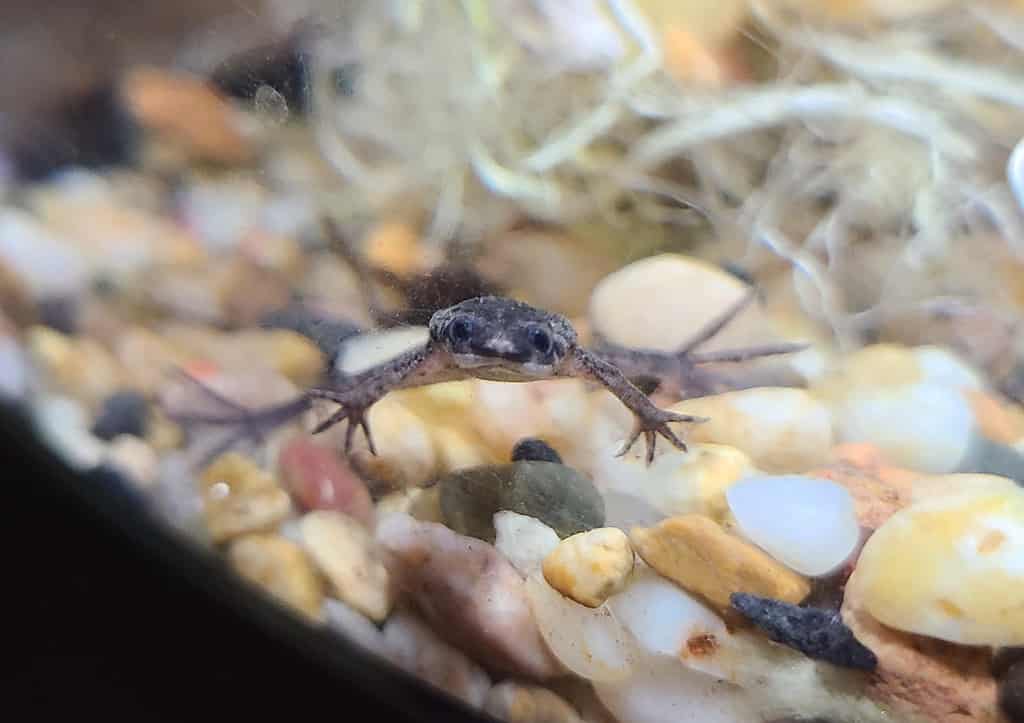
African dwarf frogs grow to between 2 and 2.5 inches long.
©Ashley Magyar/iStock via Getty Images
Overview of African Dwarf Frogs
| Scientific name: | Hymenochirus boettgeri |
| Origins: | Equatorial Africa |
| Environment: | Needs to be kept with its own species. |
| Adult size: | 2.5 – 3 inches |
| Color: | Brown to olive green and black spots |
| Lifespan: | 3 – 5 years |
| Sociability: | They need to be kept with their own species. |
| Minimum tank size: | Minimum tank size: 5 gallons for 1–2 frogs, with a 10-gallon aquarium recommended for up to 4 frogs. |
- African dwarf frogs are naturally carnivorous and may prey on small fish, snails, or shrimp. If you decide to keep them with other fish or invertebrates, there is no guarantee that your African dwarf frog will not eat them.
- If African dwarf frogs can fit the fish or invertebrate in their mouth, they are likely to eat it.
- African dwarf frogs require clean and well-maintained water for their survival. You want to avoid overstocking their tank with fish, especially ones that produce a lot of waste.
- You should only house African dwarf frogs with other fish or invertebrates that require similar water conditions.
- The absolute best tank mate for an African dwarf frog is another African dwarf frog. They do not crave the companionship of other fish, but rather their own species.
Dwarf Gourami
The dwarf gourami (Trichogaster lalius) is a type of anabantoid fish that belongs to the same family as the popular betta fish. Anabantoid fish have a lung-like organ (labyrinth) that allows them to breathe atmospheric oxygen. Dwarf gouramis are typically 2 to 3 inches long, which is similar to the African dwarf frog. You can keep dwarf gourami in the same tank as African dwarf frogs if the tank is large enough, as both species need enough room to swim comfortably.
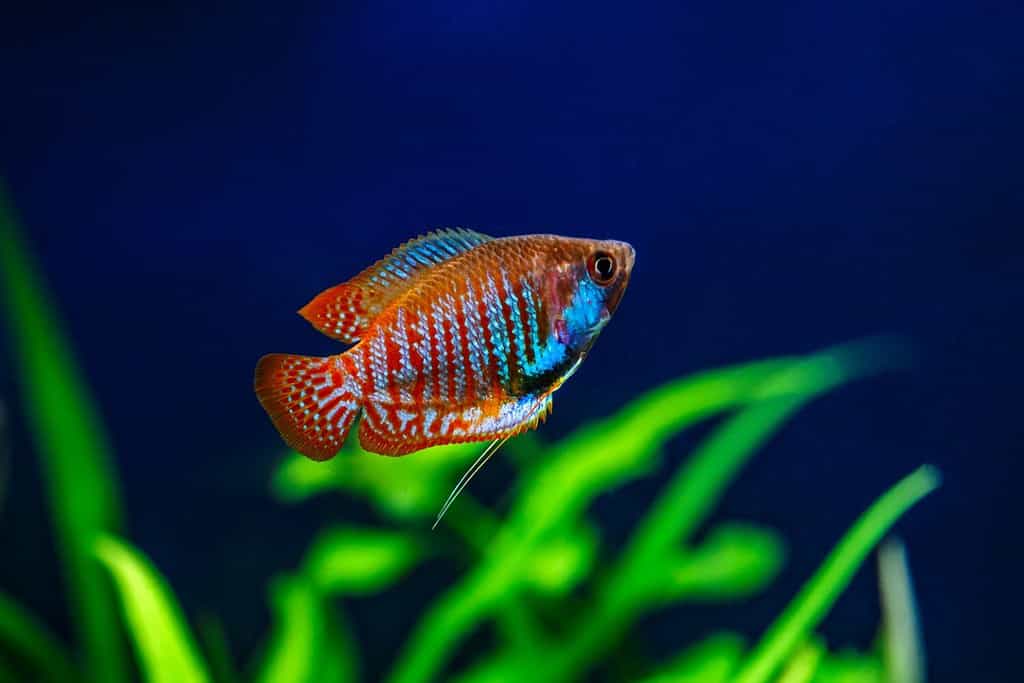
The dwarf gourami can be found in a range of different colors.
©Bukhta Yurii/Shutterstock.com
Dwarf gouramis can be found in a wide range of colors, so they will help brighten up your African dwarf frog’s tank. You can find them in colors such as orange, red, blue, and yellow. Most dwarf gouramis are peaceful fish, and they will not interact with African dwarf frogs much. You also do not have to worry about your African dwarf frogs eating adult dwarf gouramis, since they are too large to fit into their mouths.
Short-finned Molly
Short-finned mollies (Poecilia sphenops) are very hardy, colorful, and adaptable live-bearing fish that can coexist peacefully with African dwarf frogs. Most mollies are too large to fit into an adult African dwarf frog’s mouth since they reach around 2 to 4 inches in length. They are very docile and social fish that will not pose a threat to African dwarf frogs.
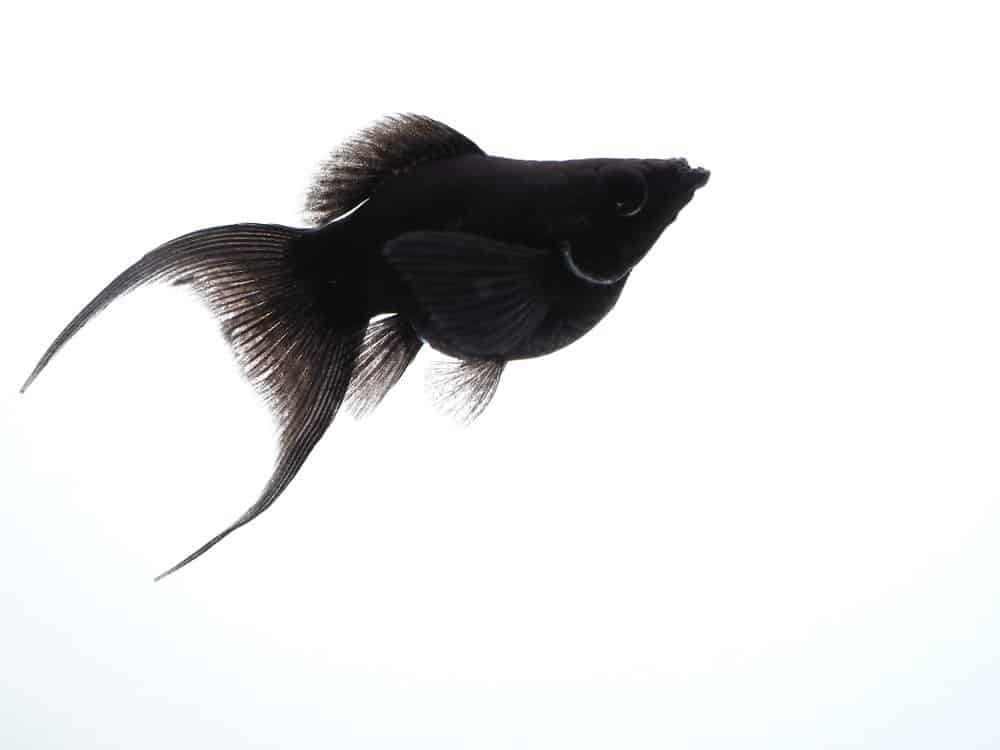
You can find mollies with various fin shapes, like the stunning lyre-tail variation.
©Palomasius/Shutterstock.com
Mollies can handle a wide range of temperatures but thrive best in the tropical temperatures that African dwarf frogs need. You can find mollies in an assortment of impressive colors and patterns, making them a colorful addition to many African dwarf frog tanks. Keep in mind that mollies are highly social fish and should be kept in groups of four or more.
If you keep mollies in the same tank with African dwarf frogs, you will need to be mindful of the tank size. The bigger the tank is, the better. However, 20 gallons is a good starting size for two African dwarf frogs and a handful of adult mollies.
Giant Danio
If you are looking for a larger, peaceful, and vibrantly colored African dwarf frog tank mate, then the giant danio (Devario aequipinnatus) is worth considering. The giant danio is the largest type of danio fish, reaching a length of up to 6.5 inches. When giant danios are fully grown, their size makes it difficult for African dwarf frogs to eat them. Giant danios are very peaceful and social fish that keep to themselves in an aquarium.
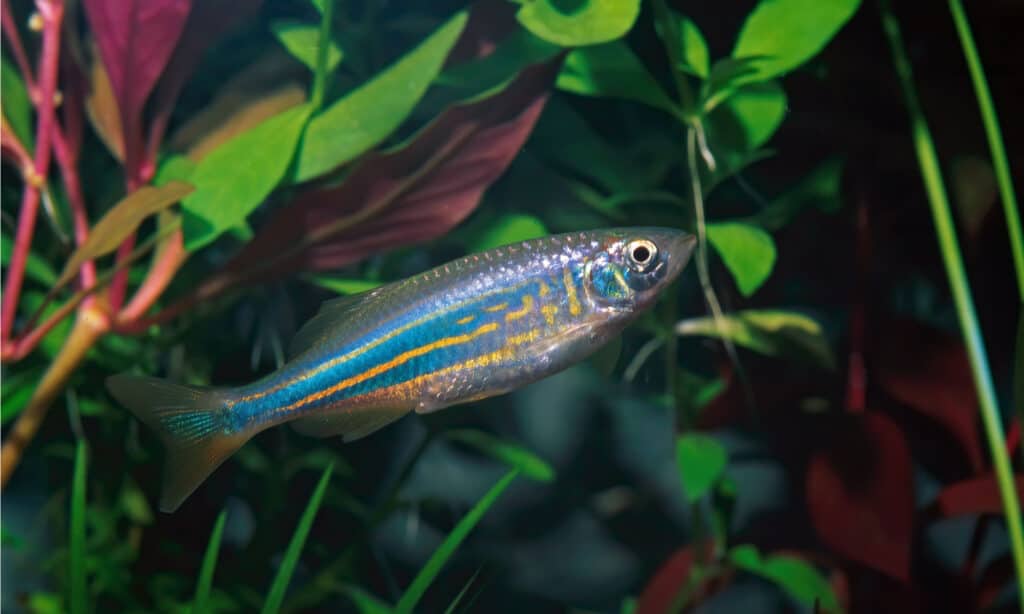
Danios are tropical fish that belong to the minnow family.
©Karel Zahradka/Shutterstock.com
Giant danios thrive in a heavily planted and spacious tank that is kept at tropical temperatures. These fish can be housed with African dwarf frogs but require a minimum tank size of 30 gallons due to their size and group numbers. Giant danios have a striking appearance, consisting of a vivid gold body with blue markings.
Swordtail
Swordtails (Xiphophorus helleri) are live-bearing fish that are sometimes mistaken for mollies. The main difference between the two is that male swordtails have a tail fin that extends out and resembles a sword. However, the female swordtails do not have this extension, which makes female swordtails easier to identify.
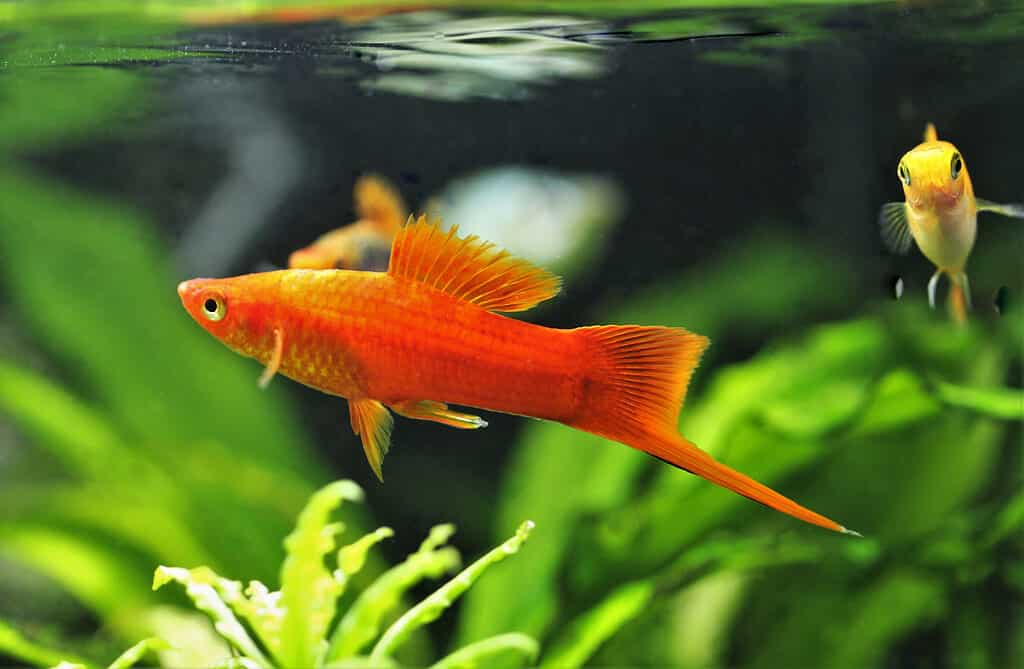
Male swordtails have a tail extension that resembles a sword.
©Arunee Rodloy/Shutterstock.com
Both male and female swordtails can be found in different colors that can liven up an African dwarf frog aquarium. You can find them in vibrant oranges, reds, golds, blues, yellows, and even silver.
Swordtails typically grow to around 4 to 5.5 inches in length, including the male’s elongated tail. When fully grown, swordtails can be successfully kept with African dwarf frogs. They are usually too large to be eaten by African dwarf frogs but still require plenty of dense vegetation to hide in. In comparison to mollies, the swordtail is slightly more sensitive to water quality changes.
They are not as tolerant of sudden temperature fluctuations and do not handle environmental stress well. Swordtails need to be kept in groups of four or more.
Mystery Snail
As an alternative to fish, the mystery snail (Pomacea bridgesii) is a good choice. Mystery snails reach an adult size of 2 to 2.5 inches and are generally too big to be eaten by African dwarf frogs.
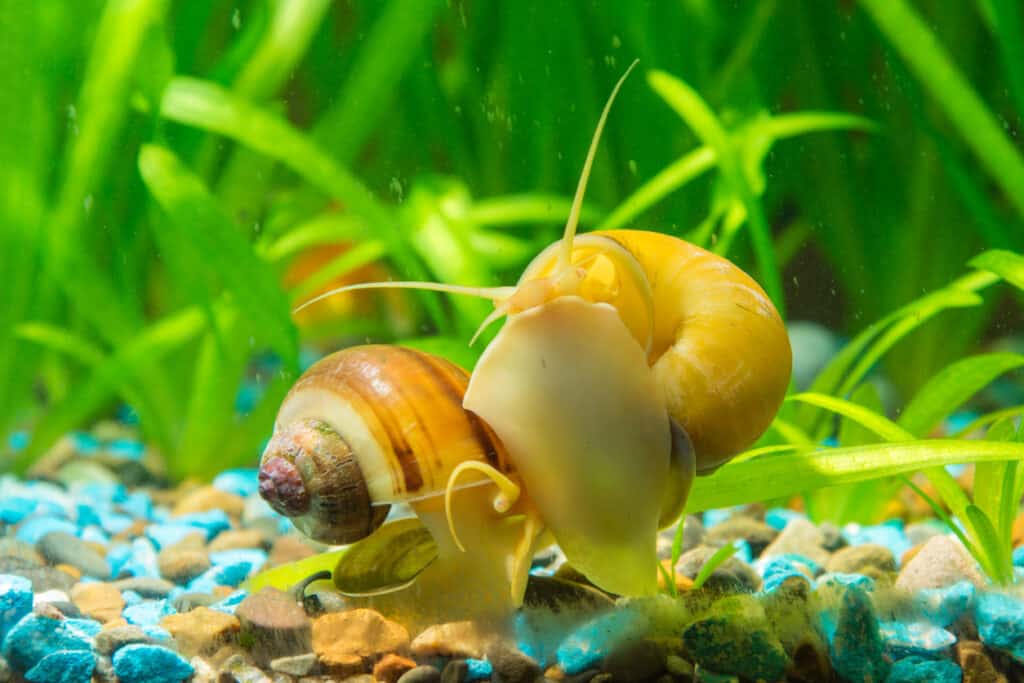
Mystery snails are like the jewels of the snail world since they can be found in various colors. Purple, baby blue, pink, olive, gold, and chestnut are some popular color forms.
©iStock.com/Madhourse
The mystery snail is often preferred over other types of snails due to its size, ease of care, and color forms. They are peaceful snails that can be kept alone or with other mystery snails. They live for around 2 years and grow relatively quickly.
One advantage of keeping mystery snails with African dwarf frogs is that the tank does not need to be much larger than it already is to accommodate the number of frogs you are keeping. Mystery snails only require around three to five additional gallons. You won’t need to worry about mystery snails harming your African dwarf frogs since they are very docile creatures. However, African dwarf frogs might try to eat the eggs that mystery snails lay above the waterline.
Southern Platyfish
Like mollies and swordtails, Southern platyfish (Xiphophorus maculatus) are live-bearing fish from the Poeciliidae family. Mature Southern platyfish are 2 to 3 inches in length and can be found in a range of colors. Platys are peaceful and social fish that need to be kept in groups of four or more.
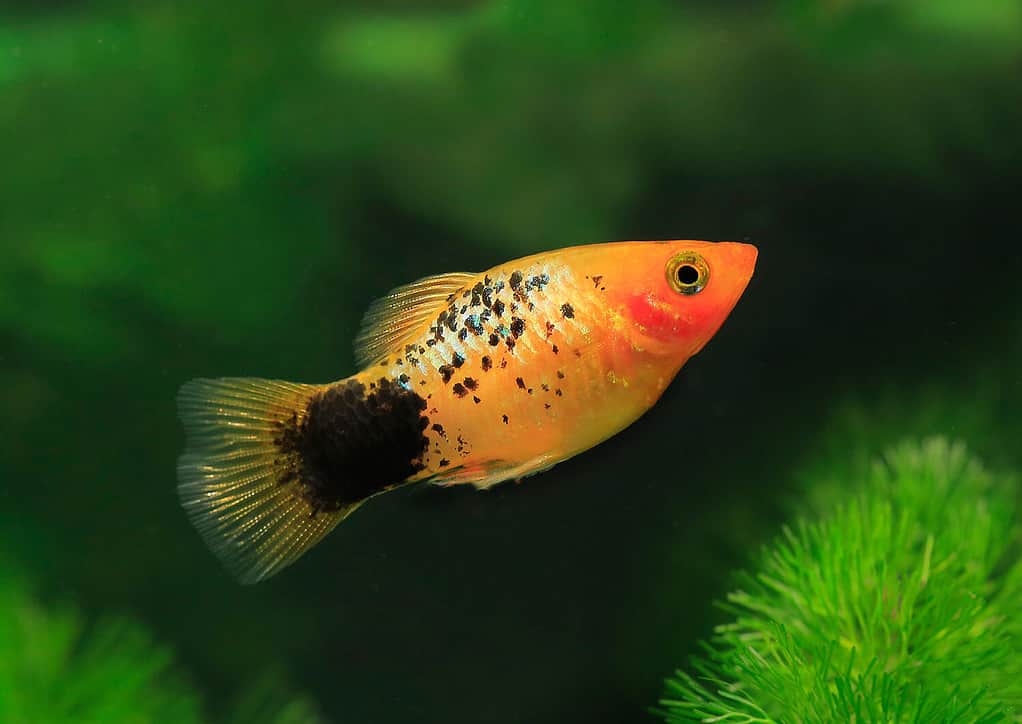
Platies are colorful live-bearing fish that do not lay eggs, but rather give live birth.
©R. Maximiliane/Shutterstock.com
When housed with African dwarf frogs, platies make colorful additions to the aquarium while being calm, even-tempered fish. They are not known to be aggressive to other fish or even amphibians like African dwarf frogs. This allows platies to coexist peacefully in the same tank as African dwarf frogs if the tank is over 20 gallons in size.
Platies swim primarily in the middle and top layers of the tank, while African dwarf frogs tend to gravitate toward the bottom, meaning these two species will rarely interact.