
Quick Take
- One frog on this list reproduces in a way so bizarre it looks like a horror film, yet the female is completely unharmed by it. See the bizarre birth →
- The African clawed frog's mating behavior is so indiscriminate it defies basic biology, which is one reason the species thrives almost anywhere. Explore the mating habits →
- One of these underwater frogs has played a bigger role in human genetics research than most lab animals you've heard of. Discover the genetics research →
- Some of these fully aquatic frogs make surprisingly low-maintenance pets, but one species secretes something that makes tank ownership a constant battle. Learn about clawed frog ownership →
While basically all frogs are semi-aquatic to some degree, some species spend nearly all of their lives underwater! Though they are quite rare, there are several notable varieties of nearly fully aquatic frogs. Most types of water frogs are part of the Pipidae family, which are native to warm, humid areas of South America as well as southern Africa. Let’s take an in-depth look at fully aquatic frogs below.
1. African Clawed Frog
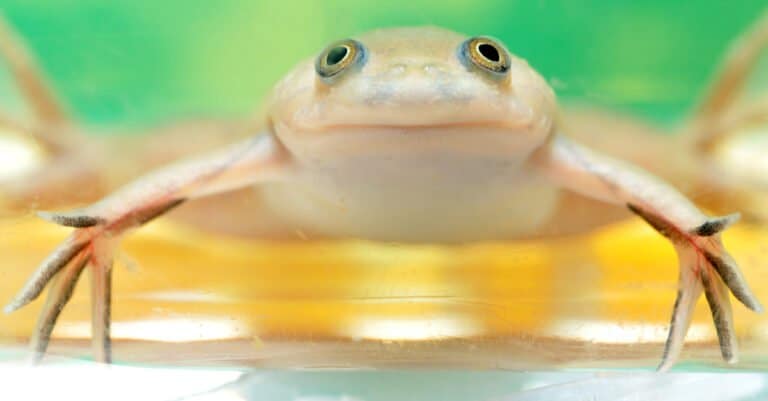
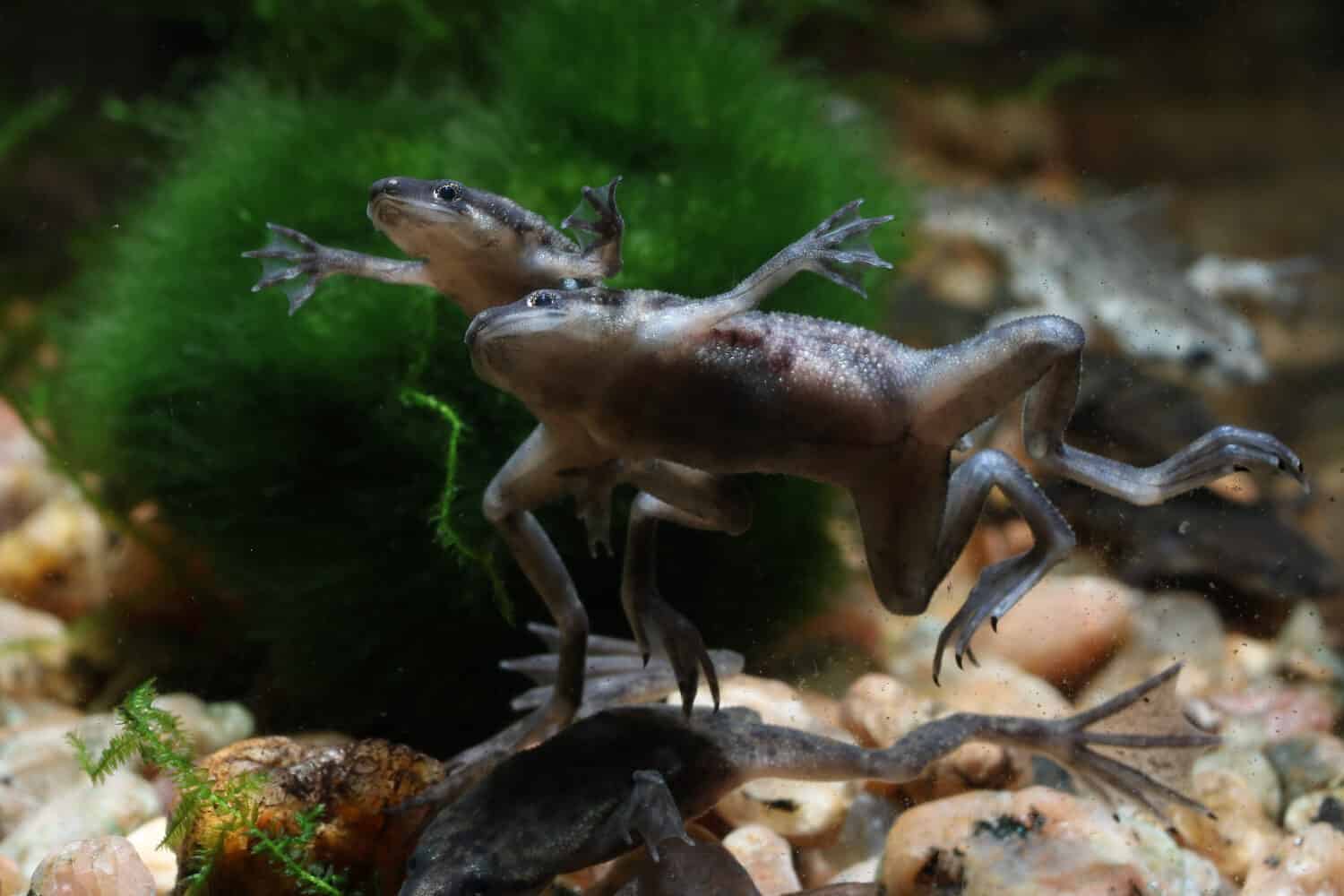
Named for the short claws on their muscular hind feet, the African clawed frog (Xenopus laevis) almost never leaves the water. These frogs measure from around 2.5 inches in males to about 4.3 to 5.1 inches in females. They are tongueless and toothless, relying on a hyobranchial pump to pull food down their throats after pushing whatever food they can find into their mouths with their forelimbs.
Additionally, they are fully carnivorous and will eat just about anything that crosses their path that is smaller and weaker than they are. They even sometimes participate in cannibalism, often feeding on their own eggs and other frogs’ eggs, tadpoles, and even froglets.
Their extreme indifference towards their food also extends to their reproductive habits. Male African clawed frogs aren’t particularly selective when it comes to their partners, often grabbing onto other males or even frogs of entirely different species. African clawed frogs have also been quite popular in the pet trade for decades. They are fairly low-maintenance pets, able to live for up to 15 years in the wild and 25–30 years in captivity under optimal conditions.
African clawed frogs will eat just about anything that crosses their path.
©D. Kucharski K. Kucharska/Shutterstock.com
2. Surinam Toad
Most people know the Surinam toad (Pipa pipa) for its bizarre method of reproduction. There are actually several species of Surinam toads within the Pipa genus, but the common Surinam toad (also sometimes known as the star-fingered toad) is the most popular. These unusually flat, beady-eyed frogs live throughout eastern South America and Trinidad in subtropical and tropical swamps and forests. They typically measure 4-8 inches in length.
The Surinam toad’s claim to fame is the way it gives birth. When a male finds a willing female, she releases her eggs for him to fertilize. Once the male fertilizes them with his sperm, he will push them onto the female’s back, so they stick to her skin. Over time, she grows a new layer of skin over the eggs, essentially incubating them on her back. When it’s time for the eggs to hatch, they will emerge from the eggs and burst out of the skin on the female’s back. Fortunately, this process doesn’t harm the female in any way. After her clutch hatches and emerges from her back, she’ll begin to regenerate the skin.
Surinam toads lead fairly solitary, uneventful lives otherwise. They feed on various aquatic invertebrates, like worms and small crustaceans, as well as small bony fish. Interestingly, both males and females of the species have sensory organs in their fingers. They use these organs to search for food!
Surinam toads are less common in the pet trade compared to other aquatic frogs, but they can still be found for sale among specialty amphibian enthusiasts. They require lots of privacy, mainly in the form of tank decorations and plants. Additionally, they prefer low-light conditions, making them difficult to observe. The water in their enclosures also has to be changed often, as the toads secrete a lot of ammonia from their skin.
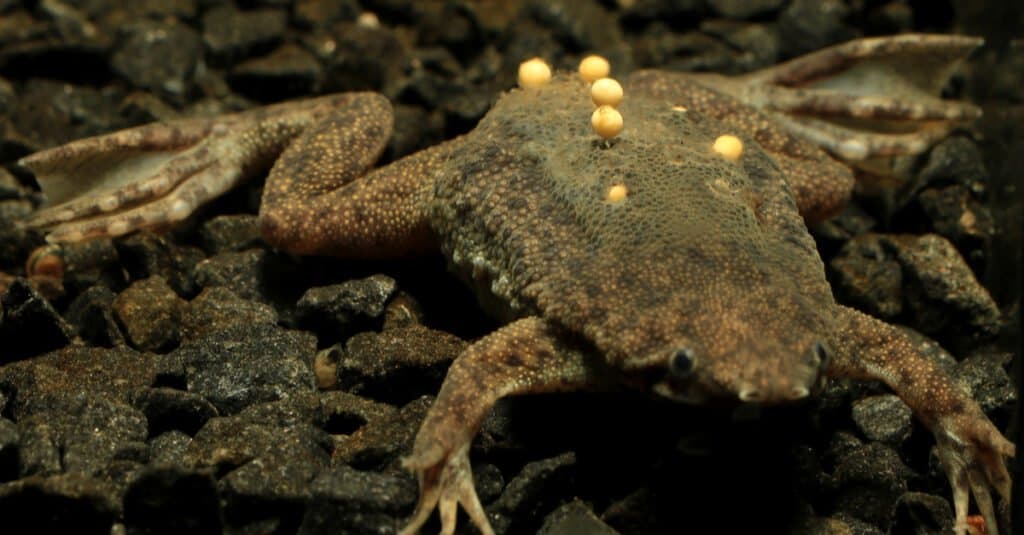
Surinam toads are well-known for the unusual way the females incubate their eggs.
©Dan Olsen/Shutterstock.com
3. Western Clawed Frog
Often mistaken for African clawed frogs, western clawed frogs (Xenopus tropicalis), also known as tropical clawed frogs, are yet another member of the aquatic Pipidae family. They are perhaps most notable for their use as a model organism in genetic studies and genome sequencing, thanks to their fully sequenced genome and evolutionary significance.
Other benefits of using them in research are that they are hardy, breed easily and quickly in captivity, and take up very little space. Scientists have found they are also good test subjects for assessing the effects of environmental toxins and diseases on amphibians, which are declining in population worldwide due to pollution and infection.
Small in size at only up to 2 inches, these little water frogs live in the rainforests of the west coast of equatorial Africa from Gabon to Sierra Leone. Their front legs are small and weak, but their hind legs are very muscular for swimming. They prefer hiding in warm, moist swamps, marshes, and river and creek beds. The species is mostly carnivorous, usually feeding on insects and invertebrates like worms, grubs, and sometimes even other frogs’ tadpoles.

Western clawed frogs are often used in genome sequencing and other genetic studies.
©TadeasH/Shutterstock.com
4. Zaire Dwarf Clawed Frog
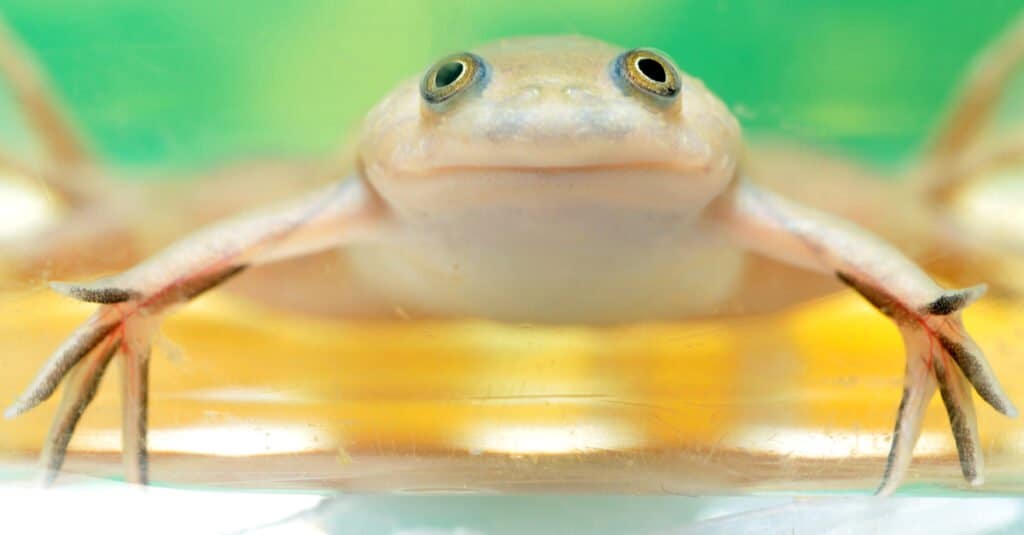
We revisit the Pipidae family once more to discuss the Zaire dwarf clawed frog (Hymenochirus boettgeri), also sometimes known as the Congo dwarf clawed frog. They are small yet hardy water frogs that live throughout central and western Africa in slow-moving rivers and creeks.
On average, they can reach up to around 2 inches long and have long, strong, back legs with short, stubby front limbs. True to their name, the frog’s hind feet have short claws, which they use for self-defense. Notably, the males tend to look as if they have enlarged heads due to their enlarged external eardrum, or tympanum.
Like other clawed frogs, the Zaire dwarf clawed frog (often sold as the African dwarf frog) is common in the pet trade due to its long lifespan and resilient, docile nature. They cannot be handled much, as their skin dries out very quickly, like that of most aquatic frogs. However, they can be fun to observe in captivity, as they are strong swimmers and are naturally curious and active.
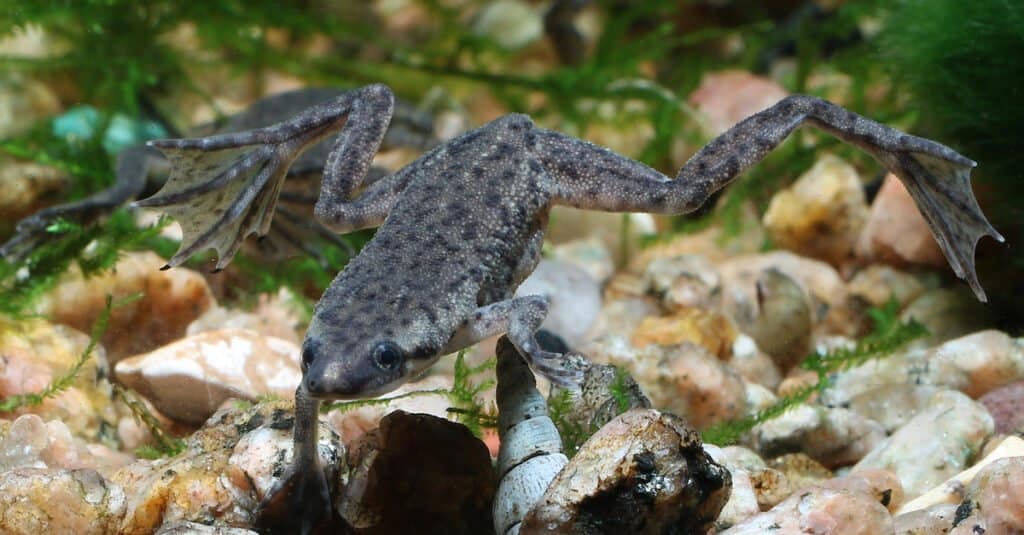
The Zaire dwarf clawed frog is naturally curious and active, making it popular in aquariums.
©Dan Olsen/Shutterstock.com
5. Green Puddle Frog
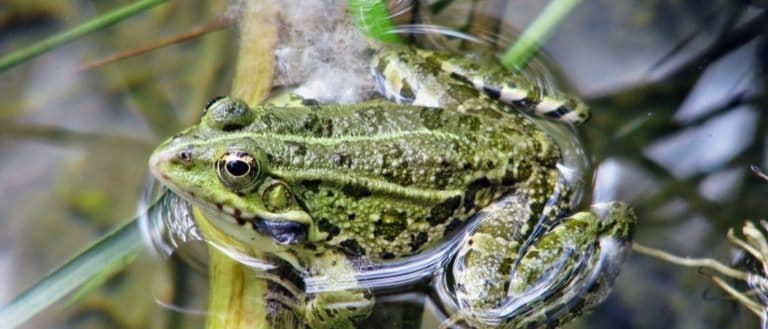
We finish this list with the green puddle frog (Occidozyga lima), a member of the Dicroglossidae family. They are also sometimes referred to as Indonesian floating frogs. Like other aquatic anurans, they spend almost their entire lives in water, only briefly coming to the surface for air. Native to South and Southeast Asia, green puddle frogs mostly inhabit shallow subtropical swamps, marshes, and slow-moving rivers and creeks.
This aquatic frog is smaller than the other frogs on our list, measuring only up to around 1.2 inches. They make good pets, as they are hardy and active and not particularly picky eaters. Because of their peaceful nature, it is common for pet owners to house them alongside fish and other water frogs. As carnivores, green puddle frogs primarily feed on small insects like crickets, worms, and flies.
Though they are docile and inexpensive to care for, green puddle frogs are very shy and reserved. They require plenty of privacy in the form of dense plant cover and rocks in captivity. Like other aquatic frogs, their skin is sensitive and dries out quickly, so they should not be handled directly.

Green puddle frogs live throughout South and Southeast Asia.
©ABS Natural History/Shutterstock.com