
Quick Take
- All seals are carnivores and have teeth; even baby seals are born with teeth.
- Seals evolved from bear-like terrestrial carnivores that are believed to have lived around 23 million years ago.
- Seals exclusively hunt underwater and use their teeth to grasp and hold prey.
- Seals have a wide range of feeding specializations and diverse adaptations in dentition.
Seals are marine mammals that primarily live in polar, subpolar, and temperate waters around the world. As carnivores, all seals have teeth. Even baby seals are born with teeth. However, the shape and function of their teeth vary depending on the species. Keep reading to find out everything you need to know about seal teeth and learn about seals’ diverse dental adaptations.
Seal Family Facts
There are over 30 species in the pinniped suborder, which includes seals, sea lions, and walruses. However, most pinnipeds are a type of seal. Eared seals, or fur seals, belong to the Otariidae family. These seals have visible ear flaps, long necks, and long front flippers. They are agile both on land and in the water. They can pull their hind flippers under their bodies and extend their front flippers to walk using all four limbs. Some of the members of the Otariidae family include Antarctic fur seals, Galápagos fur seals, and sea lions. While some species exhibit increased dental variation, eared seals tend to have simpler dentition, which refers to the type and number of teeth an animal has and how they are arranged.

Antarctic fur seals belong to the Otariidae family of pinnipeds.
The Phocidae family includes the true seals, or earless seals. Earless seals actually do have ears, but they do not have visible external ear flaps. Earless seals have small ear holes instead of flaps. These seals have shorter necks and shorter front flippers than their Otariidae cousins, and they are not as coordinated on land. They cannot pull their hind flippers under their bodies, so they use an undulating movement like a caterpillar. Some of the seal species in the Phocidae family are gray seals, harbor seals, and elephant seals. True seals have a more diverse range of feeding specializations, which has led to diverse adaptations in dentition.
Seal Teeth
Seals evolved from terrestrial, bear-like carnivores that are believed to have lived around 23 million years ago. Their terrestrial ancestors had more elaborate dentition, so unlike other marine mammals, seals’ dentition has evolved differently. In stark contrast to their land-based ancestors, seals exclusively hunt underwater. Both eared and earless seals primarily use their sharp teeth to grab and hold prey using a hunting style known as pierce feeding. They first bite into prey to secure it, and then their prey is either swallowed whole or torn into smaller chunks that they can swallow. Seals do not chew their food. They often combine this method of feeding with suction feeding, in which they create negative pressure to pull prey deeper into their mouths.
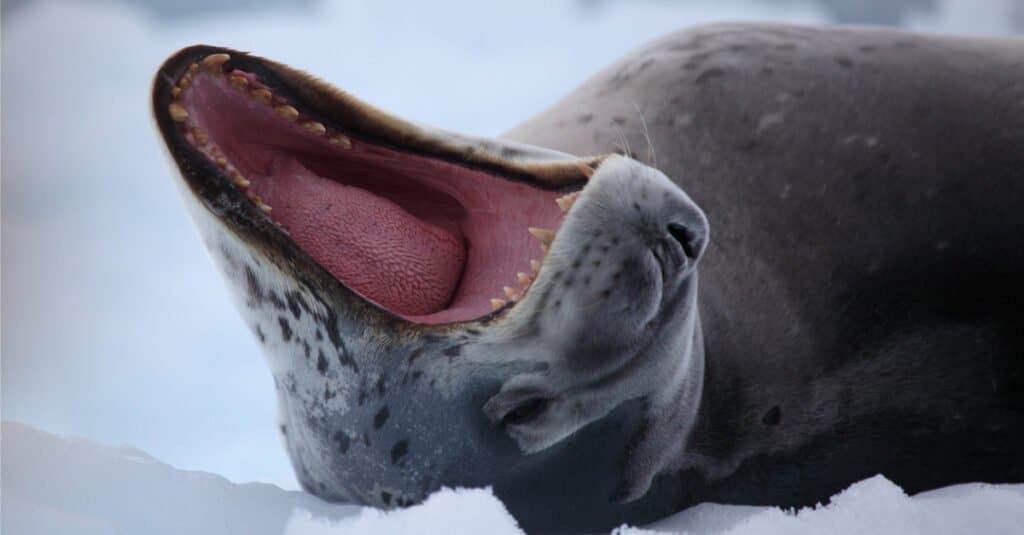
Seals generally have between 34 and 38 teeth.
©iStock.com/MogensTrolle
Although the number of teeth can vary between species, most seals average between 34 and 38 teeth. While they have kept their sharp canine teeth, their molars have been adapted for swallowing prey whole. Researchers have found that with the loss of chewing and the rise of pierce-feeding techniques, seals’ teeth have evolved to become more homodont, which means they are similar in shape and size. Sharp, uniform postcanine teeth pierce and grasp slippery prey. Their teeth also have simpler cusp morphology. Cusps are the elevations on the chewing surface of the tooth that aid in chewing. Since seals do not need to chew, they do not need complex cusps. Scientists have also found that seals teeth are spaced further apart, which is an adaptation for gripping their food.
Species-Specific Dental Adaptations
While most seal species utilize some form of pierce feeding, other species have evolved adaptations depending on their habitat, and therefore, the type of prey they consume. Crabeater seals, leopard seals, Weddell seals, Saimaa ringed seals, and harbor seals, among others, have specialized teeth adapted to their diets. Take an in-depth look at these species-specific dental adaptations below.
Crabeater Seals
The crabeater seal (Lobodon carcinophaga) does not actually eat crabs. These circumpolar seals have highly modified teeth that they use to filter feed on krill in the Southern Ocean around Antarctica. It is estimated that around 95% of their diet is krill, so they are considered krill specialists. Their multi-cusped, interlocking teeth function like a sieve to keep krill in their mouths, while they use their tongues to force the seawater out through the gaps.

Crabeater seals have special teeth for filtering krill.
©ViktoriaIvanets/Shutterstock.com
Leopard Seals
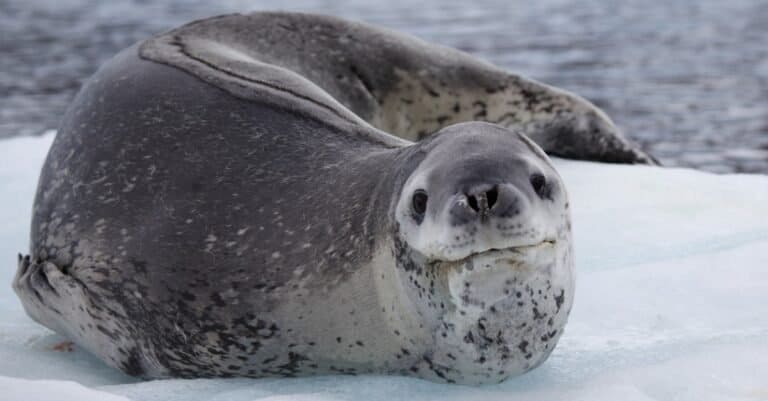
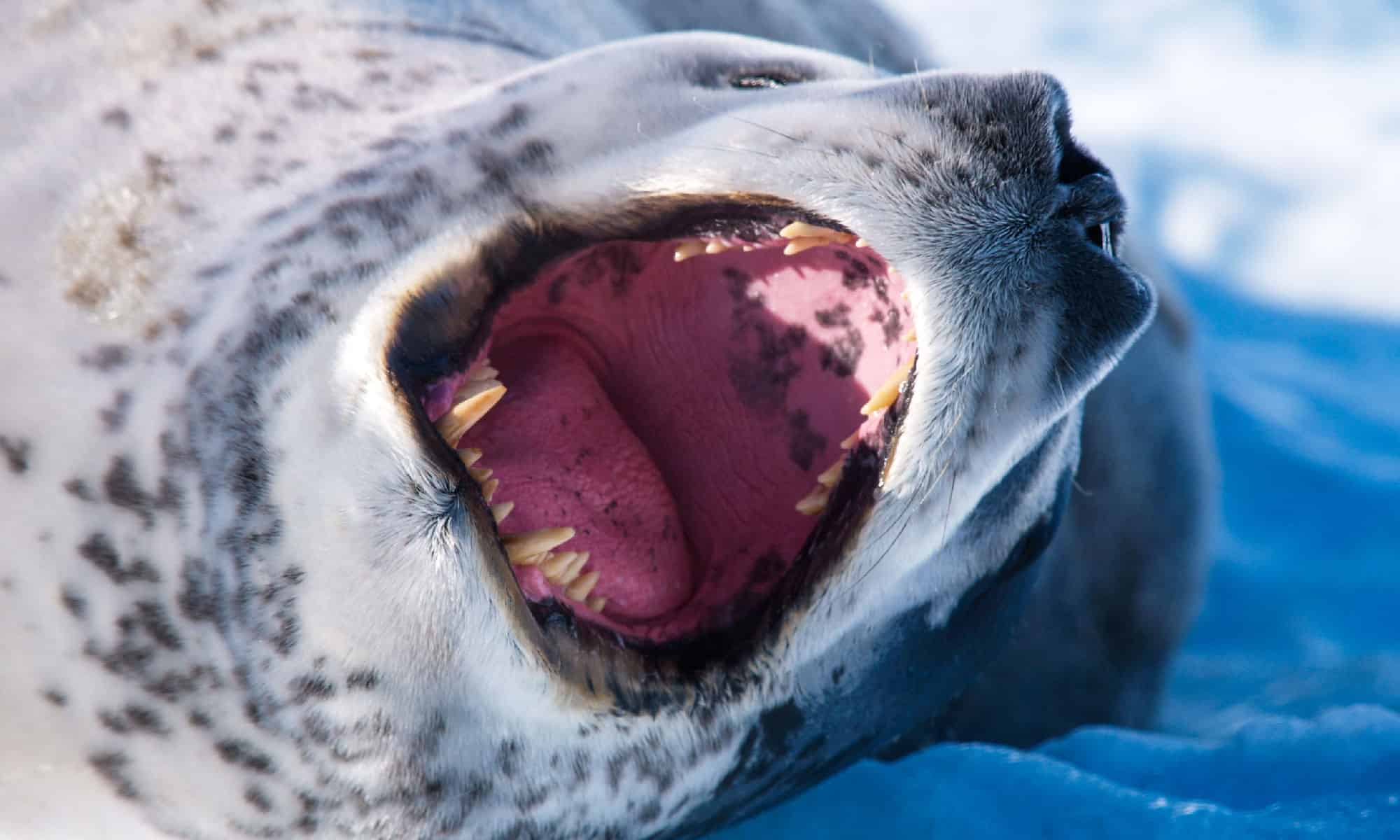
Leopard seals (Hydrurga leptonyx) have long, sharp, powerful front teeth for piercing and tearing large prey in the waters around Antarctica, such as penguins. However, they also have interlocking molars with small gaps to strain small organisms from the water. Similar to crabeater seals, they pull in large amounts of water, krill, and other invertebrates, then use their tongues to push the water back out.
Weddell Seals
Weddell seals (Leptonychotes weddellii) also inhabit the waters around Antarctica. They often dive to depths greater than 1,968 feet in search of fish. These seals have modified canine and incisor teeth that angle sharply forward, pointing out from their jaws. They used these teeth to scrape, grind, and break through ice, allowing them to create and maintain breathing holes in the frozen waters.

The Weddell seal has special teeth to create and maintain breathing holes in the Antarctic ice.
©Tarpan/Shutterstock.com
Saimaa Ringed Seals
Saimaa ringed seals (Pusa hispida saimensis) are landlocked in Lake Saimaa in southeastern Finland. These seals have been isolated in the lake for the last 10,000 years, and as a result, they have distinct adaptations in their dentition and tongues specialized for eating almost exclusively fish. These seals have sharper crowns, fewer cusps on some teeth, and broader tongues compared to other ringed seals, which researchers say suggests increased suction feeding but decreased filter-feeding.
Harbor Seals
The harbor seal (Phoca vitulina) inhabits the coasts of the Atlantic and Pacific Oceans from Canada to Mexico. At the front of their mouths, they have pointed, razor-sharp teeth to hold and eat slippery prey such as fish, octopus, and squid. However, their back molars have four sharp cusps to crush the hard shells of mollusks and crustaceans, including clams, mussels, crabs, shrimp, and lobsters.
Baby Seal Teeth
As mentioned above, baby seals are born with teeth. They develop their first set of teeth in their mother’s womb. These deciduous teeth are lost or absorbed before or shortly after the pup is born. A complete set of permanent teeth soon replaces the baby teeth.

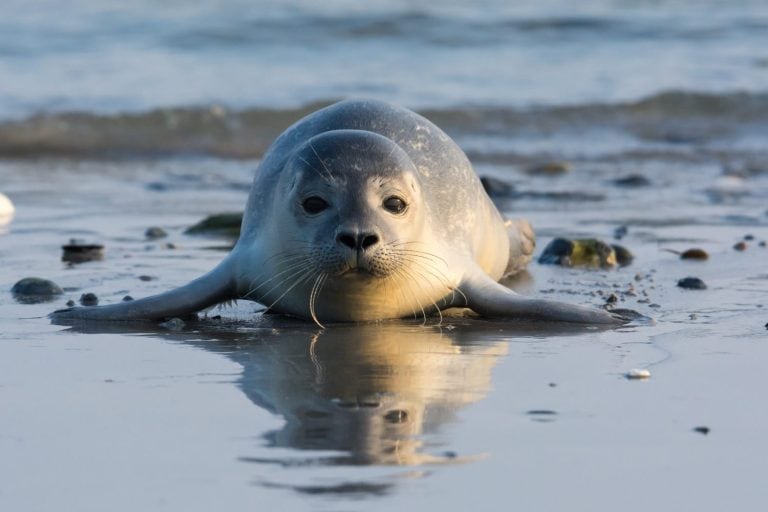
Baby seals are born with teeth that are quickly replaced with their permanent teeth.
©Leila Coker/iStock via Getty Images
While the timing depends on the species, seal pups are weaned relatively quickly. They must learn to hunt and eat solid foods while they are still very young. For example, harbor seals wean their pups after only 4-6 weeks, while northern fur seals may nurse their young for up to 4 months.