
Quick Take
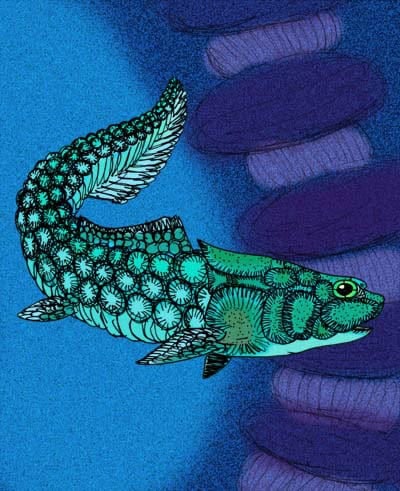
- Fossils of the ancient armored fish Romundina gagnieri reveal that early vertebrates had teeth growing on dental plates rather than directly on jaws.
- The 400-million-year-old placoderm fossils show teeth forming in concentric ring patterns, challenging previous theories about how fish teeth evolved.
- These early dental adaptations helped shape feeding strategies that ultimately supported the evolution of vertebrates, including animals that later moved onto land.
These days, all fish have teeth. The shapes of their teeth vary according to diet, ranging from the little pegs of goldfish to the formidable, pointed teeth of sharks. But fish evolved from toothless ancestors that lived millions of years ago in the ancient seas on Earth. When and how fish gained teeth has been an ongoing subject of scientific inquiry for which evidence continues to accumulate. In a recent paper published in Royal Society Open Science, paleontologists weighed in on fish tooth evolution, based on their interpretation of placoderm fossils.
“Teeth of vertebrates are the result of years of evolutionary history. And yet the earliest origins of teeth in vertebrates are not yet fully understood,” explains study author and Liège University paleontologist Sébastien Olive. “The study we led, focusing on a 400-million-year-old armoured fish, reveals more on how the first vertebrate dentitions developed.”
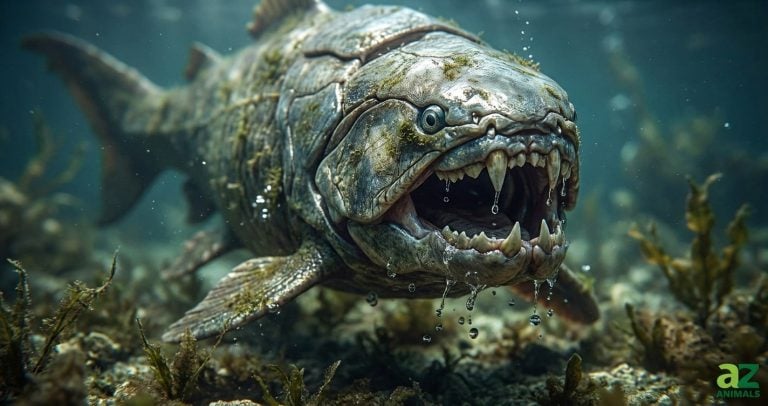
“Placoderms” (Ancient Greek for “plate skin”), the first known vertebrate animals with jaws, lived about 400 million years ago. These fish were heavily armored, with hard plates protecting their heads and necks. Their development of teeth is a nontrivial matter, since teeth supported changes in diet that supported further evolution of these early backboned animals (vertebrates). With teeth, an animal could slice and dice its food, capitalizing on novel types of food resources and colonizing new habitats.
Placoderms were closely related to the ancestors of both cartilaginous fish (sharks, rays, skates) and bony fish (all others). Among the bony fish were the first species to pioneer life on land, such as Tiktaalik, deemed to have led an amphibious lifestyle using its lobed fins to drag itself onto shorelines about 375 million years ago. So, placoderm evolution is a part of the story of how vertebrate life, including our own, came about.
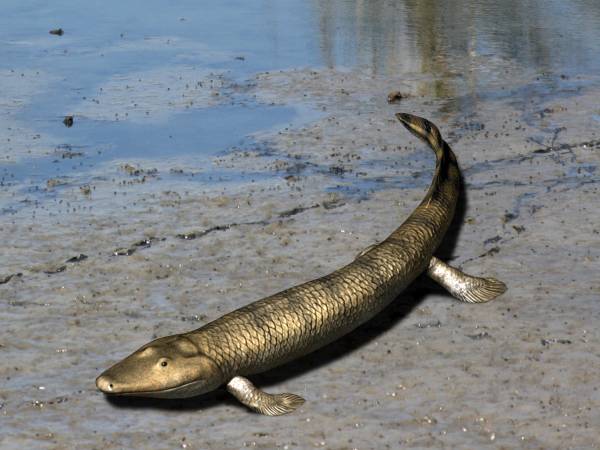
Tiktaalik was a “fishapod” that lived an amphibious land-water lifestyle.
©Nobu Tamura email:[email protected] http://spinops.blogspot.com/, CC BY-SA 4.0 <https://creativecommons.org/licenses/by-sa/4.0>, via Wikimedia Commons – Original / License
In placoderms, the jaws took the form of beak-like dental plates anchored to the roof and palate of the mouth. Until recently, it was thought that placoderms were toothless, therefore processing food with the sharp edges of their dental plates (like a sea turtle today, which chomps with its beak). However, recent paleontological studies are turning up teeth in placoderm fossils. The teeth have been found mostly toward the back of the mouth, suggesting that teeth evolved from back to front.
The new study focused on skull fossils unearthed on Prince of Wales Island, Arctic Canada. The skulls belonged to a newly described species of placoderm that the study authors dubbed Romundina gagnieri. Both fossils were extracted from a formation called “Drake Bay,” made of the limestone rock that’s characteristic of places that were once ancient seas. After dissolving the limestone matrix, the researchers examined the fossils from multiple angles using X-ray computed tomography (a scanning technique to visualize slices of solid objects digitally).
Teeth of vertebrates are the result of years of evolutionary history. And yet the earliest origins of teeth in vertebrates are not yet fully understood.
Sébastien Olive, study author and Liège University paleontologist
“The study revealed that early teeth didn’t grow only from the back of the mouth as previously thought, but in all directions, and not only on cheekbones but also on bony plates attached to the palate,” says study author Olive.
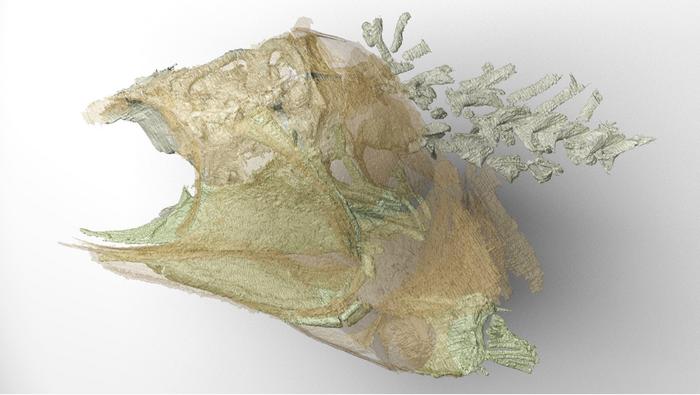
In R. gagnieri, they observed a record of growth on a pair of top dental plates from the roof of the mouth, with older teeth near the center and younger teeth around the outside. The pattern refuted the hypothesis that teeth first evolved in the backs of fish’s mouths. It appears that in this placoderm, the dental plates grew wider as teeth erupted in concentric rings, like seasonal tree rings.
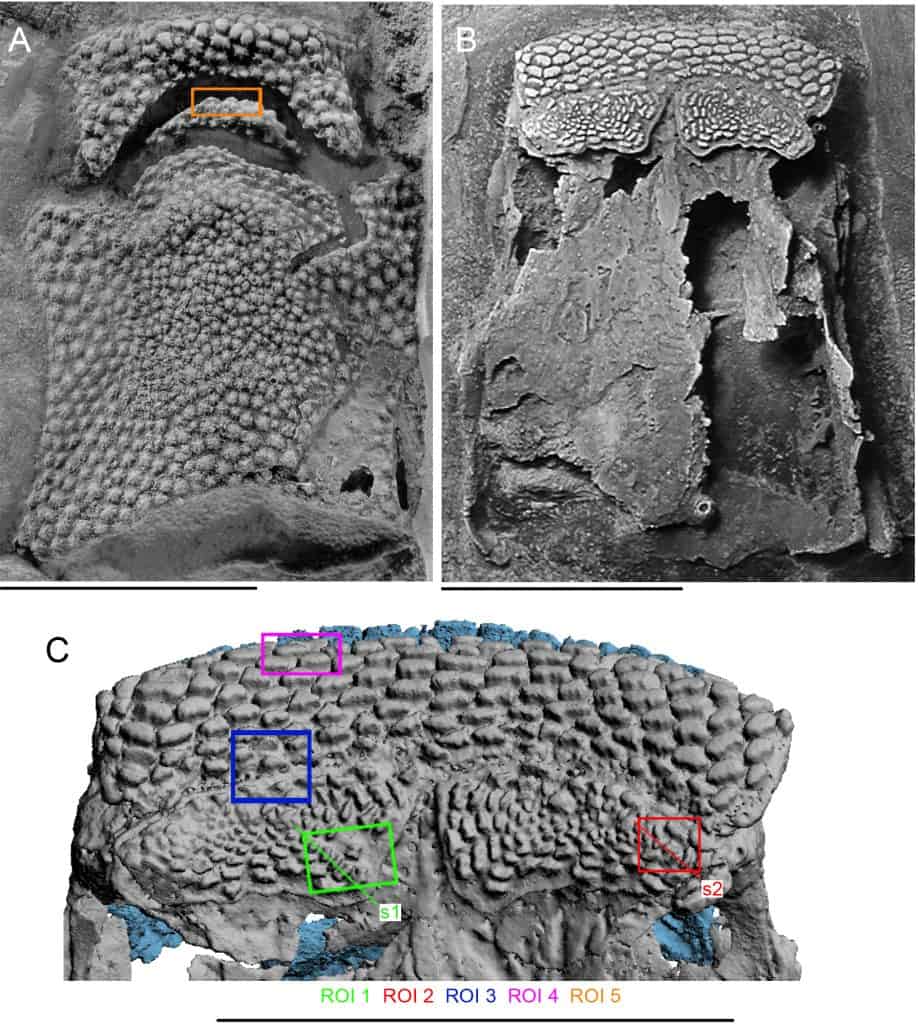
These images show the teeth on the fossilized dental plates of the placoderm R. gagnieri.
©Olive et al., DOI: 10.1098/rsos.250837/CC-BY-4.0 – Original / License
“This is an organizational model that we didn’t know about and which could correspond to the ancestral model of all jawed vertebrates,” explains Olive in a press release. “Armored fish are not only the first vertebrates to have jaws, but they are also the first vertebrates to show different patterns of dental organization.
In R. gagnieri, some teeth have enamel caps over dentine core material, a structure common in vertebrate teeth today, like ours. Given that later placoderms lacked enameled teeth, the enamel feature may have been lost and then re-evolved again as an adaptation for crunching on hard prey. The fact that Romundina teeth are on dental plates rather than jaws is noteworthy, since it disrupts the prior assumption that jaws were a precursor for the evolution of teeth. “We are looking here at one of the first steps in tooth evolution,” adds Olive.
So, the toothy smile of R. gagnieri has given us a peek into what was happening with teeth 400 million years ago during the Devonian Period. Fish with jaws and teeth offer a preview of the diversity of bony fishes and sharks that live today. While the placoderms were to go extinct at the end of the Devonian Period, some of their sister groups of fish would survive. The adaptive changes in mouth architecture to support new feeding styles paved the way for successful vertebrate life on land.