
Quick Take
- One glance at a single body part can instantly reveal an eastern box turtle's sex, yet most people never think to look there. See the cloaca differences →
- Female eastern box turtles have a reproductive superpower that makes them unlike almost any animal most people have encountered. Discover the sperm-storing ability →
- The most commonly cited method for sexing a box turtle can actually lead you to the wrong conclusion. Check the shell shape caveats →
- Male and female eastern box turtles have claws built for completely different jobs, and the reason behind each shape is more purposeful than you would expect. Explore claw shapes and purposes →
The eastern box turtle (Terrapene carolina carolina) is a sub-species of the common box turtle. These turtles are found in the eastern U.S. from Maine south to Florida, and west as far as Texas and the Great Lakes. They are terrestrial turtles, so they spend most of their lives on land in grasslands, forest edges, woodlands, and wetlands. However, what is life like for each sex, and what sets them apart? Read on to learn the differences between the male vs. female eastern box turtle.
Comparing Male vs. Female Eastern Box Turtle
| Male Eastern Box Turtle | Female Eastern Box Turtle | |
|---|---|---|
| Coloration | Brighter colors; orange, bright red, or pinkish-red eyes | Less vivid colors; yellowish-brown, dark brown, or amber eyes |
| Shell size and shape | Larger overall size and flares out; convex plastron | Higher domed shell; concave plastron |
| Cloaca | Slit shape and longer than females; away from body, at the east edge of the tail near the tip | Star-shaped and rounder than males; close to the turtle’s body at the base of the tail |
| Claws | Short, curved, and thick | Long, straight, and thin |
| Tails | Long and thick with a notch on top for mating | Short and thin with no notch |
| Mating behaviors | Occasionally spar with competing males; sparring involves biting shells | Doesn’t fight with other turtles; can store sperm for 4 years |
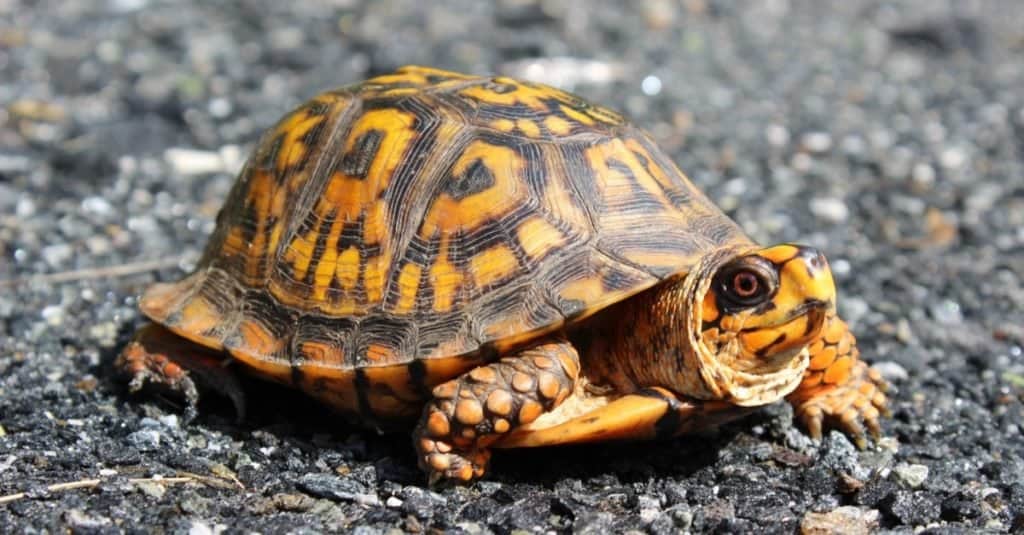
One primary difference between male vs. female box turtles is that males tend to be more vividly colored.
©Lisa Holder/Shutterstock.com
Male vs. Female Eastern Box Turtle: Key Differences
The key differences between a male vs. female eastern box turtle are their coloration, shell shapes, cloacas, claws, tails, and mating behaviors. Read on for an in-depth look at each of these differences between male and female turtles in the sections below.
Coloration
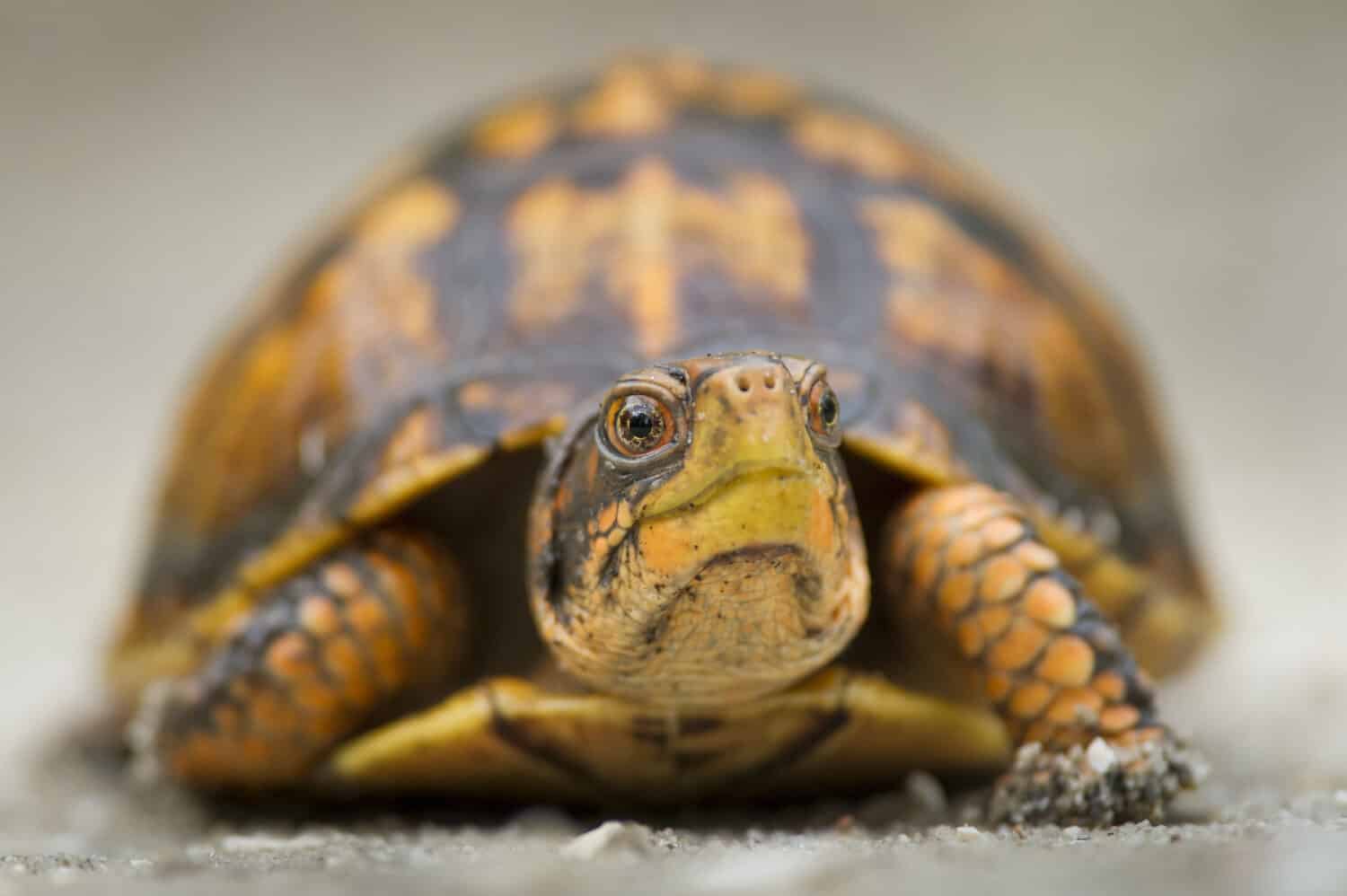
One of the fastest ways to determine whether you’re looking at a male or female box turtle is by assessing their eye color. Male box turtles usually have bright red, pinkish-red, or orange eyes. Female box turtles generally have yellowish-brown, dark brown, or amber eyes.
Both males and females have reddish pattern markings on their heads, necks, and forelimbs, but males’ markings tend to be more vivid. Their carapace patterns are distinct, allowing for easy identification within a population. Males have brighter, more distinct colors than females. Males have dark brown or black carapaces with vibrant blotches of bright yellow, orange, or red. Females have brown or olive-black carapaces with muted yellow, tan, or orange blotches. However, coloration alone isn’t enough to definitively determine the sex of a box turtle. You also need to look at the shape of their shells.
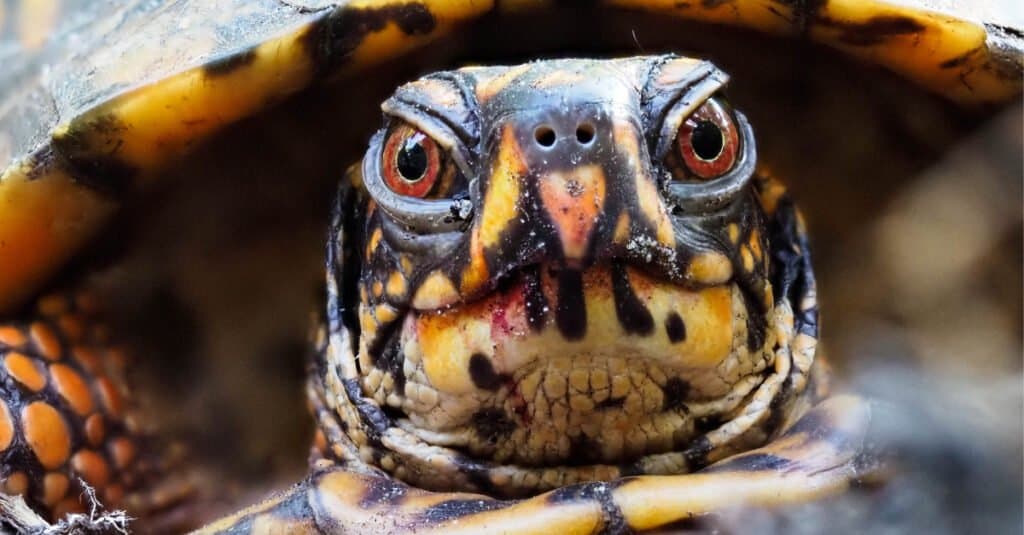
Female box turtles have neutral, brownish eyes, and males have bright red, pinkish-red, or orange eyes.
©iStock.com/Alan Doucet
Shell Shape
Every turtle species has its claim to fame. Snapping turtles have powerful jaws, and box turtles can seal themselves off entirely. They’re famous for their high-domed shells with a hinge that closes tightly. When they’re young, males and females have flatter carapaces. As they mature, the carapace becomes more prominent, but it diminishes as the turtles age.
As land turtles, their shells resemble a tortoise’s. Size is measured by carapace length. Eastern box turtles generally range from 4.5-6 inches and weigh less than one pound, with male box turtles generally being larger than females. Males typically have a lower sitting shell with an oblong shape. The male’s carapace flares outward, while the female’s does not. Females also usually have higher-domed shells than males. The female’s shell tends to be more rounded as well.
When you pick up an eastern box turtle, you’ll notice their undershell, or plastron, ranges from yellow-brown to brownish-black. Male box turtles have concave plastrons. Female box turtles have flat plastrons. However, looking for a concave vs. convex plastron can be misleading, as sometimes the female’s plastron is so shallow it doesn’t help with identification.

Female eastern box turtles have a rounder, higher-domed shell than males.
©samray/Shutterstock.com
Cloaca
The shape and location of the cloaca will help you determine the gender of an eastern box turtle. The opening looks like a small vent and it’s present in both sexes. The male box turtle’s cloaca is longer. It sits at the outer edge of the tail, closer to the tip. For the male, the opening is right past the margin of the carapace.
The female box turtle’s cloaca has a star shape and is more round than the male’s. It sits much closer to her body, right at the base of the tail. It practically disappears into the female’s shell. You can locate the cloacal opening directly under the edge of the carapace.
Claws
Male box turtles have short, thick, curved hind claws. The curved hook shape allows the male to latch on to the female’s shell so he does not fall off. It also helps him balance his weight.
Females have long, straight, thin hind claws. The longer, straighter claws help the females dig a nest in the dirt and fashion a nest chamber where they can lay their eggs.
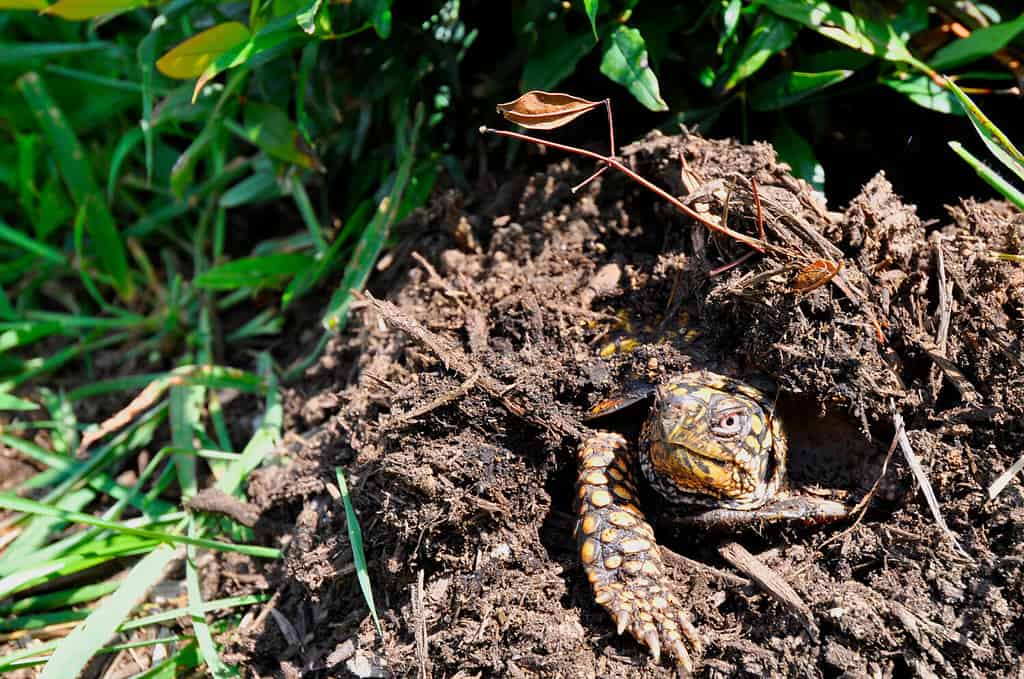
Their long, thin, straight hind claws help female box turtles dig nests in patches of open, sunny soil.
©Keri Delaney/Shutterstock.com
Tails
Male box turtles have longer, thicker, and overall larger tails. Females have less pronounced, short, thin tails. However, tail size can be misleading when there’s an overlap between the genders. Thankfully, for many turtle species, you can also identify their gender by looking for a tail notch.
Male turtles usually have a small notch at the end of their carapace. The notch is there to help with mating. Without the gap, the male’s upper shell could crush its tail. Females don’t need the same notch because of the position they assume while mating.
Mating Behavior
Male and female box turtles generally do not travel outside their home range of a few acres, but the female may travel farther to find a suitable nesting place. Mating occurs when a male’s and female’s paths cross in their home ranges. Males will aggressively chase, circle, and push the female to get her attention. He may also bite her on the head and neck to get her to pull into her shell so he can more easily latch on to her. Now and then, male box turtles spar with competing males. They bite each other’s shells but don’t cause damage.
Female box turtles can pause pregnancy through a process called embryonic diapause. They can store sperm in their oviducts for up to 4 years. After a single mating, they can produce viable eggs for years. They lay their eggs in shallow holes when environmental conditions are good. Females show a preference for laying eggs in clear-cut land over grassy meadows. They’ll choose the sunniest soil spots and lay 3 to 8 tough, leathery eggs. Then the female will cover the eggs, which incubate and hatch on their own. A female can lay several clutches yearly, and the incubation lasts about 3 months.
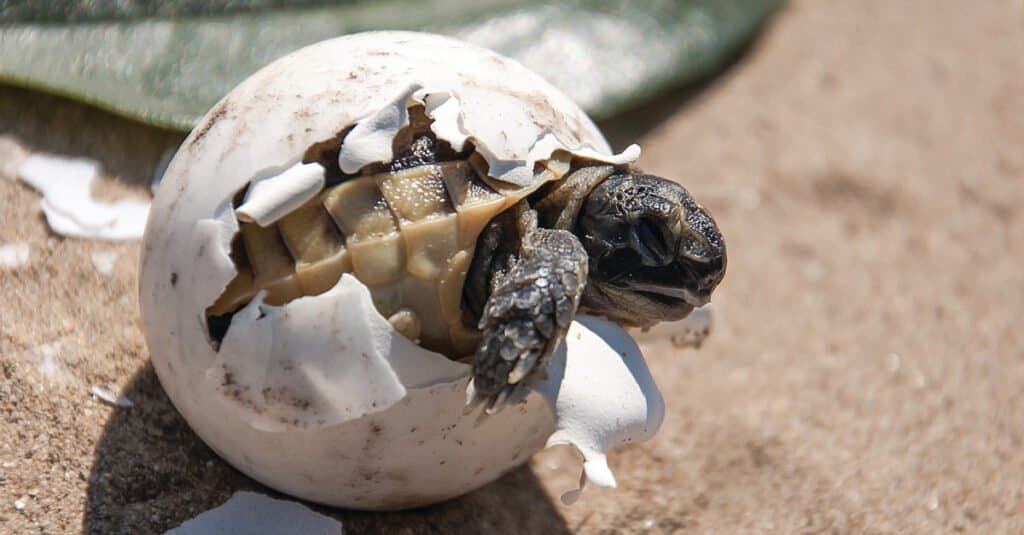
Female eastern box turtles can pause pregnancy for up to 4 years.
©Attila N/Shutterstock.com