
Quick Take
- A newly named prehistoric snake from India may have just dethroned the creature long considered the largest serpent ever, though the story is more complicated than a simple size comparison. See the size comparison →
- Researchers rebuilt the picture of a 47-million-year-old giant from just 27 bones, and what those fragments revealed about this snake's body is genuinely unsettling. Explore the fossil fragments →
- This snake belongs to a family that survived for nearly 100 million years and spanned multiple continents, a lineage that most people have never heard of. Meet the Madtsoiidae family →
Prehistoric snakes have a habit of getting more terrifying with each new discovery. The latest prehistoric snake species to be described is truly ginormous. Here’s what experts have discovered so far about this remarkable reptile.
The Discovery of One of the Largest Snakes Ever
Part of the vertebral column of a giant snake was discovered in what is now Gujarat, India. It has been named Vasuki indicus. In total, 27 mostly well-preserved vertebrae were found. These vertebrae are much larger than those of most other snake fossils. Each vertebra measured between 1.48 and 2.47 inches long and 2.46 to 4.39 inches wide. This suggests that when it was alive, this snake had a thick and cylindrical body.
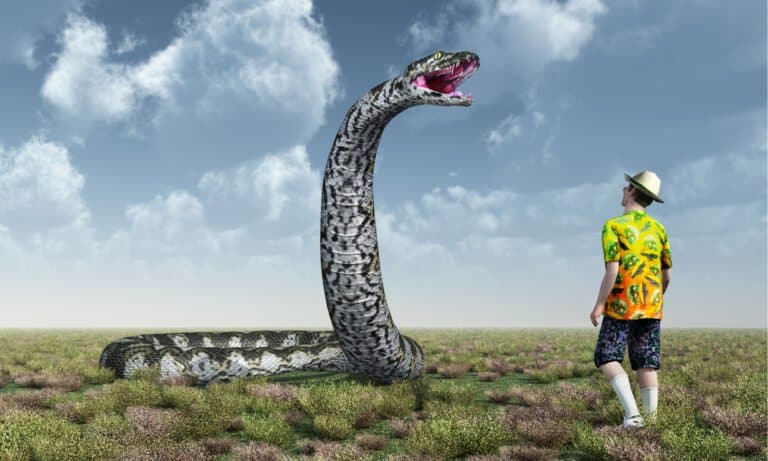
Using recognized quantitative estimation methods, researchers calculated that the snake measured between 35.8 and 49.9 feet in length! The upper estimate would make it longer than Titanoboa, the largest snake ever discovered. However, the vertebrae of this new species are slightly smaller than those of Titanoboa, and since these measurements are estimates, Titanoboa may have actually been the larger snake.
What Else Do We Know About the Giant Snake?
Scientists are confident that this massive creature lived during a warm Middle Eocene period, which was around 47 million years ago. During this period, average temperatures were about 82°F. Its fossil was found in a grey shale unit from Panandhro Lignite Mine, Kutch, in Gujarat State, western India.
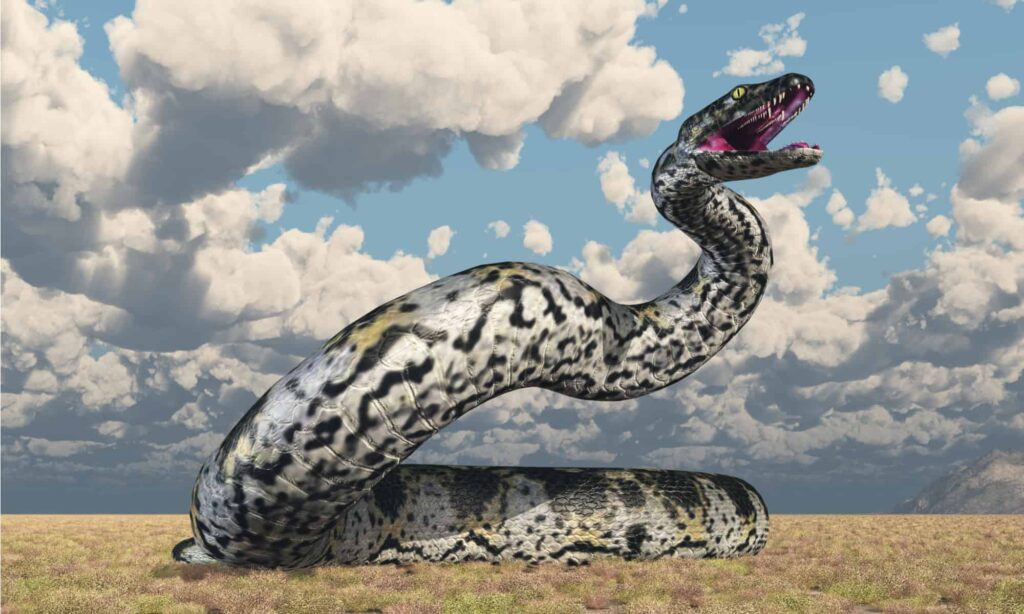
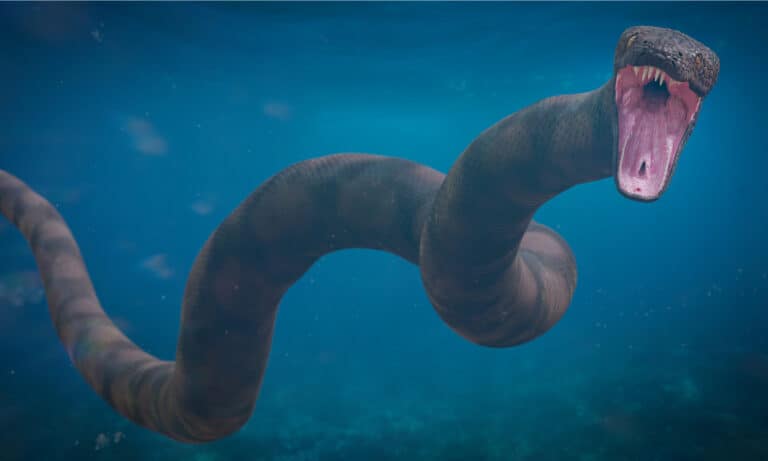
Prehistoric giant snake Titanoboa was huge!
©Michael Rosskothen/Shutterstock.com
Experts have classified it as a member of the Madtsoiidae family. These were a group of snakes that existed for nearly 100 million years, from the Late Cretaceous to the Late Pleistocene. During their existence, their range extended across Africa, Europe, and India. The findings also suggest that this snake represents a ‘relic lineage.’ It is believed to have first evolved in what is now India before spreading through southern Eurasia and into Africa during the Eocene Period.
The Madtsoiidae family is now extinct, but their range once covered Madagascar, South America, India, Africa, and the European archipelago. They varied in body size, but the family included some of the largest known terrestrial snakes that ever lived. This creature was one of them!