
Quick Take
- NOAA Fisheries coordinates a national network of partners that together are trying to keep endangered sea turtles on this planet.
- Organizations as disparate as a North Carolina nonprofit with grassroots origins, and an aquarium in Missouri hundreds of miles from any ocean, have become a critical lifeline for stranded sea turtles.
- Climate change isn't just warming the oceans. It's quietly rewiring sea turtle migration in a way that's overwhelming rescue centers far from traditional stranding zones.
- Concerned citizens and volunteer pilots have carved out an irreplaceable role in the turtle rescue chain, and the whole network would struggle to function without them.
Earlier this year, more than a thousand sea turtles were found cold-stunned along the Texas coast when the air temperature fell to 27°F and the water temperature to 42°F. When temperatures get below about 50°F, sea turtles become lethargic and unable to swim. As their heart rates plunge, their circulation stalls, eventually leading to diseases and death.
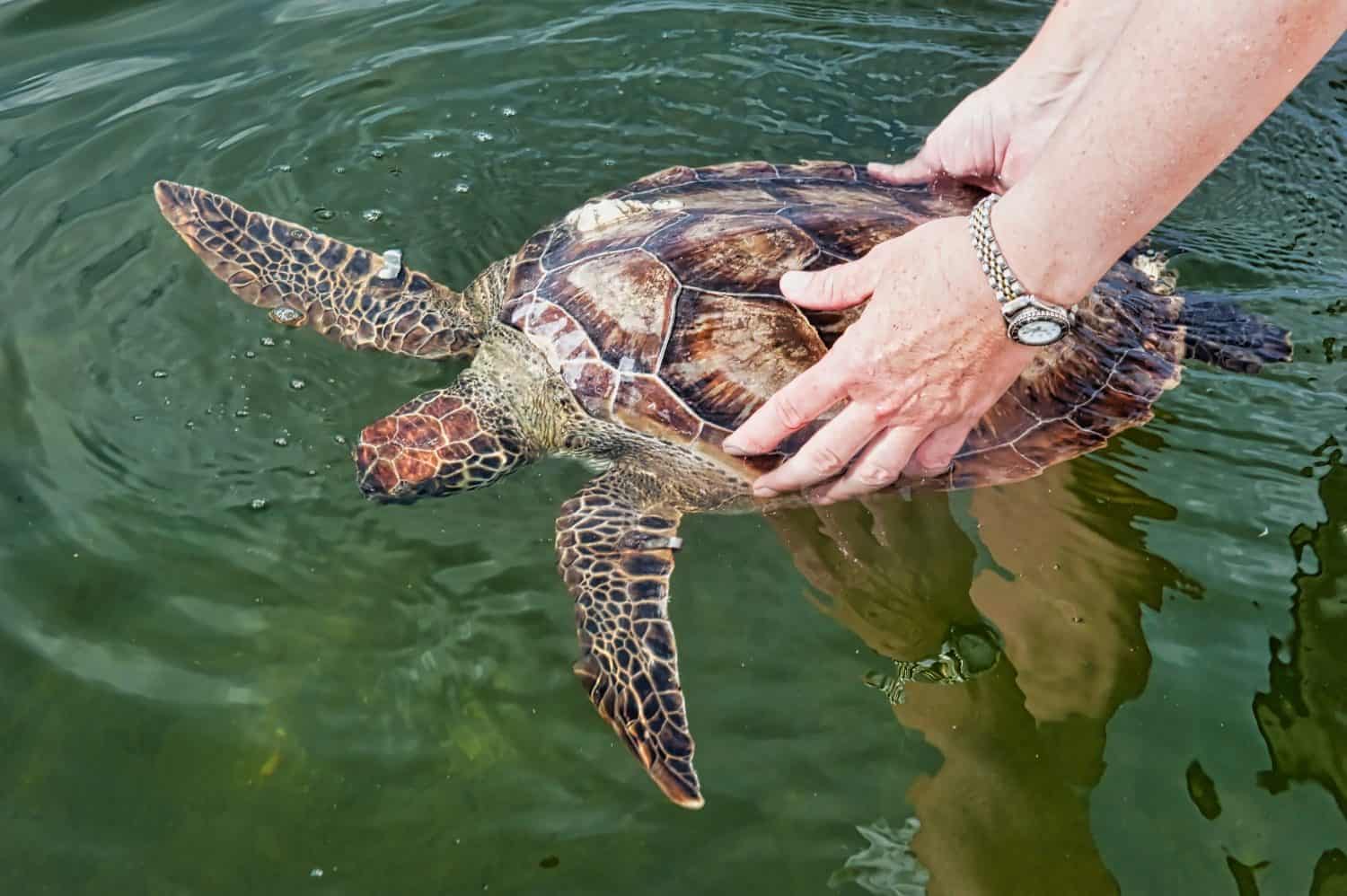
In Texas, volunteers and rescue staff spotted the immobilized turtles and brought them to rehabilitation facilities for medical care. As individual turtles recovered sufficiently and ocean temperatures rose higher, they were released back into the sea, often to the delight of beach spectators.
The Rescue Network For Stranded Turtles
Those turtles from Texas waters were just some of the thousands of sea turtles rescued along U.S. coastlines every year, thanks to the Sea Turtle and Stranding Network run by NOAA Fisheries. When people report a sea turtle that appears sick, injured, or stranded, it activates a chain of actions to save the turtle. Depending on the turtles’ location, that chain may cross state lines to include multiple individuals and organizations. Getting a turtle rehabilitated and back to the water requires a stunning level of coordination (no pun intended).
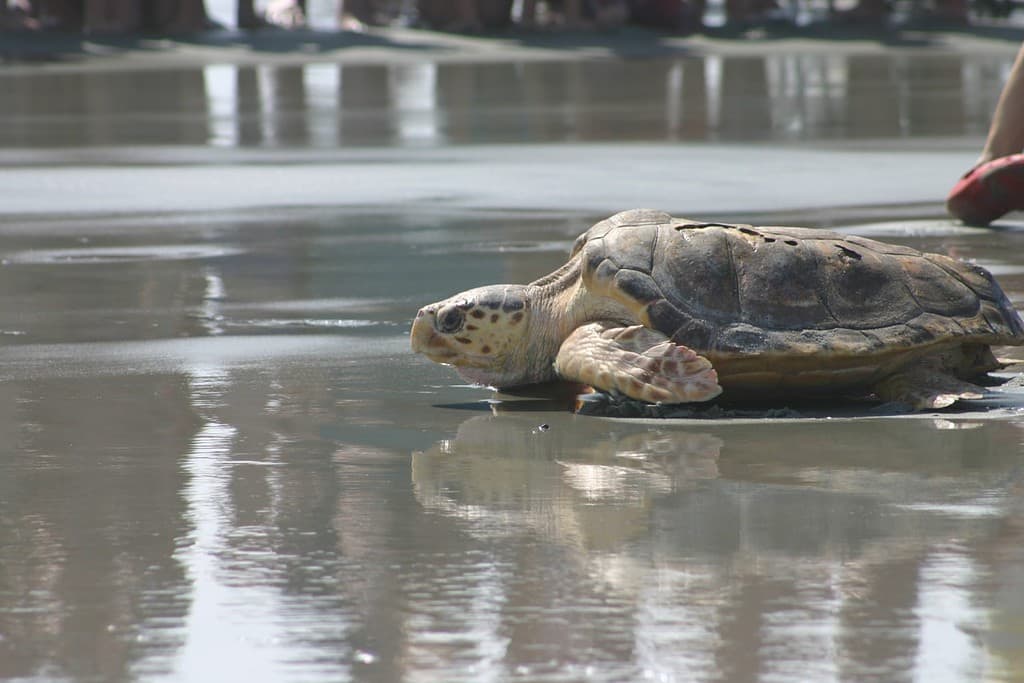
A loggerhead sea turtle rehabilitated at the South Carolina Aquarium was released from the Isle of Palms to a rousing send-off by a crowd.
©Grace Thoma/Shutterstock.com
A Behind-the-Scenes Look at Turtle Rehabilitation
When I visited turtle rehab centers in several states, I became aware of the growing list of organizations that ensure cold-stunned marine turtles are successfully rehabbed and returned to the sea. The organizations working to keep sea turtles on the planet differ in size and funding models while contributing to the same mission.
Wonders of Wildlife Aquarium
Head north to Missouri, and you’ll find a relatively new rehab operation at the Wonders of Wildlife National Museum & Aquarium. It’s funded privately through the Johnny Morris Conservation Foundation, a nonprofit established by the owner of Bass Pro Shops. Mike Daniels, the Director of Animal Care, explained how their sea turtle rehab program started in 2020 during a downturn in temperature that stunned hundreds of sea turtles. Despite their landlocked location, WOW Aquarium accepted 10 needy turtles in response to a U.S. Fish and Wildlife Service request for organizations that could help.
WOW’s participation grew from there. Since 2020, WOW’s Sea Turtle Center has rehabbed more than six dozen turtles, which typically spend about 12 to 16 weeks in care before being deemed strong enough for release back to the wild. Each turtle is evaluated and given a customized rehab plan by the Aquarium’s veterinarians and marine biologists. Turtles are treated not only for cold shock but also for any injuries, infections, illnesses, broken bones, and dehydration. A 30-foot round tank, subdivided with partitions, is reserved for turtle patients, while the other 30-foot round tank serves other aquarium species, such as sharks. Some 12-foot rounds have a rotation of species.
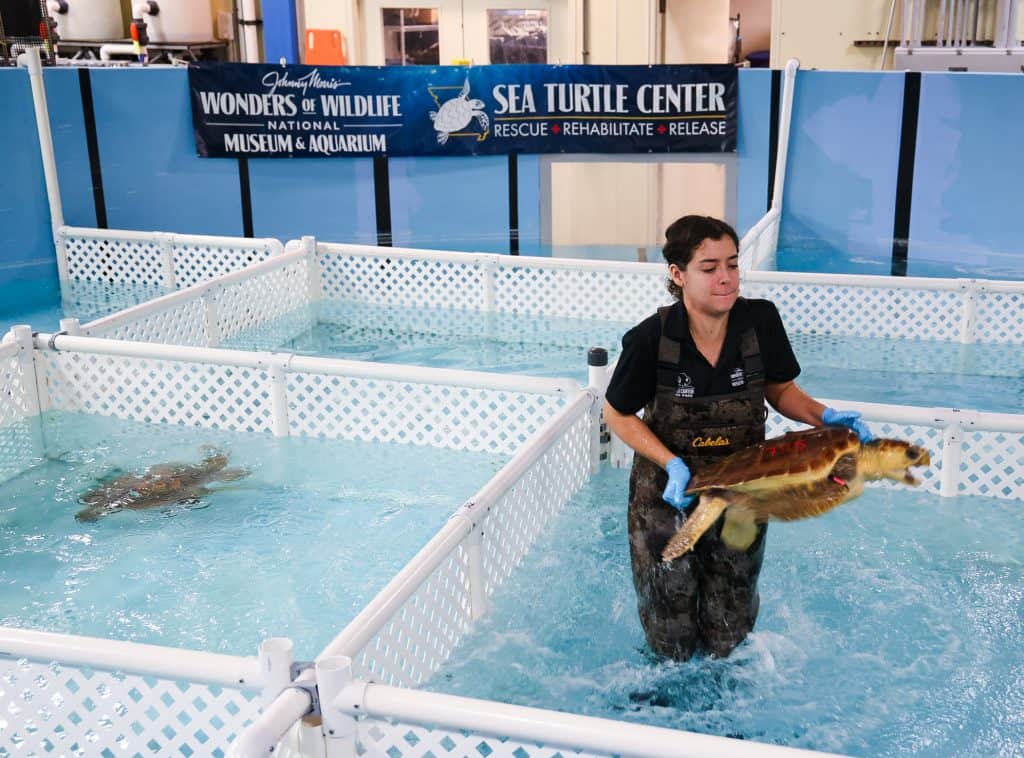
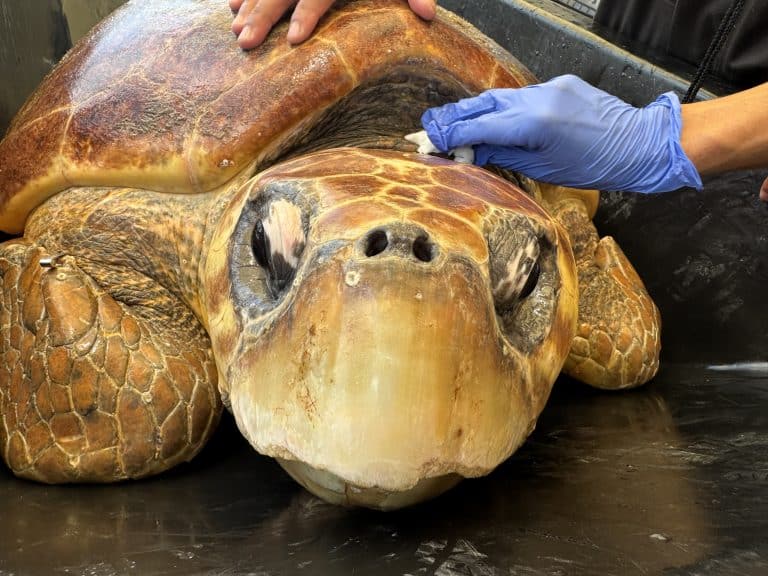
A sea turtle reacts with an open mouth as it is taken from the water for a veterinary check-up.
As Daniels says, this is “triage” care. In “the best-case scenario, they’re just really lethargic, and they need to start eating to get healthy and feisty and robust again. In the worst-case scenario, they’ve been hit by a boat. They’ve got damage to their lungs and carapace.” So, beyond mitigating cold-stunning, the rehabbers have a chance to identify and treat health issues that would otherwise go untended. “We receive a lot of turtles that have pneumonia,” says Daniels, “and may have some minor wounds” incurred during their time spent cold-stunned.
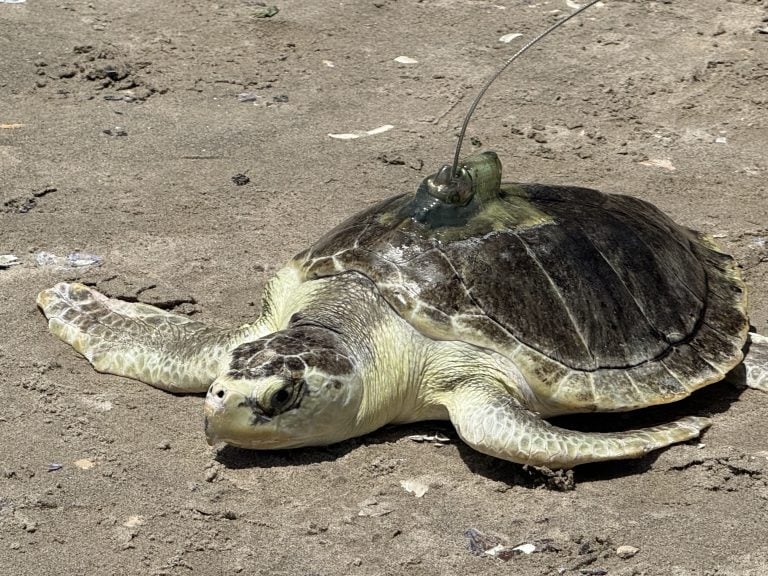
Each turtle is assigned a unique number, which is temporarily marked on its carapace, to connect rehabbers with its medical records in the database. Before a turtle is released, a PIT tag (like what’s on an EZ-Pass) is embedded in its shoulder, such that it can be identified by any rehab organization if it’s recaptured in the future. WOW’s Sea Turtle Center has also, funding permitting, started equipping a handful of turtles with satellite tags so that their movements can be tracked post-release.
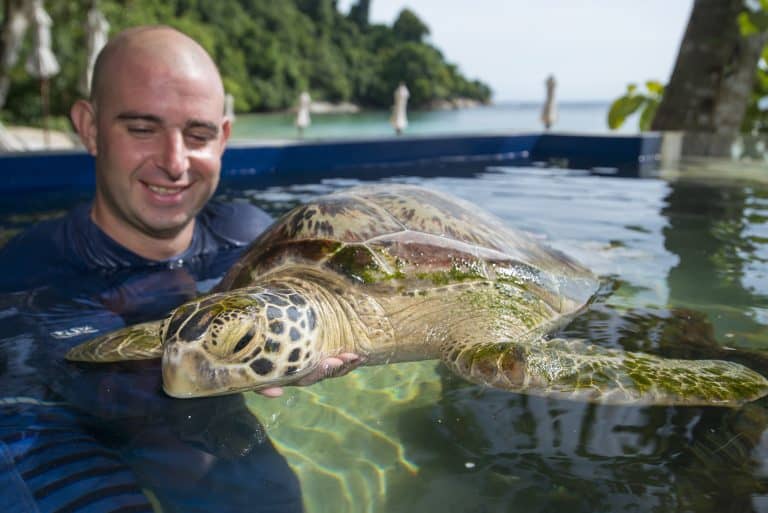
According to Daniels, the WOW rehab operation achieves about a 99 percent success rate in rehabbing their temporary turtle adoptees, but there are an unlucky few that don’t make it. Of those that survive, a couple are not releasable, such as two female green turtles — Izzy and Ms. Pam — who live permanently in the WOW Aquarium. They were both struck by motorboats, damaging their carapaces such that gas got trapped beneath. The entrapment caused buoyancy problems that would be lethal in the wild. Daniels views these permanent residents as “wonderful ambassadors that just need that extra assistance of professionals to thrive.”
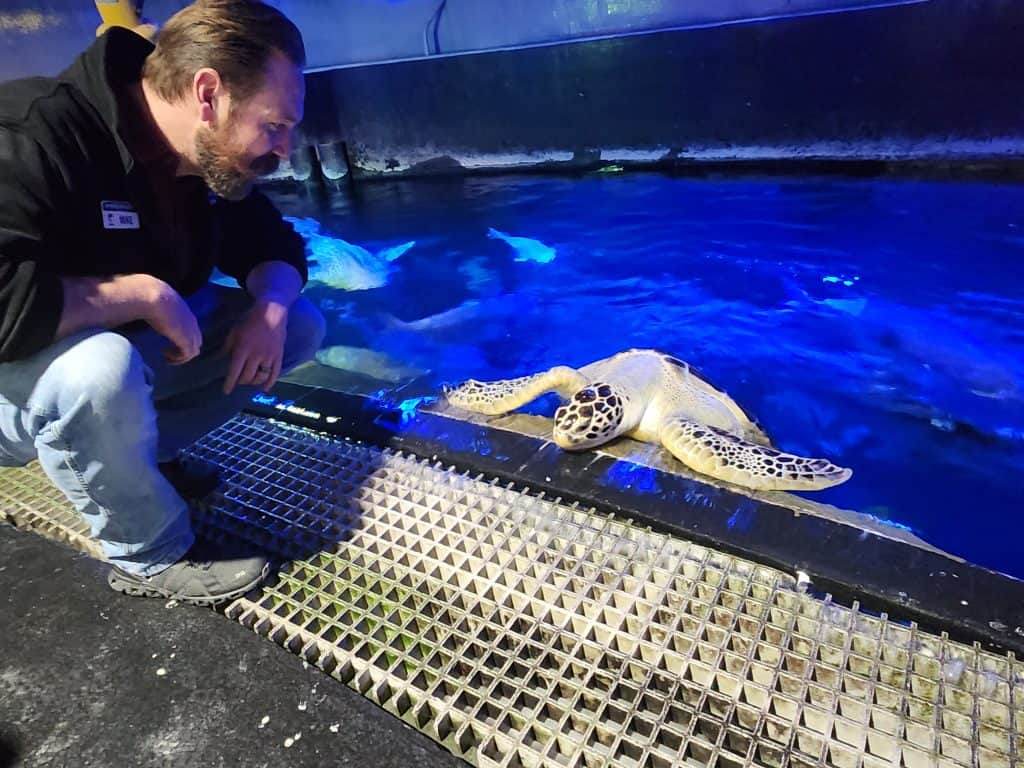
Daniels says hello to green turtle “Izzy” at the behind-the-scenes access to the Open Ocean exhibit.
Karen Beasley Sea Turtle Rescue Center
Head eastward to the North Carolina coast and you’ll encounter the Karen Beasley Sea Turtle Rescue Center that, despite its shared mission to rescue sea turtles, has a different history and set of challenges than WOW. Executive Director Kathy Zagzebski toured me around the facility, which is independent of any broader aquarium.
One of the oldest sea turtle hospitals, it became a nonprofit in 2000 after a couple of decades of operating on a shoestring to monitor and protect sea turtle nests on the beach. Its funding must be raised entirely from donations and grants, and its veterinary care is donated by North Carolina State’s College of Veterinary Medicine via monthly visits. If a turtle needs a CT scan, staff load it into a special crate, haul it to a car, and drive it to NC State. About 600 volunteers assist a handful of staff to keep the operation running.
We receive a lot of turtles that have pneumonia and may have some minor wounds.
Mike Daniels, the Director of Animal Care at Wonders of Wildlife National Museum & Aquarium
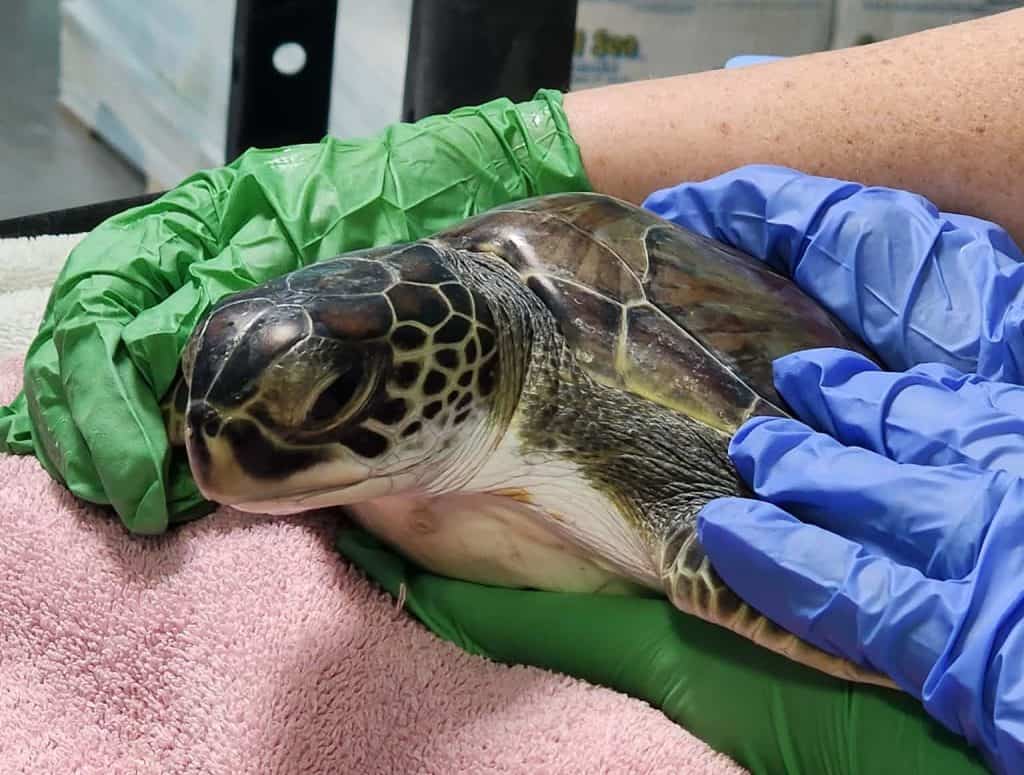
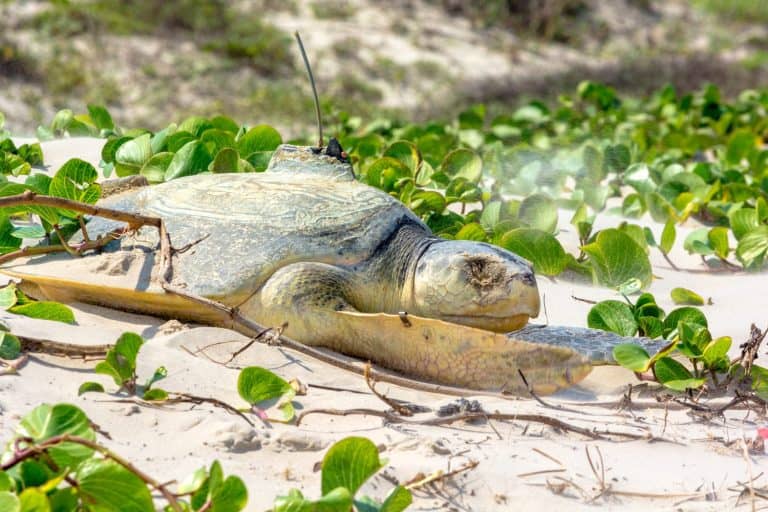
Rehabbers placate this Kemp’s Ridley during its check-up by laying gloved hands on it.
Instead of a few massive tanks, the Karen Beasley Center has many smaller round tanks containing from one to several turtles. The Center has kept as many as 106 sea turtles in their care at one time. The day of my visit, the wall was lined with big buckets, each holding an ailing turtle that was waiting to be checked into the rehab system. On their website, you can see the current list of turtles in rehabilitation.
The number of cold-stunned turtles brought into the system by NOAA’s Sea Turtle and Stranding Network has grown over time. “If turtles are housed together, however, they tend to get very aggressive,” says Zagzebski. So, she is exploring different ways to “you, know, tuck in turtles here and there,” such as tank dividers. “Then, we can have more than one per tank in a safe way.” While the center prides itself on never turning away a turtle in need, they have raced to raise funds to build additional tanks for increased capacity.
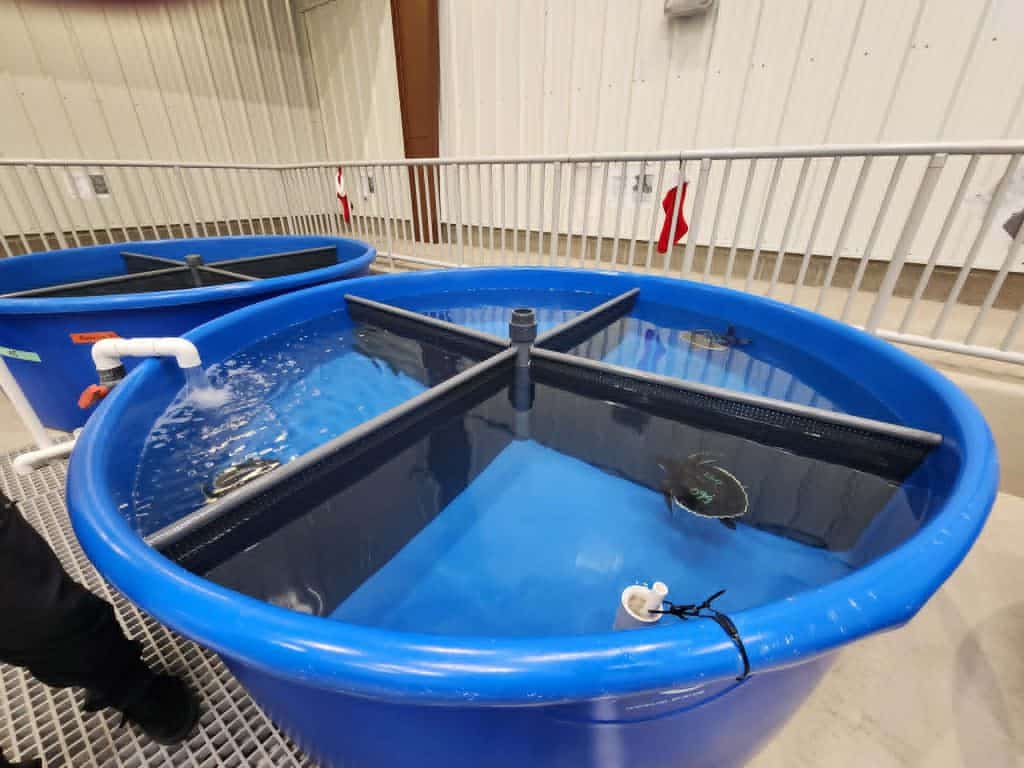
Tanks are subdivided to house more rehabbing sea turtles at the Karen Beasley Center.
Many of the Karen Beasley Center’s turtles came not from the North Carolina coast but from Massachusetts, where they got stuck in Cape Cod Bay and failed to migrate further south for the winter. Zagzebski links the problem to climate change, explaining that “warm water eddies are luring more turtles into the Gulf of Maine, from where they enter Cape Cod Bay. I’d guess that climate change is keeping water warmer for longer, and then causing a more sudden change to cold, and the turtles are just missing the cues.”
National Aquarium
Head northward to Baltimore, and you’ll find that the National Aquarium is rescuing sea turtles while also championing legislation to make more funding available to accommodate all the turtles needing care. The largest expense in turtle rehab operations, these rescue organizations told me, is salt! The Sea Turtle Rescue Assistance and Rehabilitation Act is a bipartisan bill that would free up federal grant money for organizations that rehabilitate sea turtles.
At the National Aquarium, I met with Caitlin Bovery, the Rehabilitation Manager for sea turtles and seals at that time. She showed me around their turtle hospital and explained that, like at the WOW site, the aquarium’s veterinary staff provides on-site care for the turtles (as well as all the other species at the National Aquarium). So, while it’s still an intensive job, they don’t need to rely on outside vets. Caitlin pointed out the “turtle elevator” used to lift turtles from the massive, subdivided holding tanks to the decks above for monitoring and care.
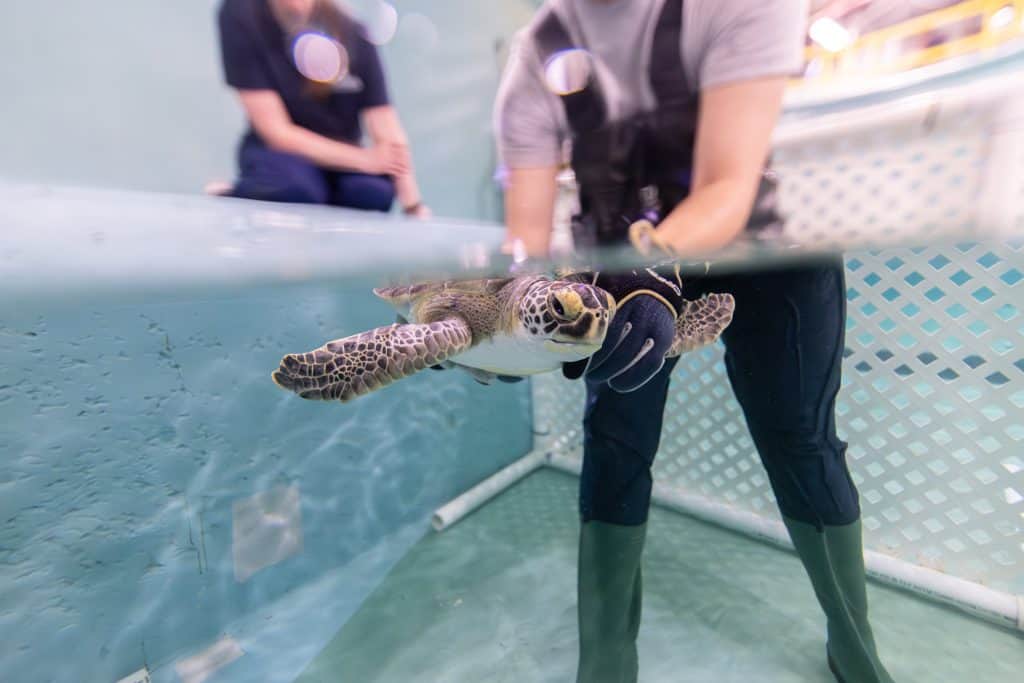
A recovering cold-stunned sea turtle swims in the National Aquarium hospital pool during its rehabilitation.
Like the other facilities I visited, this aquarium is a recipient of turtles stranded in Cape Cod and the surrounding parts of New England. Most of them are Kemp’s ridleys (Lepidochelys kempii), explains Caitlin, although some green sea turtles and loggerheads arrive too. Rarely, the National Aquarium is called upon to rescue turtles from their home state of Maryland or nearby Virginia. Caitlin points out one long-term turtle resident that was stranded two years ago in Virginia Beach after swallowing fish hooks.
A unique role played by the National Aquarium as a cog in the sea turtle stranding network is transport and secondary holding. Because they’re centrally located off major highways and have two dedicated SUVs that can fit about 20 turtles each, the aquarium fetches turtles from other locales as far as New England and drives turtles to release in places as far away as Florida. With just seven staff members and about 30 volunteers, they are, as Caitlin says, “a small but mighty group.”
On the National Aquarium’s website, you can follow the journey of a cold-stunned sea turtle from rescue to release, including the 14-hour overnight drive from Baltimore to Florida with the cadre of rehabbed turtles ready to return to the ocean.
The Volunteer Pilots Flying Turtles to Safety
Turtle rehabilitation programs also rely on a remarkable nonprofit organization comprised of volunteer airplane pilots who transport sea turtles between facilities. By specially outfitting their planes to accommodate them, Turtles Fly Too pilots bring ailing turtles to the Wow Aquarium, the Karen Beasley Center, and many other organizations that have become part of NOAA’s turtle stranding network. Each turtle is kept secure in its own big crate for the journey. At the other end, the turtles are received by climate-controlled trucks, vans, or cars to take them to rehab facilities.
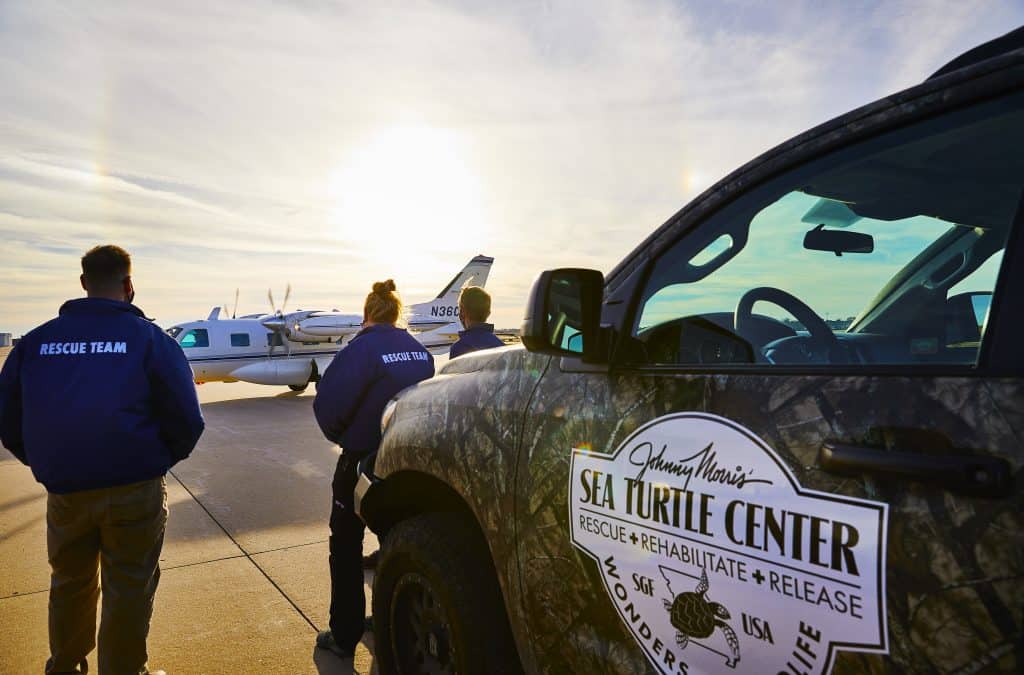
A Wonders of Wildlife Sea Turtle Center team meets a Turtles Fly Too plane at the Springfield-Branson National Airport in Missouri.
The New England Aquarium in Boston is a hub for NOAA’s Sea Turtle and Stranding Network on the East Coast. The multitude of stranded turtles found along the Northeast coastlines first arrive at the New England Aquarium. Through assessment and initial care, those able to travel are entered in a list that is sent around to partner organizations. As WOW’s Daniels explains, “An email goes out every week with a spreadsheet that has the numbers for that week of turtles ready to transport.” A regional NOAA coordinator typically reaches out to facilities one-by-one to ask, “Are you guys able to help again this year? How many turtles can you take?” says Daniels.
So, each rescue organization accepts as many sea turtles as they can care for, given constraints of tank space, staff, and funding. “Everybody does it [rehab] with the resources they have because it’s often underfunded, pieced together from other programs,” explains The National Aquarium’s Caitlin Bovery.
Each Turtle Rescue Takes a Village
Once a turtle reaches another rehabilitation facility by plane or ground transport, it is run through a standardized series of warming steps. After suffering in chilly ocean waters, turtles must be warmed gradually over a few days, explains Zagzebski. At their facility, they use several rooms for the warming process, each set at a different temperature stage. Once turtles’ body temperatures reach about 75°F, their medical rehab process begins.
It is often said that it takes a village to achieve anything significant. Buoying the survival of endangered marine turtles requires the collaboration of an exceptional range of people, from concerned citizens and aquarists to veterinarians and pilots.