

Quick Take
- A woodpecker’s tongue can reach one-third of its body length.
- This long tongue wraps around the bird’s skull, acting as a built-in helmet to absorb and redistribute forceful impacts.
- Different woodpecker species have evolved specialized tongue tips — barbed, brush-like, sticky, or smooth — tailored precisely to their diets and environments.
Imagine sprinting full-speed into a solid oak tree at 15 miles per hour — and then doing it again and again, 20 times per second. For almost any vertebrate, this would be fatal — but for a woodpecker, it’s just breakfast. While its reinforced beak and powerful neck muscles certainly help, the real secret lies in a hidden internal feature: the hyoid apparatus.
Biological Headgear
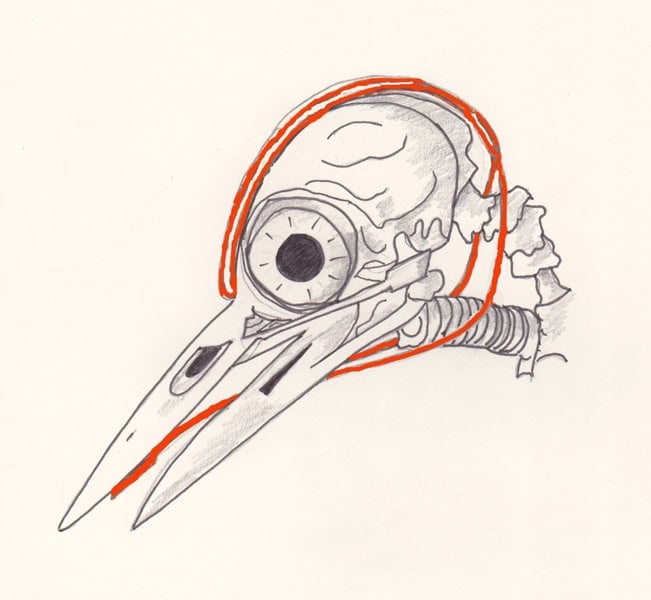
In most animals, the hyoid is a simple bone that anchors the tongue. In woodpeckers, it has evolved into a complex structure of bone and muscle that extends from the jaw, travels through the nostrils, and wraps entirely around the skull. By encircling the head like a high-tech racing harness, the tongue functions as a living shock absorber, cushioning the brain from lethal impacts.
However, the woodpecker’s tongue can be up to one-third of its body length — far too long to fit inside the mouth. Fortunately, evolution provided an elegantly simple solution: the skull itself serves as both storage space and protective reinforcement.
Depending on the species, a woodpecker’s tongue can be two to four times the length of its beak.
©Jimfbleak / CC BY-SA 3.0 / Wikimedia Commons – Original / License
The hyoid bone begins at the nostrils, rises between the eyes, splits into a “V,” sweeps over the crown, curves around the back of the skull, and passes under the jaw before reconnecting to the beak. When the bird strikes a tree, muscles around this loop tighten, cinching the head into a rigid “seatbelt” that spreads the impact across the skull.
The Retraction Mechanism
A woodpecker’s tongue is more than just super long; it is a mechanical marvel. Hyoid muscles allow it to shoot several inches past the beak and coil back into its skull-hugging path. Micro-CT scans reveal a three-part “sandwich” design: a stiff outer sheath for strength, a flexible middle layer, and an inner core of bone marrow that acts as a hydraulic cushion. This layered structure dampens vibrations, converting violent kinetic energy into harmless elastic potential and heat. The tongue has a rigid base that acts as a sturdy pillar under high G-forces, while its tip remains flexible, enabling delicate and precise probing.
Specialized Tongue Tips
Each woodpecker species has adapted its tongue tip to its specific diet. The pileated woodpecker wields a spear-like tongue with barbs that extract beetle larvae from deep within wood. Sapsuckers have shorter tongues tipped with fine, hair-like structures that absorb sticky sap. The northern flicker has the longest tongue in North America, and it is coated in thick saliva to reach deep into anthills. The ground woodpecker of Southern Africa has evolved a smooth, thin tongue that slides between rocks to harvest soil-dwelling insects, illustrating how evolution can adapt the classic wood-boring design for entirely new environments.

The northern flicker’s long tongue helps the bird collect ants.
©Ken Griffiths/Shutterstock.com
How Woodpeckers Are Inspiring Humans
The woodpecker’s tongue functions as a delicate sensor, a lethal spear, and a life-saving helmet, all at once. Its intricate blend of soft and hard materials, energy-dissipating architecture, and precise design offers a blueprint for robotics, safety equipment, and beyond. Evolution has wrapped one of nature’s most effective solutions tightly around the woodpecker’s brain — and now humans are learning from it.
For engineers, the woodpecker’s tongue provides a blueprint for creating robots that are simultaneously strong and flexible. Prototypes mimic the hyoid’s chain of rigid bones and surrounding flexible muscles, allowing robotic arms to bend, extend, and support heavy loads without sagging. This makes them ideal for navigating tight, complex spaces during search-and-rescue operations or inspecting intricate machinery that traditional machines cannot reach.

Woodpeckers drum their beaks against trees to create nests and to find food.
©silentstock639/Shutterstock.com
The woodpecker’s tongue and skull structure are also inspiring researchers to develop new ways to improve human safety. Research suggests that woodpeckers dissipate about 99.7% of the impact energy throughout their bodies, minimizing the force that reaches the brain. Inspired by the bird’s incredible mechanics, researchers are exploring sports helmet designs with graded layers to better dissipate impact forces.
Aerospace engineers are developing woodpecker-inspired shock isolation systems to protect sensitive electronics from extreme G-forces. Researchers are also exploring how similar biomimetic principles could be applied to automotive safety features, such as car bumpers, to better distribute crash energy and improve passenger protection.