
For most birds, pecking is casual foraging. For woodpeckers, each strike is a tightly controlled impact that functions like a hammer blow. New work from Brown University and the University of Münster shows that the secret to this bird’s unique pecking method is not a cushioned head, but a whole-body strategy that braces muscles from beak to tail while synchronizing breathing with each hit. This compact animal delivers rapid, powerful taps with precision and safety.
Why Do Woodpeckers Peck?
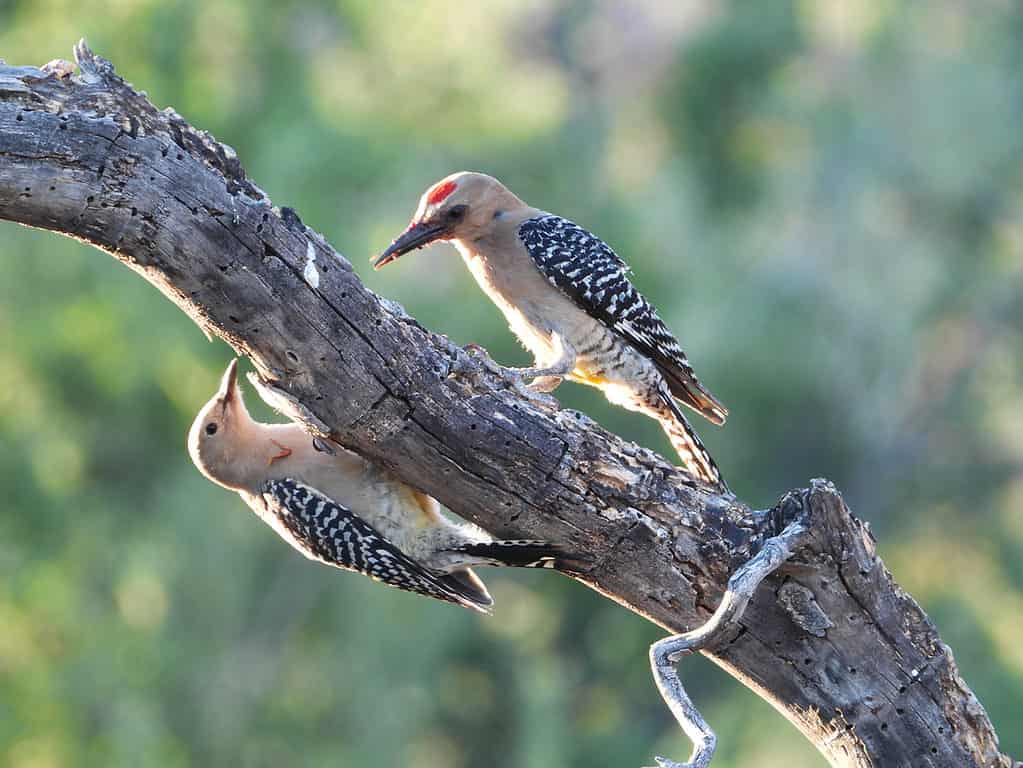
Gila woodpeckers.
©iStock.com/G Parekh
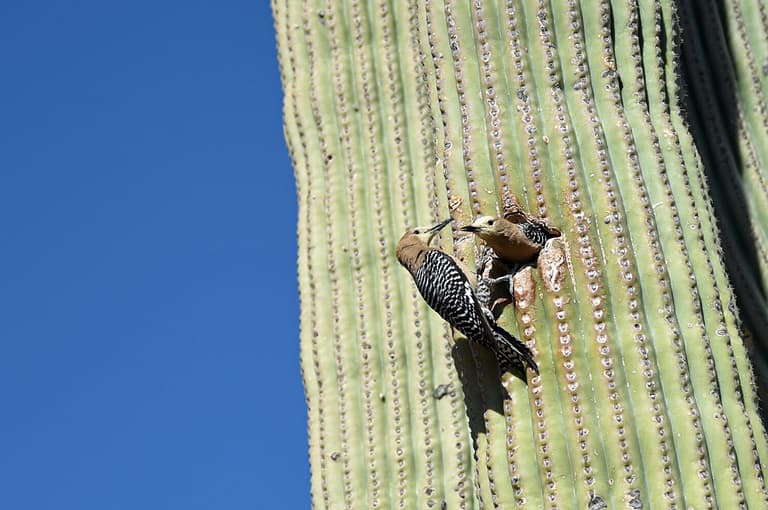
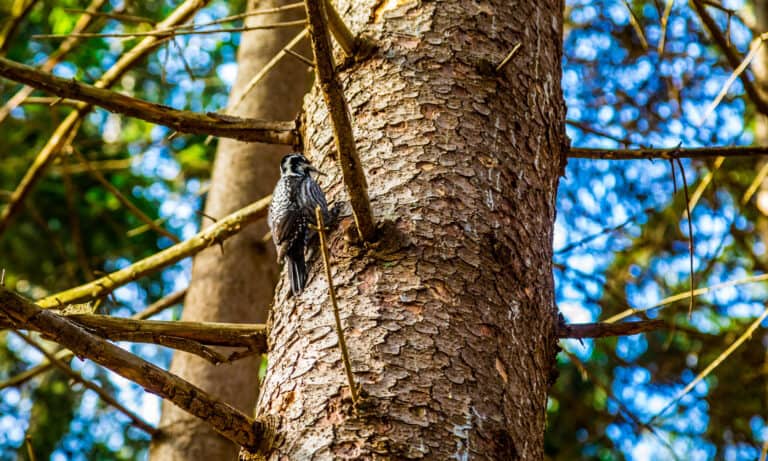
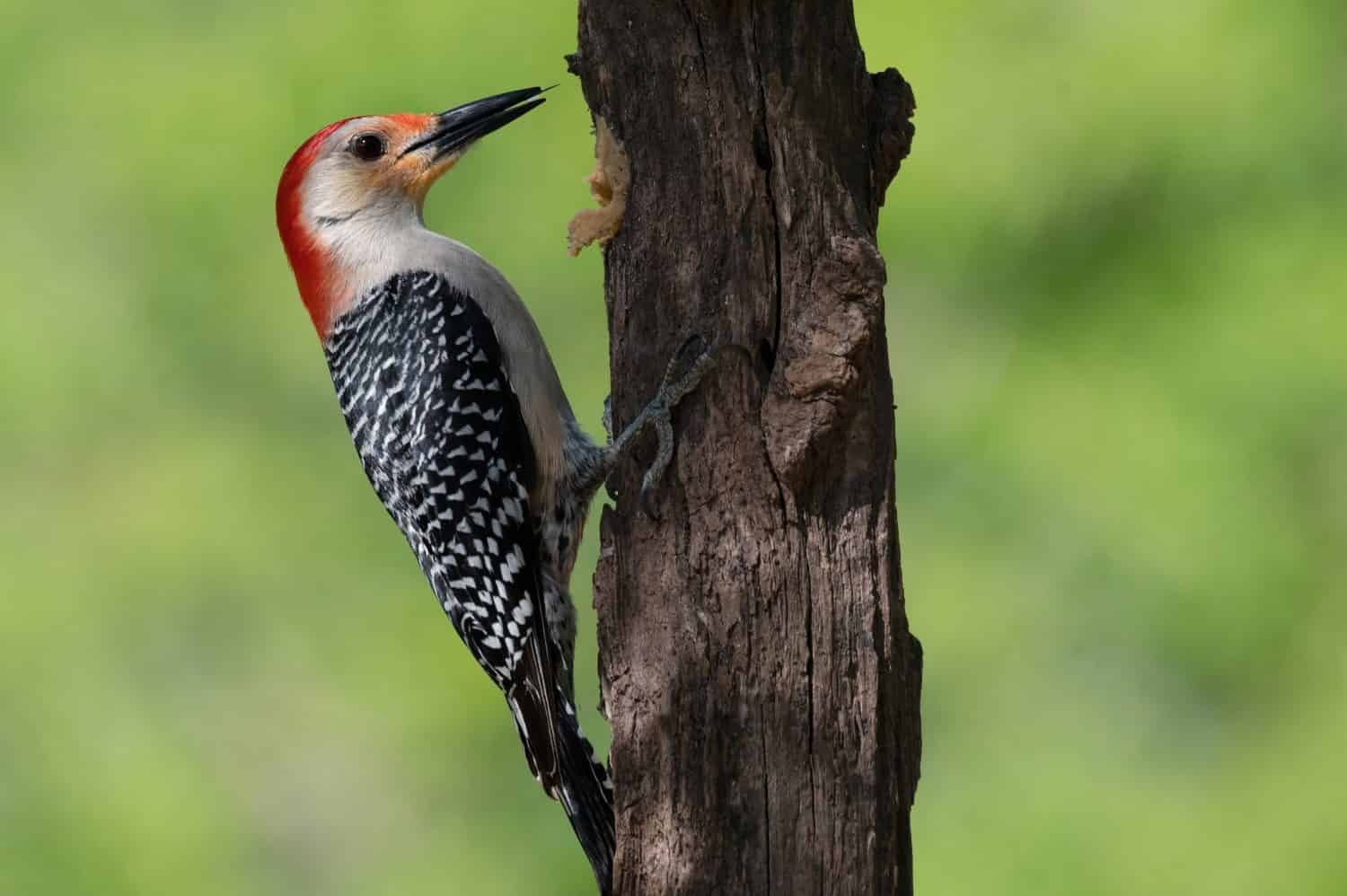
Woodpeckers are insect-hunting and cavity-nesting birds in the family Picidae, with roughly 240 species worldwide, found on most continents except Australia and Antarctica. They can peck tree branches and even wood sidings on homes extremely fast, producing rapid rolls that can reach 10–20 strikes per second. This rapid pecking is how they find insects burrowed under bark, as well as a means of creating nest cavities.
But a woodpecker’s characteristic drumming is also a broadcast. Different species produce unique rhythms that help individuals recognize neighbors and potential mates. The downy woodpecker tends to produce short, fast rolls, while the hairy woodpecker produces slightly longer and more forceful ones. Northern flickers often choose metal gutters or hollow stems that ring like drums, which makes their message carry farther. The sound can be further amplified across a territory by echoing off trees and human structures.
What This Study Set Out to Solve
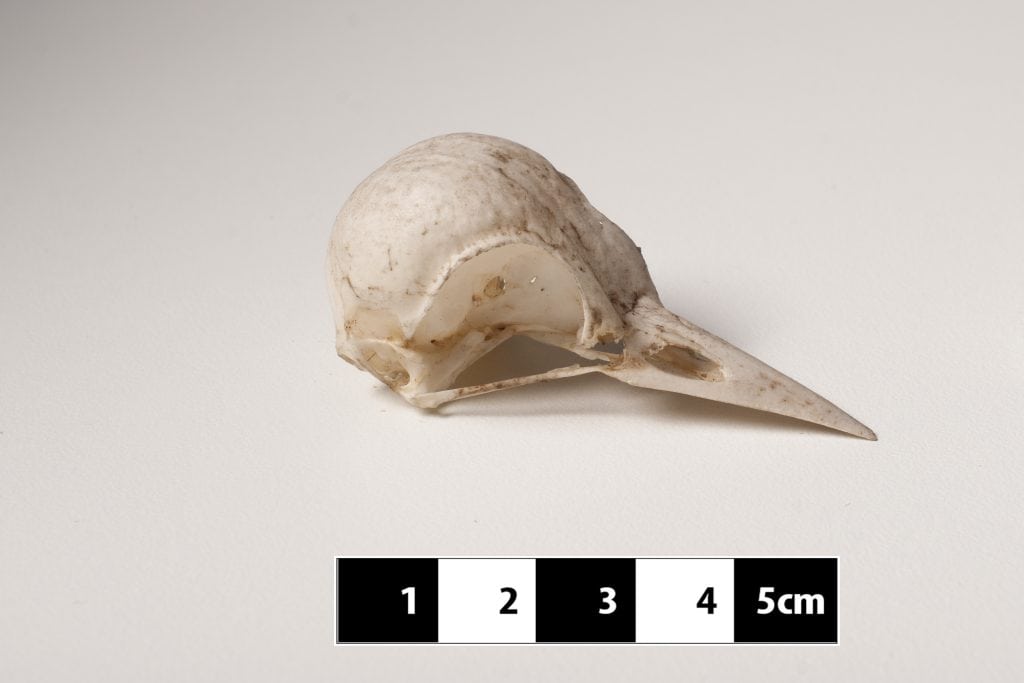
Woodpecker skull.
©Museum of Veterinary Anatomy FMVZ USP, CC BY-SA 4.0 , via Wikimedia Commons – Original / License
For years, the scientific community has believed that woodpeckers are protected by their skulls, which work like shock absorbers. Research in 2022 overturned that view, showing that the head behaves as a stiff hammer system. The new work from Brown and Münster asks a connected question: if the head is rigid, how does the rest of the body and the breathing apparatus coordinate to make drilling both powerful and safe? To answer this question, the team focused on timing across muscles and the respiratory system during real drilling and tapping.
How The Research Was Conducted
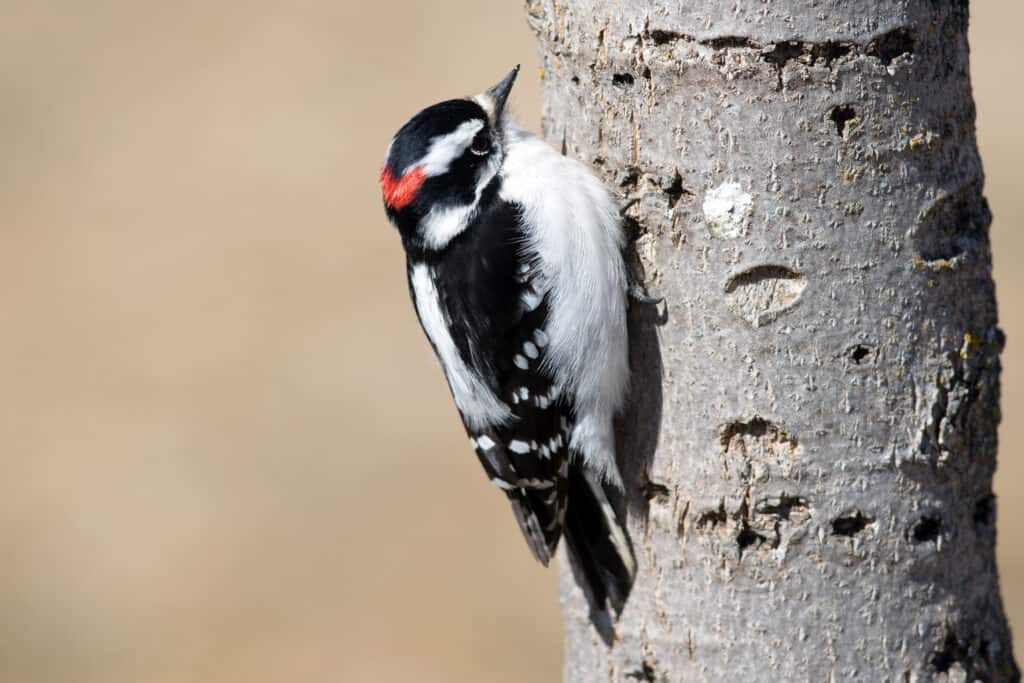
Downy woodpecker.
©Northernguy/Shutterstock.com
Researchers captured eight wild downy woodpeckers, acclimated them, and filmed them over several days as they tapped and drilled on hardwood blocks. High-speed video was aligned to the exact instant the beak contacted wood, giving a frame-by-frame view of each strike’s kinematics.
At the same time, fine-wire electromyography recorded muscle activity in the head, neck, abdomen, tail, and legs, revealing pre-impact trunk and tail stiffening followed by rapid resets. Air-sac pressure and airflow measurements tracked breathing cycles, revealing exhalation peaks at impact and brief inhales between taps. All signals were synchronized at impact to create a precise map linking movement, muscle activation, and respiration for every strike.
Key Finding 1: Woodpeckers Brace The Whole Body
High-speed video and muscle recordings revealed a coordinated bracing pattern. The head and neck muscles position the bill, while abdominal and hip muscles stiffen the bird’s core; meanwhile the feet grip and the tail feathers press against the tree to add a third point of contact for stability. Rather than winding up with a full-body swing, the bird creates a rigid linkage so that the short head motion ends in a clean, controlled stop against the wood. That system allows energy to flow into the substrate, as opposed to back into the skull. The motion is similar to a karate chop in that both aim for a crisp, brief impact so energy goes into the target, not back into the striker.
Key Finding 2: Exhalation Is Synchronized to the Strike

©Pair Srinrat/Shutterstock.com
One of the most remarkable findings is related to respiratory timing. The birds forcefully exhale at the moment of impact, a pattern that mirrors human athletes who exhale during a lift or a tennis serve. During fast tapping, exhalations align to each strike, with brief inhales in between. This breathing pattern is associated with increased co-contraction of trunk muscles, which helps stiffen the core and steady the body for the next blow. The analogy to an athlete’s grunt is helpful as long as the focus stays on function. It is the synchronized exhalation that boosts stability rather than the sound itself.
Key Finding 3: Timing Is Everything
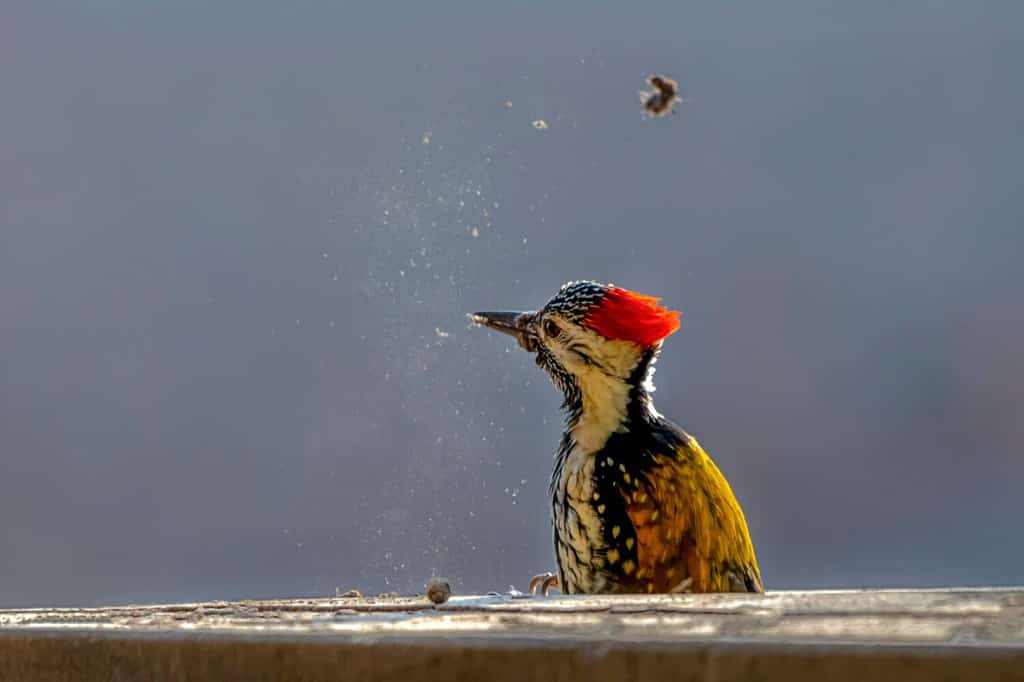
The black-rumped flameback, also known as the lesser golden-backed woodpecker or lesser goldenback.
©thsulemani/Shutterstock.com
During rapid tapping, woodpeckers strike and exhale in sync at about 13 times per second, then inhale for roughly 40 milliseconds before the next blow. This cadence locks the nervous system, muscles, and breathing into one program that resets posture, braces the core, and times each impact. Field hunches about precise rhythm are now quantified, and the accuracy of those micro-breaths is astonishing.
How This Fits With The Skull Cushioning Debate

Great spotted woodpecker male in the snow storm, winter snowy times, stunning scenery
©Dronenation/Shutterstock.com
The new results offer a major shift from 2022. The new research shows that woodpecker skulls do not protect the brain by cushioning impacts. Instead, safe hammering comes from small brain size, very brief impacts, and a stiff, well-aligned cranial system that limits relative brain motion. By documenting whole-body bracing and synchronized exhalation, the new study explains how the rest of the body supports the stiff head strategy. In short, the woodpecker is not softening the blow with cartilage or spongy skull tissue. The bird is making the blow precise and brief by bracing like a hammer.
What The Data Say About Tails, Hips, And Core
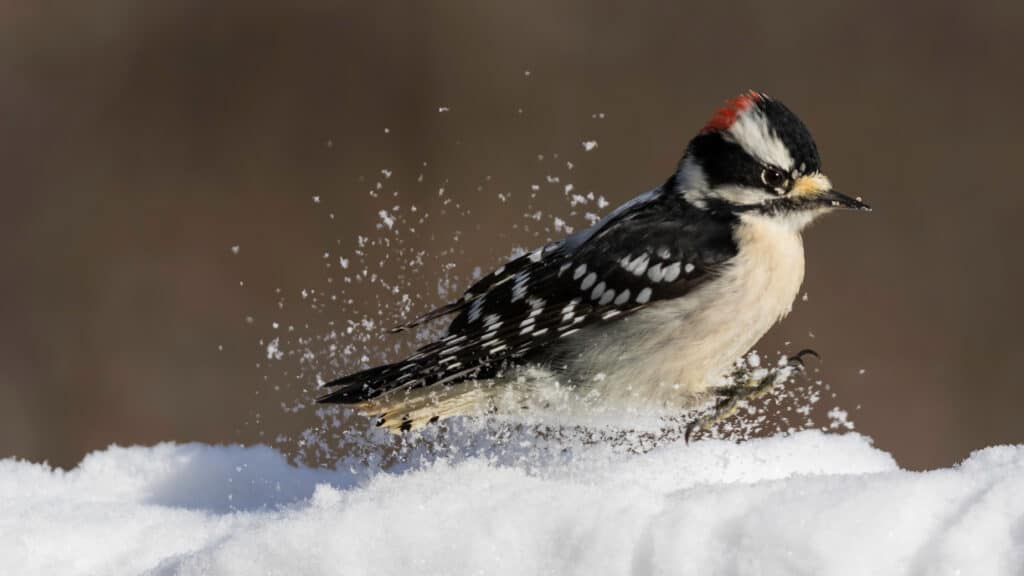
A hairy woodpecker in the snow.
©sandymsj/Shutterstock.com
Tail bracing matters, but the function is mechanical stability rather than shock absorption. The tail acts like a prop so the feet and legs can maintain a constant stance while the head moves the last few millimeters. Hip and abdominal muscles contribute to that rigid posture, allowing energy to flow from the bill into the wood instead of dissipating through unwanted body motion. The work reveals a whole-system solution to the problem. Beak, skull, neck, trunk, hips, legs, and tail cooperate to deliver short, repeatable impacts while keeping respiration going.
Drilling Power Versus Soft Tapping
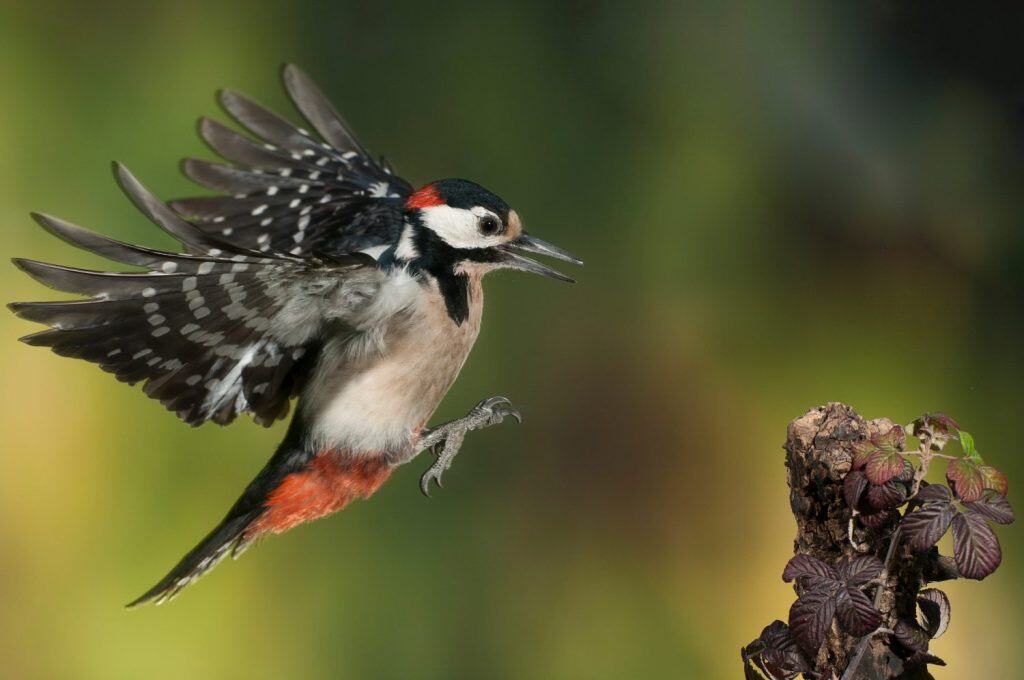
Flying great spotted woodpecker.
©FJAH/Shutterstock.com
Woodpeckers are not stuck at one power setting. When the goal is to excavate a deep cavity in sturdy wood, the bird escalates pre-impact bracing, recruits more strongly from the neck and trunk, and keeps the tail prop engaged. When the goal is exploratory tapping or communication, the bird uses lower-amplitude head motions with lighter co-contraction. The respiratory rhythm scales with the task, maintaining the exhale-on-impact pattern even when the force is reduced. Such fine control explains how a bird can switch from rapid territorial rolls to deliberate excavation with minimal wasted energy.
Implications For Engineering And Design

Research into woodpecker anatomy could help designers create safer helmets.
©Vlad Linev/Shutterstock.com
When hits are very quick and powerful, solidity and alignment can matter more than lots of padding. Think hammer-on-a-nail versus a pillow-on-a-nail. The hammer works because it is stiff, straight, and stops cleanly. Woodpeckers essentially “become” a hammer with their bodies: they brace, line everything up, and time a brief exhale to stiffen their “core” right at impact.
Engineers can copy this strategy by building machines or gear with rigid links that keep forces traveling in a straight path, then add smart timing so the system “braces” for a split second at the exact moment of contact. Examples might include: a small robot chisel that chips paint without shaking itself apart, a drill that fires tiny, timed pulses while the body of the tool momentarily stiffens, or helmets and pads that spread a hit fast and stop motion precisely rather than relying only on thick foam.
The Takeaway
The new measurements of synchronized exhalation, muscle activity, and impact timing give us the clearest picture yet of how woodpeckers perform such a body-stressing task superbly without injuring themselves. As our understanding of these birds becomes sharper, we can apply their mechanics to tools, robots, and protective systems.