
Quick Take
- Slamming your face into wood at 15 mph would kill a human, yet a pileated woodpecker does it thousands of times a day without injury. How? See how they survive →
- A split-second before every impact, something happens to protect the woodpecker's eyes from the force. What that something is will likely surprise you. Learn about eye protection →
- Pileated woodpeckers have a tongue engineered to harvest insects in a way no other bird can replicate, and the design is genuinely unsettling. Explore the bizarre tongue →
Aside from perhaps experiencing a tidal wave a hundred feet high crashing onto a city, there is likely nothing in human experience that compares to being an ant caught by a woodpecker’s tongue. In this Instagram video, a colony of insects is at the mercy of a pileated woodpecker after it breaks through a tree’s bark and gobbles up the grubs inside.
While you might struggle to chop down even a small tree, pileated woodpeckers are built for tearing through wood. Let’s learn more about pileated woodpeckers, one of the more striking-looking birds found in North America. We will also discuss their eating habits and how the remarkable structure of their tongues allows them to slam their beaks into wood over and over without sustaining any injury.
Pileated Woodpecker Basics
The largest woodpecker in North America, the pileated woodpecker stands apart from other birds, and not just due to its size. These woodpeckers (Dryocopus pileatus) have distinct black and white stripes on their face as well as vivid red crests. About the size of crows and several times more colorful, pileated woodpeckers set the tone for any region they happen to land in.
Pileated woodpeckers mostly live in the deciduous and coniferous forests of Canada and both the eastern and northwestern parts of the United States. Unlike migratory birds, pileated woodpeckers often guard their territory fiercely. They are also monogamous, forming mating pairs that stay in the same parts of a forest their whole lives. Chances are, you will hear them before you see them. That’s because pileated woodpeckers make a distinct drumming-pattern sound when they hammer into tree trunks for mating displays and territorial defense. Pileated woodpeckers can drum at up to 17 beats per second, repeating this pattern 10 to 30 times in a row.

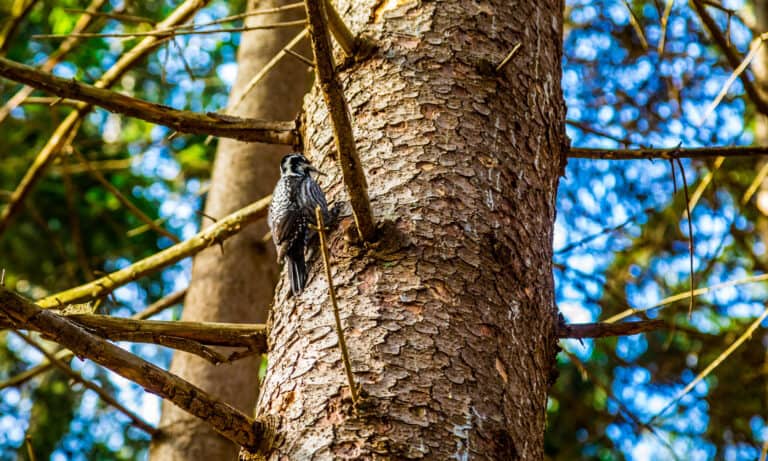
Pileated woodpeckers are the largest woodpeckers in North America.
©rhfletcher/Shutterstock.com
Using their formidable beaks, these woodpeckers drill large holes into trees and logs with ease. They primarily hunt for insects, particularly carpenter ants. However, finding colonies of ants under bark and scooping them up requires some serious physiological superpowers.
The Anatomy of a Pileated Woodpecker
In this Instagram video, a vivid-looking pileated woodpecker slams its beak into a tree trunk, tearing away at the fiber with ease. Eventually, it manages to break through and suck out a line of ants. The woodpecker in this video manages this feat with such ease, thanks to its impressive drilling skills. Woodpeckers like the pileated variety can strike wood at speeds of up to 15 miles per hour, repeating this action up to 20 times per second. This subjects the bird’s head to approximately 1,000 to 1,500 times the force of gravity (g-force).
This kind of force would be deadly to a human being. However, pileated woodpeckers take the force with ease due to their thick skulls. They also have tight third eyelids called nictitating membranes and spongy bone at the base of their bills that works like a shock absorber. When their beaks drill down into dead wood, the skull absorbs the impact, and the spongy bone at the bill base takes the shock. Additionally, the nictitating membrane closes just milliseconds before impact to prevent their eyes from literally popping out of their heads.
The tongue, however, is the pileated woodpecker’s true secret weapon. For one, it can extend several inches past its bill. This allows it to scoop up ants hiding farther in a tree trunk or log. The ends of their tongues are shaped almost like spears. Their tongues are supported by large salivary glands that help hundreds of ants stick to their surface at the same time. Even more remarkably, the pileated woodpecker’s tongue wraps completely around its skull. This adaptation allows them to snatch up between one thousand and two thousand ants each day. As seen in this Instagram video, a pileated woodpecker can make quick work of a hidden colony of ants in a dead tree.