
Quick Take
- A woodpecker's tongue is too long to fit inside its own head, and evolution found a wildly unexpected way to store it. See just how long →
- The same structure that lets woodpeckers fish bugs out of bark also keeps them safe every time they slam their beak into a tree. Discover the dual purpose →
- Woodpeckers strike at forces that would kill virtually any other vertebrate, and the secret to surviving is not what most people assume. Explore the survival secret →
- If a human had the same tongue proportions as this bird, the result is genuinely hard to picture. Understand the anatomy →
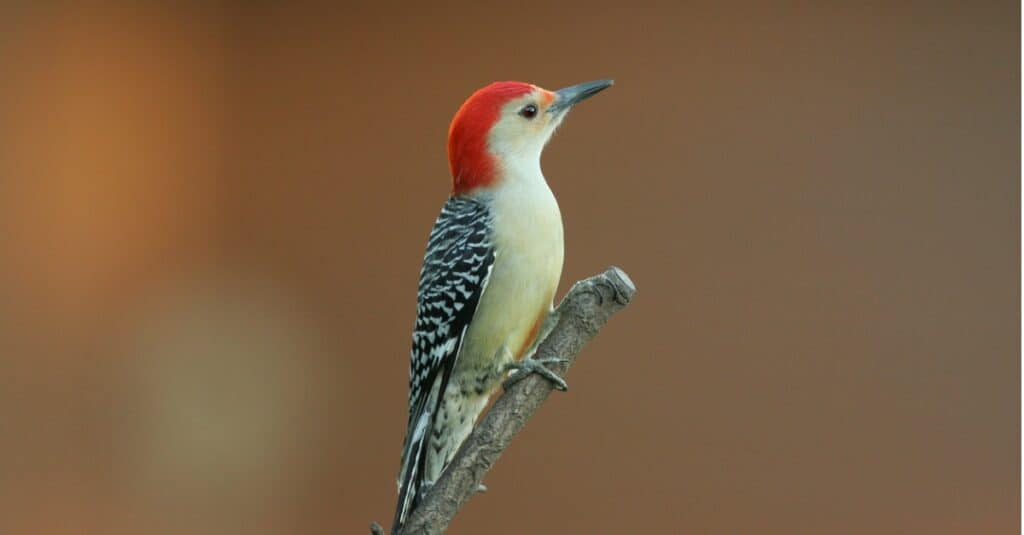
The red-bellied woodpecker has a bright red head and a slightly pink lower belly, but that’s not all that makes this bird unique. Inside its small skull, this particular woodpecker carries one of the most bizarre anatomical structures in the animal kingdom: a tongue so long that it coils around its brain.
This is everything you’ve ever wanted to know about the red-bellied woodpecker, including its ridiculously long appendage.
A Tongue Too Long for the Average Beak
Just how long is a red-bellied woodpecker’s tongue? On average, it is roughly two to three times the length of its beak, too long to keep tucked away when not in use.

The tongue of the red-bellied woodpecker is impressive, long enough to wrap around its own brain.
©Connie Moore/Shutterstock.com
According to the American Bird Conservancy, the woodpecker’s tongue splits into a V behind its eyes, wrapping completely around the skull by passing over the top and around the back of it, eventually rejoining at the base of the lower beak. If a human tongue were proportionally the same length relative to our body size, it would stretch roughly two feet long.
How is the Woodpecker’s Tongue So Long?
The hyoid apparatus, a series of elongated, flexible bones sheathed in muscle, are responsible for this anatomical oddity. In most birds, the hyoid is a much shorter structure, sitting at the base of the bill. In woodpeckers, the hyoid extends so far that it wraps the entire circumference of the skull, anchoring near the nostril or eye socket, depending on the specific species.
The hyoid is a collection of flexible bones found in the woodpecker’s head.
©iStock.com/Flatcoater
The miraculous hyoid and elongated tongue not only allow the birds to forage for bugs buried deep in the wood, but they also give woodpeckers protection while they bash their heads into trees. Repeatedly.
The Protective Purpose of the Woodpecker’s Tongue
A woodpecker drumming into hardwood has the ability to strike at rates of up to 20 times per second, using forces that would cause death via brain injury in virtually any other vertebrate, bird or otherwise. The woodpecker’s skull and beak have evolved to possess a variety of shock-absorbing features, and the hyoid apparatus is critical to that system.
When the muscles surrounding the hyoid tighten as the woodpecker’s beak strikes wood, these muscles hold the skull and spine in place, acting like a sort of seatbelt, according to recent research. A team of scientists using high-speed 3D cameras, CT scanners, and scanning electron microscopes confirmed this tensing action as a key component of the woodpecker’s concussion-prevention system.
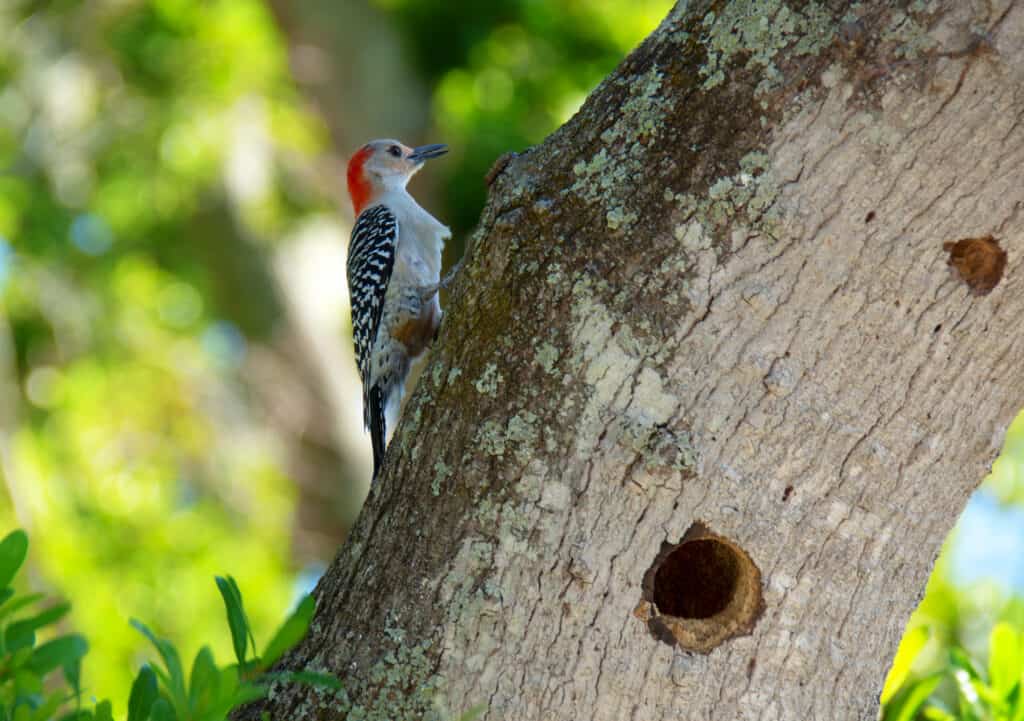
The tongue acts like a helmet as the woodpecker beats its head into trees.
©Michael O'Keene/Shutterstock.com
The hyoid bones themselves are engineered for this dual purpose, with a stiff inner core and a more flexible outer shell capable of absorbing and distributing impacts. Woodpeckers also have extra plates of soft bone inside the skull, acting as insulation between denser layers of compact bone. The upper and lower beaks are also slightly offset, which staggers the moment of impact and results in distribution of force.
The Woodpecker’s Tongue is an Evolutionary Marvel
The red-bellied woodpecker’s tongue is a precise and evolved tool, aiding in both foraging and protection in equal measure. It is one of the most fascinatingly engineered adaptations in the natural world.