
Quick Take
- For a decade, the colony thrived through drought. Then one year, the traps came up empty.
- A rodent's pregnancy is timed to a single plant-growing window, and one missed season can unravel everything.
- Degus have odd tricks for surviving dry summers, but one year they weren't enough.
- Another colony just a short distance away didn't vanish. What made the difference?
In 2020, researchers set live traps at the Germán Greve Silva experimental station in Rinconada de Maipú, near Santiago, where they had been catching and marking common degus since 2009. They caught none, and extra surveys in 2021 found none either, Chile’s Institute of Ecology and Biodiversity said in an Oct. 30, 2026 release.
The colony had kept growing through most of central Chile’s megadrought, according to the study, published in Ecology in September 2026. In 2019, Santiago got about 3.2 inches of rain against a long-term average of about 12.2 inches, a deficit of about 75%, according to a 2025 paper in Hydrology and Earth System Sciences.
The trapping began as a study of degu social life, led by Luis Ebensperger of the Pontificia Universidad Católica de Chile and Loren Hayes of the University of Tennessee at Chattanooga, according to the institute. Degus live in groups and raise their young communally. The Ecology paper now lists that social organization, along with a short lifespan and seasonal breeding, among traits that “may limit the ability of degus to buffer consecutive demographic failures under extreme conditions”.
Most adults don’t survive to their second year, according to the institute. That means a steady supply of new individuals is essential to keep a population going.
A 90-day pregnancy depends on winter rain
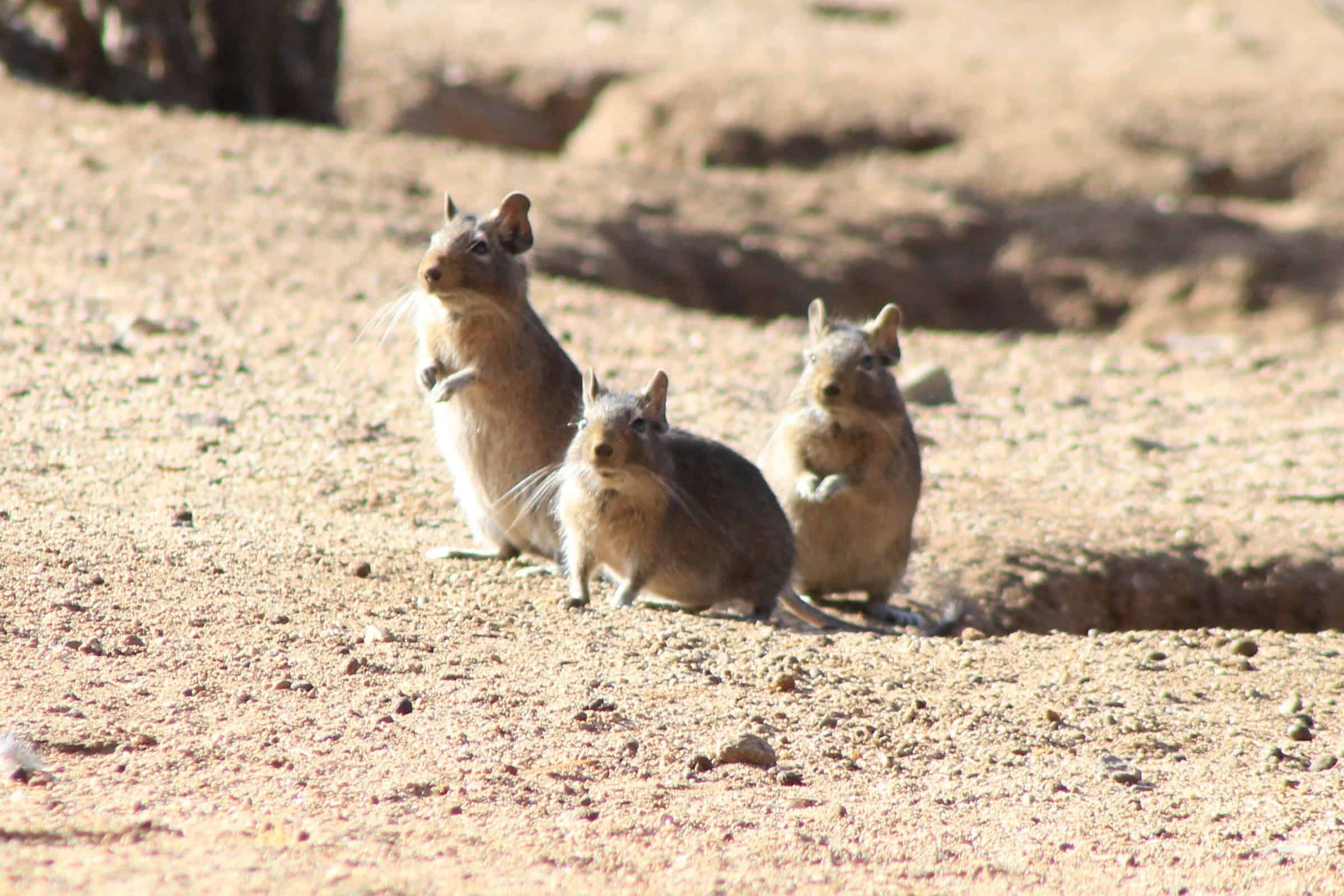
Common degus live only in Chile, in semi-arid country, sheltering in burrows and feeding by day, according to the institute. They resemble gerbils but are much larger, at 6 to 10.6 ounces, according to the University of Michigan’s Animal Diversity Web. Related females nurse one another’s pups.
Their main food is the green annual herbs that grow in the wet months, the institute said. Central Chile gets most of its rain from a handful of winter storms between May and September, according to the hydrology paper.
Gestation lasts 90 days, long for a rodent, according to Animal Diversity Web. Breeding starts in winter, the institute said, and pups arrive in late August and early September, when plant food peaks. Mothers then need enough of that food to make milk.
Degus re-eat their droppings to get through dry summers
In summer, when green herbs fade, degus range farther and eat leaves, seeds and parts of shrubs, according to the institute. They shift feeding away from the hottest hours, retreat to their burrows, conserve water and energy, and re-eat their own droppings to recycle nutrients.
Santiago’s rainfall was below average every year from 2010 to 2022, averaging about 7.5 inches, the lowest 13-year stretch on record, according to the 2025 hydrology paper. Human-caused drying explains about a quarter to a third of that megadrought.
In 2019 the winter plants never grew
Annemarie van der Marel, a biologist at the institute and the paper’s first author, described that year in the institute’s release, in Spanish. “Normally, even during the drought, there was some precipitation in winter that let plants grow and provided food for the degus,” she said. “But that year the plants didn’t grow and there was practically no food”.
The study found that gross primary productivity, a measure of how much plant matter photosynthesis produces, best predicted degu survival and recruitment. In 2019 it crossed a critical threshold, both rates fell sharply and the population collapsed.
The dry weather continued through the follow-up surveys. Rain in winter 2020 ran 25% to 33% below average, and 2021 brought Santiago about 4.4 inches, making it the fifth hyperdrought year in a century of records after 1924, 1968, 1998 and 2019, according to the hydrology paper.
A colony less than 6 miles away survived
While looking for a new place to continue their work, the researchers found another degu population within about 6 miles of the lost one, according to the institute’s release. That site has trees and shrubs, while shrubs covered only about 14% of the old one.
“Everything indicates that the characteristics of the local ecosystem may have influenced it,” van der Marel said in the institute’s release.
Animal Diversity Web lists the bark of Cestrum palqui and the leaves and bark of Acacia caven among degus’ favorite foods. They climb into low shrub branches to forage and take cover in shrubby areas when a culpeo fox or barn owl appears.
The species is listed as Least Concern by the IUCN, though the status of many of its populations in Chile is unknown. The Ecological Society of America posted an English summary of the findings on Nov. 11, 2026. Van der Marel wants to learn why some populations survive extreme drought while others vanish, the institute said, and she points to vegetation, food supply and social organization as possible factors.