
Quick Take
- Pistol shrimps have one larger, modified claw.
- When they open it and snap it shut, it produces a fast-moving vortex ring.
- The vortex ring produces a cavitation bubble, which collapses, producing heat, sound, and light.
- The shrimp uses these ‘snaps’ for hunting, defense, and communication.
The pistol shrimp is a remarkable little creature. It is capable of producing a noise louder than a gunshot and generating heat reportedly as hot as the surface of the sun. Yet it is only an inch or so long and has a very unassuming appearance. Here, we will explain how this shrimp harnesses complex principles of physics to a powerful effect.
What Is a Pistol Shrimp?
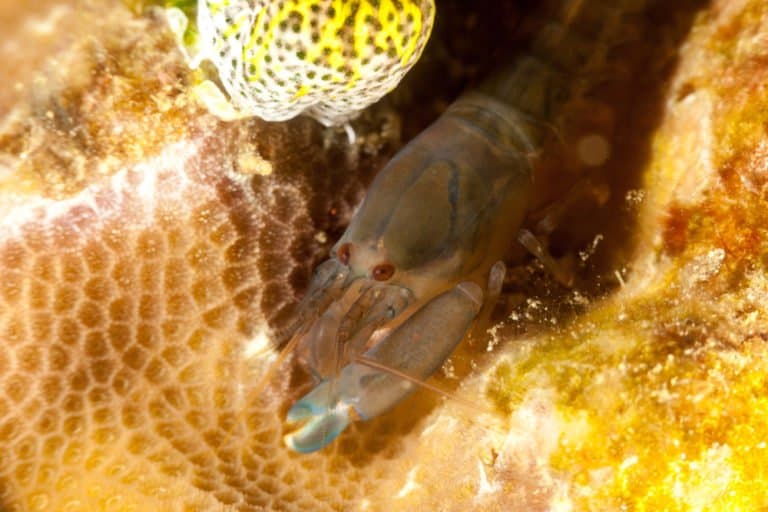
Pistol shrimps (Alpheus heterochaelis) are also called bigclaw snapping shrimps. They are native to the western Atlantic Ocean, particularly the Gulf of Mexico. Here, you will find them at the bottom of subtidal waters, at depths of 98 feet or more. During the day, they hide or burrow under rocks and shells.
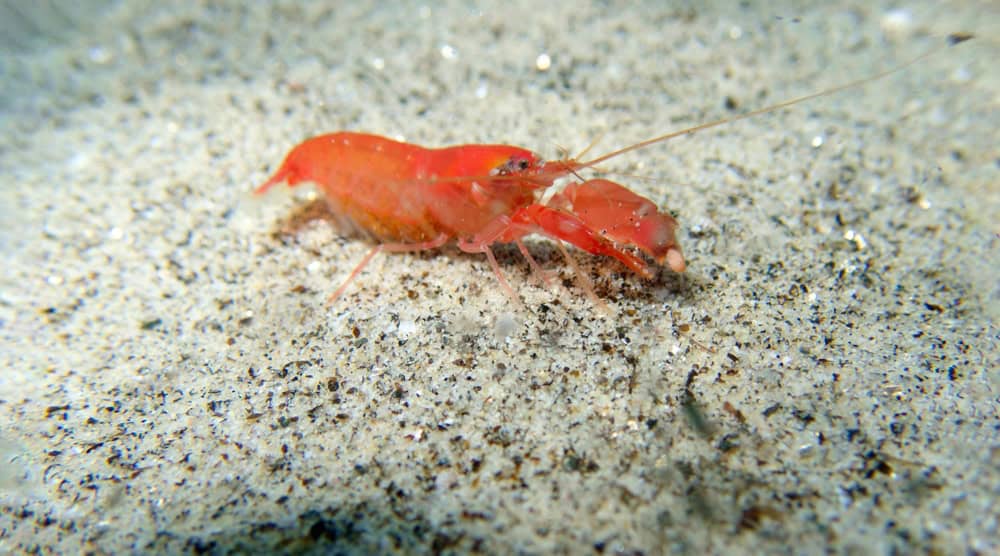
Pistol shrimps live on the ocean floor.
©Vojce/Shutterstock.com
Even though they are the largest of all the snapping shrimps, they are still not that large! An average adult will measure between 0.39 and 2.17 inches in length. They have three pairs of legs and two sets of antennae, but the most fascinating part of them is their claws.
Pistol Shrimp Claws
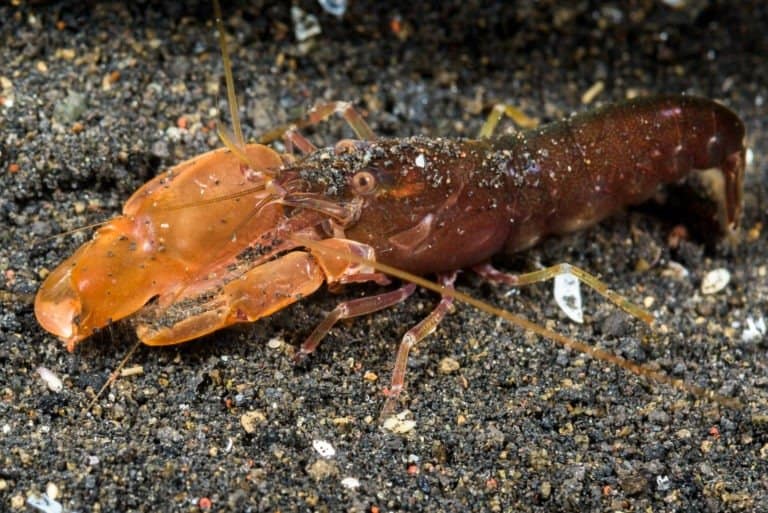
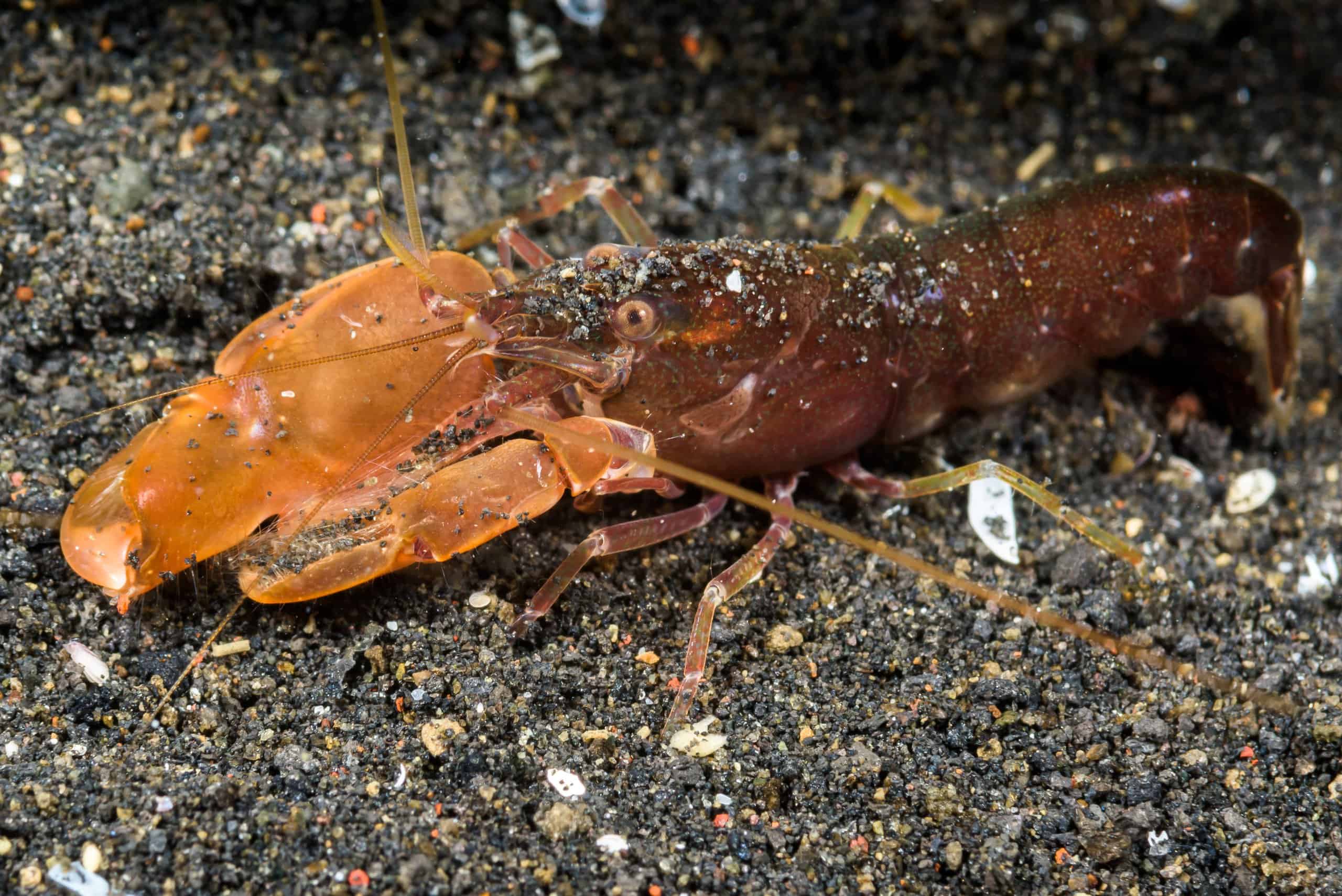
These shrimps have two claws. One is a regular claw, but the other is a modified snapping claw. Both claws are covered in fine hairs called setae. In most shrimp, however, only the modified claw is orange. The rest of the body is dark blue-green to gray. If the large claw is lost, the smaller claw grows to become the new large claw, while the lost claw regenerates as a smaller claw.
The large snapping claw has two parts: the dactyl and the propus. The dactyl has a protrusion, called a plunger, that fits into a socket in the propodus. This modified snapping claw can be locked in an open position, a bit like cocking a pistol. They achieve this by wedging the smaller digit of the pincer behind a ‘shelf’ located between the two pincer digits.
When the smaller digit is released, the two digits snap together, and the plunger forces water out of the socket. This water moves through a narrow groove, creating a fast-moving vortex ring. This behavior is only seen in adult pistol shrimps. When they ‘fire’ their claws, the vortex ring makes a ‘popping’ sound which is produced by a phenomenon called cavitation.
What Is Cavitation?
To understand cavitation, we need a basic physics lesson! The substance that we call water (H2O) can exist in three forms: solid (ice), liquid (water), and gas (vapor). When liquid water is subjected to a reduction in pressure, it turns into vapor because the molecules have more space to move around.
Sometimes, you can get vapor bubbles within liquid water because there are areas of lower pressure. So, what can cause these low-pressure regions? It can happen when the liquid has been accelerated at high speeds. This can be achieved by pumps, water turbines, propellers…and snapping claws! The vortex ring has such a high speed that local areas of low pressure are formed. This vaporizes the water, forming a cavitation bubble.
As these bubbles collapse, water surges in to fill the space at speeds greater than the speed of sound. This creates a loud noise (up to 218 dB) and a temperature of around 4800 degrees centigrade, which is similar to the surface temperature of the sun. There is also a brief flash of light. This is caused by a phenomenon called sonoluminescence, in which sound waves produce light. Importantly, the loud noise is not produced by the claw snapping itself shut.
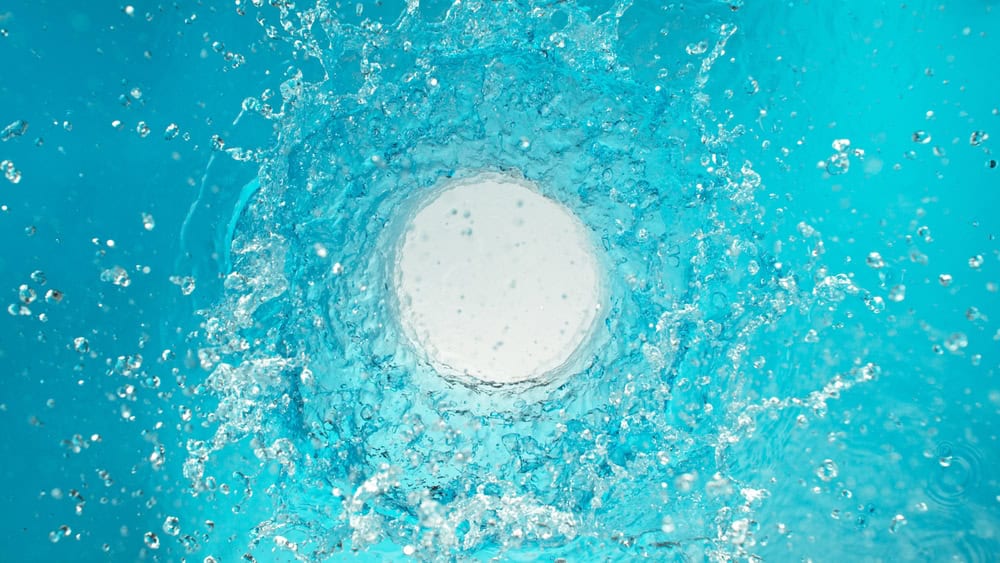
The vortex ring is so fast that it drops the pressure inside it.
©Lukas Gojda/Shutterstock.com
In many ways, this process can be compared to the formation of lightning, where air is superheated, and compression creates a low-pressure area, resulting in the formation of a bubble. Particles rush to fill the bubble, exceed the speed of sound, and cause the noise that we know as thunder.
Using the Cavitation Bubble
More importantly for the snapping shrimp, a high-pressure pulse is also generated, which immobilizes small animals in the vicinity. These shrimps are omnivores and graze on algae. However, most of their nutrition is obtained by ambushing prey in this manner. They eat small marine animals, including worms, crustaceans, shellfish, and small fish. Pistol shrimps are hunted by larger fish such as weakfish and red drum. Their claw snap, however, means that they are safe from smaller predators who would be immobilized by the pressure pulse.
For communication, they use both the frequency of their snaps and the speed of the water jet produced to send and receive information. Some studies have suggested that the shrimp can tell the gender of another shrimp from the snap they produce. Males have more aggressive snap frequencies and faster jet speeds. If one shrimp tries to take over another’s rock crevice or hunting area, it is swiftly warned away with a snap! However, these warning snaps are not fast enough to form a cavitation bubble, so the intruding shrimp survives the encounter.