
Quick Take
- Sceptobius lativentris (a rove beetle) can infiltrate ant nests undetected.
- It does this by coating itself in ant pheromones called CHCs.
- If it has no CHCs, it will dry out and die.
- Therefore, it is dependent on one ant species.
Ant colony nests are known for their impenetrability. These highly organized insect societies will soon detect an intruder’s pheromones (chemical signals) and attack with deadly efficiency. A species of rove beetle, Sceptobius lativentris, has evolved a method for breaching these defenses, but it comes at a high price. Does this beetle now find itself in an evolutionary dead end, the ultimate catch-22 situation? Read on to find out.
About Velvety Tree Ants
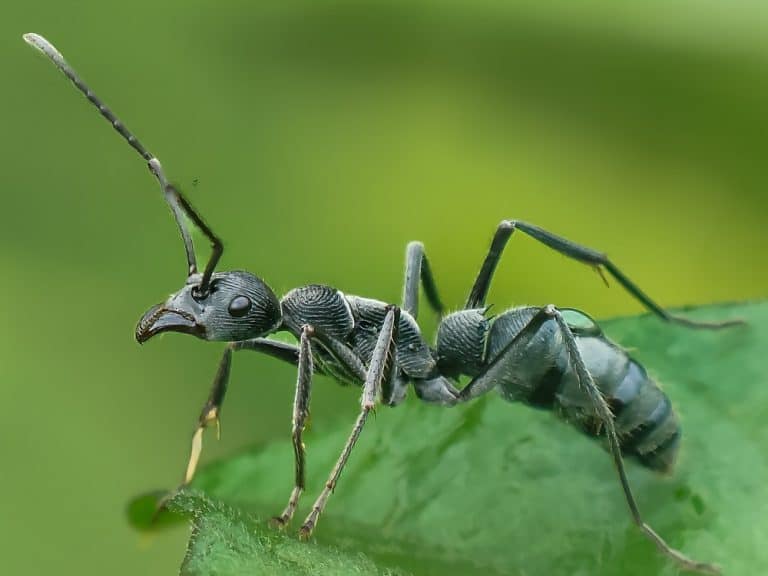
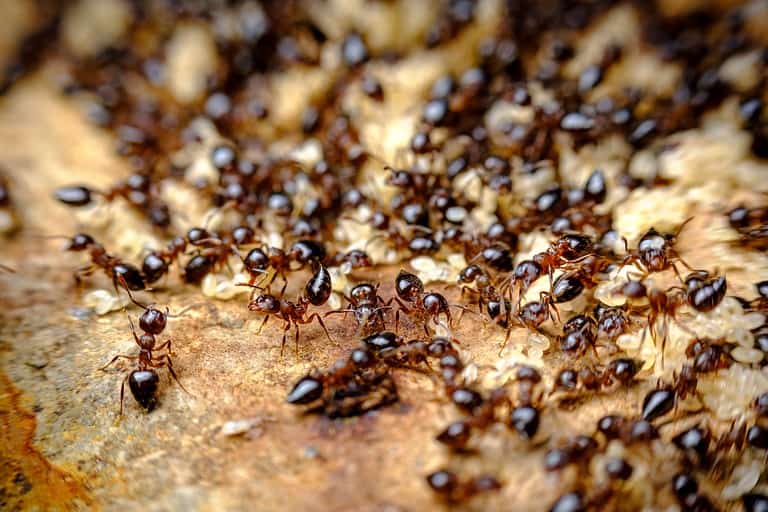
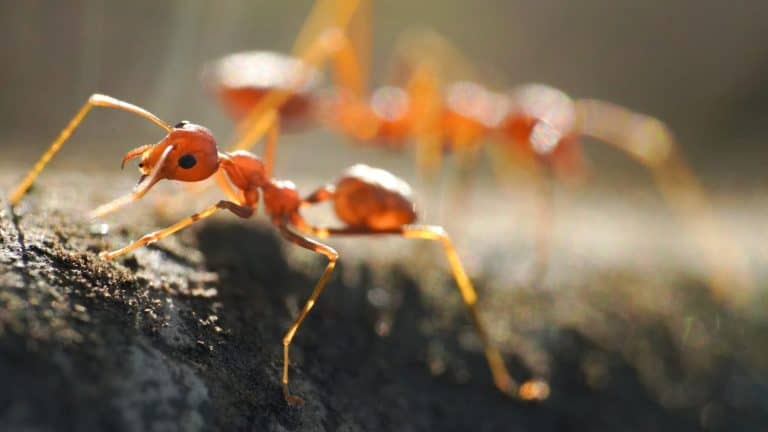
The Sceptobius lativentris rove beetle has a close relationship with the velvety tree ant (Liometopum occidentale). These beetles are myrmecophiles, meaning they live in association with ants.
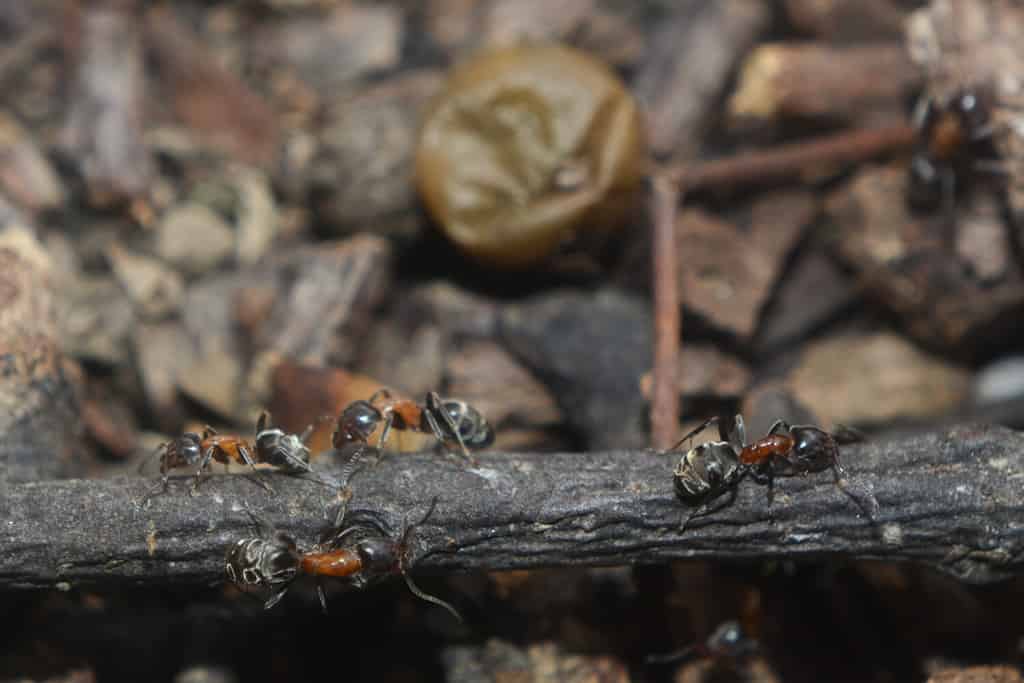
Caution is advised when dealing with velvety tree ants, as they are considered to be aggressive.
©Vincent Grebenicek/Shutterstock.com
Velvety tree ants are found in coastal regions from southern Washington to northern Mexico. In California, they are also frequently seen in urban settings. In the southwestern US, they are among the most common ant species in oak and pine forests.
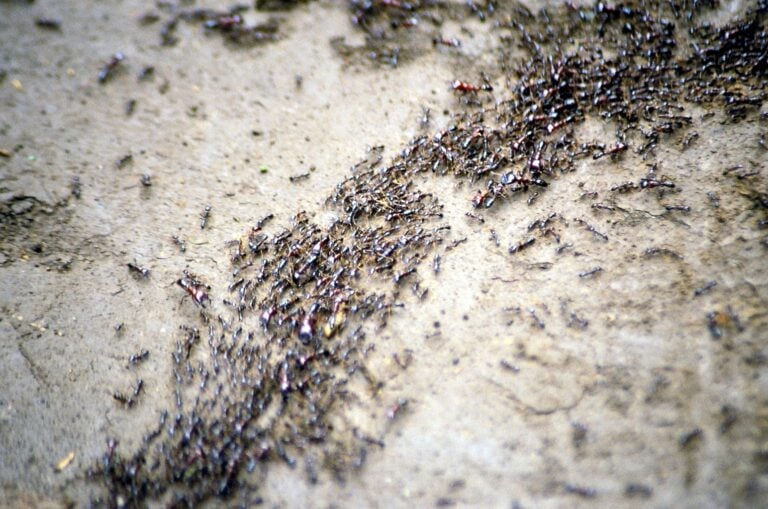
These ants form their nests in tree crevices and underneath the bark of dead trees. The nests are likely deep, located under roots or boulders, and contain tens of thousands of workers. As opportunistic omnivores, they forage along colony trails up to 200 feet from the nest. They consume other insects, honeydew produced by aphids, mealybugs, or scales. They also scavenge on dead animals and particularly like sweet substances. These ants are aggressive and will deliver a painful bite. They also spray secretions onto intruders.
How Can Rove Beetles Infiltrate the Ant Colonies?
Ants have a cocktail of pheromones on the surface of their bodies called cuticular hydrocarbons (CHCs). Velvety tree ant nestmates all have the same CHCs and, therefore, recognize each other. Any other creature in the nest (often including velvety tree ants from other colonies) will have different pheromones and will be assumed to be an intruder.
Sceptobius lativentris rove beetles have the ability to produce CHCs, but the genes that control it are switched off as soon as they emerge as young adults. The beetles enter a sort of ‘stealth mode’. They have no CHC scent and can therefore move around the ant nest without being detected. Here, they feed on ant eggs and larvae and are even fed by the ants. They occupy the nest as a social parasite and offer very little in return to the ants.
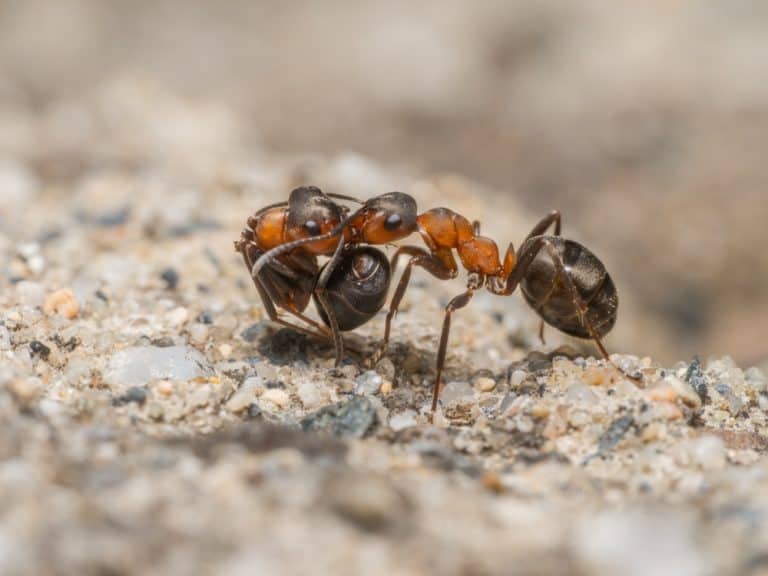
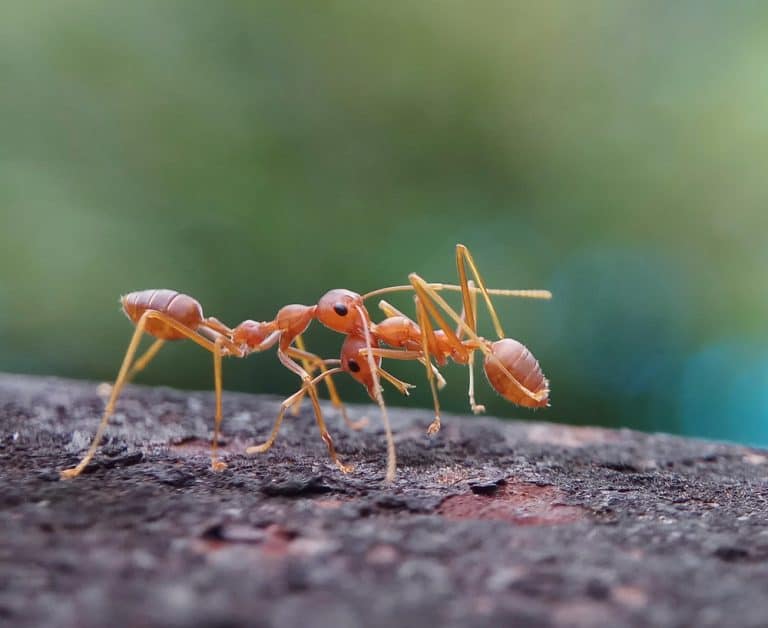
However, new research has shown that the beetles take their deception a stage further. They climb onto the ant’s body and use their tarsi (brush-like feet) to groom the ant. In doing so, they pick up the signature CHCs of the nest and smear them over themselves. Now, as far as the ants are concerned, this beetle is one of them!
Trapped in a Lifestyle
This sounds like a pretty good deal for the beetles, but this lifestyle has its disadvantages. The process is irreversible. Adults of this species have permanently lost the ability to produce CHCs, relying entirely on the ants for this function. This is a problem because CHCs are not just used for communication. They also form a waxy coating over the beetle’s body, which prevents it from drying out. So, if the beetle is removed from the ant nest, it will soon dry out and die.
Is There a Way Out of This Evolutionary Dead End?
Animals evolve different appearances and behaviors through genetic mutations. In theory, the rove beetle could escape this situation if it had a mutation that enabled it to produce its own CHCs as a mature adult. However, it would also need a second mutation at exactly the same time to lose its attraction to ants. The chances of this happening are exceptionally remote. Therefore, it is stuck.
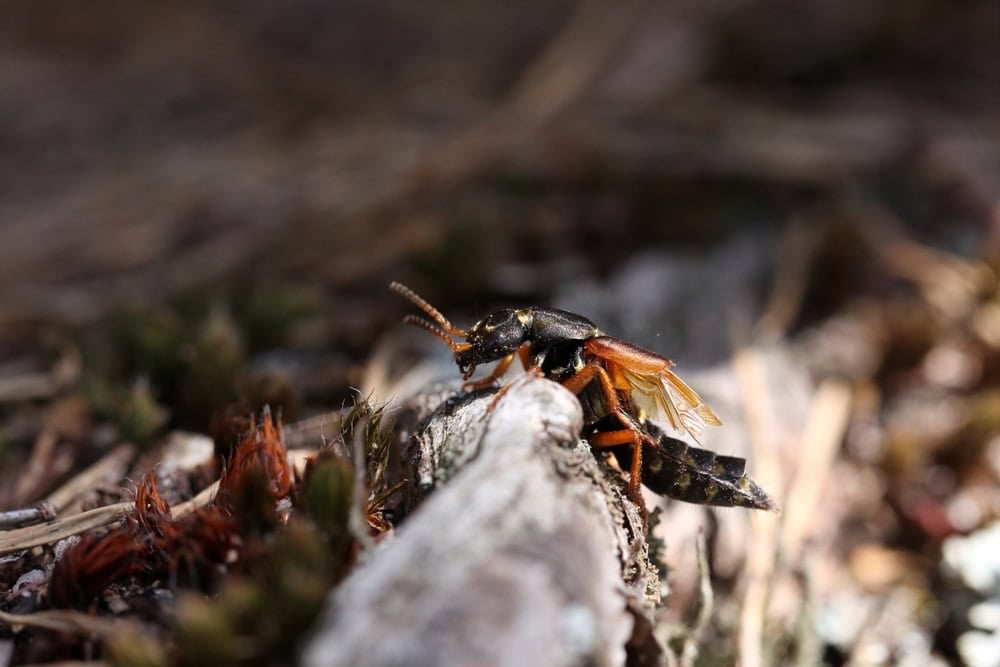
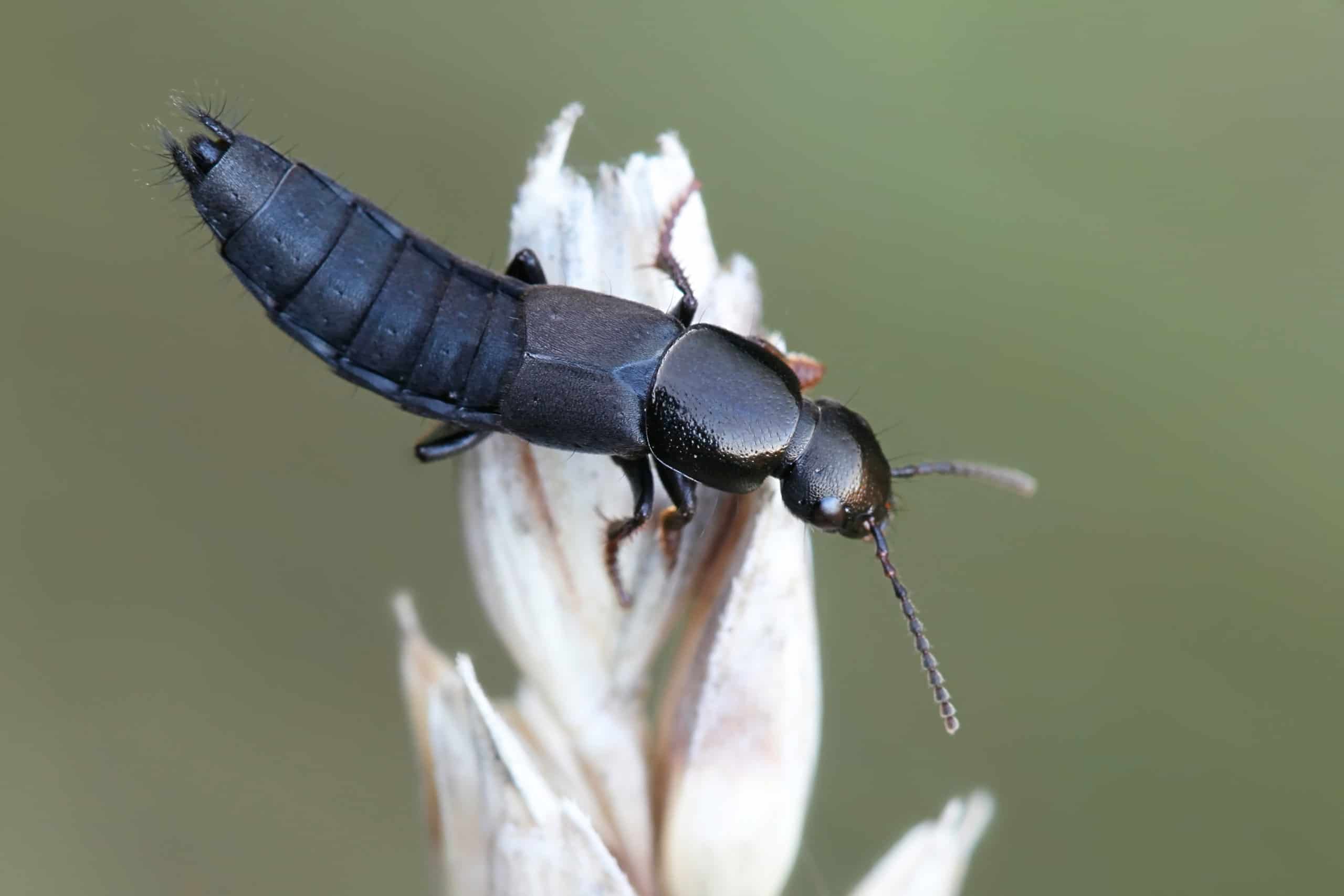
Adult Sceptobius lativentris cannot produce CHCs.
©Vladimir Woitscheck/Shutterstock.com
This is not a problem as long as the velvety tree ants survive, but what if they go extinct? The beetle will simply die off with them because it has no way to survive without them.
Could Promiscuity Be the Answer?
This beetle is highly sensitive to ant CHCs. Once it detects them, it is triggered to mount and start grooming the ant, coating itself with the pheromones. To ensure it is never far from the ants, it walks along their chemical trails when they are out of the nest.
Researchers investigated just how faithful this rove beetle is to the velvety tree ant. They placed Sceptobius beetles with other ant species. The first reaction was for the ants to recognize the beetle as an intruder and kill it. However, if the ants were prevented from doing this, the beetles mounted and groomed them as they did to the velvety tree ant. So, in the laboratory, these beetles were willing to switch between ant species.
This does not happen in nature because the beetle never gets the chance to do it. It is coated in CHCs from one ant nest, and when it comes across other ants, it gets killed! The study results indicate that these rove beetles are not faithful to one ant species but just stick with them because they are the ants that they come across most often. Once a beetle has established a relationship with one ant species, it is difficult for it to switch to another without being killed.
However, this research suggests that it is possible in theory. If the beetle had very low-level CHCs on its body and came across an alternative ant species, it would be perfectly happy to steal its pheromones and become part of that colony instead!