

Okay, admit it…Do you leave your TV on for your dog when you leave the house? Well, you are not alone! Or maybe, when you are home watching TV, you’ve caught your dog tilting their head at a barking sound on the screen or tracking a fast-moving animal across the TV. Many of us have wondered if dogs watch TV. The answer is yes, and in some cases, it can even benefit their behavior and emotional health. While watching TV won’t replace daily walks, playtime, or companionship, it can serve as a supplemental tool to help ease anxiety, reduce boredom, and offer mental stimulation. This is especially true for dogs left alone at home.
What Does the Research Say?
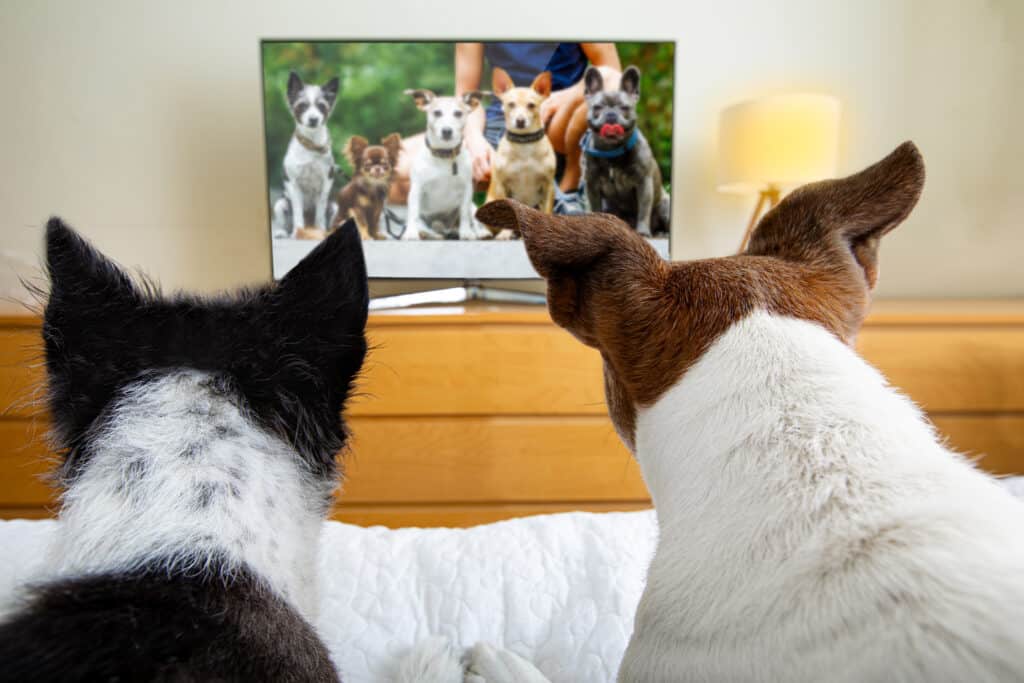
Research indicates dogs can recognize the faces of other dogs on TV screens.
©Javier Brosch/Shutterstock.com
A 2024 study involving over 1,200 dog owners found that more than 70% of dogs actively watched screens at least once a day. Most dogs focused for only one to five minutes, but the reactions were clear: there were tail wags, head tilts, vocalizations, and even dogs approaching the screen. Content that included other animals, particularly dogs, was by far the most captivating for the dogs in the study.
And more recently, in an NPR segment, reporter Nate Rott explores new research on canine TV-watching habits, prompted by a question many dog owners have: do dogs really watch TV, and what do they respond to? Jeff Katz, a psychological sciences professor at Auburn University, was intrigued by channels like DogTV (a paid subscription dog channel) and launched a study to investigate.
Surveying 650 pet owners, Katz and his team found that dogs’ reactions to TV are closely tied to their personalities. Energetic dogs are more likely to track moving objects across the screen and even look off-screen for them, while anxious dogs respond more to auditory cues like doorbells and car horns. However, some dogs don’t respond to TV at all, highlighting individual variation in canine behavior.
The study opens the door for future research into how visual and auditory stimuli impact dogs and suggests that understanding these behaviors could improve how we use media as enrichment for pets. Whether it’s customizing TV content for anxious pups or helping high-energy dogs engage in healthier ways, these insights may help pets and their people enjoy more relaxing screen time together.
Why Would a Dog Watch TV?

Dogs perceive motion and even colors differently from humans.
©sommart sombutwanitkul/Shutterstock.com
Dogs experience the world differently than we do, but that doesn’t mean they ignore what’s on the screen. Some dogs are engaged with television, while others show little interest. Personality and breed play a role in whether a dog likes TV, what their viewing interests are, and how they react to visual stimuli.
Dogs can:
- Perceive motion on the screen more quickly than humans
- Recognize other dogs, even across different breeds, in images and video
- Respond most strongly to sights and sounds that mimic real-life stimuli, like barking, nature sounds, and moving animals.
Dogs aren’t following plotlines, of course, but the sights and sounds of TV, especially content designed with dogs in mind, can hold their attention for a few minutes at a time. Some dogs may simply glance at the screen, while others bark, perk up, or move closer to investigate.
How TV Can Help Your Dog

There are several practical applications for dogs watching television.
©GaViAl/Shutterstock.com
As we can see, television isn’t just for humans anymore; increasingly, it’s being used as a tool to support canine well-being. For dogs left home alone, the TV can do more than fill the silence. Television can ease anxiety, promote relaxation, and offer meaningful mental engagement. From calming music and gentle visuals to desensitizing soundscapes, thoughtfully chosen programming can help dogs feel more secure, less reactive, and less likely to engage in destructive behavior. As our understanding of canine needs grows, so does our ability to create a home environment that supports both their emotional and behavioral health, even when we’re not there.
Here are some of the benefits:
- Eases Separation Anxiety– For dogs that struggle with being left alone, background noise and visual stimulation can create a comforting environment. Hearing familiar sounds and seeing natural scenes or other animals on screen can make the space feel less empty and more secure.
- Promotes Relaxation– Slow-moving visuals paired with calming music can help a restless or jittery dog settle down. Over time, they may associate the routine of the TV being on with a sense of peace and safety.
- Provides Mental Stimulation-Dogs need more than just physical exercise; they also need to engage their brains. Television can offer a novel form of enrichment, especially when toys or puzzles have lost their appeal.
- Helps with Sound Desensitization-Many dogs react strongly to sudden noises like doorbells, thunder, or fireworks. Exposure to these sounds in a controlled, non-threatening setting, like on a TV at a low volume, can help them become less reactive over time.
- Reduces Destructive Behavior-Dogs left alone without mental or emotional outlets may resort to chewing furniture, digging, or barking excessively. Having the TV on can reduce boredom and redirect their attention more productively.
- Supports Noise Tolerance-Dogs that become agitated by environmental noise may benefit from regular, mild exposure to a variety of sounds. Over time, this can help them tolerate unfamiliar noises with less stress.
What Kind of TV Do Dogs Like?

What your dog watches can also make a difference in their mood and behavior.
©Pixel-Shot/Shutterstock.com
Not all programming appeals to canine viewers. Younger dogs and certain breeds, especially herding and sporting breeds, tend to show more interest in screens, while older dogs or scent-focused breeds may not care much at all.
Studies and surveys show that dogs, in general, prefer:
- Other dogs on screen (but usually not barking)
- Nature scenes with movement, like birds flying or animals running
- Calming music over loud, erratic soundtracks
- Action with familiar stimuli like balls, animals, or flowing water
Dogs generally don’t respond as strongly to human characters or cartoons. Color also matters; dogs see primarily in shades of blue and yellow, so bright reds or greens may appear muted or gray to them. Programming with higher contrast and colors suited to canine vision can make the visuals more engaging.
Conclusion

Watching TV, especially in your absence, can make a difference.
©Art Studio/Shutterstock.com
Leaving the TV on for your dog while you’re away won’t magically fix every behavioral issue—but it can play a meaningful role in supporting your dog’s emotional and mental well-being. When used thoughtfully and in combination with daily physical exercise, enrichment toys, and positive reinforcement training, TV can become part of a balanced routine that helps your dog feel more secure and less stressed in your absence.
Every dog is different. Some may immediately perk up at the sight of other animals on screen or the sound of soothing music, while others may remain indifferent. But for dogs who do engage, having carefully selected programming in the background can provide comfort, reduce boredom, and offer a much-needed distraction from the loneliness of an empty house.
Next time you leave home, whether for a few hours or a full workday, take a moment to consider what your dog might like to watch or hear. From nature scenes and classical music to dog-friendly content featuring calming voices and slow-moving visuals, there’s a growing range of media designed specifically for pets. You might be surprised at how much simply leaving the TV on can contribute to a calmer, happier, and more content companion when you return home.