
Quick Take
- The researcher who first spotted the photo didn't recognize it as a dhole, and the reason why reveals just how close this species came to vanishing from Vietnam's records entirely. See how the photo emerged →
- A widespread myth about dhole populations, one believed by locals and rangers alike, may have done more damage to the species than poaching ever did. Explore the overpopulation myth →
- The single camera-trap photo raises a question scientists still can't answer: was this animal a lone ghost passing through, or proof that a hidden population has been surviving undetected for two decades? Examine the two possibilities →
- Dholes don't need expensive reintroduction programs to recover, yet one specific, overlooked threat keeps undoing every conservation effort in Vietnam. Discover the overlooked threat →
For two decades, Vietnam’s Pu Hoat Nature Reserve in Nghe An province suffered from “empty forest syndrome,” an ecological crisis where entire groups of animals vanish, leaving the forest unnaturally quiet. Top predators like tigers, leopards, and Eurasian golden jackals had completely disappeared from official records.
That silence is exactly what conservation scientists Tuấn Anh Nguyễn and Andrew Tilker hoped to better understand when they began surveying the reserve with camera traps near the Laos border. Instead, the team captured something nobody expected.
On New Year’s Eve 2023, a single camera trap photographed an adult dhole (Cuon alpinus) walking through the forest just 2.6 miles (4.2 kilometers) from the Laos border. Also known as the Asiatic wild dog, red dog, or whistling dog, this elusive predator had not been officially documented in Vietnam for 20 years. The discovery was so surprising that Nguyễn initially mistook the animal for a domestic dog. Because dholes had been missing from Vietnam’s records for so long, four independent scientists extensively verified and reviewed the image before it was officially confirmed.

As lead author of the dhole paper, Nguyễn also directed the fieldwork that captured the rare photo.
©
When the finding was published by Cambridge University Press in early 2026, it instantly rewrote local conservation history. Before this photo, the IUCN Red List considered the dhole to be locally extinct in Vietnam. With just one camera-trap image, the species officially returned to the country’s living wildlife map.
To better understand the rediscovery and what it could mean for Vietnam’s ecosystems, A-Z Animals spoke with lead researcher Tuấn Anh Nguyễn and co-author Andrew Tilker. Nguyễn is a lecturer at the University of Science, Vietnam National University, Hanoi, and has studied endangered mammals in Vietnam since the early 2010s. Tilker serves as Re:wild’s Species Conservation Coordinator and Species Conservation Advisor at the Center for Technology and Nature Conservation.
Why the Dhole Is Unlike Any Other Wild Canine
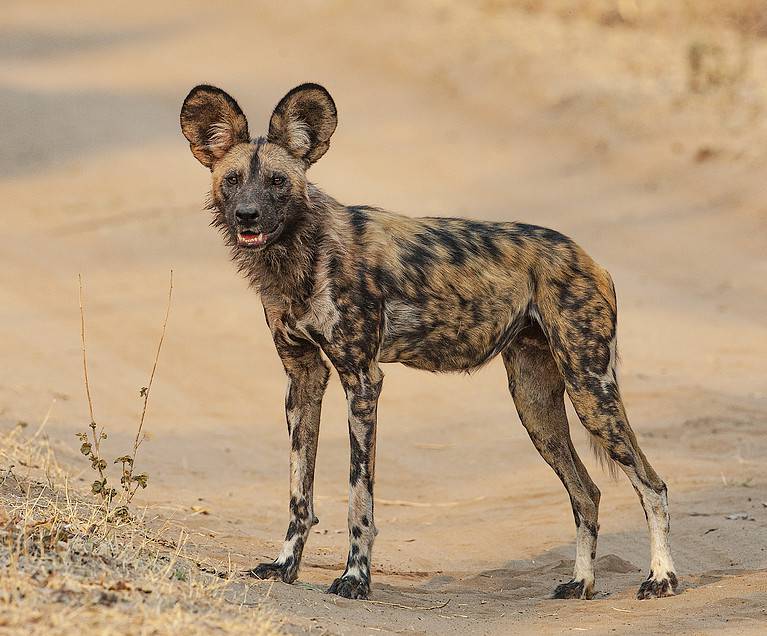
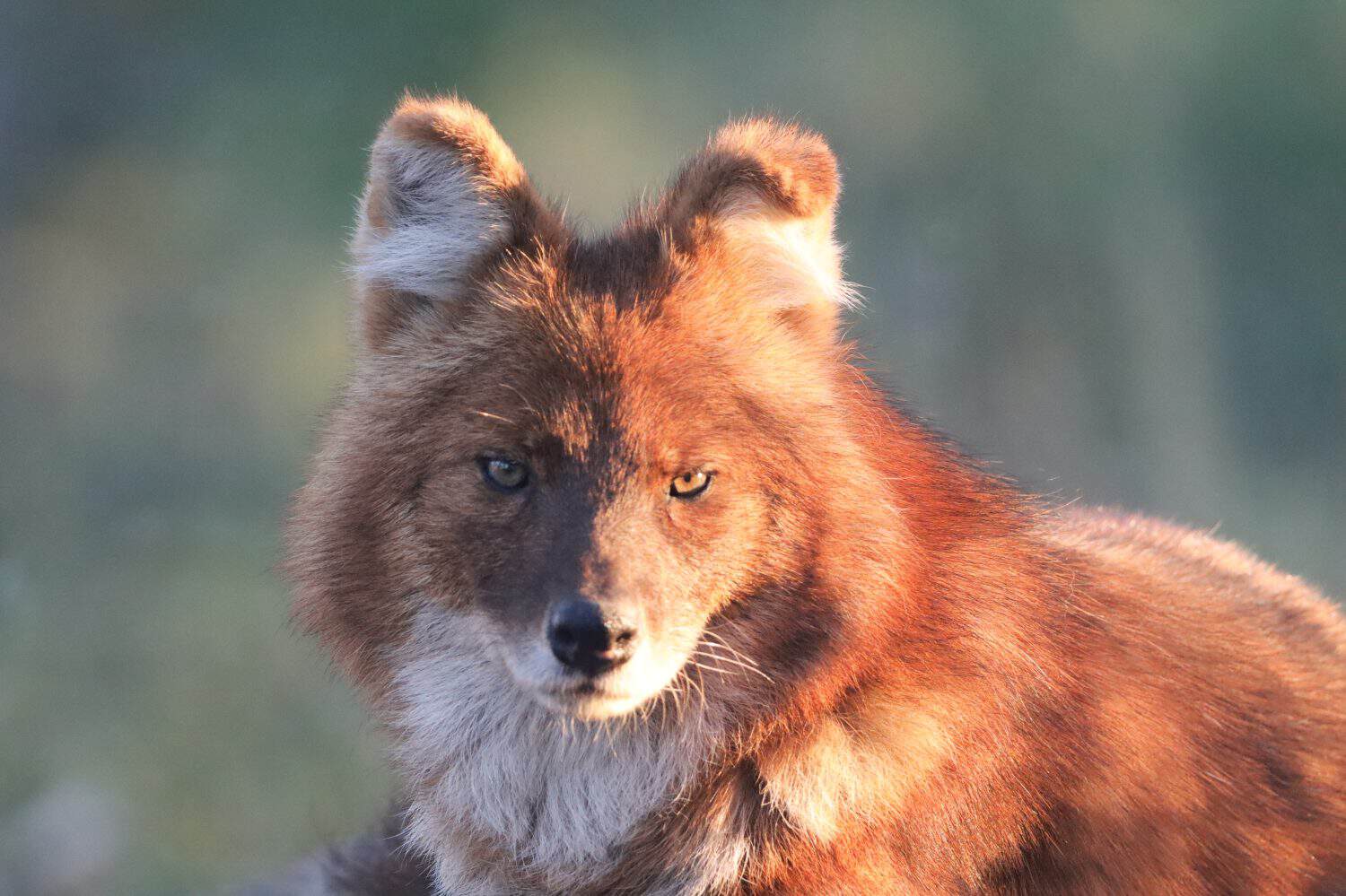
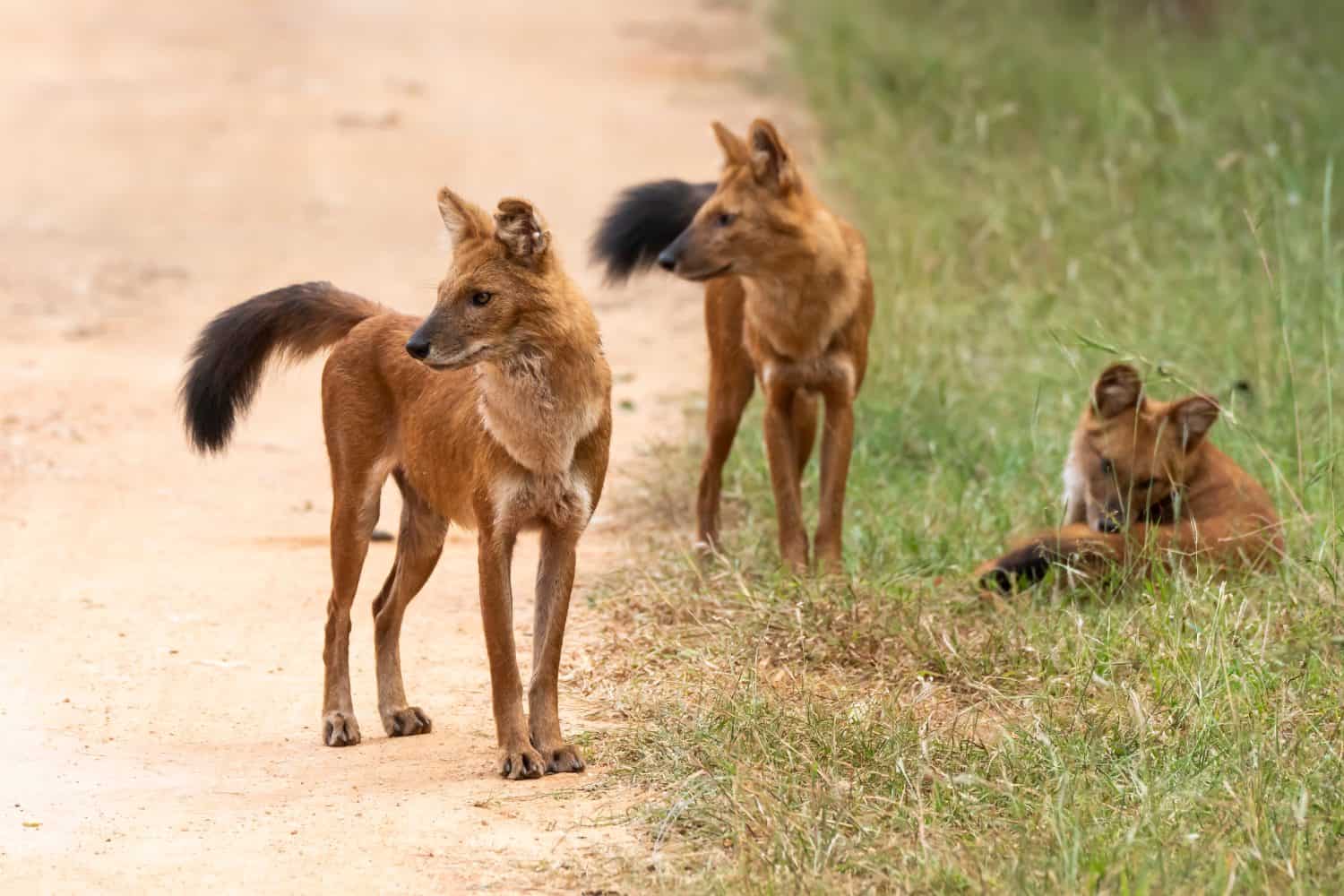
To truly understand why this rediscovery matters, it helps to look at just how unique the dhole really is. Known as the Asiatic wild dog, red dog, or whistling dog, the dhole is one of Asia’s most specialized and highly social predators. Roughly the size of a German shepherd, the dhole has a lean, fox-like body with long legs, rounded ears, and a bushy, black-tipped tail. Its coat can range from charcoal gray to sandy beige or deep rust-red, depending on where it lives. Dholes are carnivores, highly specialized for eating meat. They have shorter jaws than most other wild dogs and have only two molars on each side of their lower jaw instead of the usual three. They are fast runners, strong swimmers, and powerful jumpers that can leap more than seven feet straight up into the air.
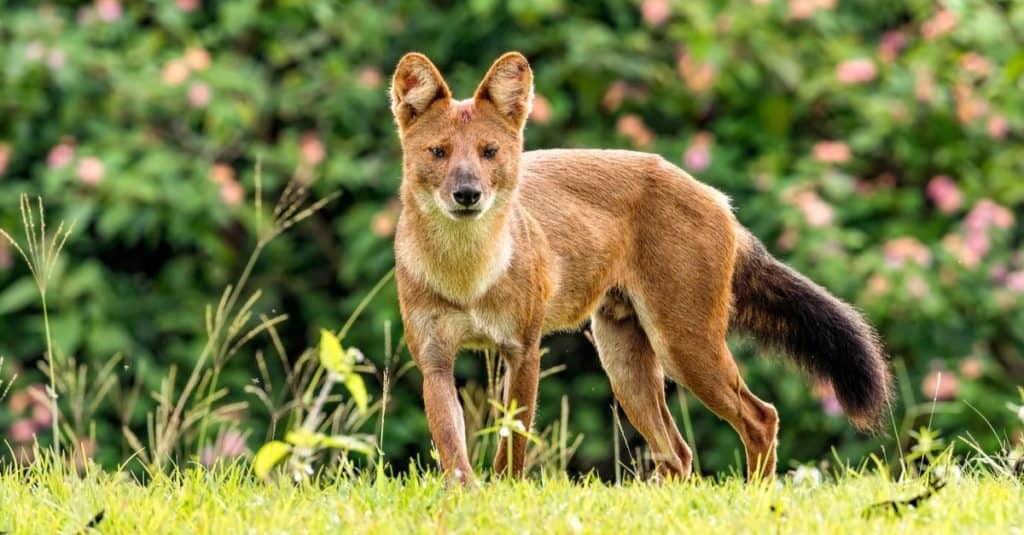
Dholes primarily prey on hoofed animals, but will also eat lizards, rabbits, bugs, and berries.
©Nimit Virdi/Shutterstock.com
When hunting, dholes operate as tightly coordinated family units. Packs typically consist of five to twelve animals. However, multiple groups will occasionally merge into temporary “super packs” of thirty or more to hunt together before splitting up again. Unlike many other social predators, dholes are remarkably cooperative and rarely aggressive toward neighboring packs. Within their own group, members frequently wag their tails, share food, and play together. Dholes use a wide variety of sounds, including screams, mews, clucks, and their most famous sound: a high-pitched whistle. They use this eerie call to coordinate hunts through dense forests, earning them the nickname “whistling dog.” Only one dominant, monogamous pair breeds in the pack. The rest of the adults act as a team to protect the pups, feed them regurgitated meat, and help raise them.
The Rapid Decline of a Once-Widespread Predator
Tragically, dholes are disappearing across much of their historical range. Dholes once lived throughout South, East, and Central Asia — stretching from Siberia all the way to the Malay Peninsula. Today, they have vanished from more than 75 percent of that historic range. The species has been completely wiped out from Russia, Central Asia, and the Korean Peninsula. This leaves only fragmented, isolated populations scattered across parts of China and just eleven countries in South and Southeast Asia. Recent estimates suggest there are around 950 to 2,000 mature adults left in the wild.
Ironically, one of the biggest challenges to protecting the dhole in Southeast Asia is a widespread myth: many people mistakenly believe that their populations are actually too high. Because dholes are secretive forest animals that are rarely seen directly, getting accurate population counts has historically been difficult. Occasional sightings by villagers and park rangers created a false impression that the predators were everywhere. As a result, locals blamed them for dropping numbers of prey animals and even regional tiger populations.
Vietnam’s Snaring Crisis May Be the Dhole’s Greatest Threat
The rediscovery in Vietnam comes at a critical time, as dholes are vanishing across most of their historic territory. However, even with the historic Pu Hoat sighting, researchers warn that dholes remain functionally extirpated across most of Vietnam. This is primarily due to industrial-scale snaring. Nguyễn explains, “The primary threat to terrestrial mammals in Vietnam is the ongoing crisis of industrial-scale, indiscriminate snaring, which plagues almost every protected area in the country.”
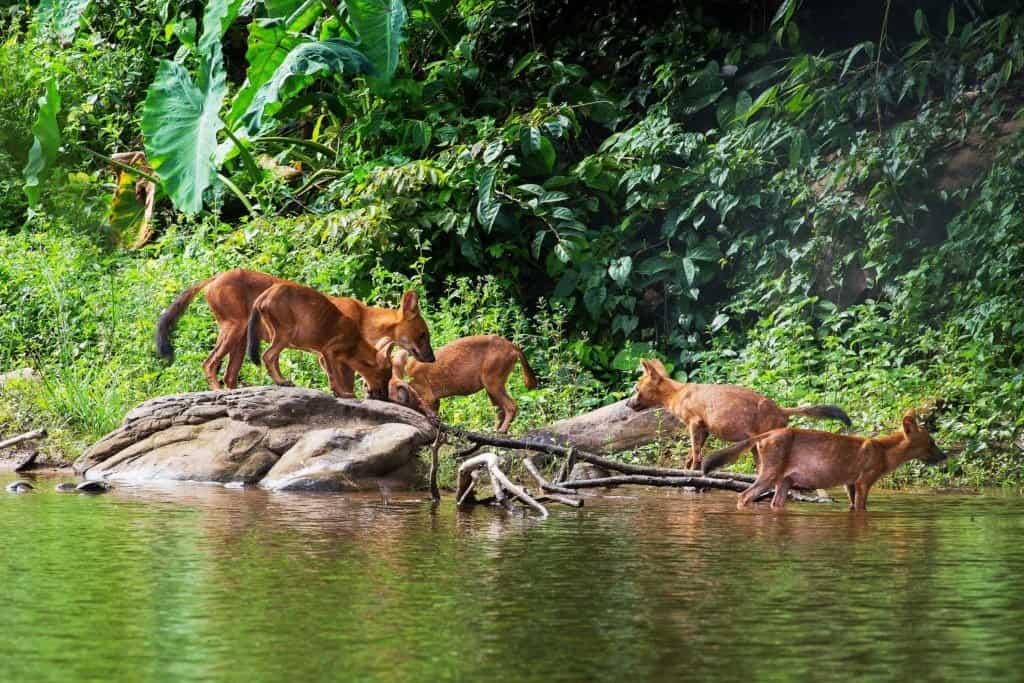
Dholes can have up to twelve pups in a single litter.
©subin pumsom/Shutterstock.com
Poachers set massive numbers of cheap wire traps that catch any animal that steps into them. In the most heavily targeted areas, patrol teams can find up to 10,000 snares in a single forest section.
Because dholes travel long distances on foot through thick brush, they frequently step into these wire loops themselves. Simultaneously, the snares are wiping out their food supply by systematically removing deer, wild pigs, and wild cattle from the ecosystem. With fewer wild animals to eat, hungry dholes must travel closer to human villages to hunt livestock. This often leads to locals killing the dholes in retaliation, using traps or poison.
The primary threat to terrestrial mammals in Vietnam is the ongoing crisis of industrial-scale, indiscriminate snaring, which plagues almost every protected area in the country.
Tuấn Anh Nguyễn, lecturer at the University of Science, Vietnam National University, Hanoi
Disease presents another major danger. Because dholes live in tightly knit packs, diseases can wipe out an entire group fast. Rabies, canine distemper, and mange are constant threats, especially when caught from domestic or stray dogs living near the edge of the forest.
Combined with habitat fragmentation, these overlapping threats continue to push the species toward collapse across much of Southeast Asia.
How Dholes Shape Entire Ecosystems
The return of a pack-hunting predator like the dhole is about much more than saving a single animal. It could signal the return of a vital “ecosystem engineer” that keeps the entire region healthy. Unlike solitary predators that hide and ambush their prey, dholes are pack-hunting animals that actively pursue herds, often targeting weaker or slower animals. This “culling effect” helps maintain healthier prey populations while preventing them from overeating the forest vegetation.
Every member of a dhole pack helps to raise and care for new pups.
©Chaithanya Krishnan/Shutterstock.com
Nguyễn notes that the loss of apex predators has caused a severe ecological imbalance in Vietnam. Without top carnivores regulating herbivore and omnivore populations, animals like wild boars and muntjac deer over-multiply and eat too many young plants, which prevents forest growth.
Co-author Andrew Tilker further points out that when top predators vanish, medium-sized predators — like civets, ferrets, and small wild cats — also increase dramatically. By reclaiming its role as a top predator, the dhole may indirectly protect a much wider range of species throughout the ecosystem. “An overabundance of mesopredators puts immense hunting pressure on smaller animals, such as ground-nesting birds, reptiles, and amphibians,” Nguyễn explains. “By keeping these mid-sized predators in check, dholes would allow a much wider array of native species in Pu Hoat to thrive.”
Was This a Lone Wanderer or a Hidden Population?
The location of the camera-trap image raises an important question: Was this just a lone, wandering animal — or proof that a hidden dhole population still survives in Vietnam?
Researchers say the answer is still unclear, but point to two possibilities. “This dhole could be a ‘vagrant,'” says Nguyễn. “A transient individual that wandered into the protected area from neighboring forests in Vietnam or across the border in Laos.” Given the heavy hunting and lack of food in Vietnam, researchers admit this is the more likely explanation. Even if this is the case, however, it proves that Pu Hoat is a vital wildlife corridor for animals moving between broken-up forests.
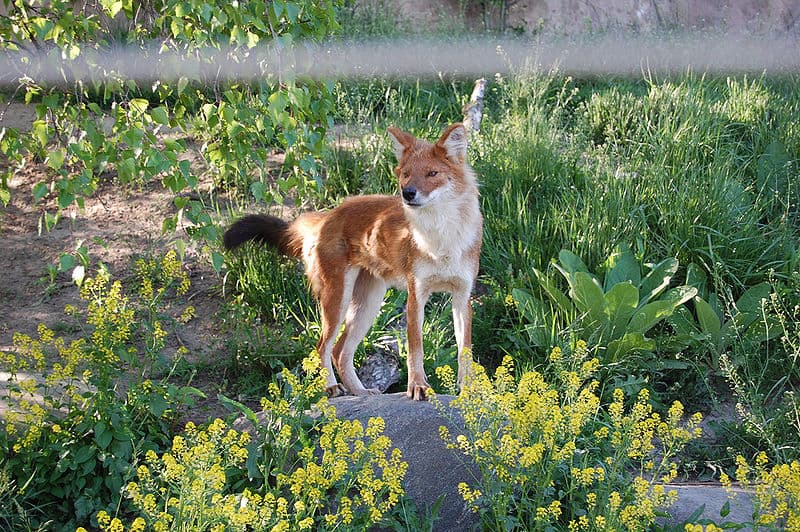
Dholes use many vocalizations to communicate with one another, including high-pitched screams, clucks, and whistles.
©cesar oliveira / CC BY 2.0 / Wikimedia Commons – Original / License
The far more hopeful possibility is that a tiny group of dholes has managed to survive undetected inside the reserve. However, Nguyễn notes that if a local population does exist, it is likely extremely small. A single photo isn’t enough to prove that breeding packs actually live there over the long term.
For now, both scientists emphasize that more monitoring and urgent field research are needed to find out the truth.
How Conservationists Hope to Bring Dholes Back
Conservationists believe the dhole still has a chance to recover — but only if immediate action is taken. Unlike some endangered predators, dholes do not necessarily need expensive captive breeding or reintroduction programs. Because they are not heavily hunted for traditional medicine or sport, their needs are simpler: they just need intact forests, enough wild prey, and protection from wire snares.
To better study these elusive animals, scientists are increasingly relying on non-invasive research techniques. For example, Cornell researchers are analyzing genetics from scat (droppings) and tracks left on the forest floor. This allows them to map where dholes live and study their health without handling the animals. Experts with the Cornell Lab of Ornithology are also developing machine-learning systems that can recognize dhole whistles. This bioacoustic monitoring allows scientists to track packs through sound without ever seeing the animals themselves.
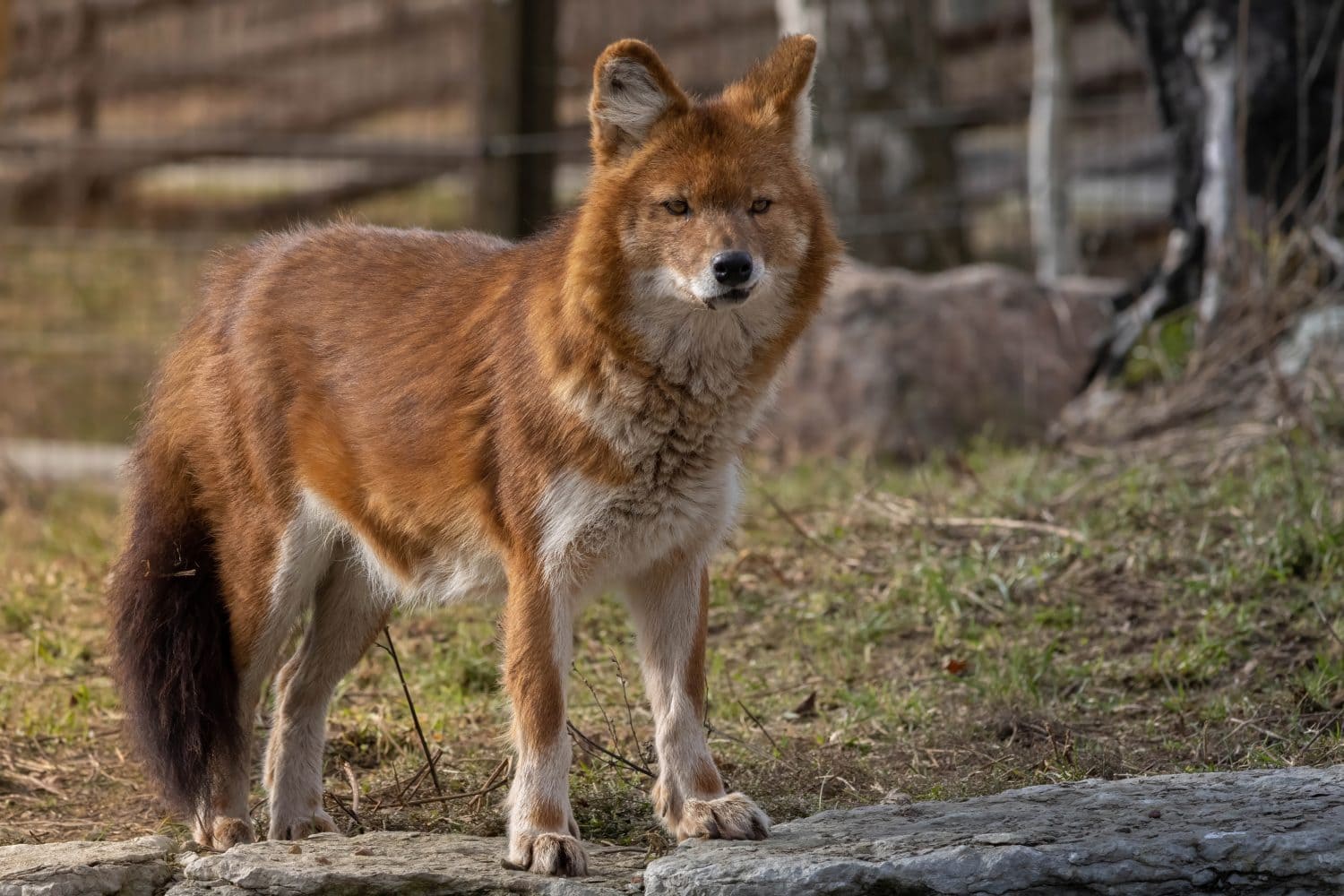
Dholes live in India and Southeast Asia.
©Number One/Shutterstock.com
While these tools are an incredible help, researchers stress that local conservation efforts must expand rapidly. Removing snares is the most immediate priority, but as Nguyễn and Tilker argue, this is only one piece of the puzzle. Tilker explains, “Ultimately, if we are going to successfully address the snaring crisis in Vietnam (and other countries in the region), we need to reduce demand, strengthen legal frameworks, and build protected area effectiveness. All of this should be done in partnership with the local communities who live in and around these forests.”
Nguyễn agrees, explaining, “These efforts cannot succeed without the direct involvement of local communities. Community patrol teams, a conservation model recently proven successful in several other Vietnamese protected areas, will be an essential framework for Pu Hoat to adopt moving forward.”
The long-term survival of the dhole depends on stronger laws and community support, including:
- Expanding community-led anti-poaching patrols
- Strengthening enforcement against illegal hunting
- Reducing the public demand for wildlife products
- Educating local communities on how to coexist with predators
- Supporting regional conservation partnerships, like the IUCN Dhole Working Group
One Image, One Last Opportunity
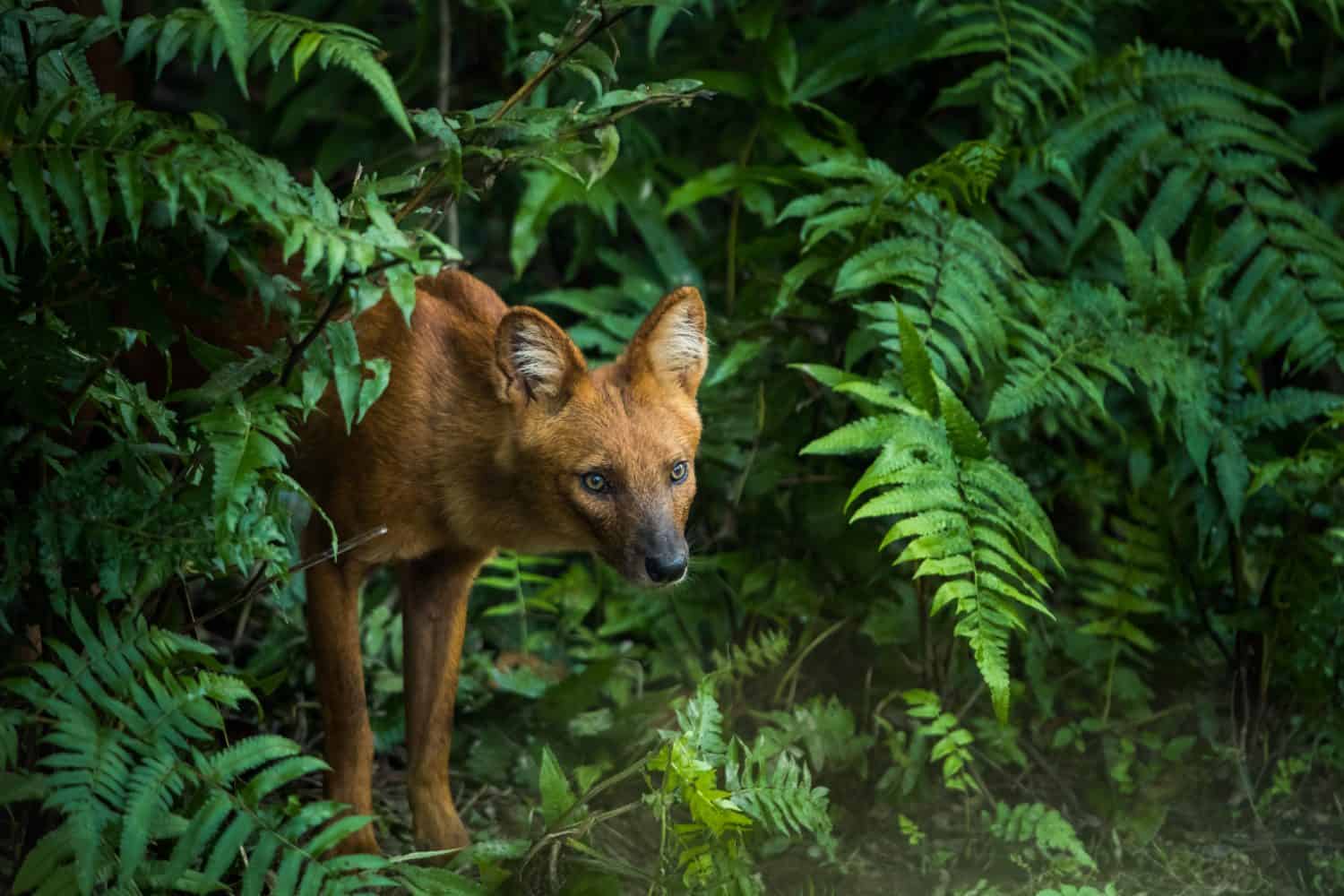
Dholes typically prefer forested habitats.
©Lab Photo/Shutterstock.com
Although it is still quite exciting, the New Year’s Eve camera-trap image does not mean the dhole has fully returned to Vietnam. A lone animal appearing after 20 years of silence is still just a single record of a critically endangered predator. The species still faces massive threats across the region, including wire snares, a lack of food, habitat loss, and deadly diseases.
However, this one image does completely change the conversation around conservation. For years, the dhole was treated like a ghost species in Vietnam — something found in history books rather than in living ecosystems. Now, there is undeniable proof that at least one is still moving through these forests. That single photograph transforms the tragedy of extinction into a real possibility for survival.
For conservationists racing to protect Southeast Asia’s remaining wild spaces, the reappearance of the forest’s “whistling dog” may represent one final opportunity to ensure its haunting calls are not lost forever.