
Quick Take
- The Merlin app offers technology to enhance nature appreciation with a focus on birds. See Merlin's early blind spot →
- Training Merlin's photo model required a task so enormous that a human doing it non-stop would still be working decades from now. Explore the photo training scale →
- Merlin's most popular feature wasn't part of the original app, and its absence reveals something surprising about how the AI learned to listen. See where Merlin still struggles →
- A music education project used Merlin in a way its creators almost certainly never imagined, which points to something bigger about how we connect with nature. Discover the unexpected users →
You’re walking in a natural area, and you see a little bird flitting around in the underbrush. You wonder what type of bird it is, but as you get closer, it flies off. You hear it calling from the high tree branch it landed on, but don’t recognize its call.
Enter Merlin! It’s not the magician from the Legend of King Arthur, but it has a similar aura of magical power. Merlin Bird ID is a tool, honed by artificial intelligence, to diagnose the species of bird you are seeing or hearing. As an Arlington Regional Master Naturalist, I often use Merlin on a hike or just a walk around the neighborhood to decipher what I’m hearing. Just outside my home, Merlin picks up the dart-like sounds of cardinals, the melodic chirps of robins, and the cheep-cheeps of house sparrows.
With over 10 million active users, the free Merlin app is installed on people’s phones all over the world. As I write this, I can see that 131,686 people are listening to birds with me. If you haven’t used it yet, download the app and give it a whirl. Merlin is an inspiring testimony to how technology is helping people connect with nature. The authors of a 2024 study in BioScience purported that “Never before has knowledge about nature, formerly held by naturalists, been so readily accessible.”
Origins of Merlin
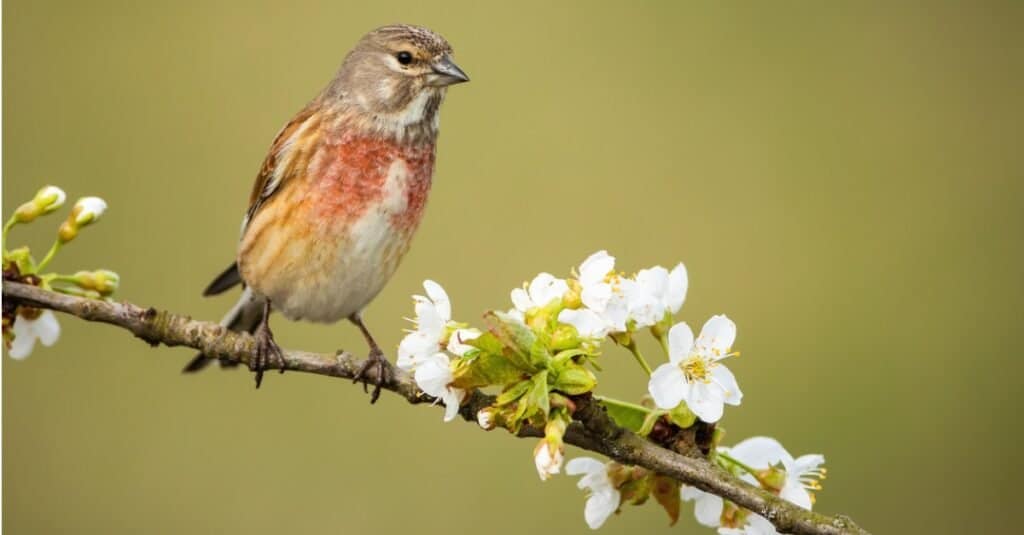
What looks like a little brown bird is a common linnet (Linaria cannabina) in this case.
©iStock.com/JMrocek
However, Merlin wasn’t always so popular or effective at recognizing bird calls. It materialized as an idea in 2008 but didn’t take flight until 2014, according to the Cornell Lab of Ornithology, which owns Merlin. Their website already allowed users to learn about birds of the world, but not necessarily to identify them in the wild. Miyoko Chu, Senior Director of Science Communications, explained in a web article, “When we looked at analytics, we saw a lot of people typing in phrases like little brown bird. It became clear they were trying to use our website as a bird ID tool.”
So, a visionary team of professionals figured out how to harness AI to identify birds from existing photos online on community sites like eBird and Flickr. Funded by a grant from the National Science Foundation, they collected images, then trained a machine learning model to recognize them to species based on features such as plumage color, body size, and location.
When the app was launched in 2014, it could identify 285 bird species, a small fraction (about four percent) of the named birds in the world. Most of those initial species were birds people might see in a North American backyard, such as the cardinals and sparrows outside my home. But birdsong was not initially part of the Merlin experience, nor were photographs. The identifications were based on the user answering five questions about the bird, which had proved to be an effective ID rubric:
- Where did you see the bird?
- When did you see the bird?
- About what size was the bird?
- What were the bird’s main colors?
- What was the bird doing?
Scaling Up Merlin

The eBird app offers a digital checklist of bird species noted all over the world.
©https://ebird.org/about/ebird-mobile/ – Original
Specifying the geographic location of the bird immediately narrows the suite of possibilities by orders of magnitude, as does the time of year for some seasonal migrators. Rapidly, the development team scaled Merlin geographically, in large part by making the app free in exchange for a user’s email address. Additionally, the project tapped into an initiative called eBird, a digital checklist of bird sightings, which was started in 2002.
The Photo ID function of Merlin now includes more than 10,000 species, according to the most recent information on the eBird website. When you ask Merlin to identify your photograph, it looks for diagnostic bird characteristics derived from models comparing thousands of images of each species. However, the process of determining the critical ID features started with human observers. A 2024 article describes how experienced birders first picked out birds in photos and drew squares around them. These squares were then analyzed by the model at a scale of 224 x 224 pixels.
“This model was trained with a minimum of 50 images for each species, for a total of 6 million different photos,” explained Macaulay Library Machine Learning Engineer Sam Heinrich in a news story. “The model is shown each photo 200 times during the training process – so, to put it into human-relatable terms, if you looked at one flashcard per second, it would take you 38 years to go through that many photos.”
Continual Improvements to Merlin
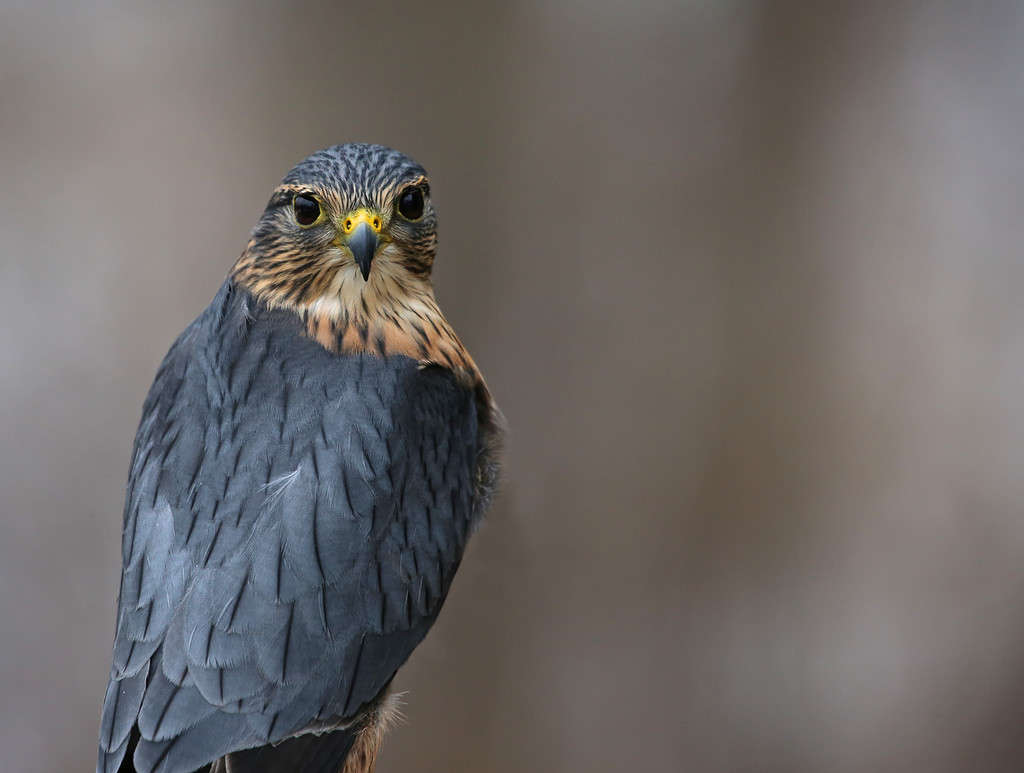
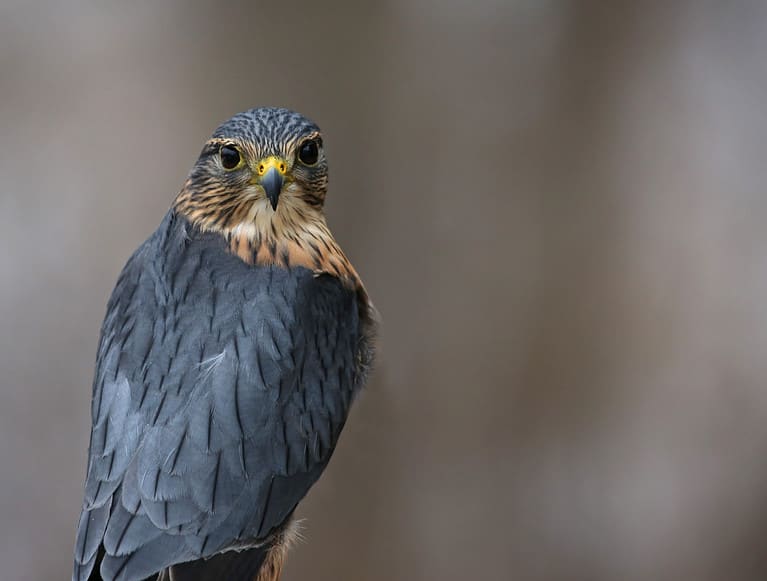
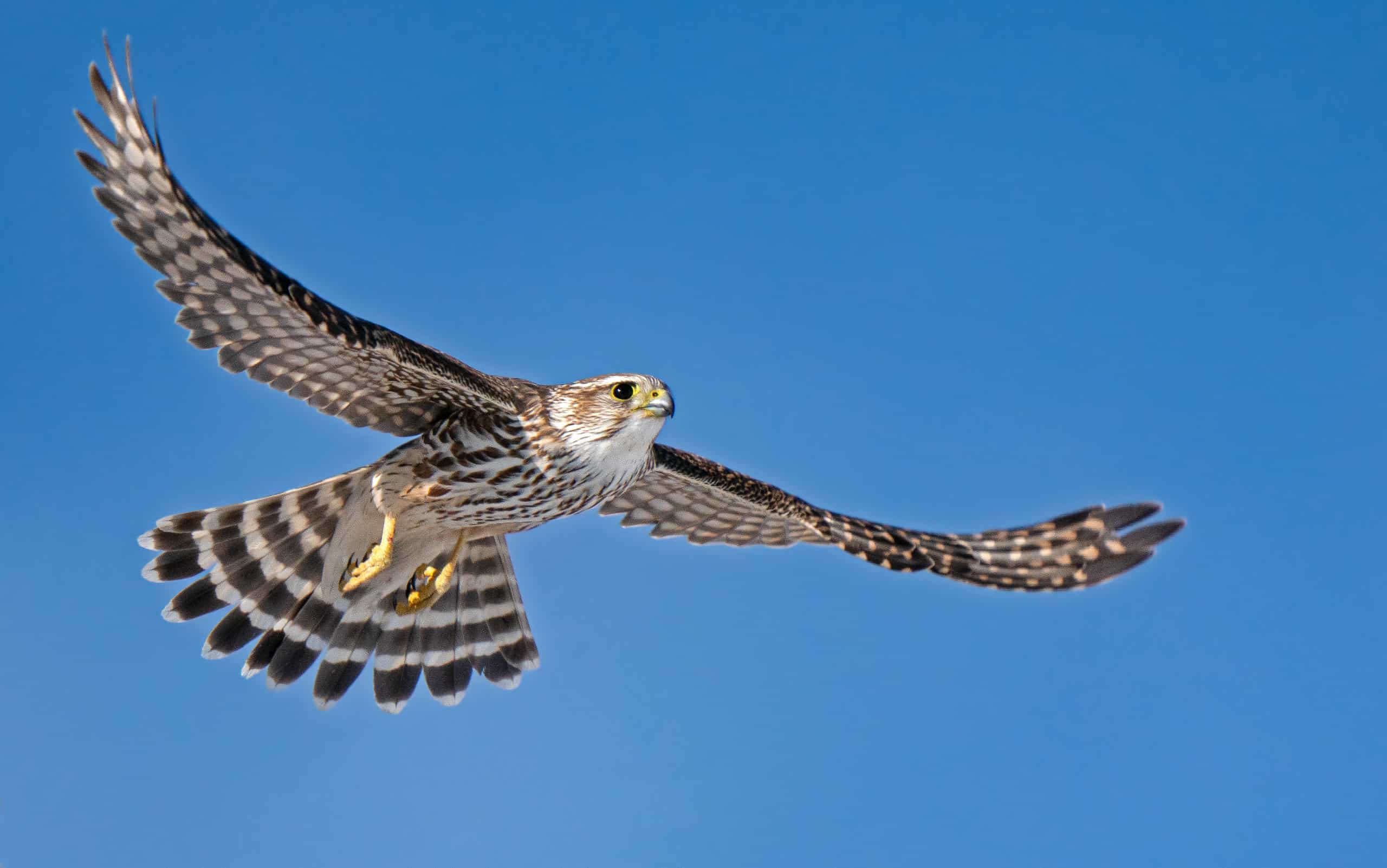
This merlin (Falco columbarius) is heavily streaked on its neck and breast, which is typical of Pacific Northwest populations.
©ca2hill/iStock via Getty Images
Like any model, the outputs are only as strong as the inputs. The author of a 2023 article described the limitations of Merlin in identifying birds that are outside their typical geographic ranges, or that deviate too much from typical appearance, deeming Merlin “it’s all but useless when confronted with outliers: vagrant birds, pigment mutations (albinism, melanism, leucism), birds on the lam from the local zoo,” and advocating for the additive value of traditional field guides.
Merlin’s models improve continually as they’re trained on more bird photos. Just since 2019, tens of millions of photos have been added to the Macaulay Library, which now contains over 67 million photos that feed the model. Recent updates to Merlin have boasted higher accuracy in identifications, including in distinguishing species of birds that have subtle variations in appearance across their range.
For example, the bird called the “Merlin” (after which the app is named) appears heavily and darkly streaked in the Pacific Northwest, but has only faint reddish streaks in Eurasia,” explained Macaulay Library Project Leader Jay McGowan in a news story, a distinction that the app can now make.
The Sound ID function of Merlin, which currently includes data for 2,066 bird species, takes your live recordings and compares them to known songs for species to find the best sound match. As of the most recent update, the majority of those birds—1,487—were in Latin America and the Caribbean, showing how the initial temperature bias of Merlin had shifted. Still, with 638 total species in the sound database, the U.S. and Canada rank second, while Australia and New Zealand, which total a similar bird diversity, rank sixth. As the pool of Merlin users continues to become more geographically inclusive, so will the database of birds.
Community Magic of Merlin
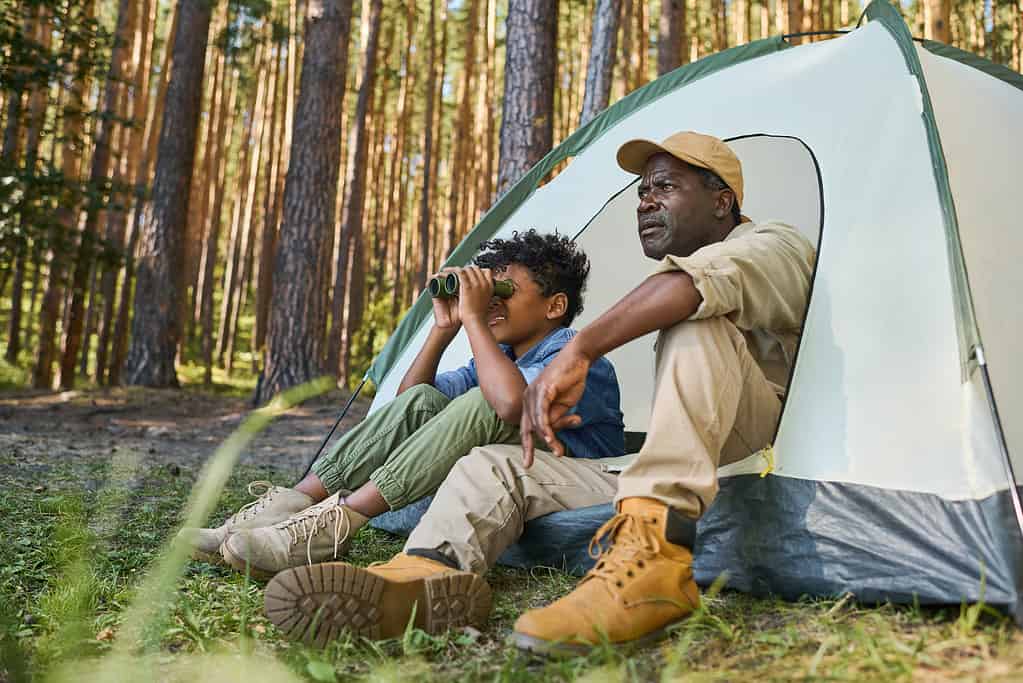
A free app like Merlin can bring people together over a shared interest in nature.
©shironosov/iStock via Getty Images
“Merlin is a wide funnel that brings people into the world of birds,” said Merlin Project Manager Drew Weber in an article. “Some of those folks are going to download eBird and start collecting data. Some of them are going to start caring about birds and give money to protect their habitats. But for many others, Merlin simply lets them start to recognize and enjoy the birds around them in a way that wouldn’t have happened otherwise.”
The Merlin app is inspiring creative approaches to nature education. A 2026 study in the Bulletin of the Ecological Society of America described how Merlin became part of an educational toolkit that students used to explore nature and listen to birds, then generate music incorporating the birdsong recordings. “By linking environmental justice, ecological monitoring, biodiversity gap-filling, and critical engagement with who participates in biodiversity data collection, alongside creative expression,” wrote the study author Diego Ellis-Soto, a University of California researcher, “this approach offers a scalable strategy to reconnect with nature.”
If you’re intrigued by the trajectory of Merlin, or better yet, hooked on the talons, take this free course from Cornell Lab to build your own capacity to identify birds using the Merlin app. You can also become a contributor to the database that trains the models. See photo upload guidelines here.
Watch out—recognizing the birds you cross paths with is addictive!