
Quick Take
- The speed gap between these two predators is massive, which just might be the Allosaurus's only real path to victory. See the speed comparison →
- One of these dinosaurs used a hunting technique so unusual that it has its own name, and this technique could do serious damage even to prey far larger than itself. Explore the hatchet technique →
- Even the winner of this fight might not walk away unscathed. The margin of victory is narrower than you'd expect. See the fight outcome →
- Across six head-to-head categories, one dinosaur doesn't dominate as cleanly as its reputation suggests, with one round ending in a dead tie. See the tied category →
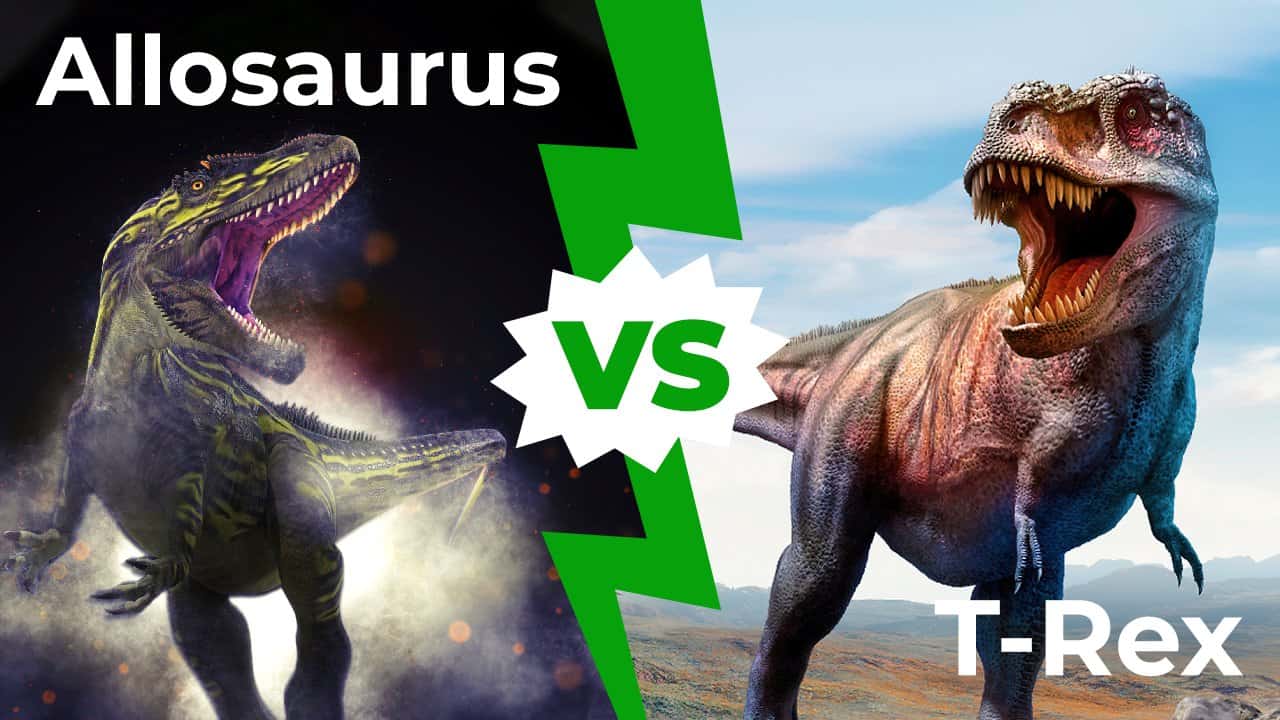
Allosaurus and Tyrannosaurus rex were both carnivorous apex theropod predators, but they lived in different time periods. Allosaurus lived during the Late Jurassic period (roughly 150 million years ago), while T. rex lived during the Late Cretaceous period (roughly 66 million years ago), separating them by over 80 million years. This discrepancy aside, it’s interesting to imagine pitting these two massive dinosaurs against each other in a one-on-one fight. When comparing massive creatures, several key factors contribute to the outcome. We have identified six crucial aspects: size, speed, bite force, offensive abilities, defensive abilities, and predatory behaviors, that help determine which creature would have the advantage in a fight. Continue reading to discover which dinosaur will be left standing.
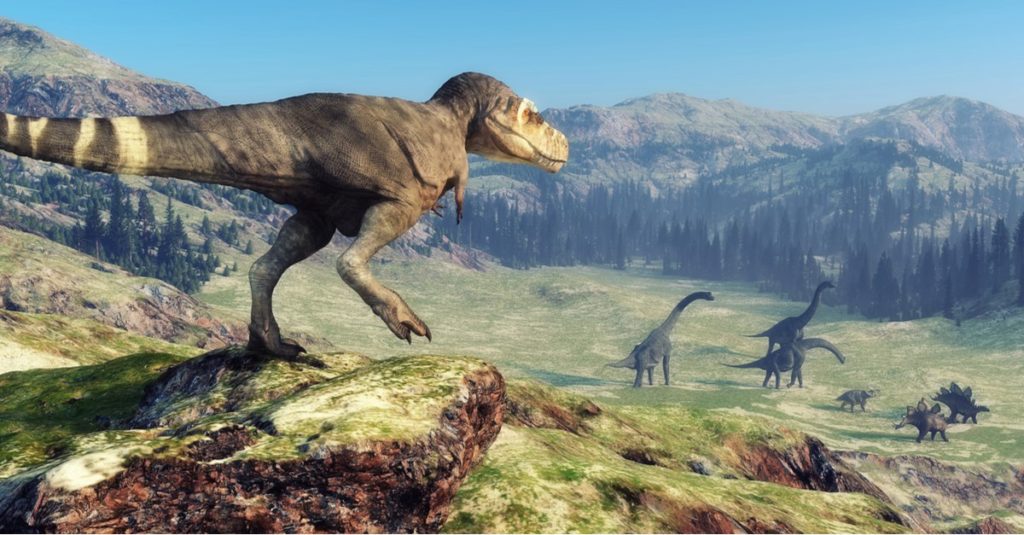
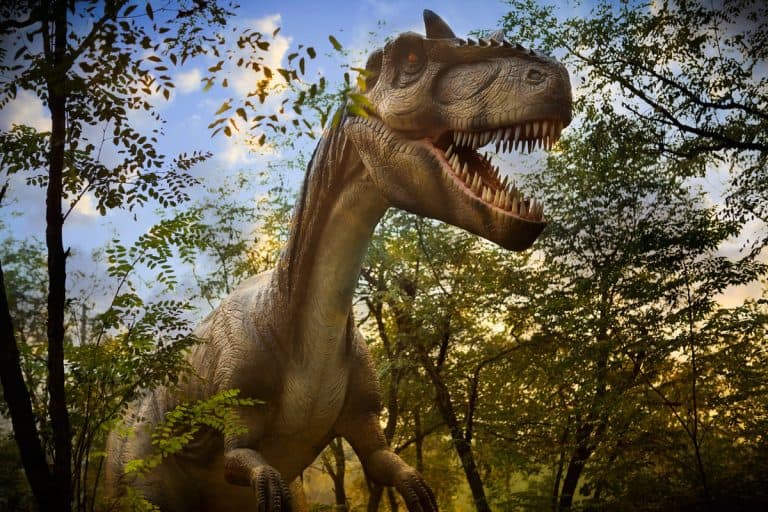
The Allosaurus vs T. rex fight would be settled by size, speed, and offensive skills
©Orla/Shutterstock.com
Allosaurus vs. T. Rex: Size
The average T. rex was significantly larger and heavier than the average Allosaurus. While both were carnivorous apex predators, T. rex evolved to be much more massive compared to the leaner, more agile Allosaurus.
The average T. rex weighed between 11,000 and 15,500 pounds, stood about 12 feet tall at the hips, and measured around 40 feet long. An average adult Allosaurus was much smaller, typically measuring 28 to 32 feet long and weighing between 3,500 and 4,700 pounds
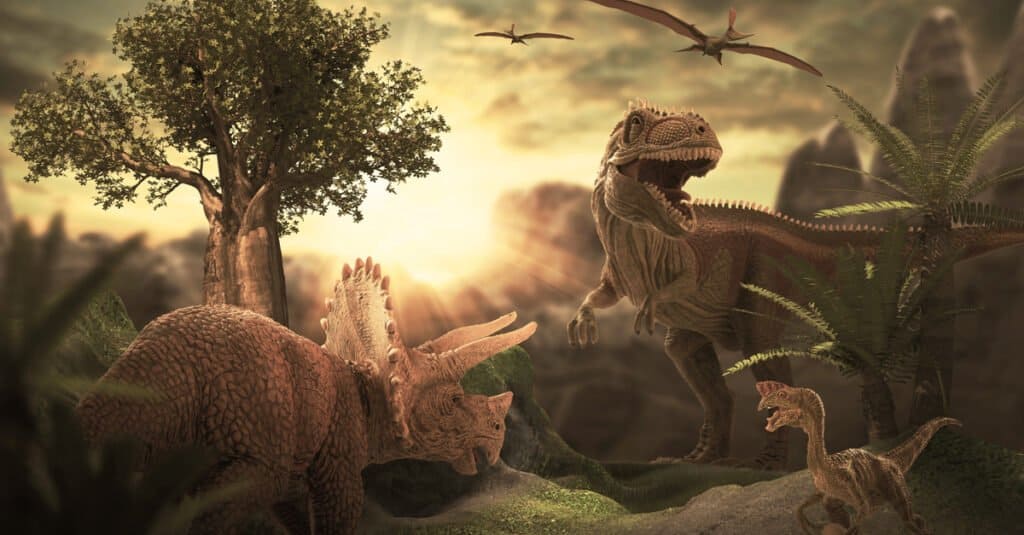
Dinosaurs like the T. rex were vast, powerful creatures
©metha1819/Shutterstock.com
Based on paleontological estimates, an adult Tyrannosaurus rex was roughly three to four times heavier than an average adult Allosaurus. T. rex was far more hardy, with a much thicker skull and denser bones.
Size Advantage: T. rex
Allosaurus vs. T. Rex: Speed and Movement
Allosaurus was built for agility and speed, while T. rex was built for power and stability. Allosaurus had a much lighter, more delicate frame than T. rex, which allowed for greater maneuverability and speed. Allosaurus was more lightly built, utilizing speed and ambush tactics, while T. rex relied on its massive, bone-crushing build, likely exceling in power, rather than speed.
In the wild, speed helps creatures land the first attack or get away from fights that they can’t win, and what the Allosaurus was missing in size, it more than makes up for with speed. Allosaurs were swift creatures, running at speeds up to 21 miles per hour (mph). The T. rex could reach a maximum speed of 11 to 25 mph, according to recent studies.
Speed Advantage: Tie
Allosaurus vs. T. Rex: Bite Force and Teeth
Many dinosaurs are believed to have killed their prey outright with their teeth or to finish off creatures wounded by other methods. The Allosaurus had almost 40 teeth that were each 2-4 inches long, with a bite force of 6,125 pounds per square inch (PSI).
The T. rex had a significantly larger jaw containing up to 60 4-inch teeth with 8-inch roots, and a bite force estimated at up to 12,000 PSI.
Bite Force Advantage: T. rex
Allosaurus vs. T. Rex: Defenses
Sometimes, an impenetrable defense can stop deadly predators and prolong a fight. The T. rex was massive and stocky, while the Allosaurus was lighter, faster, and leaner. The defensive strength of a T. rex would overwhelmingly defeat an Allosaurus in a one-on-one encounter.
Defensive Advantage: T. rex
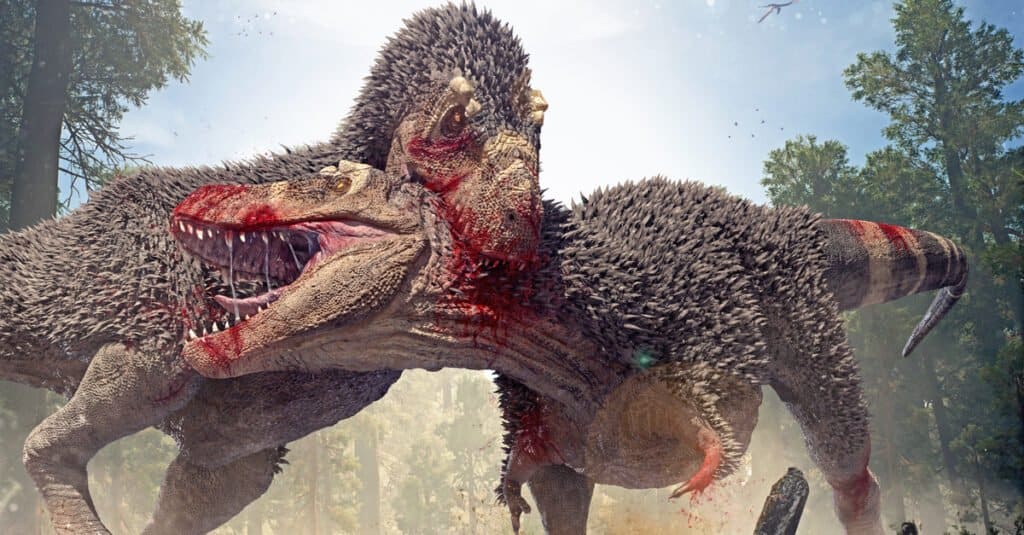
Tyrannosaurus Rex had an incredibly powerful bite force.
©Herschel Hoffmeyer/Shutterstock.com
Allosaurus vs. T. Rex: Offensive Capabilities
Equipped with serrated, blade-like teeth, long hooked claws, and a surprisingly strong bite, the Allosaurus was a formidable predator. Rather than crushing bone, it used a unique hatchet method (swinging its upper jaw to inflict deep lacerations), which, combined with clawing, could inflict severe, bleeding injuries even on massive prey.
The T. rex used one tool very well: its massive jaws and teeth could deeply puncture prey and snap bones with ease.
Offensive Capabilities: Tie.
Allosaurus vs. T. Rex: Predatory Behaviors
The Allosaurus was likely an ambush predator that used its speed and power to overwhelm its prey. T. rex sniffed out its prey and attacked based on opportunity. Because it was an overwhelmingly powerful apex predator, it likely utilized its tremendous sense of smell and bone-crushing bite to efficiently hunt.
Predatory Advantage: T. rex
Who Would Win in a Fight Between Allosaurus and T. Rex?
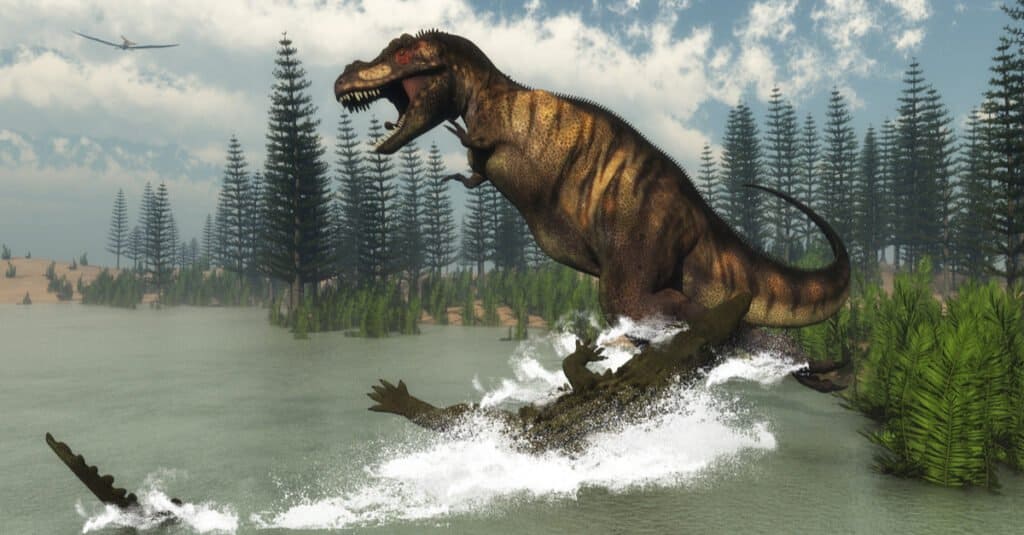
The T. rex would win in a fight against an Allosaurus.
©Elenarts/Shutterstock.com
A T. rex would win a one-on-one fight with an Allosaurus. The Allosaurus was a powerful creature in its own right, but the T. rex was simply larger and more powerful. There are two possible scenarios for the fight:
The best case for the Allosaurus would feature it ambushing the larger T. rex, waiting for it to get just close enough before dashing out of its cover and making a thrashing leap for the T. rex. The Allosaurus would crash into the massive foe, using its teeth to anchor it to its side while clawing with its feet and arms.
The wounds would be significant, and the T. rex would thrash around until the Allosaurus fell off. The T. rex would be hurt, but not too injured to fight back. The Allosaurus would go in for attack after attack, dodging with its great speed and agility, but it only takes one bite for the T. rex to do serious internal damage that ends the Allosaurus.
The other possibility is that the T. rex, using its amazing senses, discovers the Allosaurus lying in wait. The Allosaurus would charge once discovered, right into the waiting maw of the T. rex, ending the fight in a back-breaking crunch.
The Allosaurus is strong and tough, but unless it managed to avoid the T. rex entirely, it would not inflict fatal damage or end the fight decisively. However, the T. rex’s victory could be pyrrhic. If it sustained enough injuries, the resulting blood loss and trauma could eventually kill it or leave it vulnerable to other predators.