


Quick Take
- Some dolphins here deliberately beach themselves mid-hunt, and it leaves a strange mark on their teeth.
- A bald eagle and an osprey played out the same heist twice in a few days. Why does the eagle never have to fish?
- A crab trap held a surprise no one expects to find in a South Carolina creek.
- One sunset tour ended with tears on board. What did two dolphins do after the rescue?
Just beyond the beaches of Charleston, South Carolina, lies an extraordinary world where dolphins launch themselves onto muddy banks to catch fish, bald eagles steal meals from unsuspecting ospreys, and strange creatures lurk beneath the surface of winding tidal creeks.
Welcome to South Carolina’s Lowcountry, where some of the most remarkable wildlife encounters happen in places most visitors barely notice.
With more than two decades exploring the waterways surrounding Isle of Palms, Captain Robert Hopkins of Barrier Island Eco Tours has witnessed everything from unusual dolphin hunting techniques to incredible encounters between predators. And some of his most memorable experiences sound almost too extraordinary to be true.
An Entire Ecosystem Hiding in Plain Sight
Thousands of visitors cross the Isle of Palms Connector every year, passing seemingly endless stretches of marsh grass on their way to South Carolina’s beaches. But beneath those muddy waters is one of the most productive ecosystems on Earth.
“The tidal salt marsh of the Lowcountry is one of the most easily overlooked ecosystems on the planet,” Hopkins explains.
Twice daily, tides rise and fall by approximately six feet, dramatically transforming the landscape. At high tide, fish, shrimp, and crabs spread into flooded marsh grass, where they find shelter from predators. As the water retreats, those hiding places disappear, forcing animals into increasingly crowded tidal creeks.
Hopkins compares the phenomenon to a playground, where high tide becomes a game of hide-and-seek and low tide turns into tag.
Even the Lowcountry’s distinctive pluff mud plays a critical role. Its unmistakable smell comes largely from decomposing organic material in oxygen-poor sediment. That breakdown helps support a nutrient-rich food web sustaining everything from tiny shrimp to hungry bottlenose dolphins.
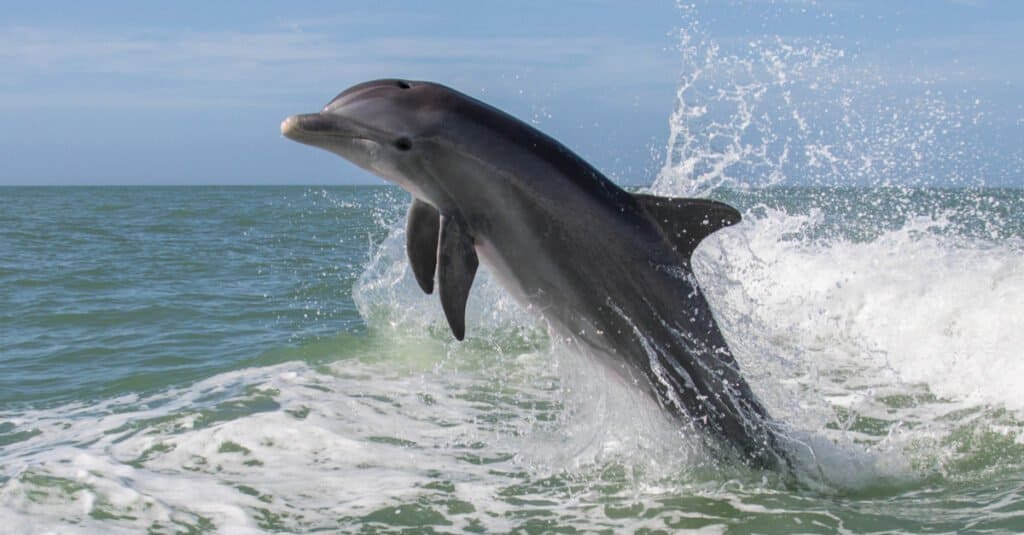
On average, bottlenose dolphins live for 40-60 years.
©Tory Kallman/Shutterstock.com
Dolphins Have Developed Some Incredible Hunting Techniques
Few animals capture visitors’ attention quite like the Atlantic bottlenose dolphins patrolling South Carolina’s tidal creeks. But these intelligent marine mammals do much more than swim gracefully alongside passing boats.
One of their most extraordinary behaviors is called strand feeding, a learned hunting technique in which dolphins herd schools of fish toward muddy banks before rushing forward. Panicked fish leap from the water, and the dolphins partially strand themselves to snatch their prey before sliding back into the creek.
Hopkins says local dolphins are particularly fascinating because of their tendency to strand-feed on their right sides, a behavior that can even contribute to uneven tooth wear.
Another technique, known as stun feeding, involves dolphins striking the water with their tails to disorient fish. Hopkins has observed this behavior in groups containing mothers and calves, where younger dolphins may benefit from the easier catches.
Perhaps even more remarkable is one local dolphin that Hopkins says survived after losing its tail flukes, possibly to a shark. Despite the severe injury, the animal adapted its swimming movements and continued surviving among other dolphins.
For Hopkins, these encounters reveal just how intelligent, adaptable, and socially complex these marine mammals can be.

©Finley Delouche/Shutterstock.com
Bald Eagles, Ospreys, and the Birds That Rule the Marsh
The wildlife spectacle doesn’t stop at the water’s surface. South Carolina’s salt marshes are also home to an incredible variety of birds, each equipped with specialized hunting strategies.
American oystercatchers use their long, narrow bills to pry open shellfish. Herons, egrets, and roseate spoonbills stalk shallow water for fish and shrimp. Ospreys plunge toward the water to seize fish in their powerful talons.
But sometimes catching a fish is only half the battle.
Hopkins recalls watching an osprey successfully grab a fish before a bald eagle suddenly appeared and gave chase. “The bald eagle literally tapped the back of the osprey. The osprey dropped his fish, and the bald eagle swooped down and got it,” he remembers.
Even more astonishing, Hopkins witnessed nearly the same encounter just days later. The behavior, known as kleptoparasitism, allows bald eagles to steal food caught by other birds rather than hunting it themselves.
Meanwhile, brilliantly pink roseate spoonbills provide another colorful example of the marsh’s interconnected food web. Their distinctive coloration comes from pigments obtained through their diet. As Hopkins puts it, the spoonbill is simply turning the shrimp of the Lowcountry into a feast.
Sharks, Octopuses, and Other Unexpected Marsh Residents
While dolphins and birds attract much of the attention, the Lowcountry harbors plenty of animals visitors might never expect. Bonnethead sharks, smaller relatives of hammerheads, patrol shallow tidal creeks searching for blue crabs. Despite their intimidating appearance, these sharks generally pose little threat to humans.
And then there are the octopuses. Hopkins remembers pulling up a crab trap and discovering an octopus inside, an encounter that surprised even him. On another excursion, he discovered a baby octopus no larger than a baseball. The animal’s curiosity and remarkable ability to interact with its surroundings left a lasting impression.
Jellyfish, however, are among the creatures Hopkins respects most. Some species deliver painful stings, and their nearly transparent bodies make them difficult to spot in the water. Still, he emphasizes that these animals aren’t actively seeking confrontations with people. They’re simply trying to survive in their own environment.
The Unforgettable Day Two Dolphins Were Rescued
Of all the wildlife encounters Hopkins has experienced, one involving two dolphins stands above the rest. During a sunset tour, he noticed unusual activity around a crab trap float. Upon closer inspection, he discovered that a dolphin’s tail had become tangled in the equipment. As the boat approached, a second dolphin swam toward the vessel, surfaced nearby, and returned to its trapped companion.
Hopkins and a passenger carefully lifted the float and cut the entangling line, freeing the struggling animal.
What happened next was extraordinary. Both dolphins disappeared briefly before resurfacing near the boat. “They swam and jumped out of the water and did flips,” Hopkins recalls. The dolphins repeated the spectacular jumps several times before swimming away.
Although no one can know exactly what the dolphins were experiencing, the encounter left everyone aboard deeply moved. Hopkins remembers looking at his former student, who helped free the animal, and realizing they both had tears in their eyes.
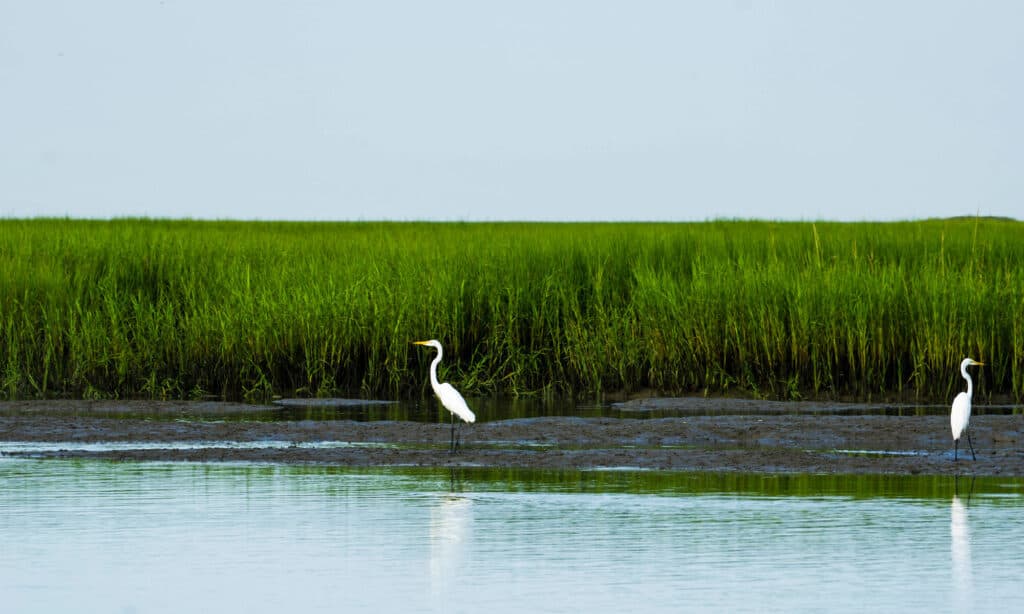
Great egrets are frequently spotted on Hopkins’s tours.
©iStock.com/makasana
Protecting South Carolina’s Remarkable Wildlife
After decades exploring the Lowcountry, Hopkins believes the best way to protect wildlife is to help people experience and understand it firsthand. From recovering bald eagle populations to the countless creatures depending on healthy tidal marshes, he has witnessed the incredible resilience of nature. “We’re only going to really be into the idea of protecting something we’ve learned to like, love, and respect,” he explains.
It’s a simple philosophy that guides the environmental education programs at Barrier Island Eco Tours. Once visitors discover the extraordinary animals living beneath those seemingly ordinary stretches of marsh grass, they begin to see the entire landscape differently.
That’s perhaps the greatest lesson from South Carolina’s Lowcountry: some of nature’s most remarkable stories are unfolding right beneath our noses.

To explore these incredible waterways yourself, visit Barrier Island Eco Tours. And be sure to watch the full A-Z Animals interview with Captain Robert Hopkins for more fascinating wildlife stories from South Carolina’s coast.


