
B
Species Profile

Bottlenose Dolphin

Tursiops truncatus

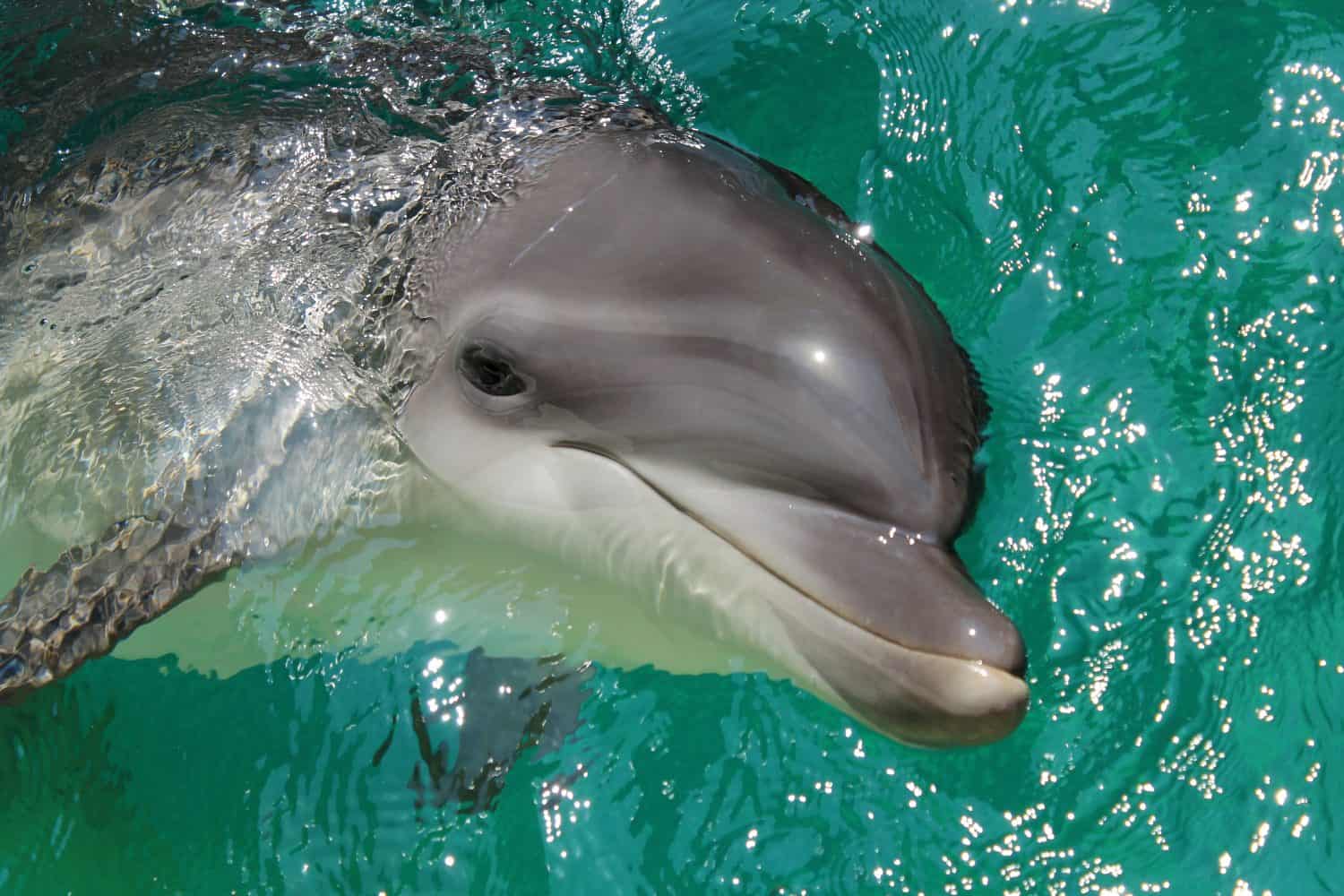
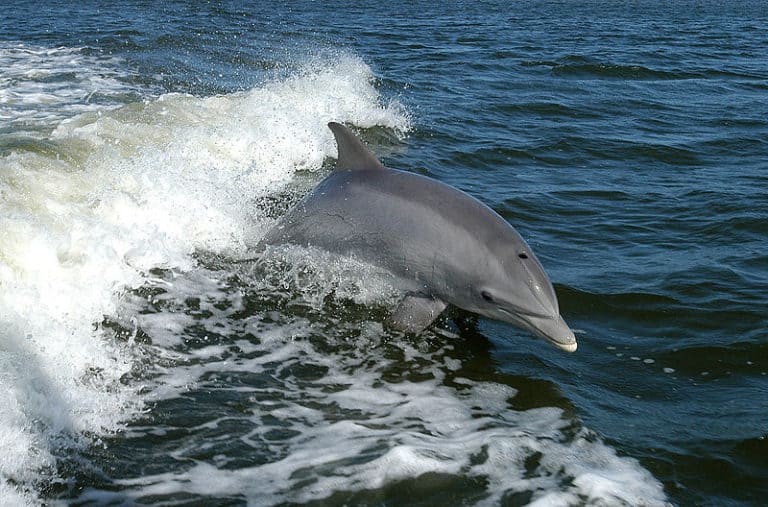
Built for the surf-and sonar.
Faraj Meir / Creative Commons

Bottlenose Dolphin Distribution

Click a location to explore more animals from that region

This map shows coastal regions where Bottlenose Dolphin are found.

Loading map...

At a Glance

Wild Species
Also Known As Bottlenose dolphin, Bottle-nosed dolphin, Bottlenosed dolphin, Atlantic bottlenose dolphin, Flipper
Diet Carnivore
Activity Cathemeral+
Lifespan 25 years
Weight 650 lbs
Status Least Concern
Did You Know?

Adult size is typically 2.0-4.0 m long and ~150-650 kg (NOAA species profile; ranges vary by ecotype and region).

Scientific Classification

A highly adaptable delphinid dolphin found in temperate to tropical oceans worldwide, well known for complex social behavior, intelligence, and frequent coastal occurrence.

Kingdom
Animalia
Phylum
Chordata
Class
Mammalia
Order
Cetacea
Family
Delphinidae
Genus
Tursiops
Species
truncatus

Distinguishing Features

  • Robust body with a relatively short, well-defined beak (rostrum)
  • Tall, curved (falcate) dorsal fin
  • Gray coloration with darker back and lighter belly; variable regional patterns
  • Highly social; often seen in groups and may bow-ride near boats

Physical Measurements

Males and females differ in size

Length
10 ft 10 in (8 ft 6 in – 12 ft 10 in)
8 ft 2 in (7 ft 7 in – 9 ft 2 in)
Weight
992 lbs (573 lbs – 1,433 lbs)
441 lbs (331 lbs – 551 lbs)
Top Speed
20 mph
Top speed about 32 km/h

Appearance

Primary Colors
Secondary Colors
Skin Type Hairless, smooth cetacean skin with a thick blubber layer; epidermis rapidly sloughs/renews, contributing to a glossy appearance and aiding hydrodynamics (Perrin et al., 2009; Jefferson et al., 2015).
Distinctive Features
  • Robust, fusiform body; short-to-moderate rostrum ("bottle" snout) clearly demarcated from the melon; conical, homodont teeth adapted for grasping fish and cephalopods (Perrin et al., 2009).
  • Tall, falcate dorsal fin near mid-back; tapered pectoral flippers; broad flukes-overall silhouette differs subtly between coastal vs offshore ecotypes, with offshore animals typically larger and more robust (Wells & Scott, 2018; NOAA Fisheries species profile).
  • Adults commonly show tooth-rake scars and other markings used for long-term individual identification in coastal study populations (e.g., Sarasota Bay), reflecting frequent social contact and aggression/display behaviors (Würsig & Jefferson, 1990; Wells & Scott, 2018).
  • Size (species-level): adults commonly ~2.0-4.0 m total length and ~150-650 kg; offshore ecotypes/populations trend toward the upper end of this range (Jefferson et al., 2015; NOAA Fisheries).
  • Longevity: commonly 30-40+ years; maximum reported longevity is higher for females than males, with well-studied wild females documented into their 50s+ (Wells & Scott, 2018; Perrin et al., 2009).
  • Many areas have coastal and offshore Tursiops truncatus groups (ecotypes) that differ in body size and range. T. aduncus lives in parts of the Indo-Pacific and can be mistaken for it.
  • Makes tonal whistles for social talk, including unique 'signature whistles', and broadband echolocation clicks for finding food and moving. Often shows porpoising, tail slaps, and spyhops at the surface.
  • Diet/foraging: generalist predator of fishes and cephalopods; hunting can include cooperative herding/encirclement, strand-feeding in some coastal areas, and other locally specialized tactics (Wells & Scott, 2018; NOAA Fisheries).
  • Human activities change Common Bottlenose Dolphin look: bycatch and getting tangled cause fin notches and line scars; PCBs and disease harm skin; boats, noise, tourism, and feeding raise injury and dorsal fin damage risk.

Sexual Dimorphism

Sexual dimorphism is primarily size-based: adult males are, on average, longer and heavier than adult females; external coloration is broadly similar between sexes (Wells & Scott, 2018; NOAA Fisheries).

  • Typical adult male total length about 3.0-3.8 m and body mass commonly ~300-650 kg in larger individuals/populations; generally more robust head/neck region (NOAA Fisheries; Jefferson et al., 2015).
  • Typical adult female total length about 2.6-3.5 m and generally lower body mass than males; mammary slits present (NOAA Fisheries; Jefferson et al., 2015).

Did You Know?

Adult size is typically 2.0-4.0 m long and ~150-650 kg (NOAA species profile; ranges vary by ecotype and region).

Females can live 50+ years; the oldest well-documented wild bottlenose dolphin reached 67 years in long-term studies (Sarasota Dolphin Research Program).

They use individually distinctive "signature whistles" that function like learned name-calls and can be copied by close associates (Janik & Slater 1998; Janik 2000).

Echolocation clicks are ultrasonic; bottlenose hearing extends to ~150 kHz, supporting high-resolution acoustic "vision" in turbid water (Au 1993; NOAA hearing data summaries).

Some populations use specialized, local hunting traditions-e.g., "mud-ring feeding" in Florida and "strand feeding" in the U.S. Southeast-passed socially within communities (Lewis & Schroeder 2003; Rigley et al. 2010).

Daily food intake is often several percent of body mass (commonly ~4-6%), mainly fish plus cephalopods, but prey choice shifts with habitat and season (NOAA; Würsig & Jefferson references in marine mammal texts).

Short, powerful bursts can exceed ~30 km/h, but typical travel speeds are much lower during routine movement and foraging (field bioenergetics/behavior syntheses; NOAA summaries).

Unique Adaptations

  • Echolocation system: a fatty "melon" focuses outgoing clicks; the lower jaw conducts returning echoes to the middle ear-enabling prey detection even in low visibility (Au 1993).
  • Broad-band ultrasonic hearing (up to ~150 kHz) supports fine target discrimination and ranging; click repetition rate can increase during prey capture ("buzzes").
  • Deep-dive physiology: high myoglobin stores and a dive response (bradycardia, peripheral vasoconstriction) support repeated submergence; typical dives are minutes long, with longer dives possible during foraging.
  • Collapsible lung/alveolar control reduces nitrogen uptake at depth, lowering decompression risk relative to similarly diving terrestrial mammals (general cetacean physiology syntheses).
  • Thermal insulation via blubber plus countercurrent heat exchange helps maintain core temperature across temperate-tropical ranges.
  • Streamlined body and strong tail flukes generate efficient thrust for rapid acceleration and maneuvering in surf zones and around reefs.
  • Potential electroreception: experiments suggest bottlenose dolphins can detect weak electric fields using vibrissal crypts on the rostrum (Czech-Damal et al. 2012), which may aid close-range prey detection.

Interesting Behaviors

  • Coastal vs offshore ecotypes: many regions show smaller, more coastal-resident communities and larger, wide-ranging offshore populations with genetic and ecological separation (e.g., U.S. Atlantic/Gulf management stocks; NOAA stock assessments).
  • Fission-fusion society: groups form and split frequently; individuals maintain long-term social bonds, with some populations showing stable female networks and cooperative male alliances.
  • Signature whistle communication: calves develop a unique whistle (often within the first year) and use it for cohesion and contact; close companions may "address" one another by whistle matching.
  • Cooperative hunting: individuals coordinate to herd fish schools, take turns through prey balls, or corral fish against shorelines/shallows.
  • Mud-ring feeding (Florida): one or more dolphins stir a circular plume of mud with tail beats; fish leap out of the ring and are snapped up by waiting dolphins (documented in Florida Bay).
  • Strand feeding (South Carolina/Georgia): dolphins surge onto muddy banks to seize fish, then wriggle back into the water-often performed in culturally transmitted "teams."
  • Crater feeding: dolphins dig into sandy bottoms for buried prey, leaving visible feeding pits.
  • Bow-riding and wake-surfing: they frequently ride pressure waves created by boats or large animals; this can save energy but increases risk from vessel strikes.
  • Unihemispheric rest: they can rest one brain hemisphere at a time, maintaining surfacing and vigilance while partially asleep.
  • Human-focused foraging in some areas: individuals may learn to depredate fishing gear (taking bait/catch), increasing entanglement and retaliation risk.

Cultural Significance

Common bottlenose dolphin (Tursiops truncatus) is well known near coasts and beaches, famous from media like Flipper. People see them as smart and friendly. They attract tourism and warn of pollution and coastal harm.

Myths & Legends

Ancient Greece: the poet Arion was said to be saved from drowning when a dolphin carried him to shore after he sang-one of the best-known classical dolphin rescue legends.

Greek foundation myth: Taras, eponymous hero of Taranto, was carried to safety on a dolphin's back; dolphins were associated with protection of sailors and safe harbors.

Apollo Delphinius: in one tradition, Apollo took the form of a dolphin to guide Cretan priests to Delphi, tying dolphins to guidance and sacred journeying.

Dionysus and the pirates: in a Homeric Hymn, pirates who tried to kidnap Dionysus were transformed and driven into the sea as dolphins-linking dolphins with salvation of the shipwrecked and divine retribution.

Celtic and Atlantic seafaring lore (Ireland/Scotland): dolphins were often treated as auspicious companions that could guide boats or signal nearby land or fish-folk associations preserved in coastal storytelling rather than a single fixed tale.

The name "bottlenose" and the TV show Flipper made people see Common Bottlenose Dolphins (Tursiops truncatus) as kind helpers, changing how coastal communities view dolphin encounters.

Conservation Status

LC Least Concern

Widespread and abundant in the wild.

Population Unknown

Protected Under

  • CITES Appendix II (international trade in specimens regulated).
  • CMS (Convention on Migratory Species): listed on Appendix II (international cooperation encouraged for conservation/management).
  • Regional agreements: ACCOBAMS (Mediterranean/Black Sea) and ASCOBANS (N.E. Atlantic/Baltic/North Sea) cover conservation measures for small cetaceans including bottlenose dolphins where applicable by range.
  • United States: Marine Mammal Protection Act (MMPA) prohibits take and regulates interactions; additional protections may apply via stock-specific management and sanctuary rules.
  • European Union: Habitats Directive lists Tursiops truncatus on Annex II and Annex IV (strict protection; designation of Special Areas of Conservation required for Annex II species).

Life Cycle

Birth 1 calf
Lifespan 25 years

Lifespan

In the Wild
1–67 years
In Captivity
1–51 years

Reproduction

Mating System Polygynandry
Social Structure Aggregation Group
Breeding Pattern Transient
Fertilization Internal Fertilization
Birth Type Internal_fertilization

Common bottlenose dolphin (Tursiops truncatus) have a promiscuous (polygynandrous) mating system in fission-fusion societies. Males form alliances to guard females in short consortships; females often mate with multiple males, leading to multiple paternity.

Behavior & Ecology

Social Pod Group: 10
Activity Cathemeral, Diurnal, Nocturnal
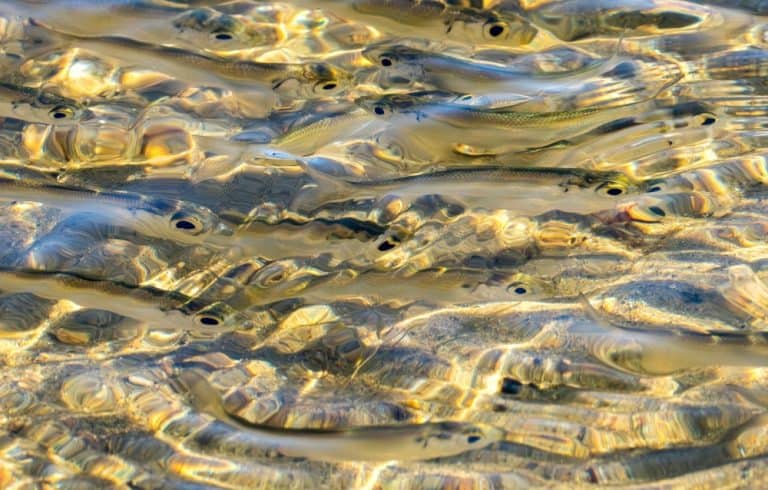
Diet Carnivore Schooling coastal fishes-especially mullets (Mugilidae) where available (diet is strongly regional and seasonal).
Seasonal Migratory 497 mi

Temperament

Highly social and cognitively complex; exhibits long-term social bonds and learned traditions (behavioral specializations can differ between neighboring communities) (Connor et al., 2000; Wells, 2003).
Curious and investigative toward novel objects/boats; can be habituated in coastal areas, though responses vary by population and exposure (Wells, 2003; NOAA Fisheries).
Can be assertive to aggressive in intraspecific interactions: male alliance competition, coercive herding of females, and documented infanticide in some populations (Connor et al., 2000; Patterson et al., 1998).
Some common bottlenose dolphins (Tursiops truncatus) show cooperative foraging learned in local communities (e.g., strand feeding, tool use), but these behaviors do not occur in all populations.
Long-lived with extended maternal care; maximum documented longevity ≥67 years (female) in a long-term monitored population, supporting multi-decade social familiarity and learning (Wells, 2014).

Communication

Signature whistles Individually distinctive contact calls used for cohesion and recognition); strong evidence for individual identity coding (Caldwell & Caldwell, 1965; Janik & Sayigh, 2013
Whistles beyond signature types (affiliative/contact and social contexts), with context-dependent rate changes.
Burst-pulse sounds Including squawks/buzzes) often associated with close-range social interactions, aggression, or excitement (reviewed in Connor et al., 2000; Janik & Sayigh, 2013
Echolocation clicks for navigation and prey detection; rapid click trains ("buzzes") during prey capture attempts.
Tactile contact Pectoral fin rubbing, body rubs) important for affiliation and bonding; calves maintain frequent tactile contact with mothers (Wells, 2003
Postural/visual displays: synchronous surfacing, arching, head/rostrum presentations used in coordination and social signaling.
Surface impacts: tail slaps, breaches, and chin slaps that can function as signals over distance Especially in noisy coastal waters
Jaw claps/rostrum jabs in agonistic contexts; threat displays can escalate to ramming in conflicts Connor et al., 2000
Bubble production Streams/rings) used in play and social contexts; also bubble curtains in some foraging situations (reported across delphinids; context varies by population

Habitat

Coastal Estuary Mangrove Rocky Shore Coral Reef Kelp Forest Open Ocean Deep Sea Seabed/Benthic +3
Biomes:
Terrain:
Coastal Island Rocky Sandy Muddy
Elevation: -59055 in

Ecological Role

Mobile marine mesopredator to local apex predator (depending on ecosystem), linking pelagic and coastal food webs by concentrating on schooling fishes and cephalopods.

Regulates local fish and squid populations via predation (top-down control) Influences prey behavior and schooling dynamics (risk effects) Transfers nutrients across habitats through movement and excretion (coastal-offshore nutrient coupling) Serves as a sentinel/indicator species for coastal ecosystem health and contaminant burdens (bioaccumulation at high trophic level)

Diet Details

Main Prey:
Teleost fishes Cephalopods Crustaceans

Human Interaction

Domestication Status

Wild

Tursiops truncatus (common bottlenose dolphin) is wild, not domesticated. Humans have captured and kept them for display, research, military work, and shows (especially since the mid-1900s). They can be trained and bred in marine parks and care centers, but no domestication over many generations has occurred. Human interactions include fisheries conflict, tourism, feeding, rescue, and military use.

Danger Level

Moderate
  • Bites and lacerations (powerful jaws; can occur during feeding/provisioning or close-contact programs)
  • Blunt-force trauma from ramming/tail strikes (documented in aggressive or stressed individuals, especially habituated dolphins near humans)
  • Drowning risk during in-water interactions (strong animal, unpredictable movement; hazards amplified in open water)
  • Zoonotic and skin/soft-tissue infection risk from marine mammal-associated pathogens (e.g., Brucella spp. in cetaceans; Erysipelothrix, Mycoplasma and other opportunists-risk increases with handling/close contact)
  • Boat-strike and shared-waterway hazards (risk to humans in small craft during close approaches; risk also to dolphins)

As a Pet

Not Suitable as Pet

Legality: Common bottlenose dolphin (Tursiops truncatus) cannot be kept as a private pet in most places. Laws (e.g., US MMPA, CITES) require permits and limit ownership to licensed facilities, not individuals.

Care Level: Expert Only

Purchase Cost:
Lifetime Cost: $1,000,000 - $5,000,000

Economic Value

Uses:
Ecotourism (dolphin-watching, coastal tourism branding) Commercial/public display & managed-care facilities (where permitted) Scientific research value (behavior, cognition, bioacoustics, physiology, conservation biology) Military/industrial programs (trained detection/inspection tasks in some countries) Fisheries interactions (economic losses from depredation; costs of bycatch mitigation; gear damage)
Products:
  • Tour operations and related coastal tourism revenue
  • Education/programming revenue at licensed facilities (where permitted)
  • Research outputs (datasets, publications, monitoring methods)
  • Mitigation technologies/practices (acoustic deterrents, gear modifications)

Relationships

Related Species 8

Indo-Pacific Bottlenose Dolphin Tursiops aduncus Shared Genus
Burrunan Dolphin Tursiops australis Shared Genus
Common Dolphin Delphinus delphis Shared Family
Pantropical Spotted Dolphin Stenella attenuata Shared Family
Atlantic Spotted Dolphin Stenella frontalis Shared Family
Risso's Dolphin Grampus griseus Shared Family
Short-finned Pilot Whale Globicephala macrorhynchus Shared Family
Killer Whale
Killer Whale Orcinus orca Shared Family

Ecological Equivalents 5

Animals that fill a similar ecological role in their ecosystem

Indo-Pacific Bottlenose Dolphin Tursiops aduncus Coastal generalist delphinid that uses echolocation to catch prey and lives in split-and-join (fission-fusion) social groups like Tursiops truncatus. Both species hunt fish and squid near shore, feed together, and receive extended maternal care.
Common Dolphin Delphinus delphis Often occupies a similar mid–upper trophic niche to other fast-swimming delphinids that target schooling epipelagic fishes (e.g., clupeids and engraulids) and squid. Shares reliance on group foraging and echolocation, but is typically more pelagic than many coastal Tursiops truncatus populations.
Pantropical Spotted Dolphin Stenella attenuata Warm-water delphinid with overlapping distribution in tropical and subtropical seas; shares a similar prey base (small pelagic fishes and cephalopods) and social, group-foraging ecology, though it is more consistently offshore in many regions than coastal bottlenose dolphins.
Harbor Porpoise
Harbor Porpoise Phocoena phocoena In temperate coastal systems, it fills a comparable role as a small odontocete mesopredator, feeding on fishes and cephalopods and using echolocation. It overlaps in nearshore habitat use and potential prey guilds, though it is typically smaller-bodied and less social than Tursiops truncatus.
California Sea Lion Zalophus californianus Not a cetacean; an ecological counterpart in many coastal ecosystems: an intelligent, mobile marine predator that hunts schooling fishes and cephalopods in neritic waters, sometimes overlapping with bottlenose dolphins in prey types and foraging areas.

The bottlenose dolphin is one of nature’s most intelligent species 

The bottlenose dolphin is a well-known species of dolphin that lives across the world and is known for its incredible intelligence. Bottlenose dolphins are one of the few species that have demonstrated self-recognition and have a highly developed spoken language that scientists believe closely resembles human communications.

Incredible Bottlenose Dolphin Facts!

  • Bottlenose dolphins are so intelligent that in some locations they’ve learned to hunt with humans! In the town of Leguna, Brazil they’ve been cooperating with local fishermen to hunt since 1847!
  • Bottlenose dolphins are believed to have the longest memory of all non-human species. Scientists from the University of Chicago discovered dolphins can recognize whistles from their mates after being separated for more than 20 years!
  • Bottlenose dolphins have been observed changing how they communicate to a “common language” when they encounter other dolphin species.

Scientific Name

The scientific name of the common bottlenose dolphin is Tursiops truncatus. This is derived from tursio, which describes a fish that looks like a dolphin. “Ops” means the dolphin looks like this fish, which was first described by Pliny, the ancient Roman historian. Truncatus describes the animal’s short beak.

Other names for the dolphin are the bottlenose porpoise, the common porpoise, the black porpoise, or the gray porpoise, even though it’s not a porpoise at all. A porpoise is another aquatic mammal found in an entirely different family.

Animals That Use Sonar-dolphin

The scientific name of the common bottlenose dolphin is Tursiops truncatus.

Evolution

Scientists believe that dolphins are descended from four-legged land-dwelling ancestors–possibly the Pakicetus, which lived 50 million years ago. As these creatures spent more and more time in the water, their bodies evolved, losing their land-living abilities and adapting to aquatic living. The mid-stage animals which were semi-aquatic include the Protocetids, while the first known animals to live exclusively in water are the Durudon and Basilosaurus, around 38 million years ago.

In the early Miocene Era, dolphin-like animals inhabited oceans. They were cetaceans with mid-sized teeth in the family Kentriodontidae, fed on small fish, and were echolocators.

Five million years ago, the genus Tursiops appeared from which the bottlenose dolphin belongs.

Classification and Taxonomy – Types of Bottlenose Dolphin

The taxonomy of bottlenose dolphins has been under debate in the scientific community. Today, the IUCN (the organization that determines whether species are endangered) recognizes two species of bottlenose dolphins.

  • Common bottlenose dolphin (Tursiops trunatus): the most commonly found bottlenose dolphin found in temperate waters across the world.
  • Indo-Pacific bottlenose dolphin (Tursiops aduncus): A species found in the Indian Ocean and waters off China and Australia which has a dark-grey color and is generally smaller than common bottlenose. It was first recognized as a separate species in 1998.

Finally, in 2011 researchers in Australia published research that a third species of bottlenose dolphin existed. They named it the Burrunan dolphin. The species lives in a small geographic area near Melbourne and as few as 150 individuals in the species may survive.
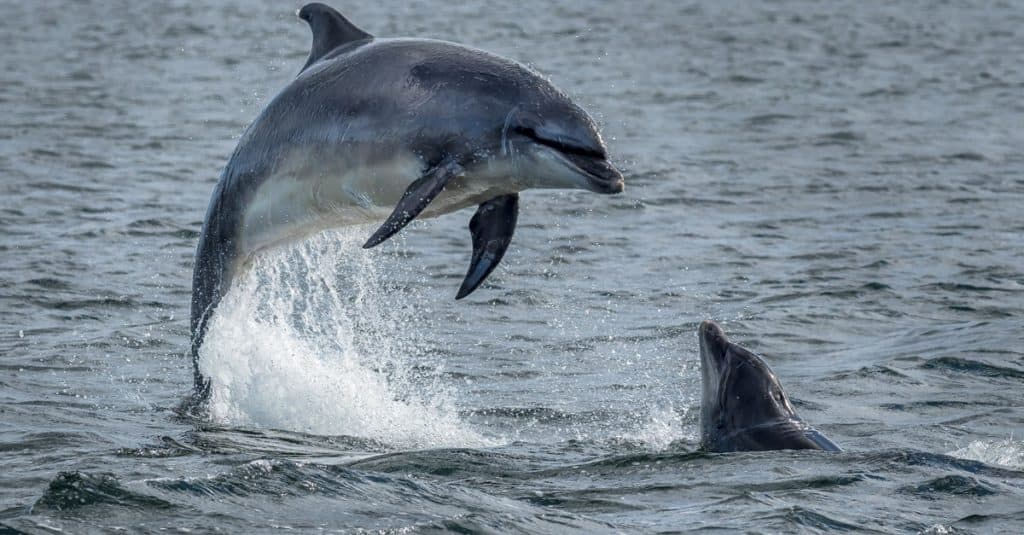
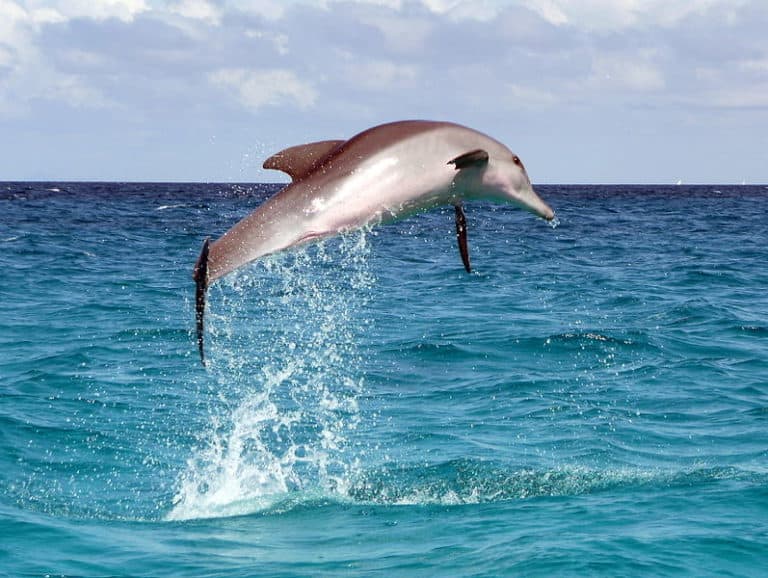
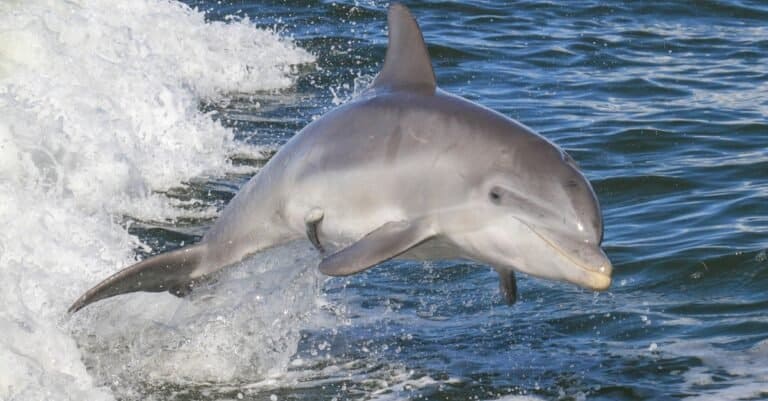
Wild Bottlenose Dolphins jumping out of the ocean water at the Moray Firth near Inverness in Scotland.

The two main types of bottlenose dolphins are the Common and the Inco-Pacific bottlenose dolphin.

Appearance and Behavior

The bottlenose dolphin grows to about 12 feet long (3.5 m), though smaller individuals can be only about 6.6 feet long (2 m). It can weigh between 300 and 1400 pounds (135 to 635 kg), and males are usually bigger than females. Sometimes they weigh twice as much. Biologists believe this is because females become mature at an earlier age, which takes a lot of energy. Males keep growing until they become mature.

The bottlenose dolphin has a robust body that’s dark gray on the back and lighter gray on the sides. The belly is white or even a bit pinkish, though the color of individual animals can range from nearly black to albino. Some dolphins have what looks like a cape over their heads, and older females can have spotted bellies.

The beak that gives the dolphin its scientific name is indeed short and bottle-shaped, and there’s a groove between the snout and the dolphin’s forehead. The fin on the animal’s back is near its center. It is broad at the bottom and has a pointed tip. Since dolphins don’t chew their food, they have multiple stomachs to aid in digestion. While most dolphins have three stomachs, some have two.

Bottlenose dolphins swim in pods. These pods usually have about 15 dolphins, but a pod can range from just two dolphins to over 1000 that come together briefly. Dolphins use echolocation to find food. This echolocation is so precise it can not only tell the dolphin where the prey is but its shape. Sometimes the echolocation is so powerful that it stuns the prey. At other times, the dolphin simply listens to find its food.

Bottlenose dolphins use a great number of sounds to communicate with each other, including squeaks and whistles. There is a type of oil in their heads that helps amplify sound waves. The dolphins also use their bodies to communicate. Slapping its tail on the water is often a sign the animal is angry about something. They can also stroke and caress each other and come to each other’s aid when they’re injured.

Like humans, bottlenose dolphins often do things simply for fun. They ride the bow waves of boats or even surf and leap out of the water. Sometimes, their curiosity makes them approach humans so closely that the human can reach out and touch them.         
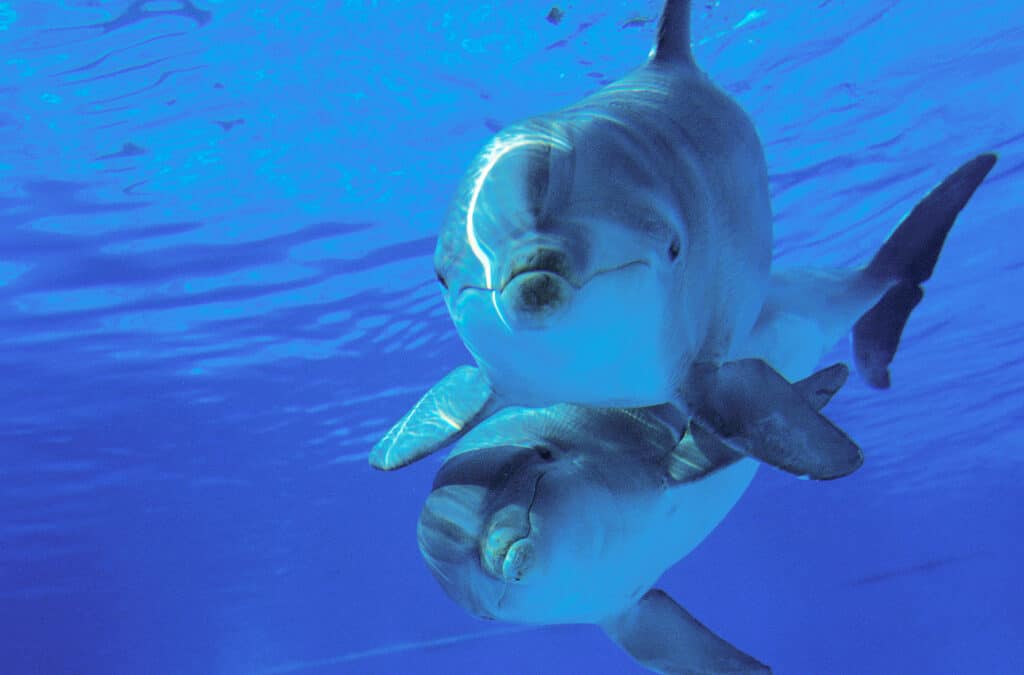
two dolphins

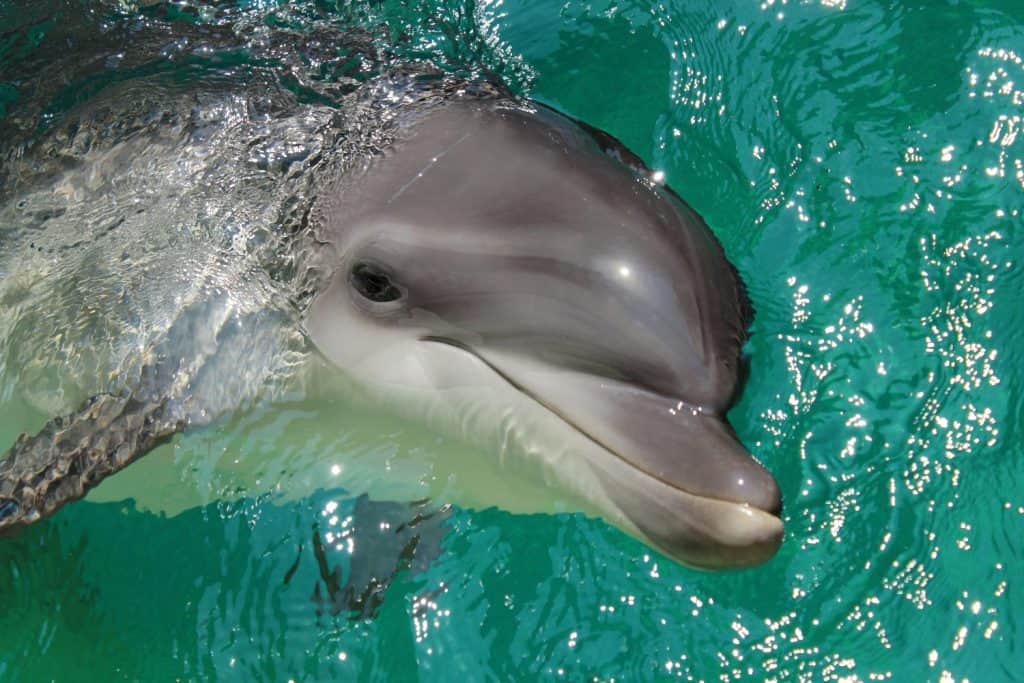
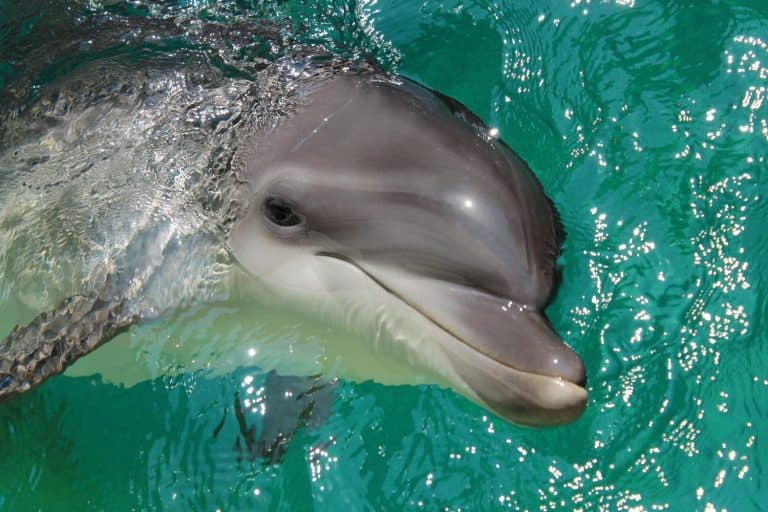
The bottlenose dolphin’s beak is short and bottle-shaped with a groove between its snout and forehead.

Habitat

Bottlenose dolphins are found in warmer waters around the world. They are not often found in the polar regions. They live in estuaries where rivers meet the ocean, shallow bays, and even freshwater rivers and other bodies of water close to the shore. Some pods can also be found offshore in deep water. The dolphins that live offshore are bigger and darker than those that live inshore and have been known to migrate as much as 2600 miles in a season while inshore pods have been known to migrate during El Niño events.
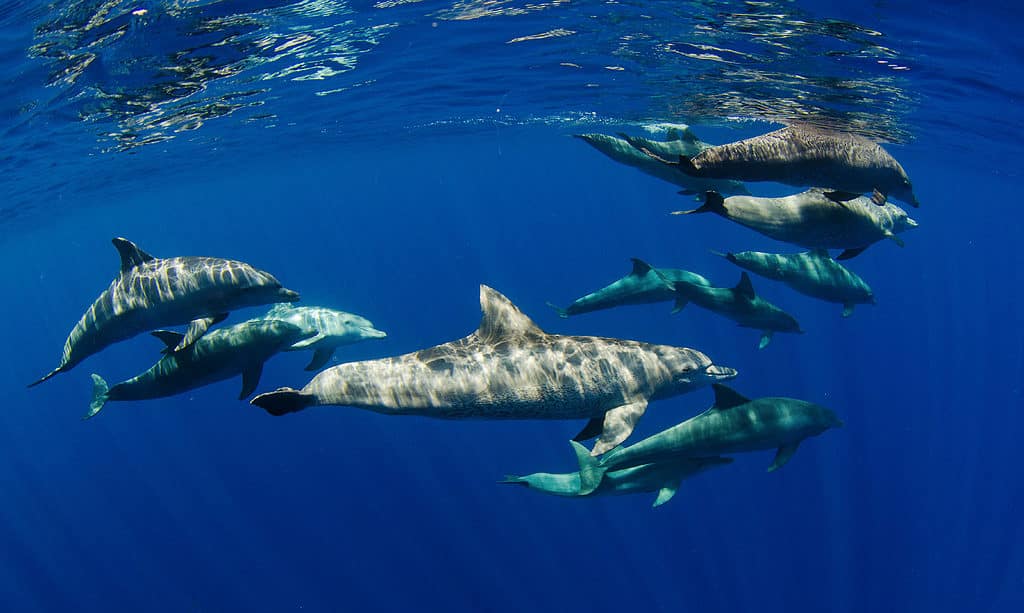
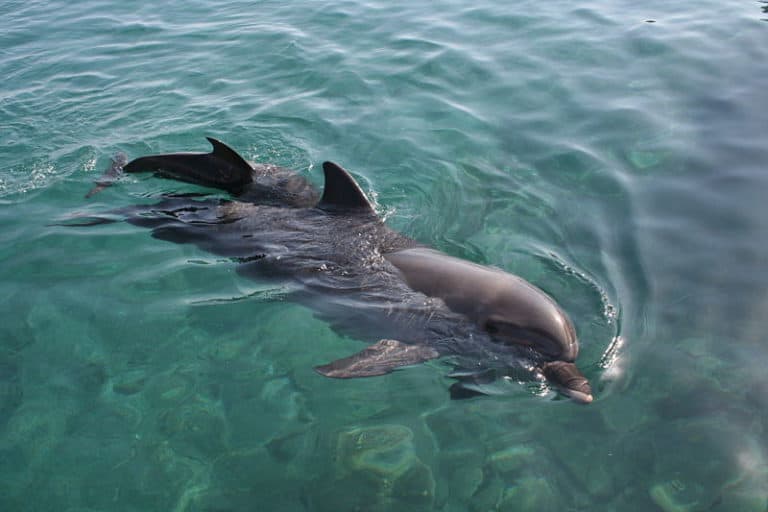
bottlenose dolphins

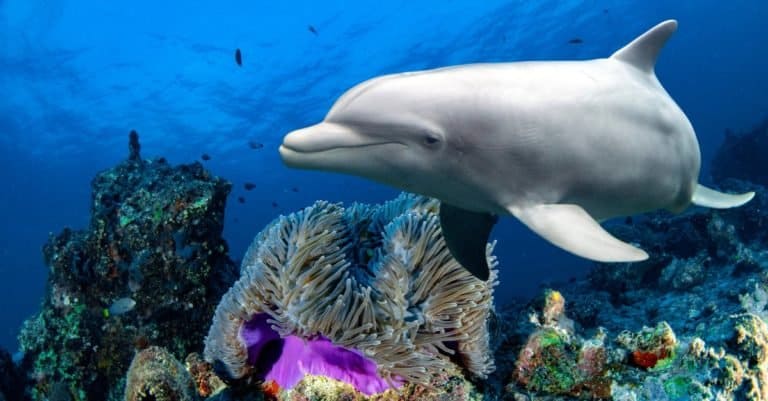
Bottlenose dolphins live in estuaries, shallow bays, and even freshwater rivers and other bodies of water close to the shore.

Diet

Bottlenose dolphins eat a great variety of seafood, including fish, shrimp, crabs, and squid. They love to follow fishing boats and grab the unwanted fish that’s tossed overboard, though this risks the dolphin getting tangled in the nets. If the dolphin can’t free itself and come up for air, it will drown. Other dolphins can be fatally injured if they swallow fish hooks.

Though bottlenose dolphins have teeth, they use them to hold on to their prey. They don’t chew but swallow prey whole. Pods sometimes come together to hunt.

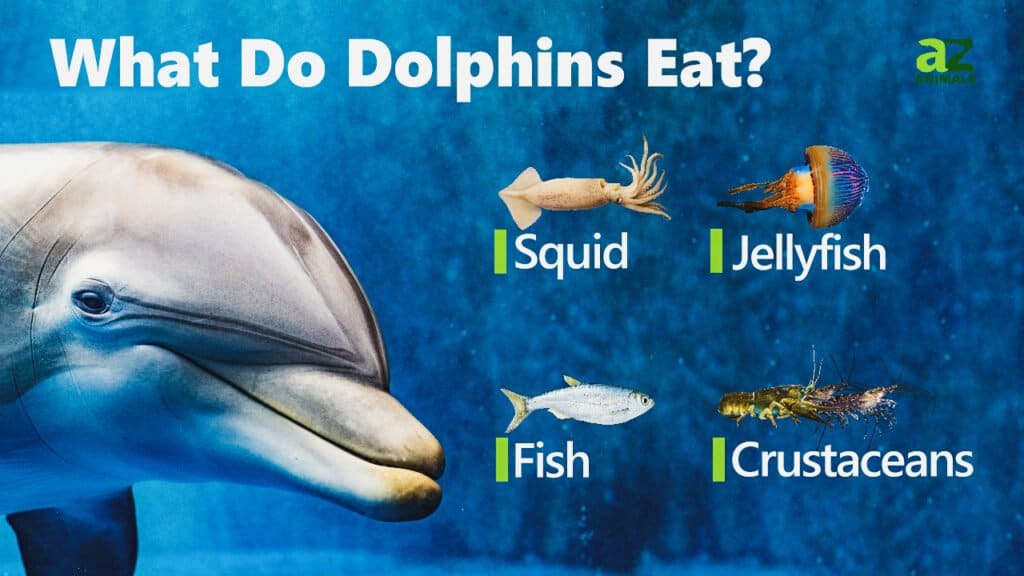
What Do Dolphins Eat
Dolphins eat squid, jellyfish, fish, and crustaceans.

Predators and Threats

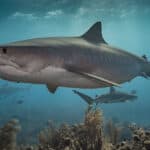
The primary predators and threats to bottlenose dolphins are humans and big sharks such as bull sharks and tiger sharks. While bottlenose dolphins aren’t often deliberately hunted for food, they can be tangled in large fishing nets. In addition, they face threats like pollution, oil spills, and development around estuaries and areas they congregate. For example, fertilizers and contaminants released into water deplete the water of its oxygen and can cause blooms of poisonous algae. When the dolphins eat the fish that live in these polluted waters, they get sick and sometimes die. Just swimming through contaminated waters also causes dolphins to sicken.

Sharks such as the tiger and bull shark are especially partial to smaller dolphins, including babies and females. It’s not unusual to see a dolphin with scars from the bite of a shark. Biologists believe they survive thanks to their blubber. Stingrays have also been known to kill bottlenose dolphins.
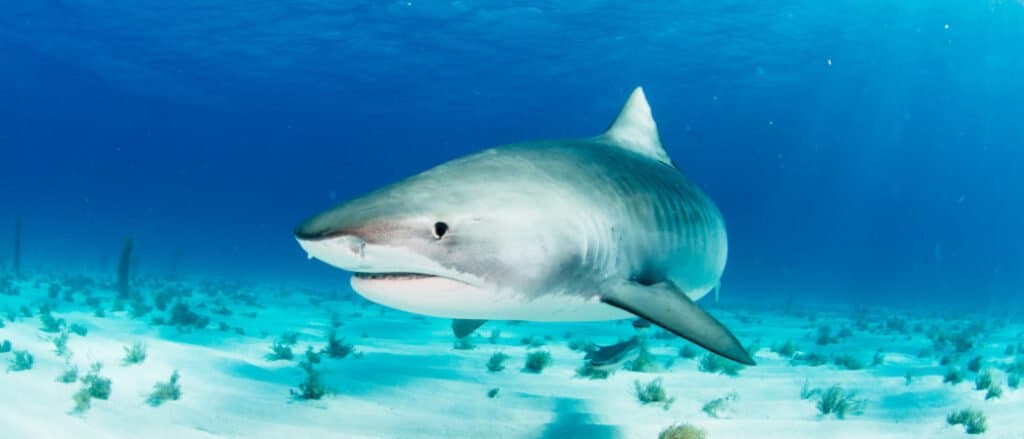
Largest Tiger Shark- Tiger Shark Swimming

Tiger sharks are one of the predators of the bottlenose dolphin.

Reproduction, Babies, and Lifespan

Like many mammals, the female bottlenose dolphin has a period of estrous, when she’s able to become pregnant. Sometimes a group of males will look for a female who is ready to mate, while other males pursue females singly. They don’t stay together after mating, and the bulk of childcare is left to the mother. Male bottlenose dolphins are bulls, females are cows, and their babies are calves.

Females are mature when they’re about five to 10 years old, while males are mature when they are between eight and 13. However, as with humans, it may be a long time between the time a bottlenose dolphin becomes sexually mature and when it reproduces. Some, for example, don’t reproduce until they’re about 20.

Females are pregnant for about a year, and they only have one calf at a time. The mother helps the baby to the surface so it can take its first breath. She’ll nurse her calf for about 18 to 20 months, then become pregnant again after it is weaned. The calf stays with its mother until it’s about five years old. As with humans, dolphin babies are born all year round, but most are born during the summer months. A female bottlenose dolphin can give birth throughout her life, and a group of females will help raise each other’s calves.

The average lifespan of a wild bottlenose dolphin is about 25, while a dolphin in captivity can live for over 50 years. Females tend to live longer than males, and the oldest dolphin on record was a captive female who lived to be 53.
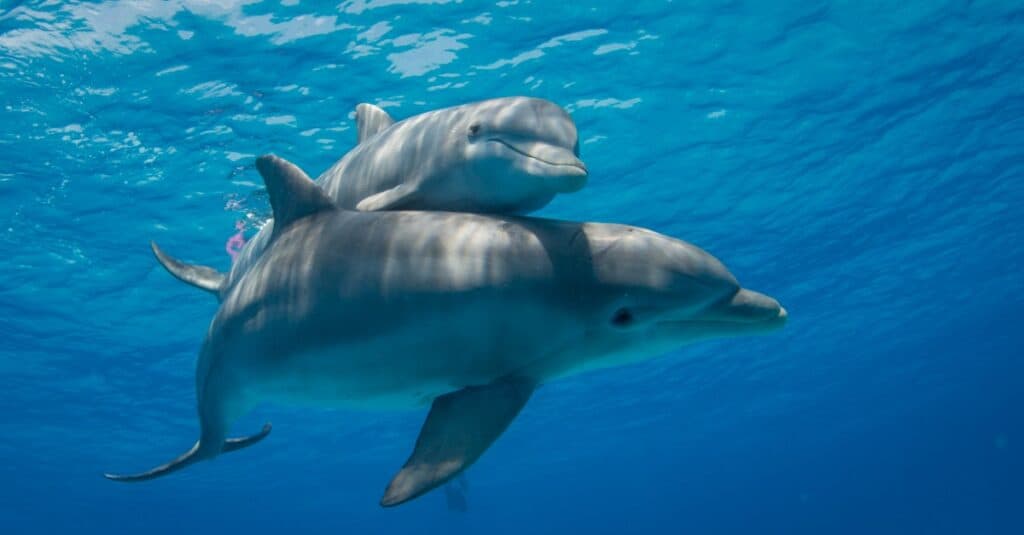
baby dolphin swimming on top of mommy dolphin

The bottlenose dolphin calf stays with its mother until it’s about five years old.

Population – How Many Bottlenose Dolphin are Left?

There are about 600,000 common bottlenose dolphins around the world, and their conservation status is LC or “Least Concern.” The animal is protected by several agreements, including the Convention on the Conservation of Migratory Species of Wild Animals, the Memorandum of Understanding Concerning the Conservation of the Manatee and Small Cetaceans of Western Africa and Macaronesia and the United States Marine Mammal Protection Act of 1972.

While the common bottlenose dolphin is classified as “Least Concern,” with only an estimated 150 individuals found in a small area on Australia’s southern coast, the recently identified Burrunan species of bottlenose dolphin may be protected in the future.
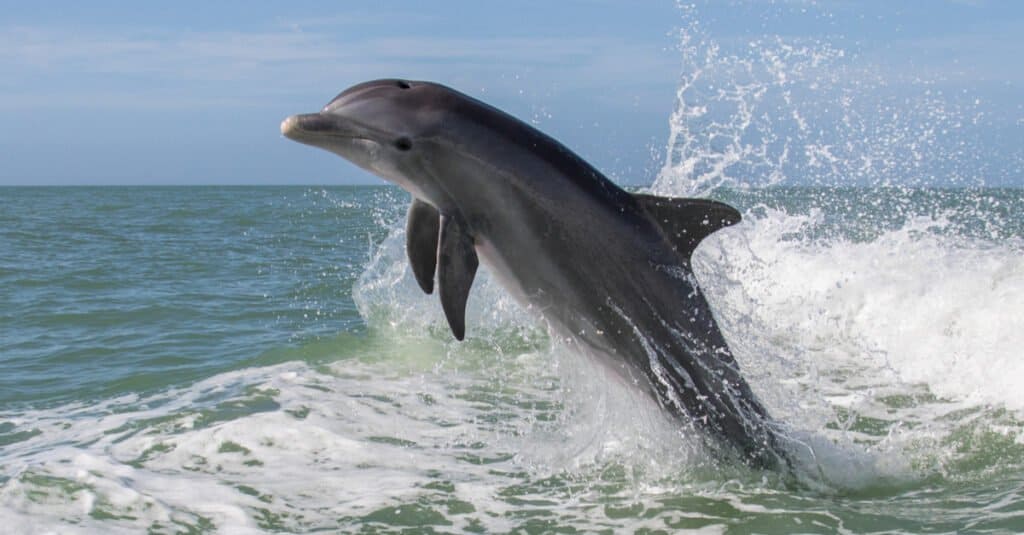
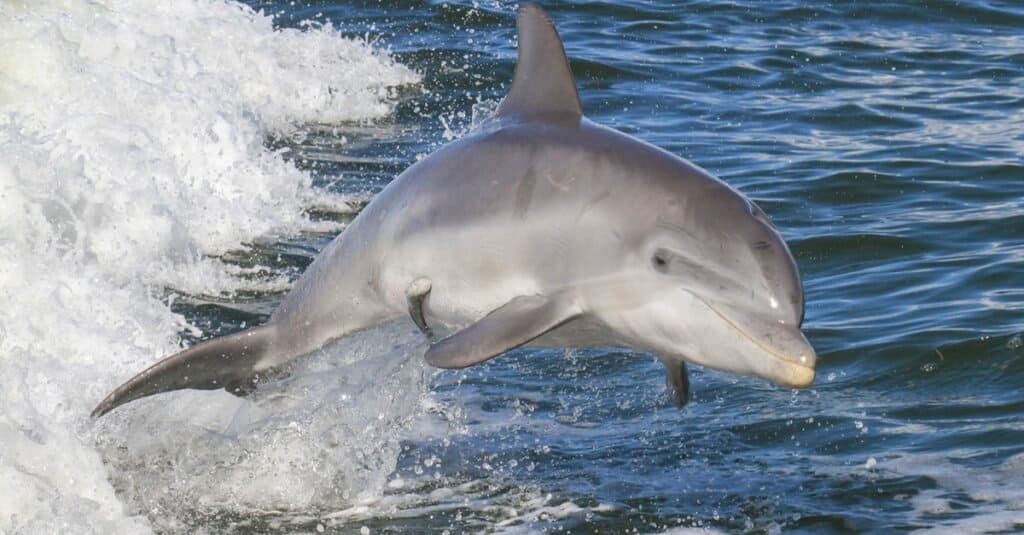
bottlenose dolphin jumping out of the water

There are about 600,000 common bottlenose dolphins around the world, and their conservation status is LC or “Least Concern.”

Bottlenose Dolphin Facts

A killer whale and a dolphin mating?

When a male false killer whale and a female bottlenose dolphin mate, the resulting hybrid animal is named a “wholphin.” This mating is possible because while false killer whales have the term “whale” in their common name, they’re more closely related to bottlenose dolphins. While wholphins have been observed mostly in captivity, they have also been seen in the wild.

It’s believed dolphins can speak their own language!

Some scientists even believe that they have a language, as opposed to calls and sounds other herd animals make to warn of danger or draw attention to food. But what sort of language the bottlenose dolphin speaks has yet to be deciphered.

Part of the difficulty in studying the communications of bottlenose dolphins is their frequency characteristics are much different than human hearing. The bottlenose dolphin is far from the only dolphin species to have observed language. For a longer discussion, you can read our page on dolphins! 

How can bottlenose dolphins nod yes?

One of the things that makes bottlenose dolphins attractive to humans is that they can move its neck and make nodding motions as if it understands what it’s being told. This is because most of the neck vertebrae aren’t fused like they are in other kinds of dolphins.

Bottlenose dolphins came from a … dog-sized animal on land?

Millions of years ago, the ancestor of the dolphin was a dog-sized animal that walked on land. Over time, it adopted a wholly aquatic lifestyle, and its body morphed into the shape of a fish. Its hind legs receded, its tail developed flukes and its front legs turned into flippers. It lost its external ears and developed a fin on its back. Its nostrils migrated from the front of its face to the top of its head so the animal can breathe without having to raise its whole head out of the water. The nostril, now called a blow-hole, snaps shut automatically when the dolphin submerges and automatically opens up when it surfaces.

Bottlenose dolphins sleep by turning off half their brains!

For a long time, people wondered how dolphins could sleep when they had to surface for air every minute or so. The amazing discovery was that one half of their brain sleeps while the other half stays awake enough to allow them to surface, breathe, and watch for predators and threats. Its brain cycles between the halves of its brain resting in two-hour periods so it can rest both halves!

Bottlenose dolphins have been observed socializing and cooperating with other species

Dolphins have been monitored swimming together with the same group of false killer whales in locations that can range hundreds of miles away. The groupings appear not to be encountered, but the species intentionally socialize and cooperatively hunt in large groups.  

Other examples of dolphins cooperating with other species include dolphins that have learned to hunt with local fishermen. In 2011 researchers even discovered a group of sperm whales had adopted a bottlenose dolphin with a spinal deformity!

Dolphins are used by militaries for their advanced intelligence and echolocation

Bottlenose dolphins are the main animals used by the U.S. Navy for its “Marine Mammal Program.” The bottlenose dolphin is reported to be better at any machine in detecting mines. They’ve been used for tasks ranging from identifying old mines left over from World War II to guarding nuclear weapons off the coast of Washington State.

View all 453 animals that start with B
How to say Bottlenose Dolphin in ...
Danish
Øresvin
German
Großer Tümmler
English
Bottlenose Dolphin
French
Grand dauphin
Hebrew
דולפינן ים תיכוני
Croatian
Dobri dupin
Japanese
ハンドウイルカ
English
Tummeleer
Dutch
Tuimelaar
English
Tumler
Polish
Butlonos
Swedish
Öresvin
Turkish
Afalina
Chinese
宽吻海豚

Sources

  1. David Burnie, Dorling Kindersley (2011) Animal, The Definitive Visual Guide To The World's Wildlife / Accessed November 10, 2008
  2. Tom Jackson, Lorenz Books (2007) The World Encyclopedia Of Animals / Accessed November 10, 2008
  3. David Burnie, Kingfisher (2011) The Kingfisher Animal Encyclopedia / Accessed November 10, 2008
  4. Richard Mackay, University of California Press (2009) The Atlas Of Endangered Species / Accessed November 10, 2008
  5. David Burnie, Dorling Kindersley (2008) Illustrated Encyclopedia Of Animals / Accessed November 10, 2008
  6. Dorling Kindersley (2006) Dorling Kindersley Encyclopedia Of Animals / Accessed November 10, 2008
  7. David W. Macdonald, Oxford University Press (2010) The Encyclopedia Of Mammals / Accessed November 10, 2008
  8. Joe Roman / Published January 31, 2013 / Accessed January 4, 2020
  9. Will Worley / Published September 12, 2016 / Accessed January 4, 2020
  10. Kate Charlton-Robb / Published September 15, 2011 / Accessed January 4, 2020
Abby Parks

About the Author

Abby Parks

Abby Parks has authored a fiction novel, theatrical plays, short stories, poems, and song lyrics. She's recorded two albums of her original songs, and is a multi-instrumentalist. She has managed a website for folk music and written articles on singer-songwriters, folk bands, and other things music-oriented. She's also a radio DJ for a folk music show. As well as having been a pet parent to rabbits, birds, dogs, and cats, Abby loves seeking sightings of animals in the wild and has witnessed some more exotic ones such as Puffins in the Farne Islands, Southern Pudu on the island of Chiloe (Chile), Penguins in the wild, and countless wild animals in the Rocky Mountains (Big Horn Sheep, Mountain Goats, Moose, Elk, Marmots, Beavers).
Connect:

Thank you for reading! Have some feedback for us?


Bottlenose Dolphin FAQs (Frequently Asked Questions)

Bottlenose dolphins are carnivores. This means that they eat meat, and since they are aquatic, the meat comes in the form of fish and marine invertebrates. Dolphins who live inshore might eat fish that are found there such as spots and croakers. They’ll also take clams, crabs, shrimp and other mollusks. Those who live in the deeper waters dine on squid and ocean fish such as pandoras.