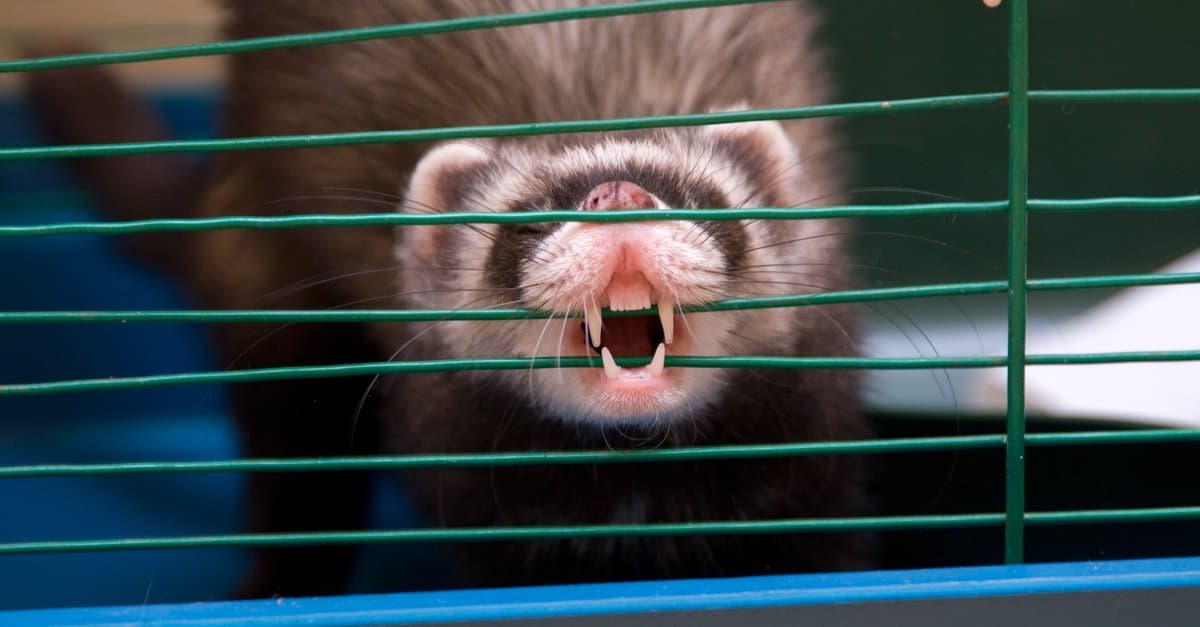

Quick Take
- Ferrets are found in households worldwide.
- Ferrets are diphyodonts, growing two sets of teeth: deciduous (baby) teeth and permanent (adult) teeth.
- Proper care and regular oral check-up are recommended to maintain your ferret’s health and prolong its life.
Ferrets (Mustela putorius furo) are carnivorous mammals that belong to the weasel family Mustelidae. They are widespread throughout Europe, and have established feral populations in New Zealand and the Atlantic Islands: the Azores and Madeira. Ferrets are also found in households worldwide, where they are beloved for their playful and intelligent nature. The typical ferret is between 12 and 24 inches long and weighs no more than four pounds. Although they are small, ferret teeth are sharp, and ferrets are likely to nip, especially when they are young. However, malicious biting is rare. Like most mammals, ferrets have heterodont teeth, including incisors, canines, premolars, and molars. Continue reading to discover everything you need to know about ferret teeth.
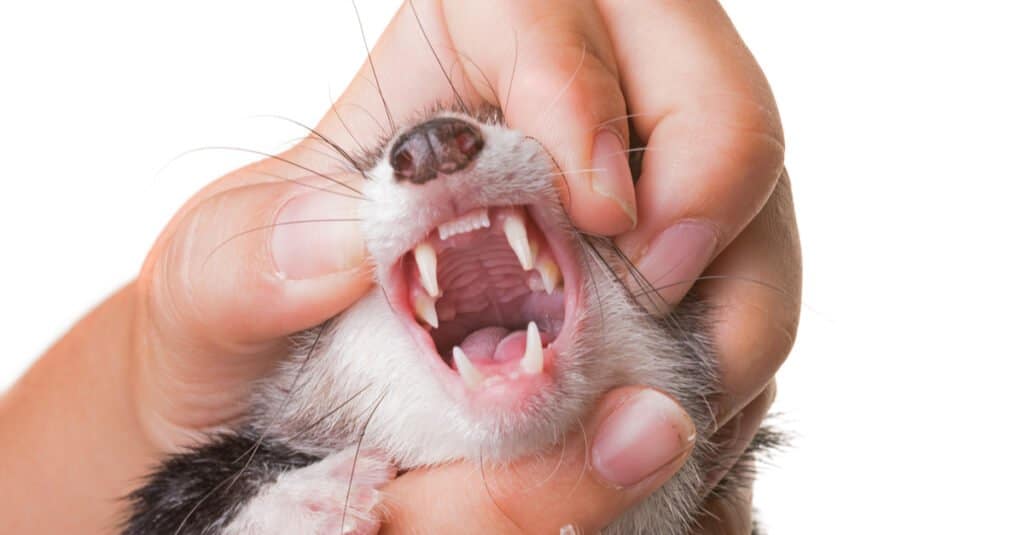
Sharp canines are a hallmark of ferret teeth.
©cynoclub/Shutterstock.com
What Kind of Teeth Do Ferrets Have?
Ferrets have heterodont teeth, which include incisors, canines, premolars, and molars.
They are diphyodonts, which means they grow two sets of teeth in their lifetime: a set of deciduous (baby) teeth and a set of permanent (adult) teeth.
Baby ferrets, called kits or kittens, are born without teeth. However, by two weeks of age, their deciduous teeth begin to erupt. Ferrets have between 28 and 30 deciduous teeth. The dental formula is I3-4/ C1/1; M3/3 = 28 to 30. Each number refers to the number of teeth in each quadrant of the mouth: upper left, upper right, lower left, and lower right.

Ferrets have 28 to 30 deciduous teeth and 34 permanent teeth.
©Olga Pysarenko/Shutterstock.com
At 7 to 9 weeks of age, the kits will start losing their milk teeth as their permanent teeth begin to erupt. By the time they are nine months old, they will have their full set of permanent teeth.
Adult ferrets have a total of 34 permanent teeth, with a dental formula: I3/3; C1/1; P3/3; M1/2.
How Do Ferrets Use Their Teeth?
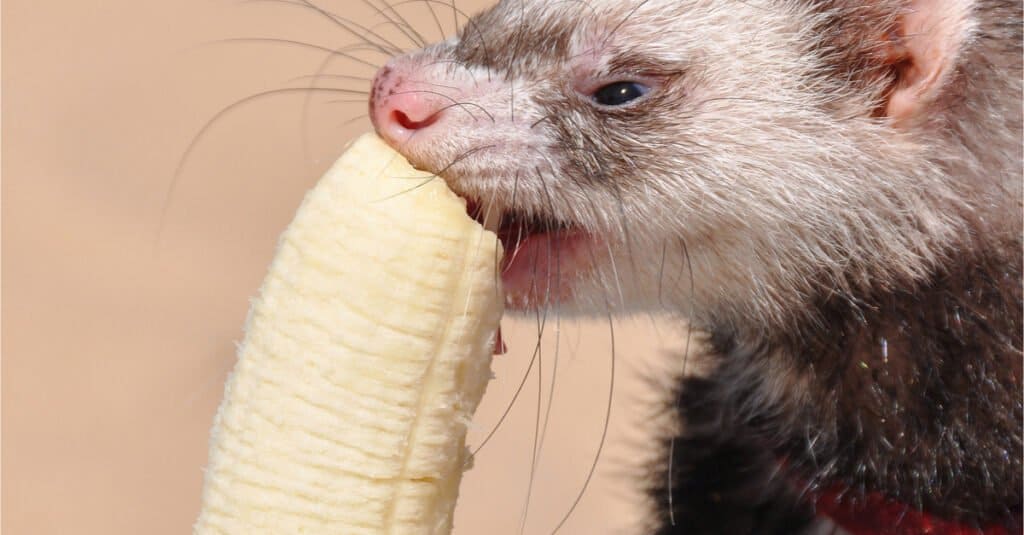
Ferrets use their incisors to grasp food and canines to cut their prey.
©Zanna Pesnina/Shutterstock.com
Ferrets use their 12 incisors, the teeth at the front of their mouth, to gather and grasp food. They also use their incisors for grooming themselves and each other. They use these front teeth by nibbling to remove dirt, untangle fur, and scratch.
Ferrets use their four long, fang-like canines to kill their prey and cut its flesh. Their teeth are adapted for this purpose: while their incisors are used to grasp the food, the canines are used for shearing and tearing it.
Their 12 premolars are flat with sharpened edges, called cusps, which are used to shred and cut their food into smaller pieces. The six molars have the same flat structure and cusps as the premolars and are used for grinding and crushing the ferret’s food.
Do Ferrets Bite?
Like puppies and cats, ferrets are playful, but they also bite. Ferrets love discovering things, and they will sometimes use their sharp teeth to play or nip people. Ferrets can bite for several reasons, including fear, aggression, or teething.

©Gera Photo/Shutterstock.com
Because of their sore gums, ferrets undergoing the teething stage tend to chew and bite more often. When ferrets are in pain or suffering from diseases, they can also develop behavioral problems such as aggression, leading them to bite. Ferrets may also bite when they are handled. To avoid such behavior, ferrets must be trained to socialize starting at an early age.
Ferrets’ little nips are generally considered a normal part of their play and communication, and can be a sign of affection or a request for attention. When a finger or a hand smells of food, ferrets may also nip or nibble. Play-biting is generally considered an appropriate behavior and not a cause for concern.
Do Ferrets Have Dental Issues?
Proper dental hygiene and regular oral examinations are required to keep ferrets’ teeth healthy. Ferrets typically live 5–10 years, with some individuals reaching 10 years or more if well cared for, including proper dental health.
Common dental problems in ferrets include bad breath, red and irritated gums, tartar build-up, irregularly placed teeth, mouth sores, and broken teeth. Ferrets depend on their teeth for feeding, so regular dental check-ups and preventative care are essential in maintaining their overall health. Without healthy teeth, they can experience significant pain, nutritional deficiencies, and other serious health problems.