There are roughly 350 species of hummingbirds and now we can add a hybrid to that ever-growing list. A gold-throated hummingbird was discovered by scientists in Peru’s Cordillera Azul National Park.
Experts have never seen a bird like this one before! A DNA examination revealed that the bird wasn’t actually a new species at all. In actuality, it is a cross between the Heliodoxa gularis and the Heliodoxa branickii hummingbird species.
The necks of these two hummingbirds are pink. But this lovely bird has a gold neck that shimmers! Scientists were perplexed by the discoveries, wondering how a bird with a golden throat could have developed from two separate birds with pink throats.
The difficult processes used to choose the hues of iridescent feathers provide us with some answers. The foundational color, which is the real pigment, and structural hue, are both sources of the color of the animal’s plumage.
Thanks to the use of modern techniques and genetic data, we’re able to comprehend more fully how these processes occur over time and space. It’s amazing how science and discovery continuously leave us in awe.
Pink-Throated Hummingbird Facts

Pink-throated brilliant hummingbirds live in Peru, Ecuador, and Columbia.
©Virginie Merckaert/Shutterstock.com
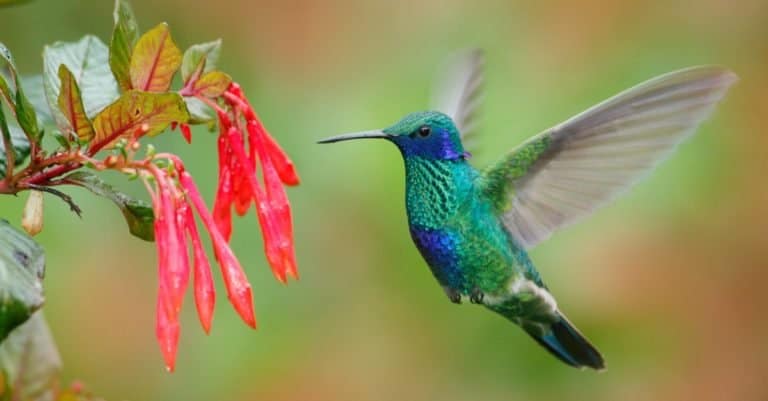
Since this shimmering new discovery comes from two pink-throated hummingbirds, it’s important to know a bit about them. The pink-throated brilliant is typically less than five inches long. The two sexes are nearly interchangeable. Although the female’s throat region is smaller, both feature the characteristic dazzling reddish-pink throat spot.
They have gleaming emerald upperparts with an beautiful incandescent green band in the center of the forehead. These birds also have a nearly straight black bill. The undertail cover is pale, the abdomen is gray, and the breast has a brilliant green color. The long, forked tail is a copper-green hue.
As for size, the rufous-webbed brilliant is comparable to a pink-throated hummingbird. On a typical basis, both sexes weigh about .2 ounces. The inner, cinnamon-rufous wing feathers that give the species its English name are what give the wing its darker color.
A black bill with a lighter mandible base is shared by both sexes as well Most males have a deep green sheen. They have an alluring rose gorget and a more vibrant, sparkling green forehead.
Bright white undertail coverts are present. The majority of the feathers on the tail are dark blue, while the middle pair is green. We look forward to learning more about the hybrid of these two hummingbirds as scientists and researchers continue to discover more about the gold-throated hummingbird.