
Quick Take
- One bird on this list keeps its spectacular crest hidden completely flat, only flashing it during life's most dramatic moments. See the hidden crest →
- A bird nicknamed the 'stinkbird' earned that name through a digestive trick it shares with cows, and its crest turns out to be the least bizarre thing about it. Meet the stinkbird →
- Some of the most jaw-dropping crests on this list belong to birds currently racing toward extinction. See the endangered flycatcher →
- The tiniest bird on this list weighs less than a paperclip, and yet its crest rivals anything a bird ten times its size could pull off. Meet the tiny coquette →
From tall, wispy crowns to brilliant fans, spiky tufts, and floppy quill-like feathers, bird crests come in an astonishing variety of shapes and sizes. These striking head ornaments can help birds attract mates, communicate, defend themselves, or simply make the birds easy to spot.
The birds below feature some of the most incredible crests in the world. Ranging from massive species that roam open grasslands to tiny hummingbirds weighing just a few grams, these birds illustrate just how creative nature can be when it comes to avian headwear.
Secretary Bird (Sagittarius serpentarius)
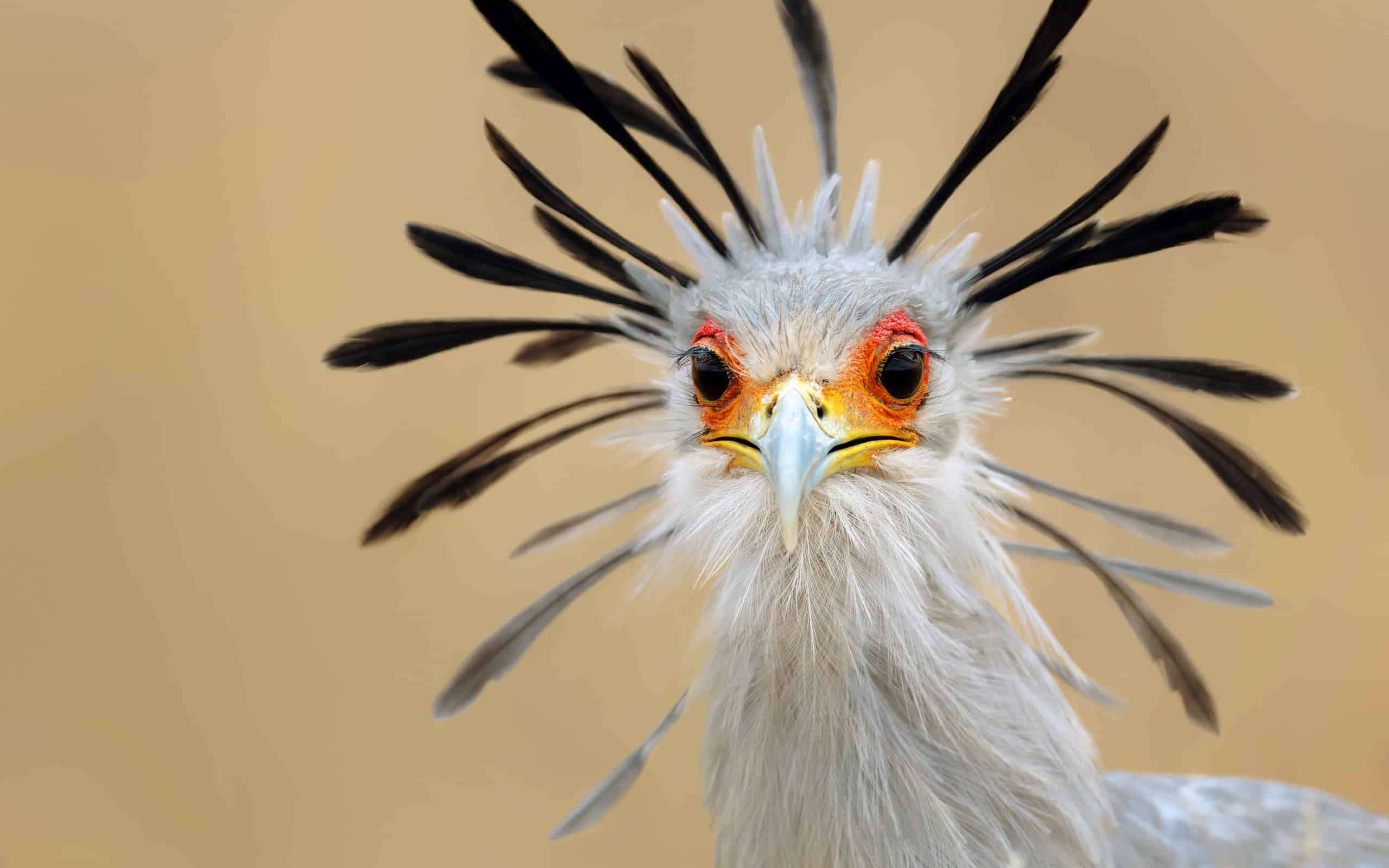
Standing more than 4 feet tall with a nearly 7-foot wingspan, the secretary bird is found across Africa south of the Sahara Desert. Although it can fly, this unusual bird of prey spends most of its time on the ground. At night, it flies up to acacia trees to roost.
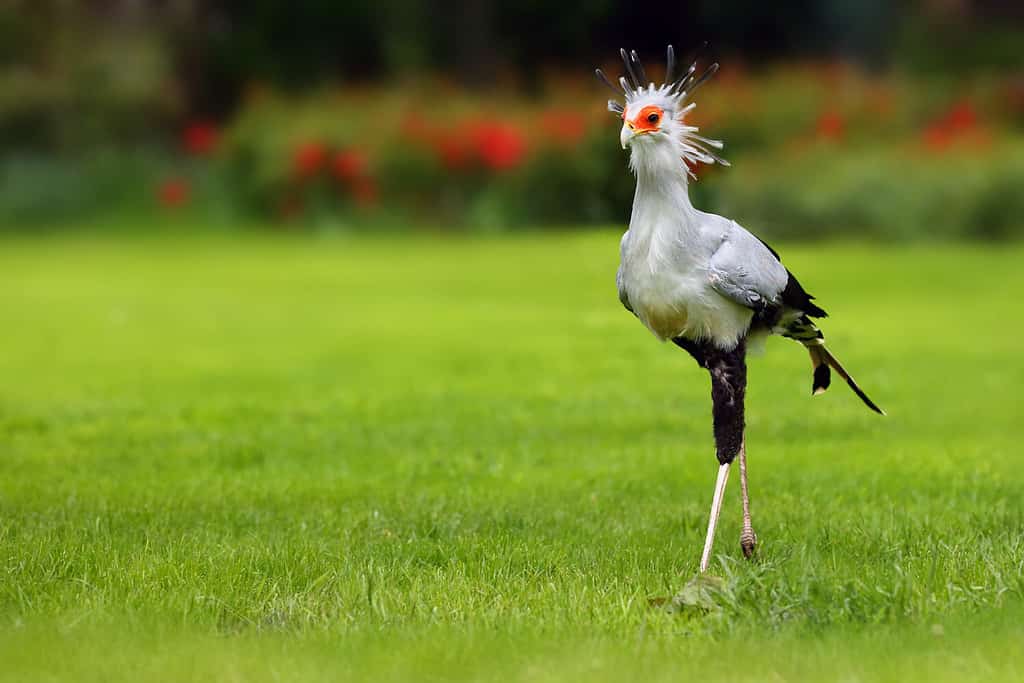
The secretary bird is a skilled hunter and eats a variety of animals, including insects, small mammals, birds, and snakes.
©Karel Bartik/Shutterstock.com
Its name comes from its dark, quill-like crest feathers. Nineteenth-century European observers thought these looked like goose-quill pens tucked behind a secretary’s ear. The secretary bird’s gray body and long, dark legs completed the look, making it look as though it is wearing a tailcoat and knee-length pants. Its scientific name means “archer of snakes,” fitting for a bird that hunts venomous reptiles.
Amazonian Royal Flycatcher (Onychorhynchus coronatus)
This small bird normally looks understated in plain brown feathers — making its hidden crest quite surprising. Most of the time, the bird’s crest lies completely flat, giving the head a long, hammerhead-like shape. When raised, however, the fan-shaped crest reveals brilliant black-and-blue-tipped feathers with bright scarlet hues in males and golden-orange in females. The birds briefly flash these vibrant crests during courtship, territory defense, preening, or when threatened.
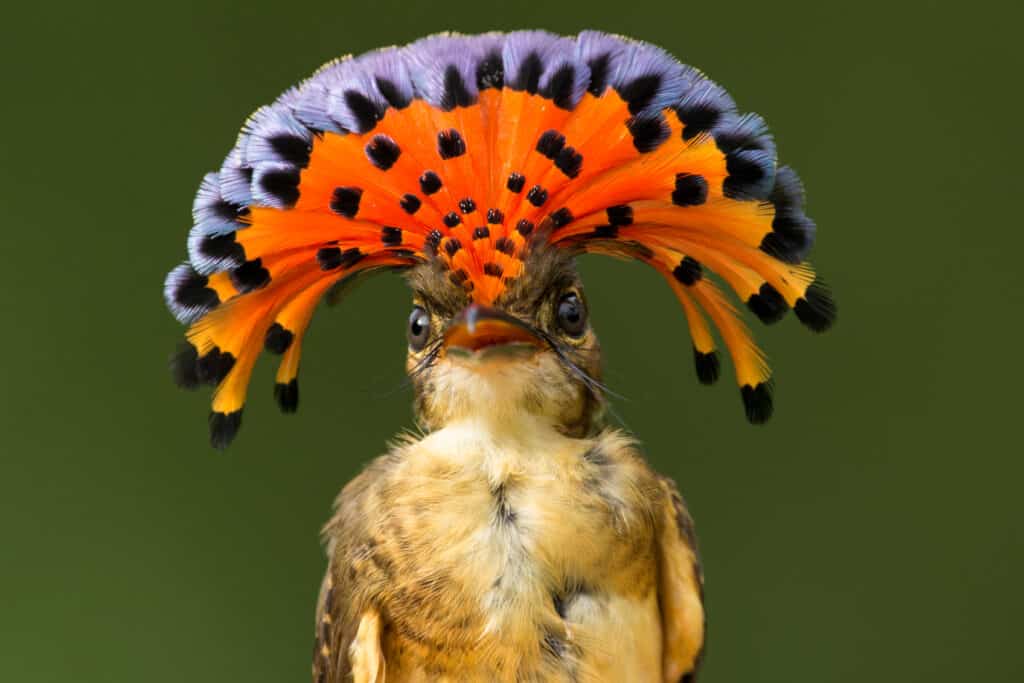
Amazonian flycatchers are found from southern Mexico to northern Bolivia,
©Tiny Turkey/Shutterstock.com
A quiet, solitary insect eater, Amazonian royal flycatchers sit patiently on low forest branches before darting out to snatch flies, beetles, and other winged bugs mid-air.
Guianan Cock-of-the-Rock (Rupicola rupicola)
Found in the humid, rocky forests of northeastern South America, the Guianan cock-of-the-rock sports an unmistakably striking appearance and some rather dramatic mating rituals.
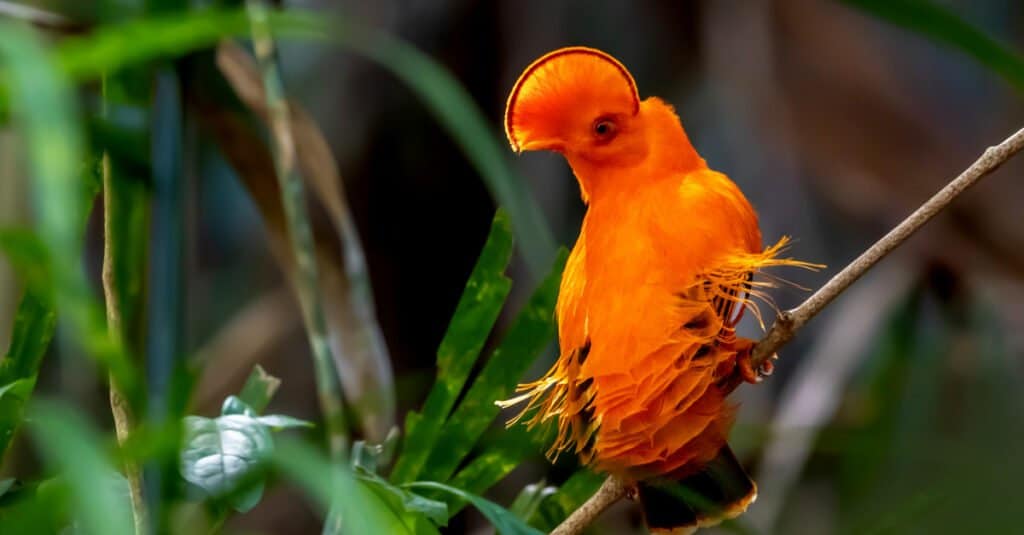
The Guianan cock-of-the-rock is a vital seed dispersers and feeds mainly on forest fruits.
©Wang LiQiang/Shutterstock.com
Males are impossible to miss with their brilliant orange feathers, black-and-white wing accents, and a half-moon-shaped crest that fans out forward to obscure the beak. Females are smaller, drab gray-brown, and have a much smaller crest.
The bird’s crest takes center stage during the species’ elaborate lek mating displays. Males gather in forest clearings to strut, snap their wings, and flex their headwear to win over females. Females, in contrast, have dark grey or brown feathers that help them blend into their surroundings while they protect their eggs.
Major Mitchell’s Cockatoo (Lophochroa leadbeateri)
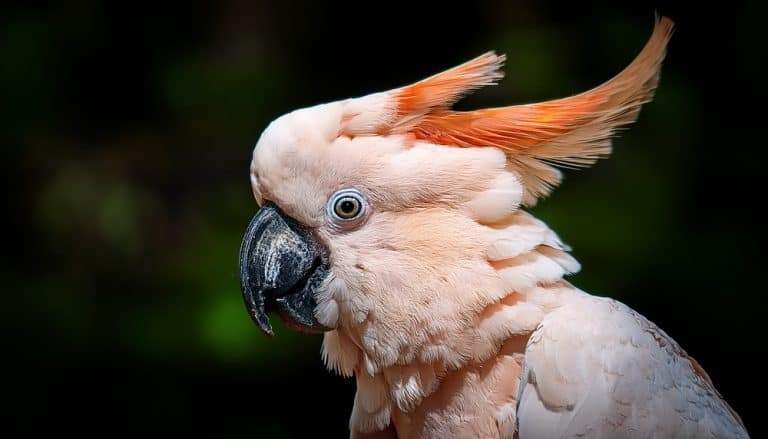
Native to Australia’s interior, Major Mitchell’s cockatoo has soft white feathers with delicate pink hues and a truly showstopping crest. When raised, the crest reveals a brilliant fan of banded red and yellow feathers.
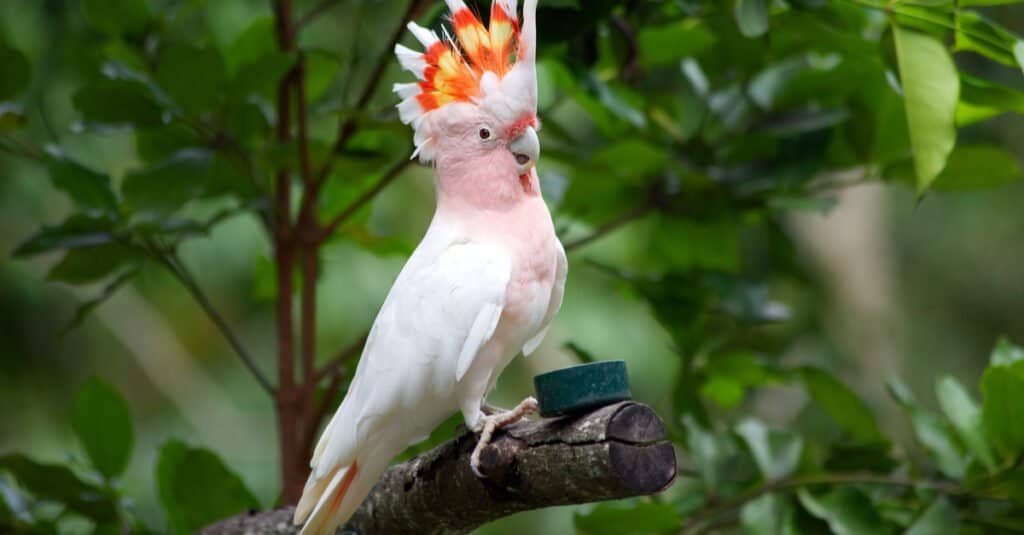
One captive Major Mitchell’s cockatoo lived to be 82 years old.
©Tanya Puntti/Shutterstock.com
These intelligent, long-lived birds feed on seeds, fruits, roots, bulbs, and insect larvae. Sadly, local populations face threats from land clearing and illegal poaching for the pet trade.
Hoatzin (Opisthocomus hoazin)
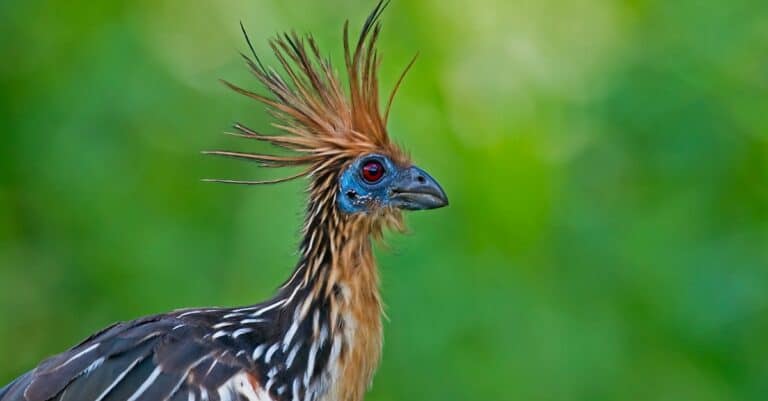
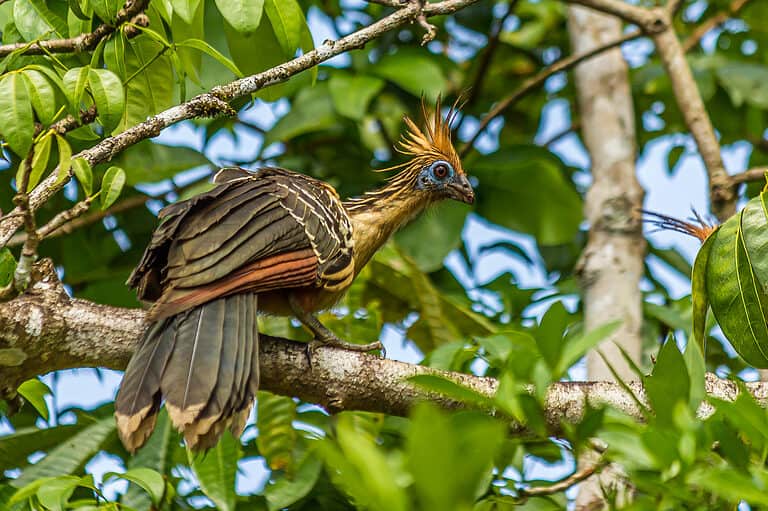
The sole survivor of an ancient bird lineage, the hoatzin lives in the swampy forests, flooded riverbanks, and mangroves of the Amazon and Orinoco Basins. Its wild, spiky rufous-orange crest adds a unique touch to an already unusual appearance that includes bright blue facial skin, red eyes, and dark-brown streaked feathers.
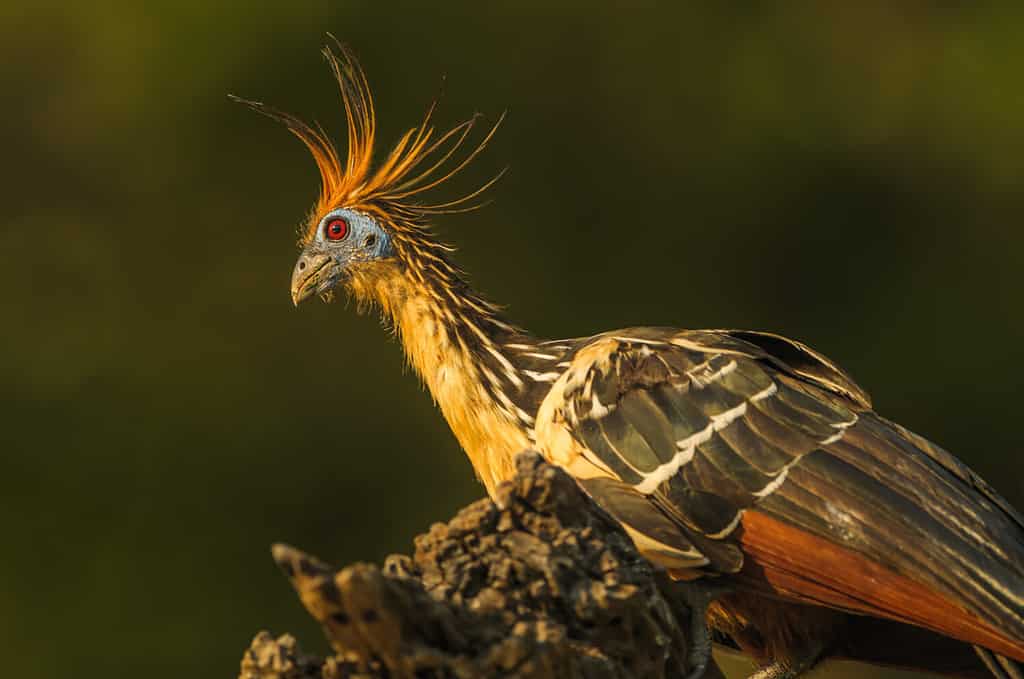
Some people call the hoatzin the “flying cow.”
©Marcos Amend/Shutterstock.com
Nicknamed the “stinkbird,” the hoatzin relies almost entirely on foregut fermentation to digest leaves — a plant-eating system similar to that of a cow — giving the bird a strong, manure-like odor.
The hoatzin is a heavy, awkward flier due to its oversized crop. Young birds have functional claws on their wings, which allow them to swim to safety if threatened and climb back up into the trees.
Victoria Crowned Pigeon (Goura victoria)
Native to the forests and swamps of northern New Guinea, the Victoria crowned pigeon is the world’s largest living pigeon, reaching the size of a small turkey. Its most spectacular feather is a tall, wispy crown of delicate feathers atop its head. During courtship, males bow to females while fanning these white-tipped lace feathers and making low, booming calls.
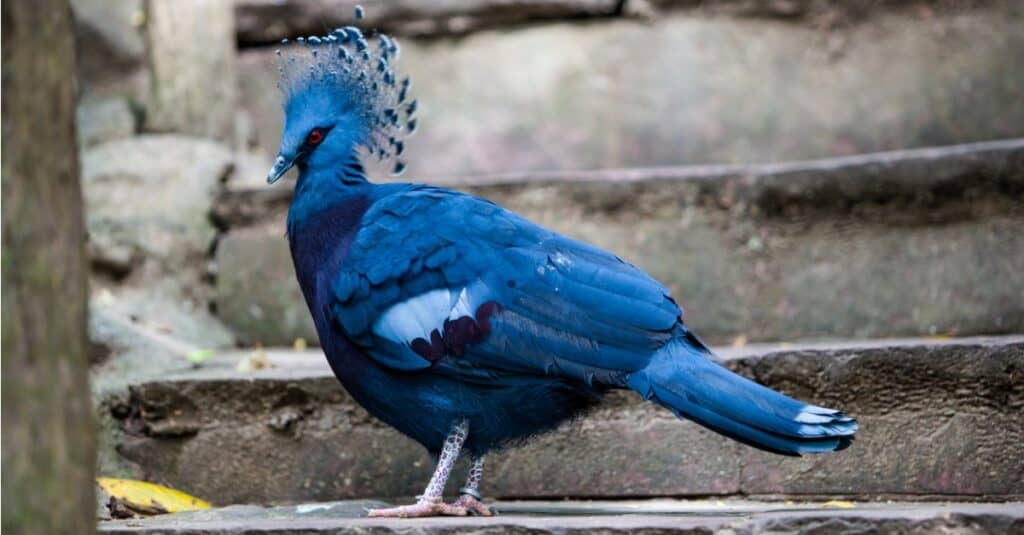
The Victoria crowned pigeon measures 2 to 2.5 feet long.
©iStock.com/ewastudio
Victoria crowned pigeons spend most of their time on the ground where they feed on fruit, insects, snails, and seeds, before flying into the trees to roost at night.
Rufous-Crested Coquette (Lophornis delattrei)
Measuring less than 3 inches long and weighing under 3 grams, this tiny hummingbird ranges from Costa Rica through parts of Central and South America down to Bolivia. Its miniature size and slow, bee-like hover make it easy to mistake for a buzzing insect.
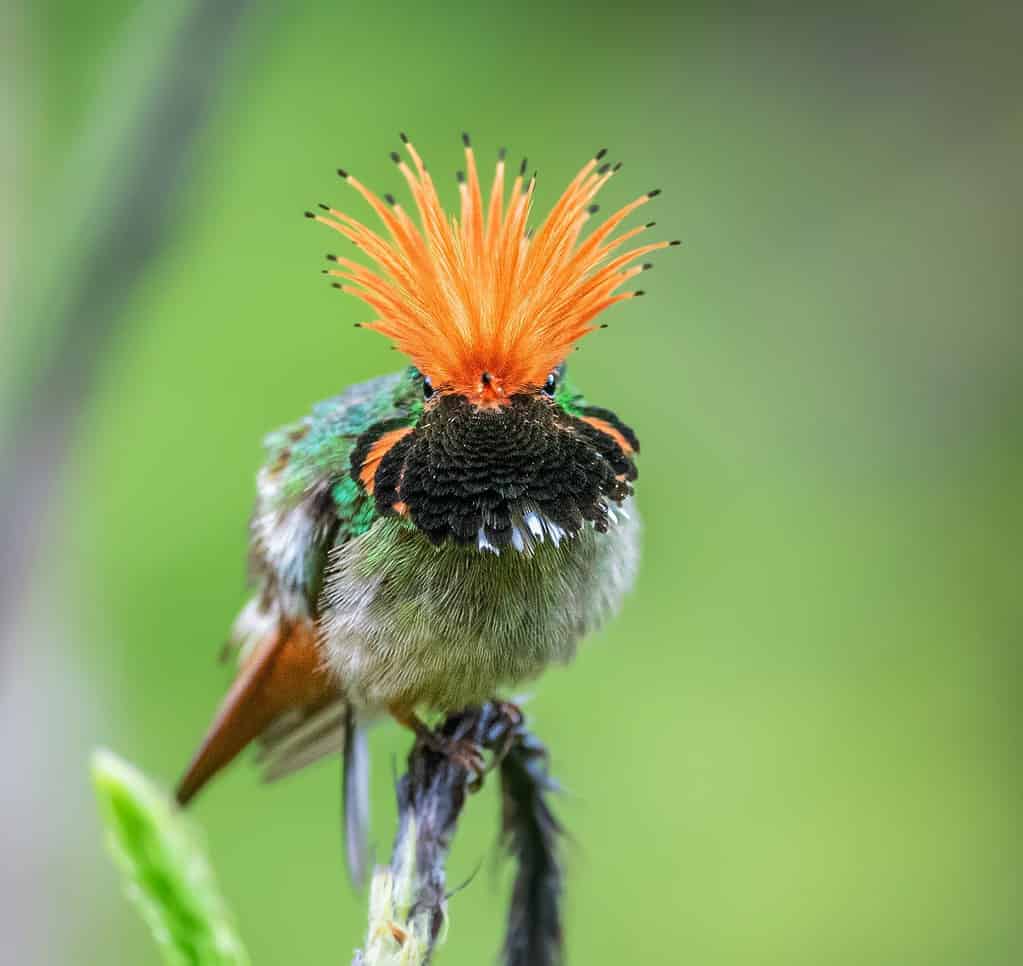
These tiny hummingbirds typically keep a low profile to avoid larger, more aggressive hummingbirds.
©Wang LiQiang/Shutterstock.com
Males sport a long, spiky orange-red crest. This is paired with a shimmering emerald-green throat and a stark white band across the lower back. Quiet, solitary, and gentle, this micro-hummingbird feeds on flower nectar and small flying insects.
Sulphur-Crested Cockatoo (Cacatua galerita)
Found across northern, eastern, and southern Australia, as well as Tasmania, the sulphur-crested cockatoo shines with snow-white feathers and a brilliant yellow crest.
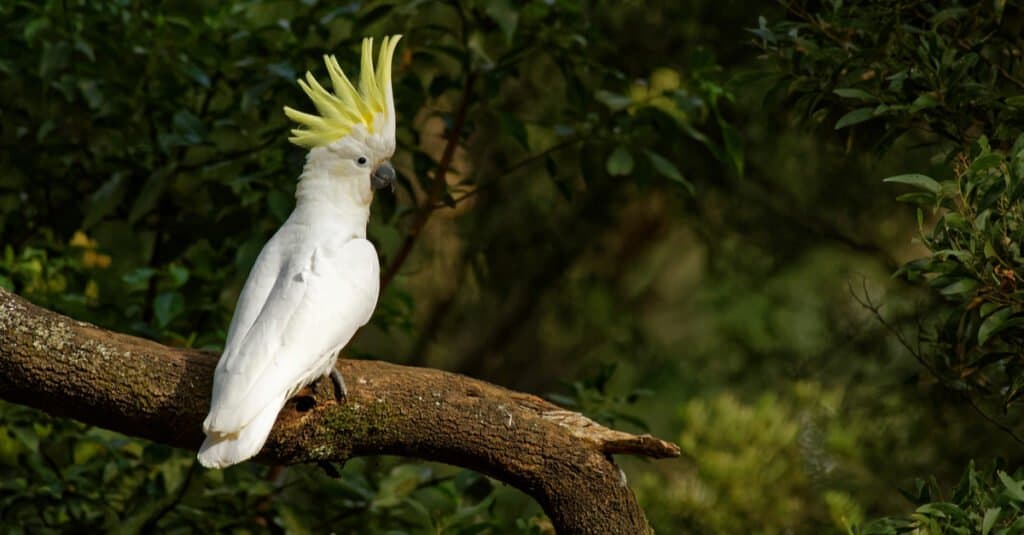
These birds form lifelong pair bonds and can live for more than 80 years.
©Martin Pelanek/Shutterstock.com
While its striking crest is its most iconic feature, this parrot is also famous for its high intelligence, loud calls, and impressive problem-solving skills. Sulphur-crested cockatoos feed on seeds, nuts, berries, and roots, often adapting well to living alongside humans.
Atlantic Royal Flycatcher (Onychorhynchus swainsoni)
Like its Amazonian relative, the Atlantic royal flycatcher conceals a brilliant, fan-shaped crest tipped with iridescent steel-blue accents — bright scarlet on males and golden-orange on females. The bird dramatically unfolds its crest during courtship dances and territorial disputes.
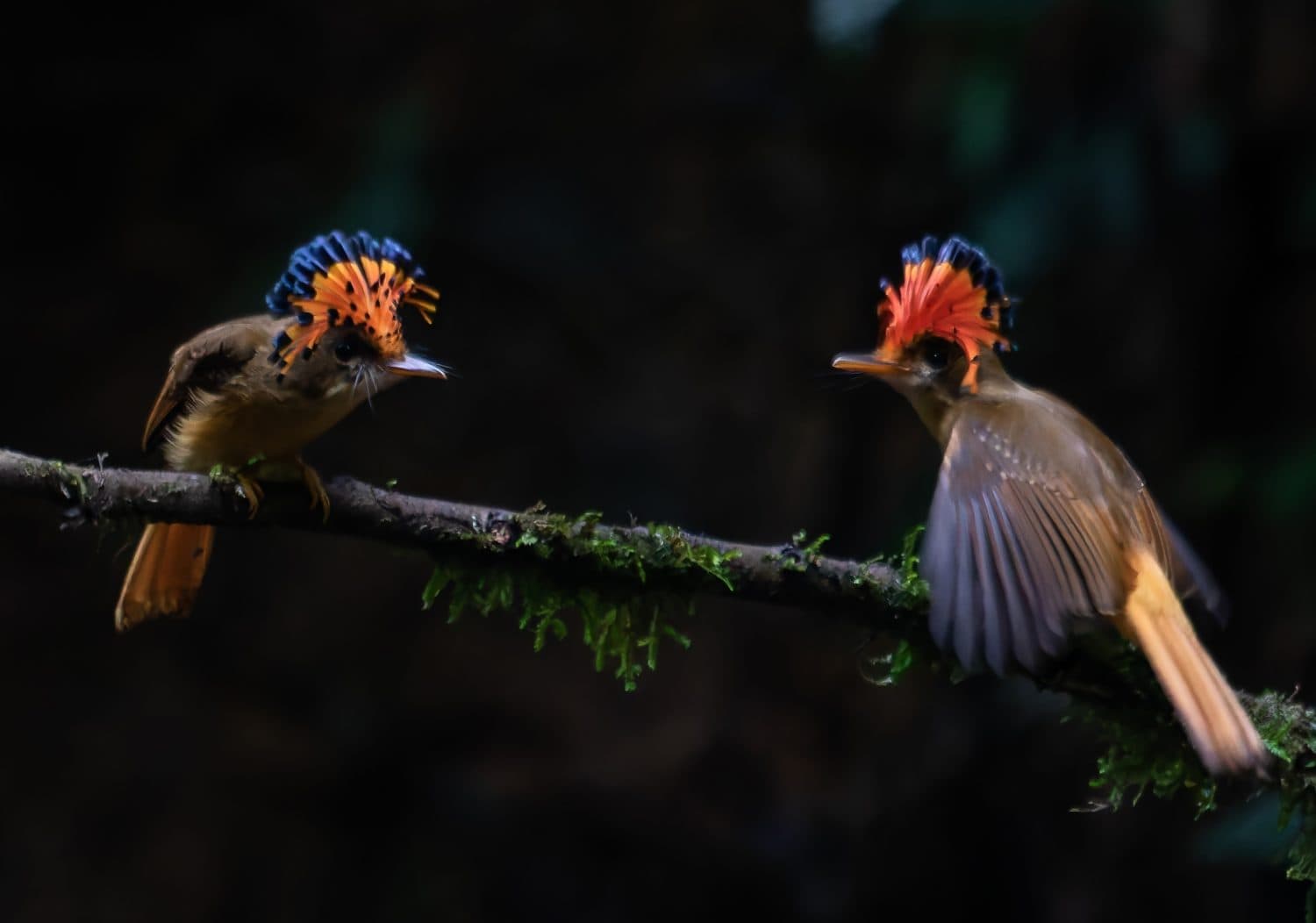
The Atlantic royal flycatcher perches low in the shaded canopy before darting out to snatch dragonflies, beetles, and flies mid-air.
©photosla/Shutterstock.com
Endemic to southeastern Brazil’s Atlantic Forest, this rare bird lives in humid lowland forests and shaded streams. Sadly, Atlantic royal flycatchers are classified as Vulnerable. There is an estimated population of just 600 to 1,700 adult birds left in their shrinking forest home.
Curl-Crested Aracari (Pteroglossus beauharnaesii)
This colorful bird gets its name from the unique, shiny, plastic-like black feathers that curl over its head. Native to the dense lowland forests of southern Peru, western Brazil, and northern Bolivia, it moves through the high tree canopy in small groups to feed on fruit.
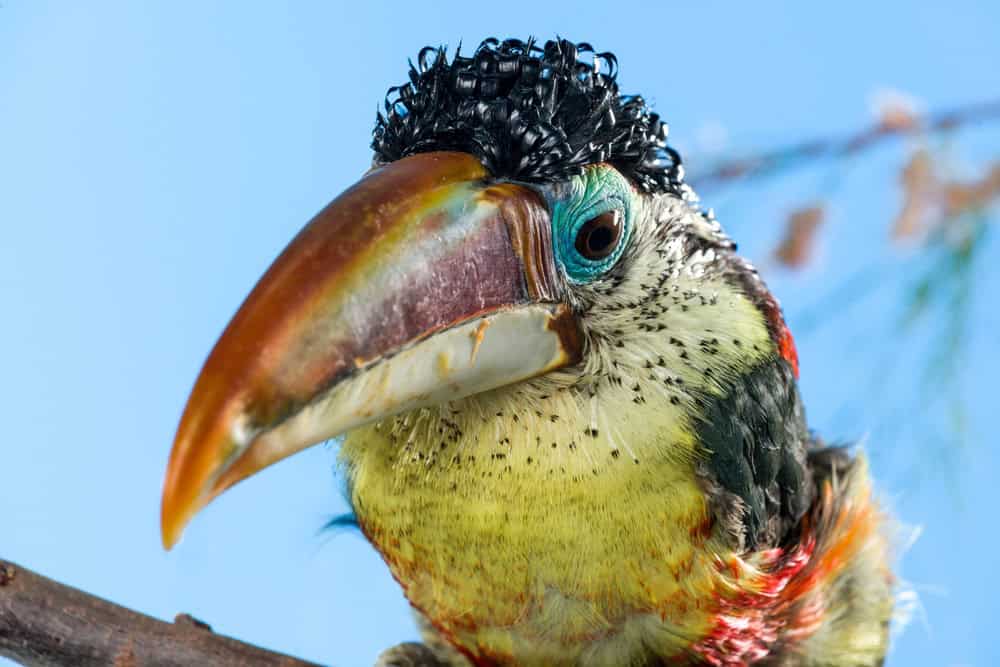
The modified feathers atop this bird’s head grow into shiny curls.
©LifetimeStock/Shutterstock.com
Curl-crested aracaris are easily recognized by their bright plumage — a red back, a yellow belly with a red breast band, and an intricately patterned, multicolored bill — as well as their distinct rising “eeee-yak” call.
Crested Wood Partridge (Rollulus rouloul)
The crested wood partridge is a small ground bird with a plump, round body, red legs, red beak, and bright red skin around its eyes. Male birds are larger and have shiny green feathers, a blue belly, brown wings, and a tall reddish crest. Females have dark green feathers, brown wings, and gray heads.
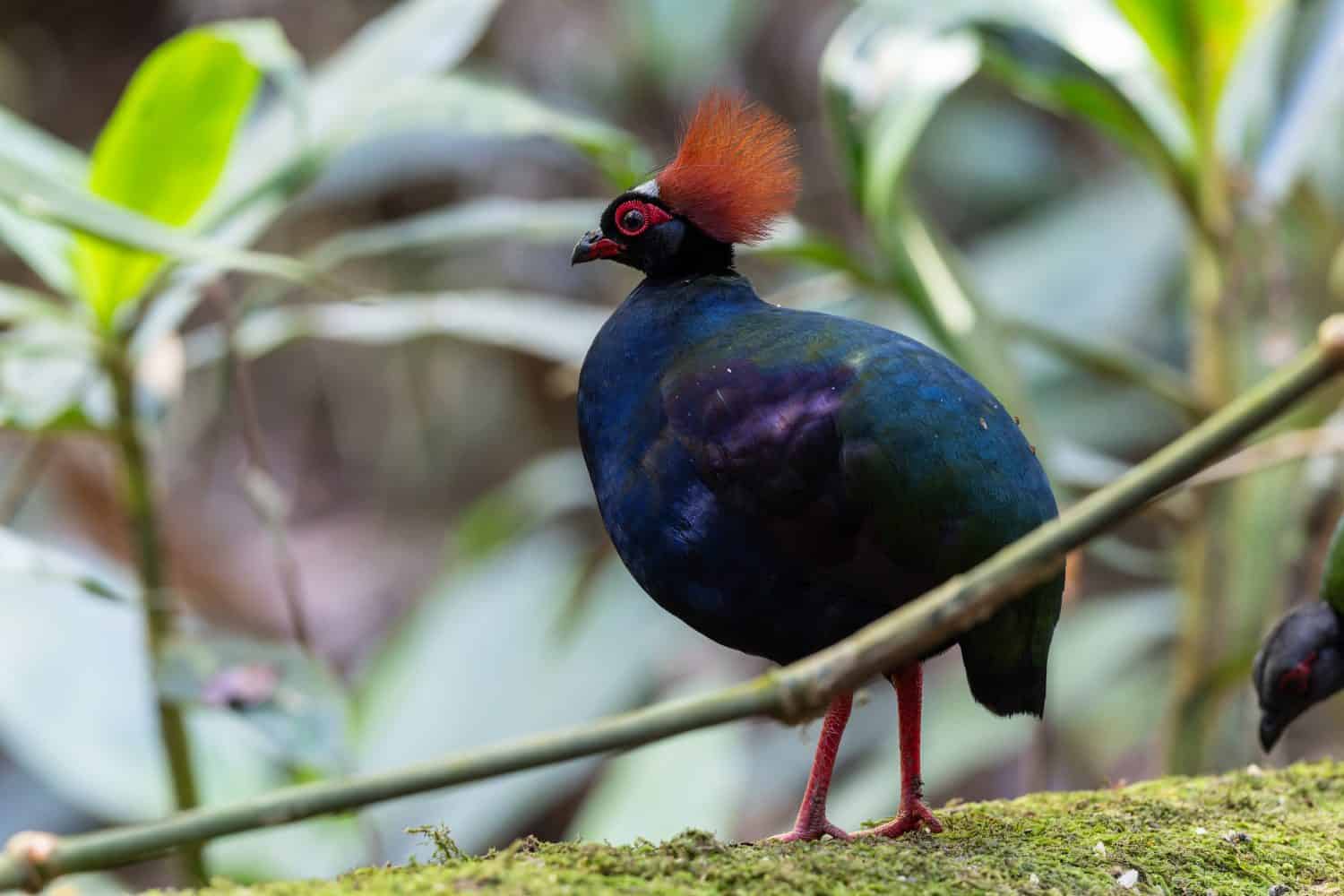
When startled, these birds prefer to run into dense bushes rather than fly away.
©Alen thien/Shutterstock.com
Crested wood partridges spend their days on the forest floor scratching through the dirt for insects, seeds, and fruit. Unfortunately, crested wood partridges are listed as Near-Threatened on the IUCN Red List. Rapid deforestation is destroying their lowland forest habitat.
Grey Crowned Crane (Balearica regulorum)
Standing around 3 feet tall, the grey crowned crane lives across eastern and southern Africa, including Uganda, Kenya, Tanzania, and South Africa. Its stiff, golden head feathers form a dramatic crown. This impressive crest perfectly contrasts with the crane’s gray body, white wings and cheek patches, and bright red gular pouch.
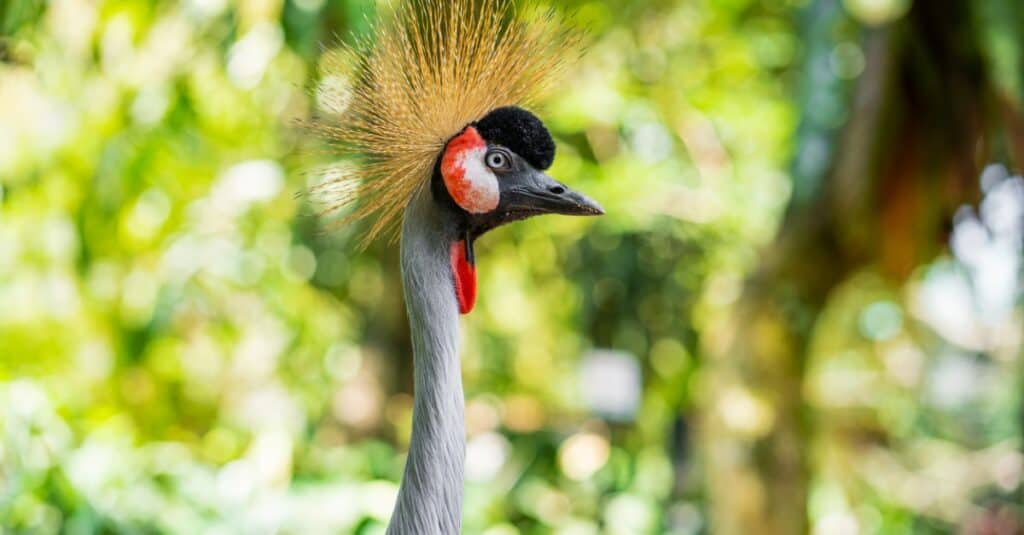
Grey crowned cranes eat seeds, insects, small animals, and crops like corn, soybeans, and peanuts.
©iStock.com/Kateryna Kukota
Sadly, this iconic species is Endangered, with only an estimated 20,100 to 24,600 mature birds remaining. Their numbers continue to decline due to habitat loss, power line collisions, farm pesticide poisoning, and illegal egg and bird poaching.
White-Crested Hornbill (Berenicornis comatus)
This large and elusive forest bird is easily identified by its rockstar appearance, complete with a spiky white crest, white-edged wings, and a long white tail. Native to the lowland forests of Southeast Asia (including Thailand, Malaysia, Borneo, and Sumatra), it stays hidden in the canopy where it hops between branches rather than flying above.
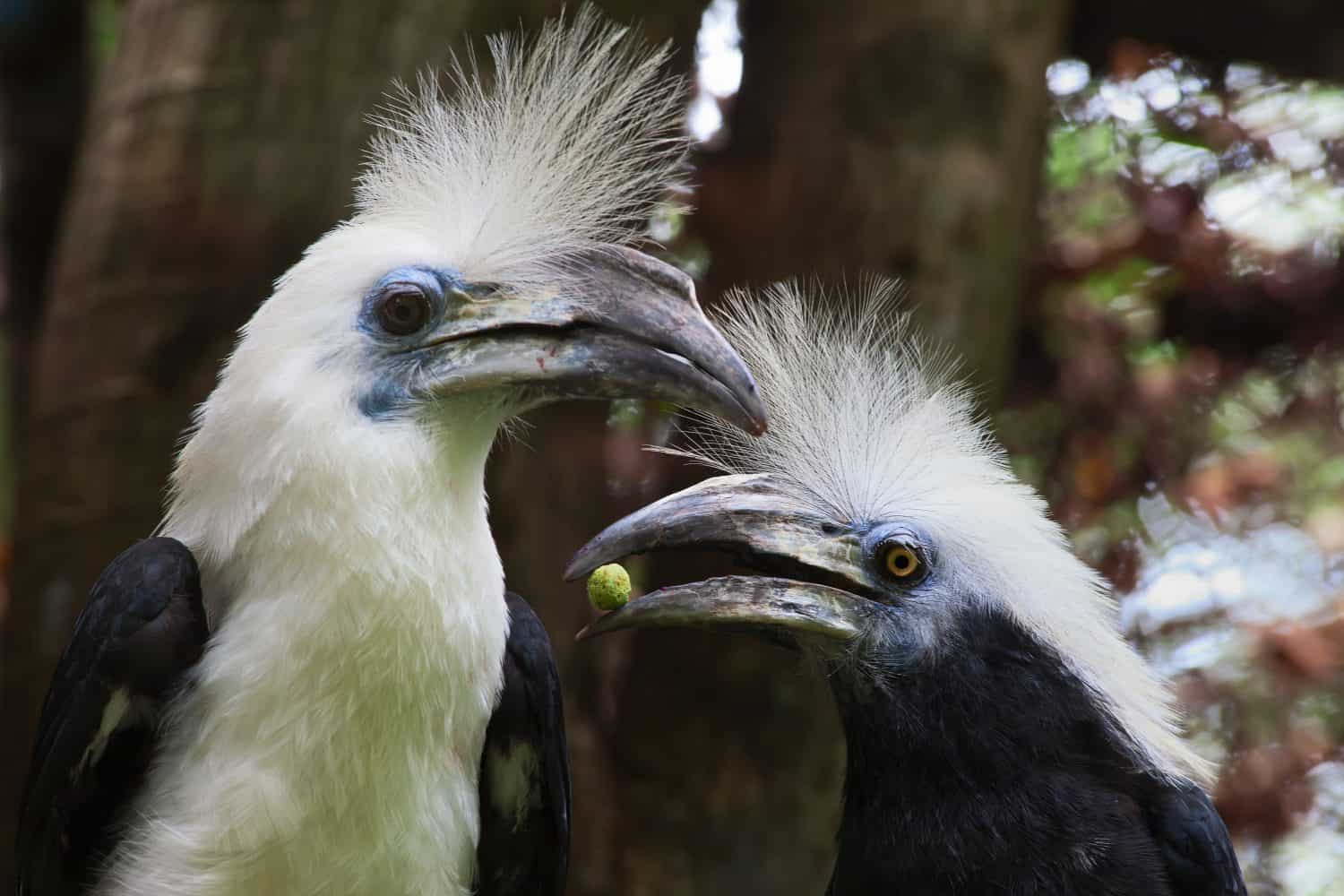
White-crested hornbills practice cooperative breeding where group members help raise the young.
©non15/Shutterstock.com
Unfortunately, white-crested hornbills are currently listed as Endangered on the IUCN Red List, primarily due to habitat destruction across their native range.