
Quick Take
- The evolutionary story you learned in school about how life conquered land just got torn apart by something scientists found missing from a fossil. See the rewritten family tree →
- A 10-foot apex predator holds the key to rewriting vertebrate evolution, a discovery that only came about because a researcher noticed it as a creature sitting forgotten in a museum drawer. Meet the apex predator fossil →
- Modern amphibians don't actually show us how land life began, and that difference turns out to matter enormously for our own evolutionary story. Discover what was absent →
- The fossil evidence that cracked this mystery wasn't found by scientists in a lab, and without a very different kind of curiosity it never would have been studied at all. See who made the find →
We’ve all seen some version of the classic evolutionary diagram. A fish crawls out of a primordial swamp, sprouts legs, transforms into something resembling a modern salamander or frog, and eventually paves the way for reptiles, mammals, and ultimately, us.
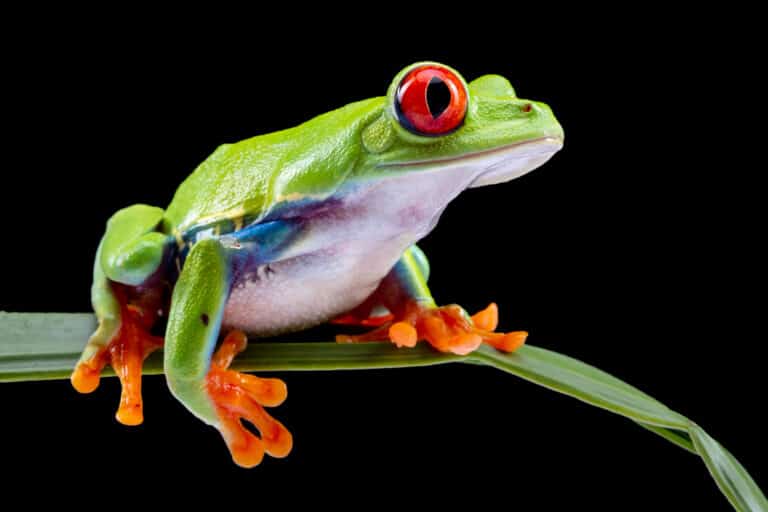
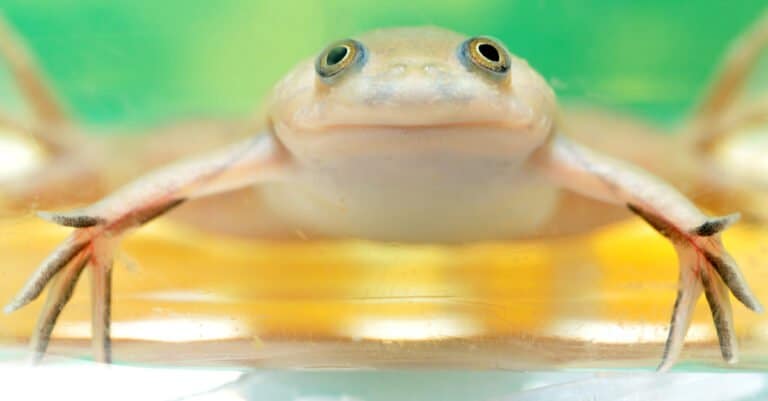
For decades, this was science textbook gospel. The assumption was that because the earliest four-legged land animals (tetrapods) transitioned from water to land, they must have grown up exactly like modern amphibians. They hatched from eggs, swam around as gill-breathing tadpoles, and underwent a dramatic metamorphosis to get their adult, land-ready bodies.
But a groundbreaking study published in the journal Science has officially turned this narrative into, as co-lead author Jason Pardo puts it, “dust in the wind.”
By analyzing incredibly rare, microscopic fossils of baby tetrapods, researchers have discovered that the first animals to conquer the land completely skipped the tadpole phase. They didn’t undergo an amphibian-style metamorphosis at all.
It’s difficult to overstate how massive this shift is. We didn’t just find a new species; we fundamentally misunderstood the childhood of our earliest terrestrial ancestors.
The Time Capsules of Mazon Creek
To understand just how monumental this is, you have to first look at where it happened. Fossilizing an adult dinosaur bone is hard enough, but fossilizing a delicate, jelly-like baby animal that lived 300 million years ago is nearly impossible.
The breakthrough happened thanks to a world-renowned fossil site called Mazon Creek, located about an hour southwest of Chicago.
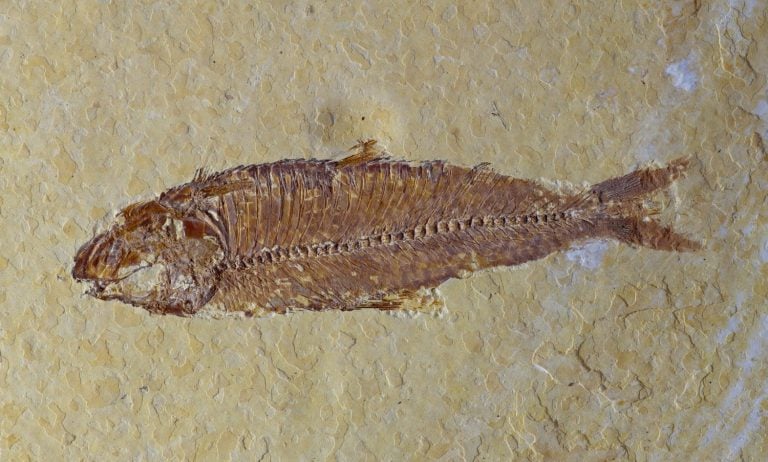
Mazon Creek is famous among paleontologists for its unique concretions, which are ironstone nodules that formed rapidly around ancient organisms before they could decay. This process acted like a prehistoric time capsule, preserving not just bones, but also soft tissues, skin outlines, and delicate juvenile structures that are normally lost to time.
The 10-Year Detective Story of the Baby Embolomere
At the heart of this new study are two tiny animal fossils called embolomeres.
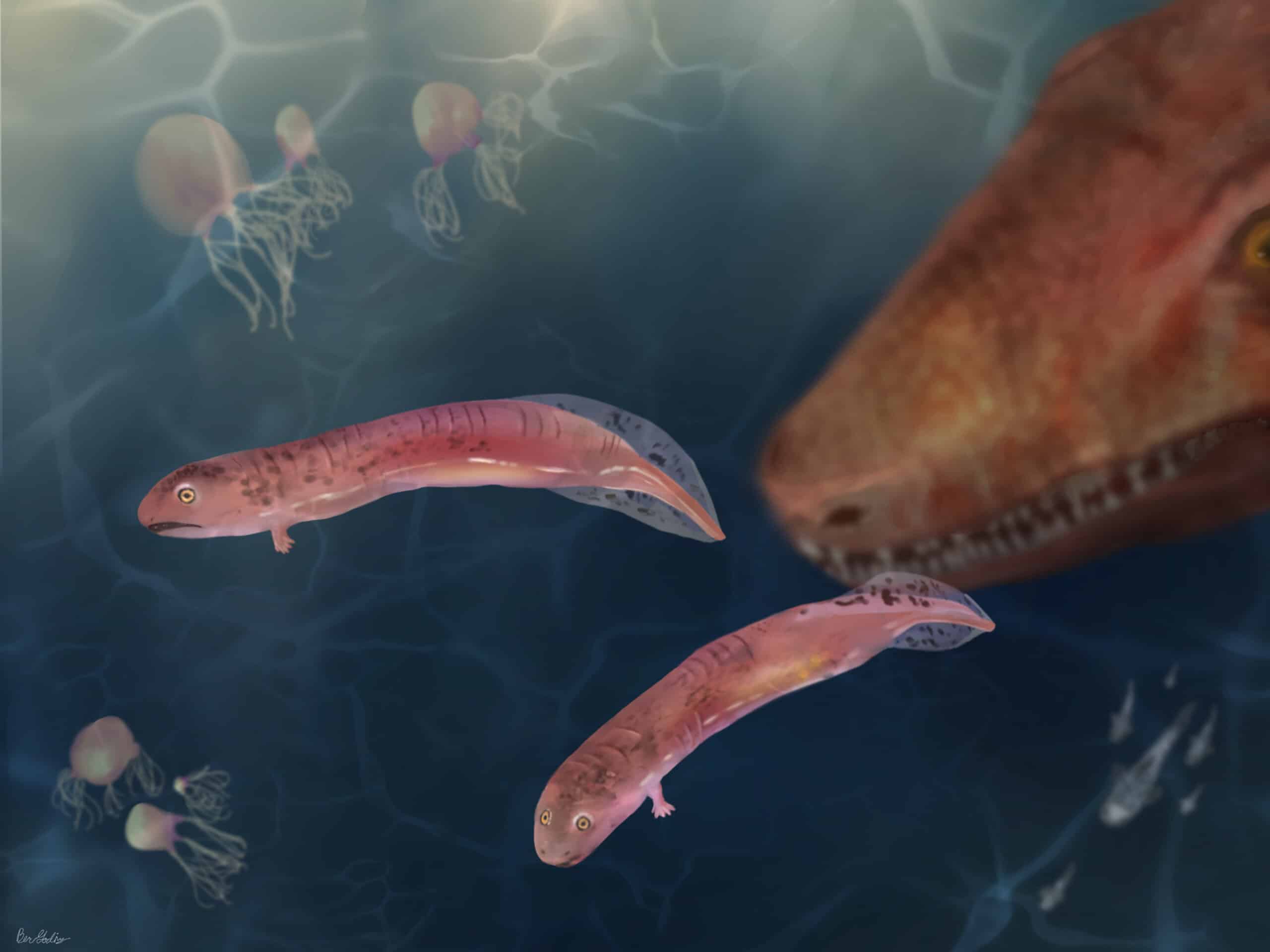
Embolomeres were massive, crocodile-like apex predators that ruled rivers and swamps between 350 and 280 million years ago, sometimes reaching lengths of more than 10 feet. But the specimens found at Mazon Creek were babies, measuring just a few centimeters long.
New fossil evidence suggests that these baby crocodile-like early tetrapods called embolomeres did not undergo a metamorphosis the way that modern amphibians do when growing up, which challenges a long-standing scientific belief that amphibians, reptiles, and mammals evolved from animals that had a tadpole stage.
©Illustration by Berit Godring
“I first saw the baby embolomere fossil about ten years ago, when I was working on my PhD,” recalls Arjan Mann, Assistant Curator of Early Tetrapods at the Field Museum and co-lead author. “It was sitting in a drawer … unidentifiable at the time, but I was really drawn to it.”
Mann and his colleague Jason Pardo spent a decade puzzling over the tiny specimen. They used advanced scanning electron microscopy at the Canadian Museum of Nature to map its features down to the micrometer, but it was what they didn’t find that was the game-changer.
What Was Missing?
If these ancient creatures grew up like modern frogs or salamanders, their baby fossils should have shown clear evidence of a larval, aquatic lifestyle. Instead, the researchers found no frilly external gills, which are the hallmark of modern amphibian tadpoles. They also didn’t find any specialized larval jaw structures that are typically used for scraping algae and filter-feeding. Finally, while these creatures grew limbs as they aged, they ultimately hatched looking like tiny versions of their adult selves.
When the team looked at other baby fossils from different lineages, the results were identical. None of them had a tadpole stage, and none of them underwent metamorphosis.
Why This Matters: Rewriting the Family Tree
If the earliest tetrapods didn’t have a tadpole stage, it means their life cycles were actually more like ours and those of modern fish than like modern amphibians. And that’s a dramatic shift from what has otherwise been a long-standing evolutionary premise.
Metamorphosis was long thought to be the key adaptation that allowed vertebrates to transition from water to land. We now know that modern amphibians like frogs, toads, and salamanders developed their unique tadpole-to-adult metamorphosis later in their own specialized evolution.
The Power of Citizen Science
Another remarkable aspect of this study is that the discovery of this radical shift in evolutionary biology couldn’t have happened without everyday people.
Many of the specimens used in the study were found, preserved, and donated by amateur collectors, hobbyists, and volunteers working with groups like the Earth Science Club of Northern Illinois and the Lauer Foundation for Paleontology, Science and Education.
It is an important reminder that science isn’t just done in sterile labs by smart and curious scientists. Sometimes, it’s also the citizen scientists who walk through a creek bed in Illinois, spot a strange rock, and have the curiosity to share it with the world, that can make all the difference.