
B
Species Profile

Box Turtle

Terrapene

The turtle that shuts the door
samray/Shutterstock.com

Box Turtle Distribution

Click a location to explore more animals from that region

Endemic Species
Loading map...
An eastern box turtle munches on a muscadine grape on the forest floor at Yates Mill County Park in Raleigh North Carolina.

At a Glance

Genus Overview This page covers the Box Turtle genus as a group. Stats below are general traits shared across the genus.
Also Known As Box tortoise, Hinged turtle, Hinged-shelled turtle, Land turtle
Diet Omnivore
Activity Diurnal+
Lifespan 45 years
Weight 1.5 lbs
Status Not Evaluated
Did You Know?

Across Terrapene, adult shell (carapace) length spans roughly 10-19 cm, depending on species and population.

Scientific Classification

Genus Overview "Box Turtle" is not a single species but represents an entire genus containing multiple species.

Box turtles (Terrapene) are terrestrial-leaning North American turtles characterized by a hinged plastron that can close tightly, offering strong protection from predators and dehydration.

Kingdom
Animalia
Phylum
Chordata
Class
Reptilia
Order
Testudines
Family
Emydidae
Genus
Terrapene

Distinguishing Features

  • Hinged plastron allowing the shell to ‘box’ shut
  • Generally high-domed carapace (especially in woodland forms)
  • Terrestrial foraging with omnivorous diet (invertebrates, fruits, fungi, vegetation)
  • Long lifespan and delayed reproduction typical of many turtles

Did You Know?

Across Terrapene, adult shell (carapace) length spans roughly 10-19 cm, depending on species and population.

Most are terrestrial, but the Coahuilan box turtle is notably more wetland/aquatic than its relatives-showing the genus's ecological diversity.

The hinged plastron can seal the shell tightly, helping deter predators and reduce water loss during dry or cold periods.

Box turtles tend to live "slow" lives: many survive 25-60+ years, and exceptionally longer (sometimes 80-100+) under ideal conditions, especially in captivity.

They often show strong site fidelity-some individuals use the same small home area for years, making relocation risky.

Sex in hatchlings is influenced by incubation temperature (temperature-dependent sex determination), so climate can affect population sex ratios.

Females can store sperm for extended periods (often years), allowing fertilization even without recent mating.

Unique Adaptations

  • Hinged plastron (movable lower shell): a hallmark of Terrapene, enabling tight closure that boosts protection and moisture retention.
  • High-domed shell shape (common in many species): helps resist crushing bites and provides space to retract limbs/head for full closure.
  • Terrestrial-leaning limb structure: sturdier, more "walking" limbs than many aquatic turtles, supporting life in forests, prairies, scrub, and (in one species) wetlands.
  • Physiological tolerance for variable conditions: many can endure cool-season brumation and short-term dry spells by sheltering and reducing activity (degree varies among species/regions).
  • Pattern diversity and local adaptation: coloration ranges from plainer browns to bold radiating patterns (notably in ornate forms), reflecting habitat differences across the genus.

Interesting Behaviors

  • Shell-sealing defense: when threatened, many Terrapene pull in head/limbs and close the hinged plastron, forming a near-complete "box."
  • Seasonal dormancy with variation: northern populations commonly brumate through winter; in hot/dry regions some individuals may aestivate or reduce activity during drought/heat.
  • Home-range loyalty: many individuals travel familiar paths among feeding sites, cover objects, and nesting areas; disruption by development can fragment these routes.
  • Flexible foraging: generally omnivorous-earthworms, insects, snails, carrion, fungi, berries, and other fruit; juveniles in many turtles skew more carnivorous than adults.
  • Rain-and-humidity activity peaks: many box turtles become more active after rains, when prey is abundant and dehydration risk is lower.
  • Reproduction on land: courtship and mating are followed by females seeking sunny, well-drained nesting spots; clutches are typically small (often a few eggs, varying by species/population).
  • Predator avoidance beyond the shell: some individuals remain motionless, wedge into leaf litter, or use dense cover; musky fluids/urination may deter attackers.

Cultural Significance

Box turtles (Terrapene) are honored in North American Indigenous cultures as symbols of endurance, protection, and long life. Today they represent local wild places, woodlands, prairies, desert-edge scrub, and rare wetlands, and lead road-safety, habitat links, and efforts against collecting them.

Myths & Legends

Haudenosaunee (Iroquois) and related "Turtle Island" traditions: Sky Woman falls from the sky world; animals help her, and a great turtle bears the new land on its back-Earth becomes "Turtle Island."

Lenape/Delaware Turtle Island narratives: the world is formed upon a turtle's back, with animals cooperating to bring up earth from the waters to create land.

Cherokee and other Southeastern tribal story cycles featuring Turtle as a persistent, sometimes underestimated figure-small but resilient, relying on wit and endurance to outlast stronger animals.

Aesop's fable "The Tortoise and the Hare": a slow, steady shelled reptile wins through persistence-often culturally associated with turtles broadly, reinforcing patience and perseverance.

Hindu tradition of Vishnu as the tortoise avatar: Vishnu takes the form of a great turtle to support Mount Mandara during the churning of the cosmic ocean, symbolizing stability and support.

Chinese mythology of a giant turtle: a cosmic turtle figure associated with supporting pillars of the world in certain creation stories, linking turtles with foundational strength and longevity.

Conservation Status

NE Not Evaluated at the genus (hub) level. Across Terrapene species, IUCN categories span at least Near Threatened/Vulnerable through Endangered (e.g., Coahuilan box turtle Terrapene coahuila is assessed as Endangered), reflecting widespread declines but variable risk by species and region. Genus-wide generalizations (with notable variation among species and populations): Adult size commonly ranges from ~10-20+ cm carapace length (smallest to largest Terrapene); mass roughly ~0.2-1.0+ kg depending on species/sex/condition. Lifespan is generally long, often multiple decades; commonly ~30-50+ years in the wild with some individuals capable of ~60-100+ years under favorable conditions (especially in protected or captive settings). Ecology/behavior: predominantly terrestrial, strong site fidelity and small home ranges are common, with activity peaking in warm/wet conditions; many populations show seasonal inactivity (brumation) in cooler regions. Diet tends to be omnivorous (invertebrates, fungi, fruits/berries, carrion), but the plant/animal balance varies by habitat and locality. Reproduction is generally slow (late maturity, low recruitment), making populations sensitive to adult mortality; degree of aquatic association varies, with some taxa tied to wetlands while others favor open prairies or woodlands.

Has not yet been evaluated against the criteria.

Population Decreasing

Protected Under

  • CITES Appendix II (Terrapene spp. listed; international trade regulated)
  • Various U.S. state/provincial regulations restricting collection/possession and protecting native turtles (coverage and strength vary by jurisdiction)
  • Protected areas and land-management policies (national/state parks, wildlife refuges, conservation easements) that can provide habitat protection in parts of the genus range

You might be looking for:

Eastern Box Turtle

38%

Terrapene carolina

Widespread eastern North American box turtle; high-domed shell; variable coloration.

View Profile

Ornate Box Turtle

20%

Terrapene ornata

Great Plains species with radiating yellow lines on a flatter shell; more open-country adapted.

View Profile

Three-toed Box Turtle

12%

Terrapene triunguis

South-central U.S. species, typically with three hind toes; often plainer shell patterning.

Gulf Coast Box Turtle

8%

Terrapene carolina major

Large-bodied coastal plain form of the Eastern Box Turtle (often treated as a subspecies).

Asian Box Turtles

7%

Cuora spp.

Geoemydid turtles of Asia sometimes called "box turtles" due to hinged plastrons; not closely related to Terrapene.

Life Cycle

Birth 4 hatchlings
Lifespan 45 years

Lifespan

In the Wild
20–100 years
In Captivity
25–120 years

Reproduction

Mating System Promiscuity
Social Structure Solitary
Breeding Pattern Transient
Fertilization Internal Fertilization
Birth Type Internal_fertilization

Box turtles (Terrapene) are mostly solitary and meet briefly to mate. There is no long-term pair bond and adults do not care for young. Both sexes may have multiple partners. Mating is seasonal with internal fertilization; females can store sperm for months or years.

Behavior & Ecology

Social Aggregation Group: 1
Activity Diurnal, Crepuscular, Cathemeral
Diet Omnivore Seasonally abundant soft fruits/berries and earthworms (varies by species, habitat, and season across Terrapene).
Seasonal Hibernates

Temperament

Generally non-social and wary; relies on crypsis and retreat rather than confrontation when undisturbed
Defensive when handled or threatened (withdrawal, shell closure via hinged plastron; occasional biting/scratching); intensity varies among species/subspecies and individuals
Males may show increased assertiveness during breeding season (courtship pursuit, nudging/ramming, occasional male-male conflict), but sustained territoriality is not typical across the genus
Activity/visibility often tied to moisture and temperature: many individuals become inactive in drought/heat (estivation) or cold (brumation), which can make them seem more secretive in some regions than others

Communication

Hissing or forced exhalation when startled/handled
Low grunts/squeaks reported during courtship/mating in some Terrapene; overall vocal communication is limited and variable
Chemical cues: scent/pheromone detection (notably by males) used to locate mates and assess conspecifics; reliance likely varies with habitat and season
Tactile signaling in courtship and contests: nudging, rubbing, chin/head contact, mounting; occasional biting during conflicts
Visual cues at close range: posture/orientation, head and limb movements during interactions; importance likely secondary to chemical/tactile cues
Substrate-borne cues: disturbance/approach vibrations may influence withdrawal/defensive behavior, especially at close distances

Habitat

Biomes:
Temperate Forest Temperate Grassland Wetland Freshwater
Terrain:
Coastal Hilly Island Muddy Plains Riverine Rocky Sandy Valley +3
Elevation: Up to 8530 ft 2 in

Ecological Role

Terrestrial omnivorous mesoconsumer and seed/fungal spore disperser in North American woodlands, savannas, and edge habitats (role varies with habitat moisture and local food availability across the genus).

Regulation of soil/leaf-litter invertebrate populations (predation on insects, slugs, snails, worms) Seed dispersal via ingestion of fruits and subsequent defecation, aiding plant recruitment Potential dispersal of fungal spores through consumption of mushrooms Nutrient cycling through scavenging and processing of detritus-associated foods in the forest floor

Diet Details

Main Prey:
Earthworms and other annelid worms Land snails and slugs Insects and other arthropods Spider Centipedes and millipedes Crayfish and other small crustaceans Carrion Small vertebrates Amphibian eggs and larvae +3
Other Foods:
Fallen fruits and berries Mushrooms and other fungi Tender leaves and shoots Flowers and buds Seeds and nuts Carrion-associated plant material

Human Interaction

Domestication Status

Wild

Terrapene (box turtles) are not domesticated. People have long taken them from the wild for pets, curiosity or education, and sometimes for food. Laws and protection now help many populations. Some are bred in captivity, but many pets came from wild capture. Because they live long and are slow to have babies, taking adults greatly harms populations.

Danger Level

Low
  • Salmonella and other zoonotic pathogens (risk increased by improper hygiene after handling, and by co-housing with food-prep areas)
  • minor bites/scratches when handled or restrained
  • allergic reactions to bedding/substrates or feeder insects in captive care

As a Pet

Not Suitable as Pet

Legality: Box turtle (Terrapene) laws vary by U.S. state, Canadian province, and Mexico. Wild capture is often banned. Some places allow only captive-bred with papers or permits. Check species and local rules before getting one.

Care Level: Experienced

Purchase Cost: Up to $400
Lifetime Cost: $3,000 - $25,000

Economic Value

Uses:
Pet trade (legal captive-bred where permitted) Education and outreach animals (zoos/nature centers) Research (ecology, behavior, toxicology, disease, conservation biology) Ecotourism and local biodiversity value Cultural value (local natural heritage; conservation flagship species)
Products:
  • live animals (where legal, preferably captive-bred)
  • educational programming/exhibits
  • scientific data and monitoring outputs

Relationships

Predators 10

Raccoon
Raccoon Procyon lotor
Striped skunk Mephitis mephitis
Virginia opossum Didelphis virginiana
Red fox
Red fox Vulpes vulpes
Coyote
Coyote Canis latrans
American crow Corvus brachyrhynchos
Red-tailed hawk Buteo jamaicensis
Kingsnake
Kingsnake Lampropeltis
Rats Rattus spp.
Feral hog
Feral hog Sus scrofa

Related Species 9

Pond sliders Trachemys Shared Family
Painted turtles
Painted turtles Chrysemys picta Shared Family
Map turtles Graptemys Shared Family
Cooters Pseudemys Shared Family
Diamondback terrapin Malaclemys terrapin Shared Family
European pond turtle Emys orbicularis Shared Family
Wood turtles Glyptemys Shared Family
Spotted turtle Clemmys guttata Shared Family
Chicken turtle Deirochelys reticularia Shared Family

Ecological Equivalents 4

Animals that fill a similar ecological role in their ecosystem

Gopher tortoise
Gopher tortoise Gopherus polyphemus Terrestrial, burrow-using chelonian in North America. Overlaps in general diet (plants and invertebrates) and shares many of the same predator guilds, though tortoises lack a hinged plastron and are generally larger and more strictly herbivorous.
Wood turtle
Wood turtle Glyptemys insculpta Semi-terrestrial emydid that forages extensively on land for invertebrates and plant matter. Exhibits similar edge-habitat use and seasonal movement patterns, though it is typically more strongly tied to streams.
Eastern mud turtle Kinosternon subrubrum Small omnivorous turtle that often forages in wetlands and at habitat edges and can be terrestrial during movements. Consumes similar prey types (worms, insects, snails), but mud turtles are generally more aquatic and have different shell mechanics.
Southeast Asian box turtles Cuora spp. Ecological analogs with a hinged plastron and omnivorous forest‑floor foraging. They occupy a similar functional niche as terrestrial-leaning, moisture-associated omnivores, although they belong to a different family and occur in a different region.

Types of Box Turtle

15

Explore 15 recognized types of box turtle

Speciess (5)

Common box turtle
Common box turtle Terrapene carolina
Ornate box turtle
Ornate box turtle Terrapene ornata
Coahuilan box turtle Terrapene coahuila
Spotted/Nelson's box turtle Terrapene nelsoni
Mexican box turtle Terrapene mexicana

Subspeciess (10)

Eastern box turtle
Eastern box turtle Terrapene carolina carolina Subspecies
Three-toed box turtle Terrapene carolina triunguis Subspecies
Gulf Coast box turtle Terrapene carolina major Subspecies
Florida box turtle Terrapene carolina bauri Subspecies
Ornate box turtle (nominate) Terrapene ornata ornata Subspecies
Desert box turtle Terrapene ornata luteola Subspecies
Nelson's box turtle (nominate) Terrapene nelsoni nelsoni Subspecies
Klauber's box turtle Terrapene nelsoni klauberi Subspecies
Mexican box turtle (nominate) Terrapene mexicana mexicana Subspecies
Yucatán box turtle Terrapene mexicana yucatana Subspecies

“A box turtle’s walking speed is 0.25mph”

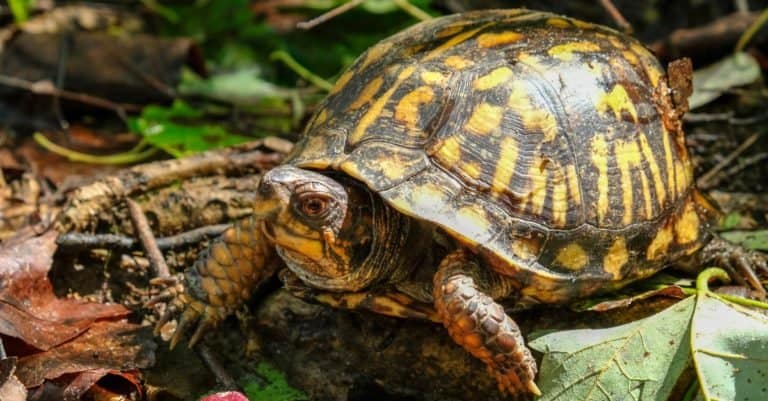
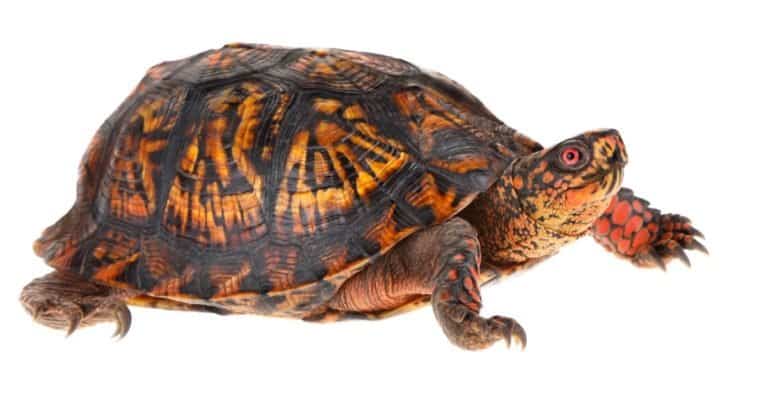
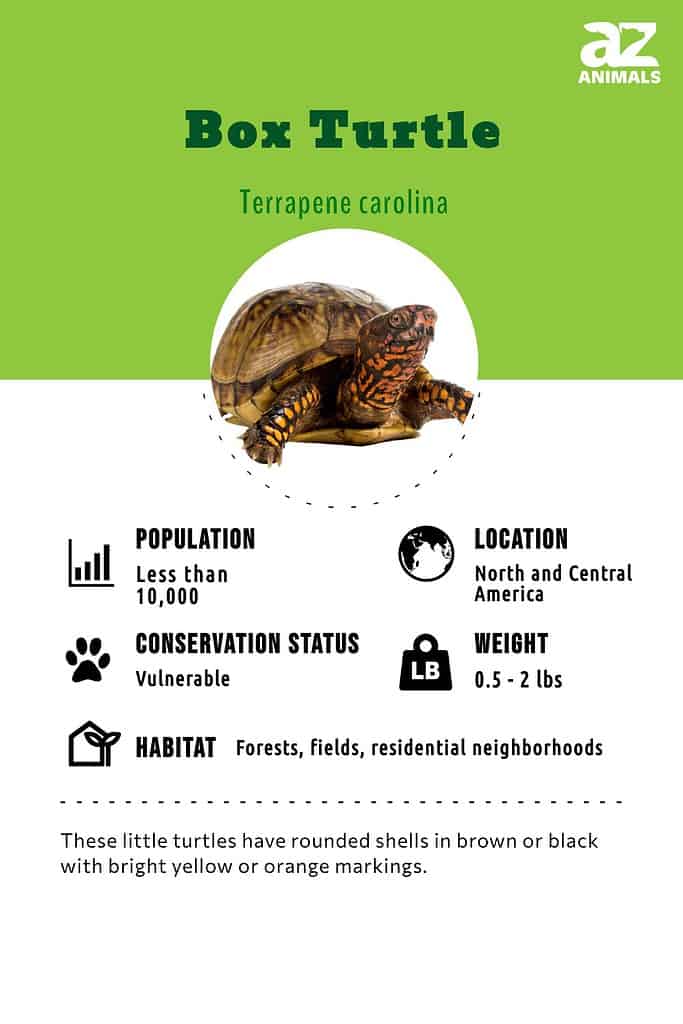
The most notable feature of a common box turtle is its dark brown or black shell featuring a bright yellow pattern. These turtles belong to the American pond turtle family. They live in forests and fields eating insects, fruit, roots, and small amphibians. Like many other types of turtles, these turtles can live a very long time. Though they can have a lifespan of up to 100 years, they usually live to be 30 or 40 years old.
Incredible Box Turtle Facts!

  • A turtle’s shell is attached to its body, specifically by its rib cage
  • These creatures stay under bushes and trees to keep cool on a hot day
  • Many of these turtles die when they try to cross a road and are run over by passing traffic
  • Box turtles have a range of territory equal to a football field
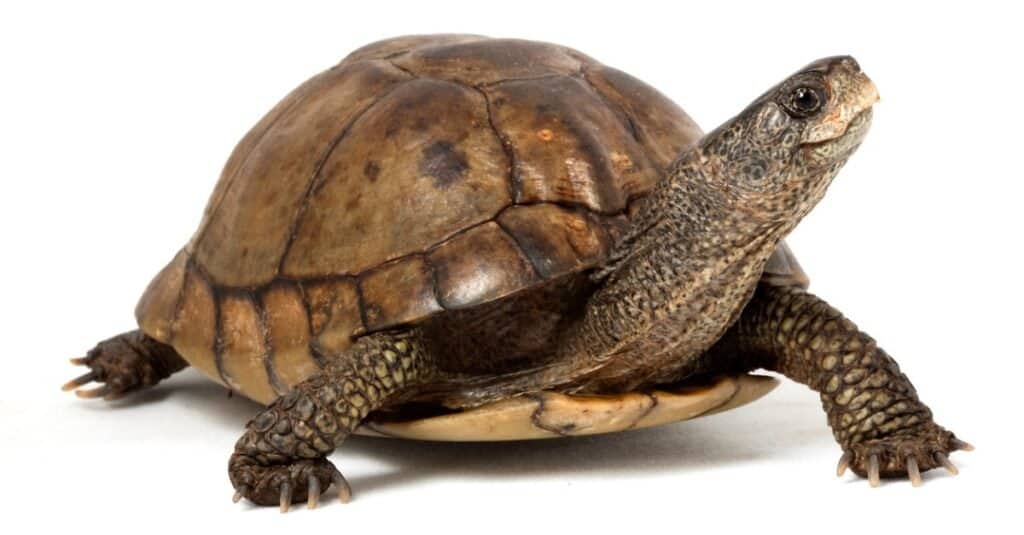
Coahuilan Box Turtle- Isolated

Coahuilan box turtles can only be found in Coahuila, Mexico.

Scientific Name

The scientific name of a common box turtle is Terrapene carolina carolina. These turtle species include different types of turtles including the Eastern, Florida, Gulf Coast, and the three-toed box turtle. These turtles belong to the Emydidae family. Members of this family are sometimes called pond turtles or terrapins. They are in the Reptilia class.

Evolution
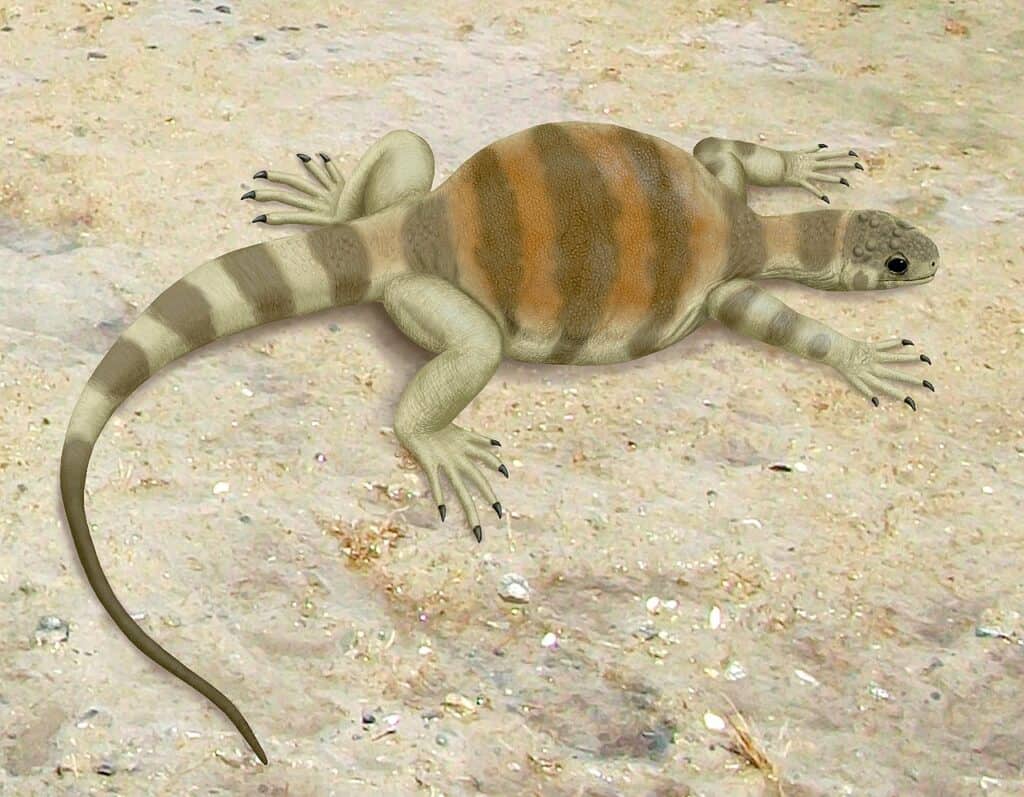
Eunotosaurus africanus

Eunotosaurus was the earliest known ancestor of the turtle and lived 260 million years ago.

The earliest known ancestor of modern turtles was Eunotosaurus, a reptile that existed during the Permian epoch, around 260 million years ago. Eunotosaurus didn’t have a shell but did have the framing for one with wide ribs that shielded the animal’s underside. Recent studies reveal that those wide ribs aided the animal in digging and burrowing by anchoring it to the ground. Eunotosaurus had evolved to be an efficient excavator. The animal was once thought to be a swimmer but the big claws and thick bones would have helped it to withstand compressive forces while burrowing. The powerful, back-facing front limbs and weaker back limbs indicated a master burrower.

Eunotosaurus fossils have been found in what is now, South Africa, and this turtle relative lived during a period when the land was dry and arid. The animal may have evolved its burrowing ability to escape droughts. Boney rings around Eunotosaurus’s eyes indicate that it may have spent a lot of time underground.

Pappochelys and Odontochelys also seemed to be equipped with digging abilities. It is believed that after the digging adaptations were made – many turtles became aquatic. Over time, complete shells formed from the wide ribcage, perhaps to protect the slow-moving turtles hampered by broad ribs from predators. Digging platforms evolved into suits of armor.

Species
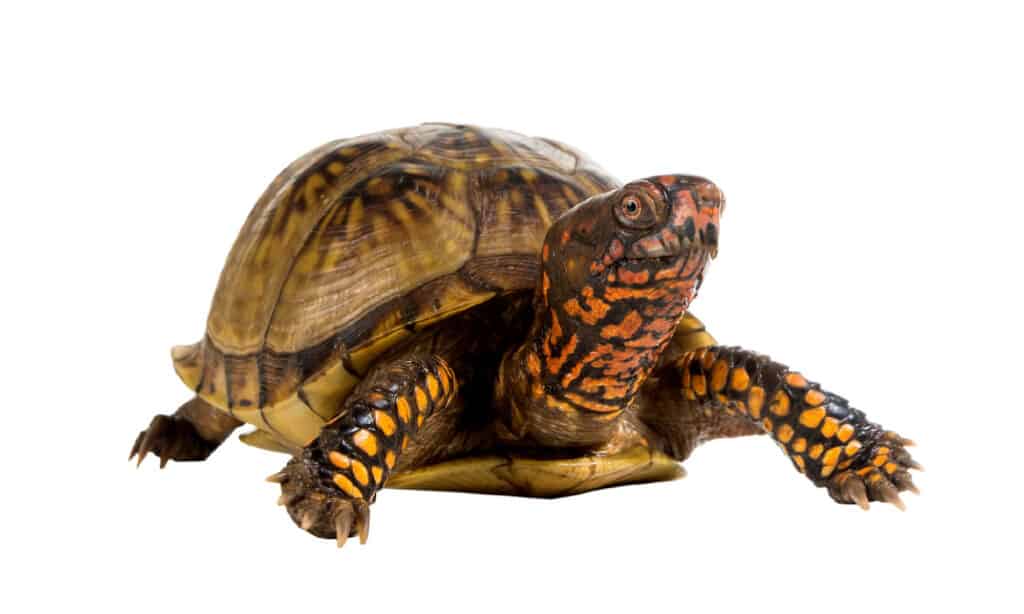
Three-Toed Box Turtle (Terrapene triunguis)

True to its name, the three-toed box turtle often has three toes on its back feet rather than the usual four.

There are nine sub-species of box turtles with various types within each species. They include:

  • Common, or Eastern box turtle (Terrapene carolina carolina) – This subspecies gets its common name from being located in the eastern United States. It is one of the most well-known and its status is vulnerable.
  • Mexican box turtle (Terrapene carolina Mexicana) – This subspecies is native to Mexico and because of exportation laws is seldom seen in the pet trade.
  • Coahuilan box turtle (Terrapene Coahuila) – The only known aquatic box turtle in North America is an endangered species endemic to Coahuila, Mexico.
  • Spotted box turtle (Terrapene Nelsoni) – This species gets its name for the tiny spots all over its shell and has not been studied enough to know much more.
  • Three Toed box turtle (Terrapene Carolina triunguis) – More capable of enduring new surroundings than most box turtles, the three-toed turtle is considered to be a good pet.
  • Yucatan box turtle (Terrapene Carolina yucatana) – Found only in the Mexican state of Yucatan.
  • Florida box turtle (Terrapene Carolina bauri) – This subspecies can be found almost exclusively in the state of Florida with occasional sightings in south Georgia.
  • Gulf Coast box turtle (Terrapene Carolina major) – This turtle can be found along the Gulf of Mexico between the states of Louisiana and Florida.
  • Ornate box turtle (Terrapene ornata ornata) – Native to the Great Plains of the United States, this small turtle has yellow lines from the center of the shell to the edges.

Appearance & Behavior
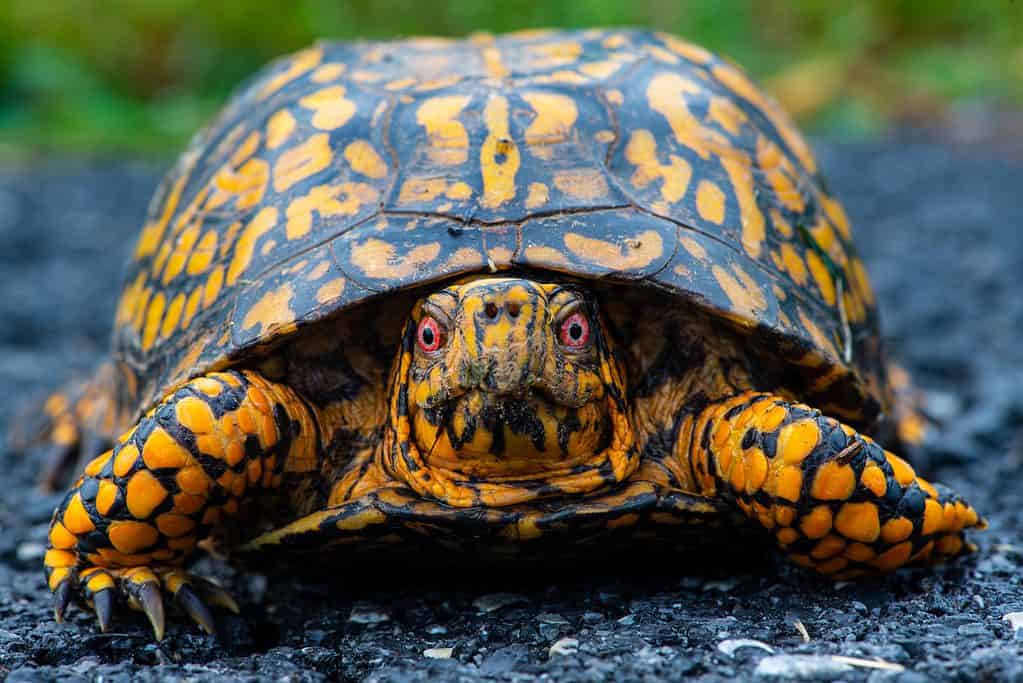
north american box turtle

The box turtles of North America have dome-shaped shells which hinge at the bottom.

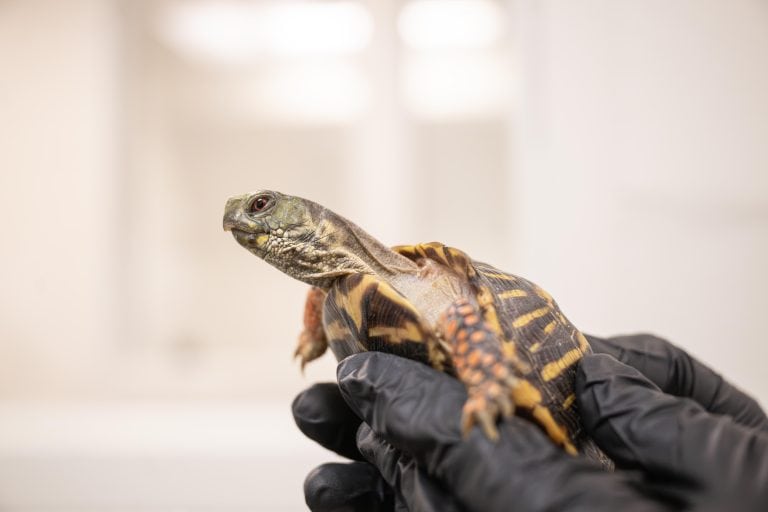
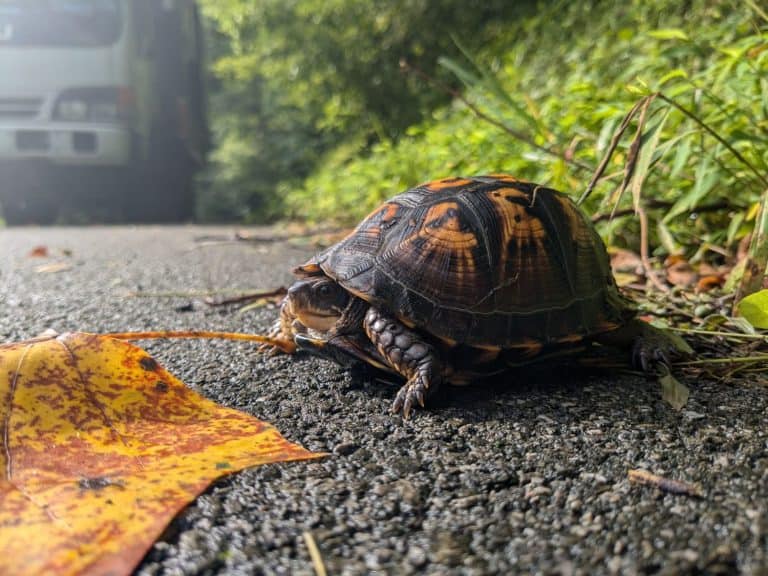
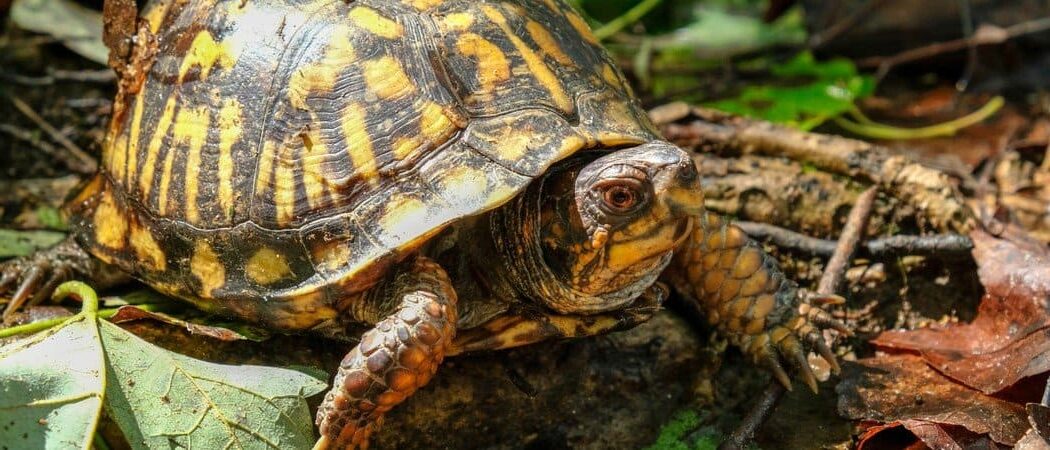
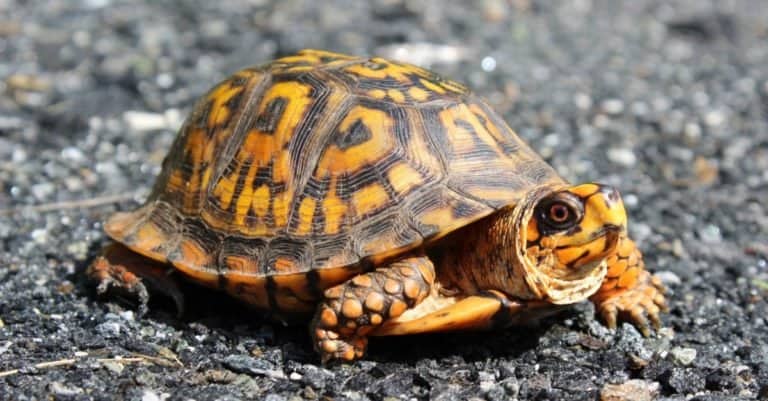
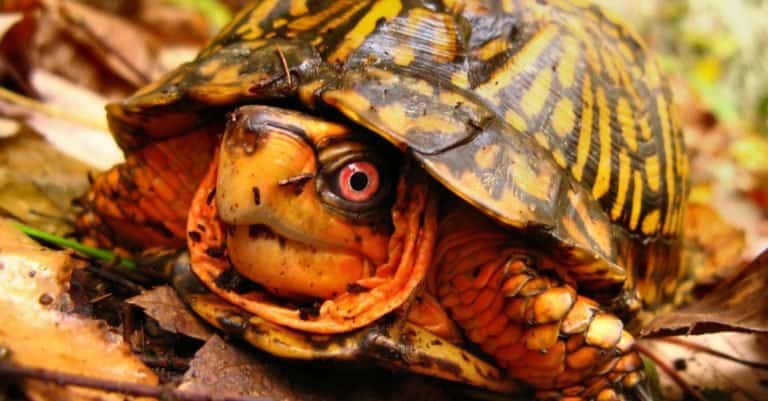
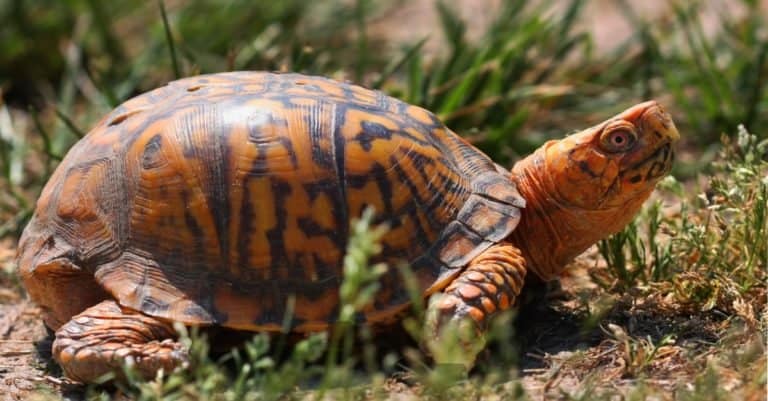
An Eastern box turtle has a dark brown or black shell, aka carapace, with yellow spots on its top. A Florida box turtle’s shell is similar in appearance. Alternatively, an ornate box turtle has a brown shell with slashes of yellow over its top. A turtle’s shell is made up of strong plates called scutes. These reptiles have four legs with five clawed toes on each front leg and four clawed toes on each of their back feet. They have an S-shaped neck making it easy to pull their head into their shell. A male common box turtle’s eyes are usually red while a female’s eyes are brown.

A common box turtle grows to a length of four to six inches. Line up three golf tees end to end. and you have a line equal in length to a six-inch turtle. These turtles weigh from .5 to 2 pounds. If you had one and a half basketballs sitting on a table in front of you, they would be the same weight as a 2-pound box turtle. The largest species of these turtles is the Gulf Coast box turtle. It can sometimes reach a length of 8.5 inches long!

Common snapping turtles don’t belong to the same family as these turtles. Their shell is different in shape and can measure up to 18 inches in length.

The only protection any type of these turtles possesses is its ability to retreat into its shell at the first sign of a threat. It can pull its head and legs totally into its shell. Predators have to work very hard to damage the tough exterior of the turtle’s shell in order to retrieve the turtle inside. Plus, the turtle’s shell can repair itself over time. Cracks and broken areas are regrown. So, even if a turtle’s shell is attacked, it can recover if the damage is not severe.

Common box turtles are solitary animals. They are shy and will stay out of sight of humans and other animals if at all possible. If turtles live near one another, it’s usually because there is an abundant food source. A group of turtles is called a bale. A bale may contain as few as three turtles or as many as 13.
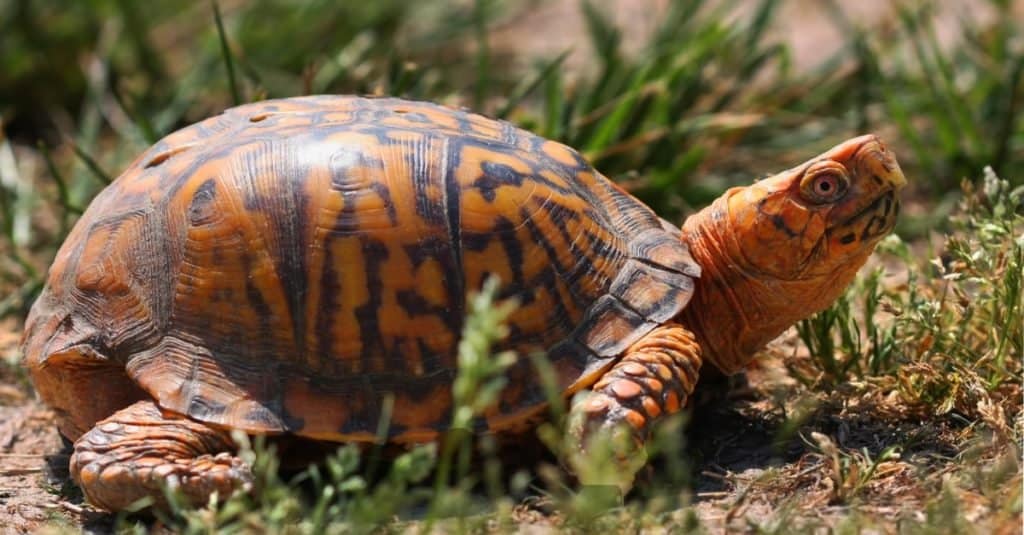
Box Turtle (Terrapene carolina) walking on grass.

Box turtles live in forests, marshy areas, meadows, and fields.

Habitat

These turtles live in the central, eastern, and southern United States as well as in Mexico in moderate to warm climates. The turtles living in areas that get cold in the winter, go into hibernation to stay warm. They seek shelter in a hollow tree or burrow into the ground using their strong back legs.

The habitat of Eastern box turtles includes forests, marshy areas, meadows, and fields. Normally, their range includes a water source such as a pond or stream. Alternatively, ornate box turtles live on prairies and in grassy areas.

These turtles avoid intense heat by looking for food early in the morning on summer days. In the heat of the day, they hide beneath a bush or under a log to stay cool.

These turtle’s feet have webbing allowing them to find food in or near a creek. Their excellent sense of smell assists them when looking for insects or vegetation to consume.

These turtles don’t migrate. But they do move around within their territory which is about the size of a football field.

Predators and Threats

These small reptiles are threatened by habitat loss and loss of their food source due to construction and land development. When roads are built in this animal’s territory, box turtles pay a high price if they are run over by cars or trucks traveling through.

What eats a box turtle?
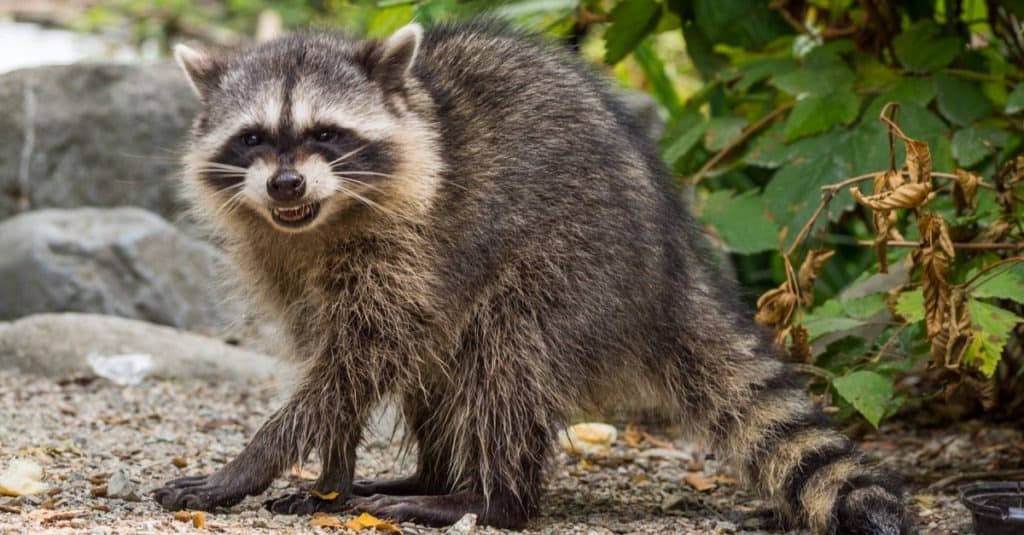
Raccoon in the park

Raccoons can use their nimble claws to reach inside a turtle’s shell.

Some of the predators of these turtles include dogs, skunks, raccoons, birds, and snakes. Some of these animals have the ability to probe around inside a turtle’s shell to injure and kill the turtle. For instance, raccoons can use their nimble claws to reach into a turtle’s shell. Dogs use their powerful jaws and teeth to crack or break a box turtle’s shell to access the inside. If a turtle is turned over on its back by a dog or other predator, it may die if it’s not able to turn itself back over after the predator leaves.

Diet
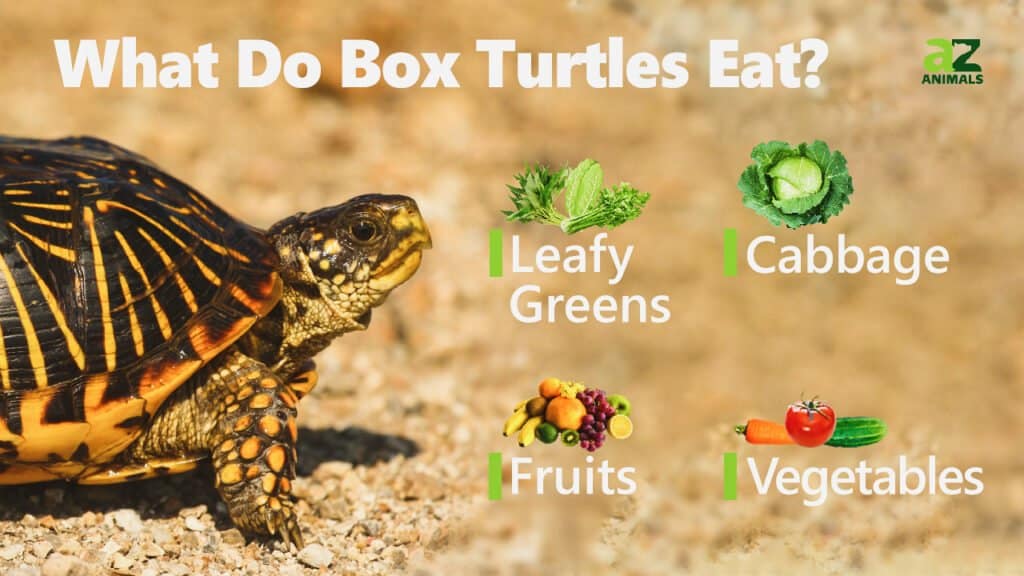
These turtles have a diet of insects, caterpillars, fruit, flowers, roots, and small amphibians.

Though Eastern box turtles are omnivores, they have different diets at different stages of life. Generally, a baby or young turtle eats insects and small amphibians. Older turtles tend to eat roots, fruit, and flowers.

Ornate box turtles eat flowers, roots, and insects as well. They also eat carrion.

Reproduction and Life Cycle
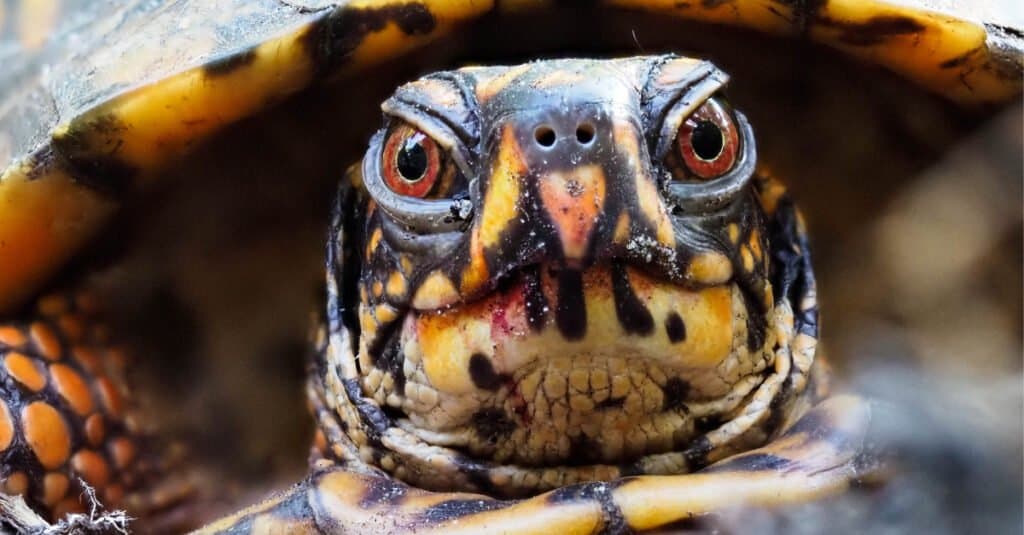
what do eastern box turtles eat

Eastern Box Turtles can live up to four decades. However, their lives are currently being shortened by human activities.

These turtles reach sexual maturity around the age of five. Their breeding season begins in the spring and goes through autumn. Males compete for mates by battling one another. The strongest male gets to mate with the female. Males can mate with several females in one breeding season. The gestation period of an Eastern box turtle is 50 to 90 days.

An interesting thing to note is a female Eastern box turtle can store sperm for up to 4 years. So, she could mate and lay her eggs three or four years later. The nesting period starts in May and continues into June. Females dig a burrow and lay from four to five eggs there. Some turtles lay as many as 11 eggs! She leaves after burying the eggs beneath the dirt or sandy surface. Box turtle eggs incubate and hatch without any care from the parents. The eggs are around two centimeters long and weigh less than an ounce. While some turtle eggs are leathery to the touch, box turtle eggs have a thin and somewhat flexible shells.

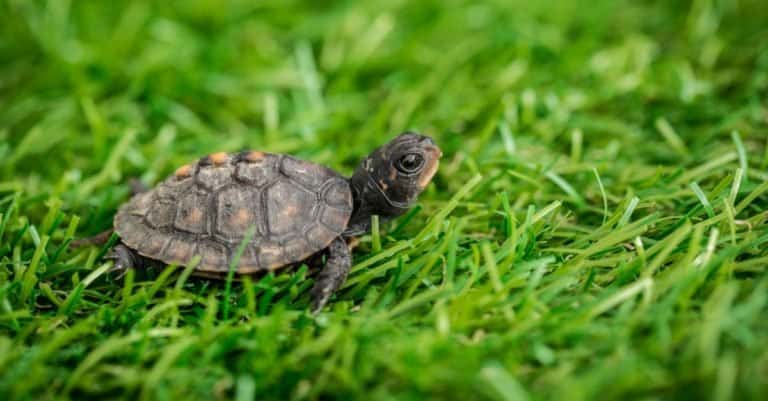
A baby box turtle is called a hatchling. The hatchlings crawl up out of their burrow and must survive on their own at that point. They begin to search for small worms, bugs, and plant life to eat. Baby turtles are vulnerable to predators because of their small size and the fact that they are born with soft shells that offer little to no protection. Not surprisingly, many hatchlings are eaten before they have a chance to grow a stronger shell they can retreat into when a predator is nearby.

These turtles are prone to respiratory diseases and parasites. Though most of these turtles live to 30 or 40 years old, they have been known to live to the ripe old age of 100!
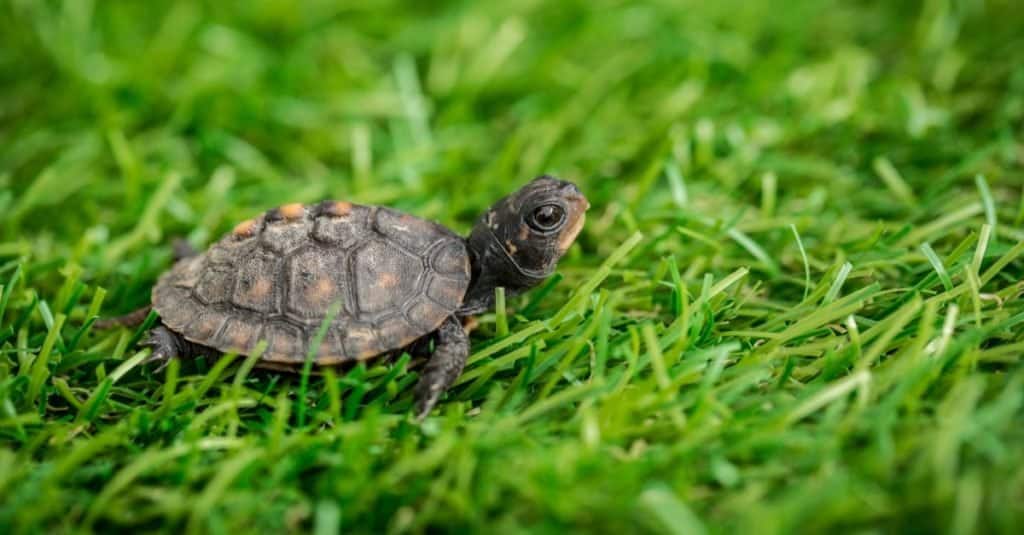
Tiny Box Turtle crawling around on grass.

Tiny baby box turtles have softer shells that make them vulnerable to predators.

Population

The population of the Eastern box turtle is less than 10,000. The overall number of these turtles has dropped due to habitat loss and land development. Many turtle deaths are caused when they try to cross roads and are run over by passing vehicles.

The conservation status of Eastern box turtles is Vulnerable with a decreasing population.

View all 453 animals that start with B

Sources

  1. Wikipedia / Accessed May 29, 2021
  2. Eastern Box Turtle / Accessed May 29, 2021
  3. Museum.state / Accessed May 29, 2021
  4. The National Wildlife Federation / Accessed May 29, 2021
  5. Dickinson County Conservation Board / Accessed May 29, 2021
Lisha Pace

About the Author

Lisha Pace

After a career of working to provide opportunities for local communities to experience and create art, I am enjoying having time to write about two of my favorite things - nature and animals. Half of my life is spent outdoors, usually with my husband and sweet little fourteen year old dog. We love to take walks by the lake and take photos of the animals we meet including: otters, ospreys, Canadian geese, ducks and nesting bald eagles. I also enjoy reading, discovering books to add to my library, collecting and playing vinyl, and listening to my son's music.

Thank you for reading! Have some feedback for us?


Box Turtle FAQs (Frequently Asked Questions)

Box turtles of all types are omnivores. This includes the Eastern box turtle, Florida box turtle, ornate box turtle, and other varieties.