
Quick Take
- Golden eagles can top 150 mph in a dive, yet the most impressive thing in this footage isn't speed at all. Watch the footage →
- Young golden eagles in the Alps start out making a specific mistake, and researchers tracked exactly how they learn to fix it. See how young eagles learn →
- For a bird with a wingspan that can exceed seven feet, the golden eagle's weight will genuinely surprise you. Check the surprising stats →
- There's a specific reason the Alps suit golden eagles better than almost anywhere else on Earth, and that reason has nothing to do with the scenery. Discover why the Alps fit →
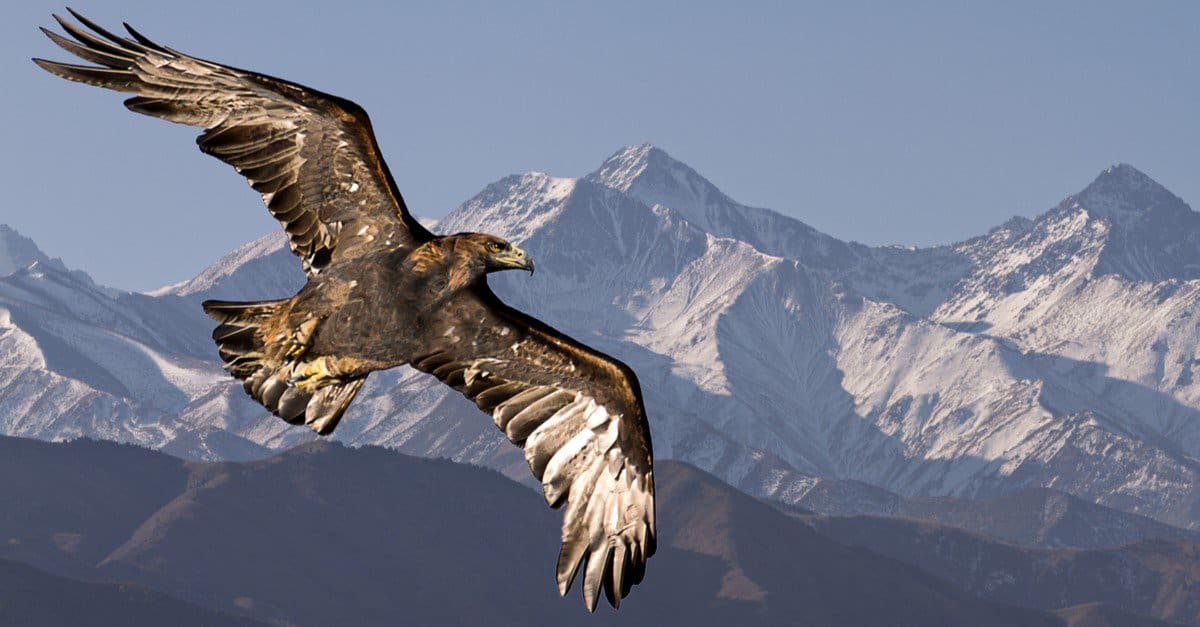
There are scenic mountain videos, and then there is footage that makes your stomach drop. In the clip above, a camera travels with a golden eagle as it leaves a rocky perch and glides over the Alps. Snowy peaks, green slopes, and deep valleys pass beneath the bird, giving us a view that normally belongs to one of the world’s most powerful fliers.
The most impressive part is not raw speed. It is how little effort the flight seems to require. The eagle holds its enormous wings nearly still, banks along the mountainside, and uses the surrounding air to remain aloft. It is a quieter side of an animal famous for its high-speed dives, and it offers a rare sense of what flying through the mountains might actually feel like.
See the Alps Through a Golden Eagle’s Eyes
The YouTube video follows a golden eagle carrying a small camera as it sweeps across alpine terrain. The bird’s head and wings occasionally enter the frame, but most of the view is open sky, steep slopes, and the valley far below. Wildlife footage can bring us close to everything from snakes to elephants. This clip does something different: for a few minutes, it turns the Alps into an eagle’s flight path.
How Do Golden Eagles Fly Through the Mountains?
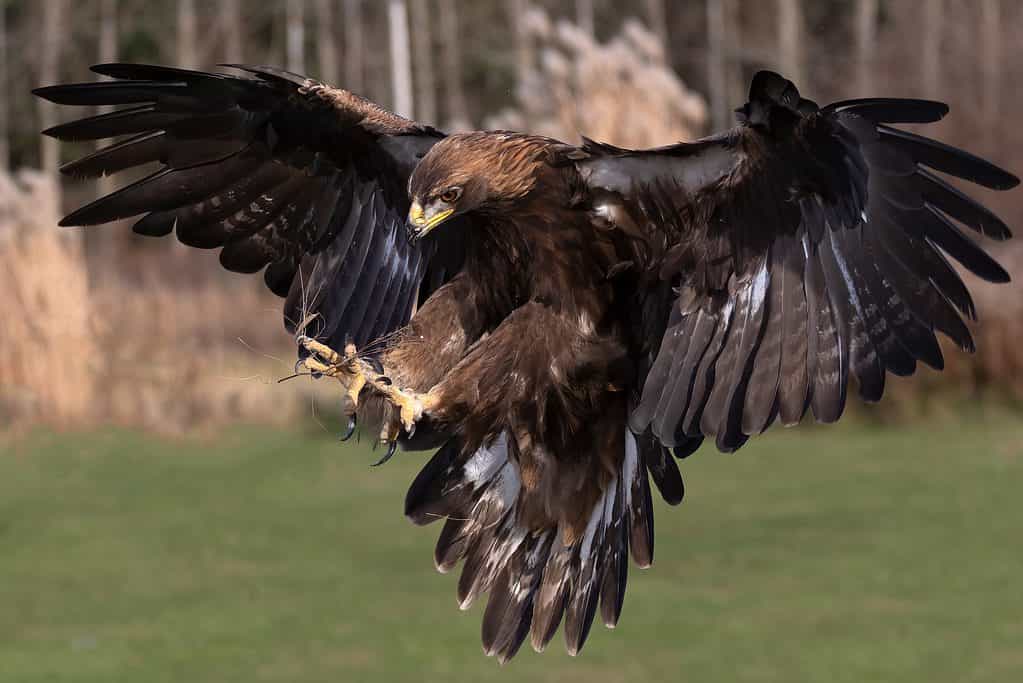
The oldest recorded wild golden eagle lived for at least 31 years and eight months.
©Touched by light images/Shutterstock.com
The golden eagle (Aquila chrysaetos) has one of the broadest ranges of any eagle. It lives across much of the Northern Hemisphere, including northern Africa, Europe, Asia, and North America. Mountain ranges such as the Alps provide the open slopes, rocky cliffs, high perches, and strong air currents that suit this species particularly well.
Golden eagles are raptors, meaning they are birds of prey, but the video calls attention to the anatomy they use in flight. Their long, broad wings generate lift, the separated feathers at the wingtips help manage airflow, and the tail works like a rudder during turns. Small adjustments allow the eagle to bank with the terrain without constantly beating its wings.
Researchers who tracked 55 young golden eagles in the central European Alps found that inexperienced birds initially stayed close to mountain ridges. Wind striking those ridges is pushed upward, creating relatively predictable lift. As the eagles gained experience, they became better at finding less obvious rising air and could explore much larger areas. The U.S. Forest Service reports that golden eagles can exceed 150 miles per hour in a steep dive, but that is not what we see here. This flight is about riding the air rather than dropping through it.
A ground animal such as a lion must keep spending energy with every stride. A soaring eagle can let rising air do much of the work. The bird still has to read those invisible currents and position its body correctly, which helps explain why the flight looks smooth even as the mountainside races past below.
Why Are Golden Eagles So Well Suited to the Alps?
The golden eagle is surprisingly light for a bird that looks so imposing in the air. Adults generally weigh about 7 to 14 pounds, measure roughly 28 to 40 inches from head to tail, and can have a wingspan exceeding seven feet. Those expansive wings spread the bird’s weight over a large surface area, making it possible to stay aloft while conserving energy.
The Alps also provide the open country golden eagles need. Rocky ledges offer nesting sites and lookout points, while meadows and exposed slopes support many of the small and medium-sized mammals in their diet. In European mountains, marmots and hares are important food sources; elsewhere, their diet can include rabbits, ground squirrels, and prairie dogs. None of that is the focus of this video, however. Its appeal is the flight itself and the extraordinary chance to see the Alps from an eagle’s point of view.