
Quick Take
- There are over 4,000 species of snakes, but only 34 species of mongooses.
- The mongoose has evolved to resist snake venom.
- Besides their venom and ability to constrict prey, snakes also use defenses such as camouflage, mimicry, defensive posturing, and rapid escape.
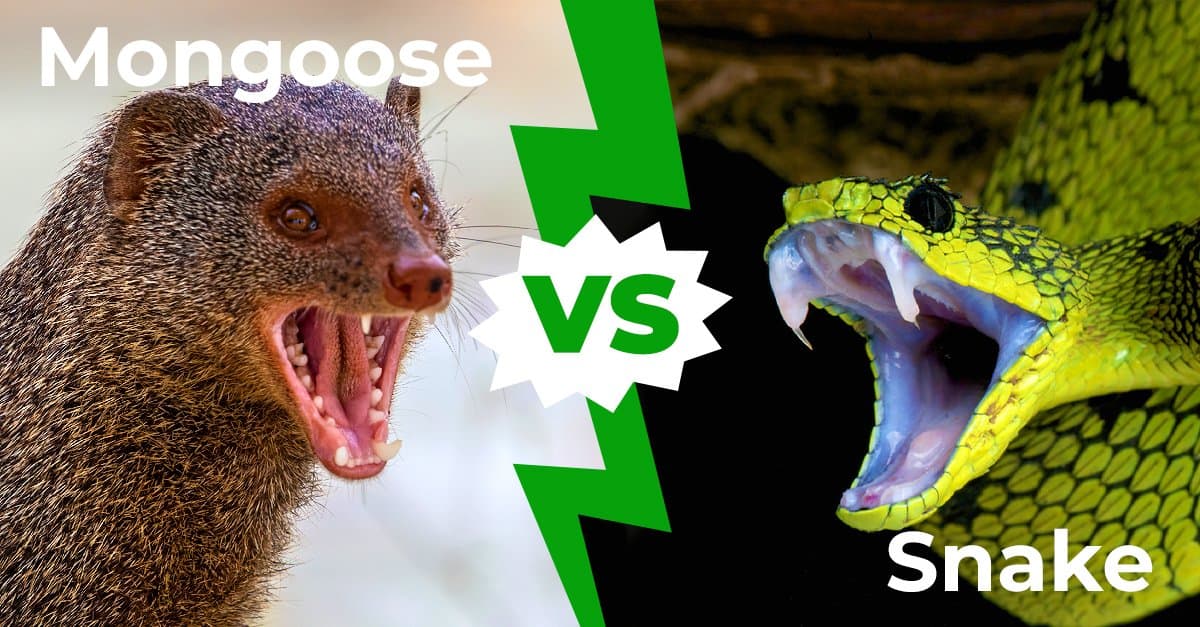
A fight between a mongoose and a snake would be an amazing battle that pits a mammal against some of the deadliest creatures in the world. Snakes are diverse, limbless reptiles comprising over 4,000 known species found worldwide, except in Antarctica, Iceland, Ireland, Greenland, and New Zealand. Approximately 600 species are venomous. Primarily found in Africa, Asia, and Southern Europe, mongooses are small, agile carnivores that are recognized for their ability to fight venomous snakes. Factors that determine the winner in a fight between a mongoose and a snake include size, speed, attack style, and more. Continue reading to discover which of these animals will be victorious in a fight between them.
Comparing a Mongoose and Snake
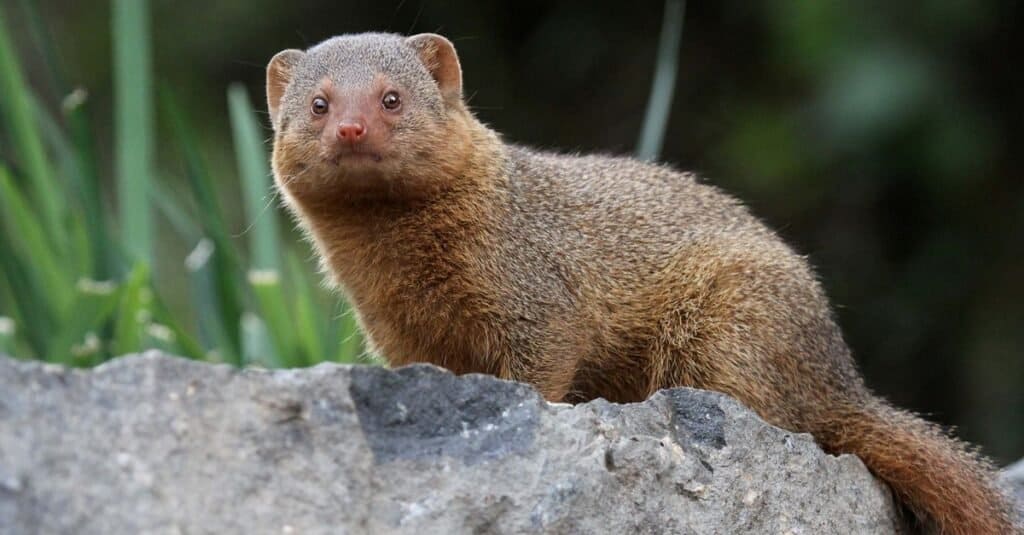
There are 34 species of mongooses worldwide.
©steve bushman/Shutterstock.com
Mongoose vs. Snake: Size
Most mongooses weigh between 0.7 and 11 pounds and measure 9 to 23 inches in body length, with the largest species reaching up to 11 pounds and 23 inches.
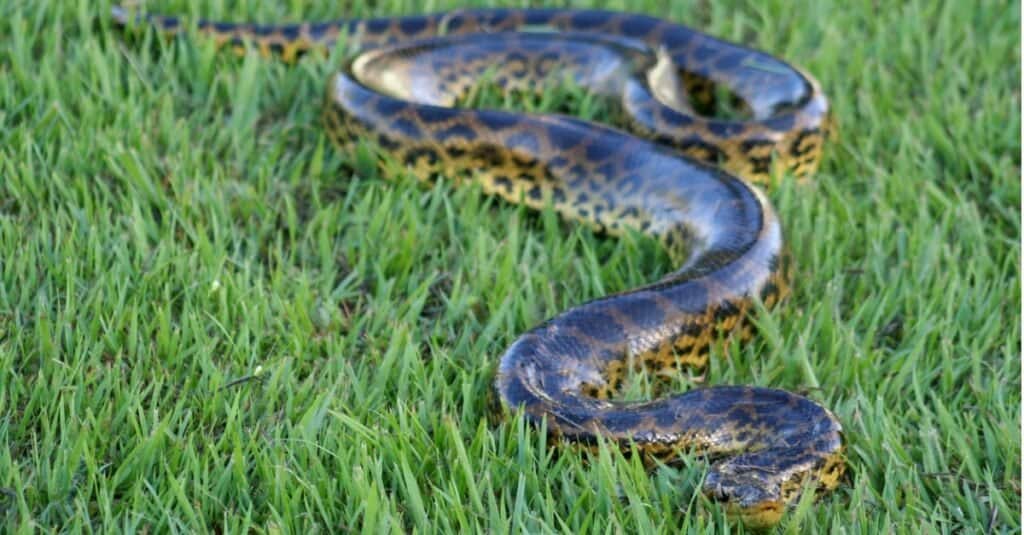
Snakes vary in size and weight.
©iStock.com/Schumaher
Most snakes weigh less than 5 pounds and are under 36 inches long, though some large species can greatly exceed these averages.
However, using size as the main factor in this fight is misleading, since mongooses have evolved to overcome size disadvantages, and most snakes are actually smaller than a mongoose.
Advantage: Mongoose
Mongoose vs. Snake: Speed and Movement
Snakes vary in their speed and movement, but most snakes move slowly, although some species, like the sidewinder, can reach speeds up to 18 miles per hour (mph). Their means of movement, an undulating slither, is not the most effective for covering ground quickly.
The mongoose is a small mammal that can run up to 20 mph.
Advantage: Mongoose
Mongoose vs Snake: Bite Force and Teeth
A mongoose has 28 teeth, four of which are powerful incisors that can instantly break bones, including vertebrae and skulls of smaller animals.
Although their fangs vary in length, unless they are venomous, a snake’s bite does not inflict much damage.
Advantage: Tie
Mongoose vs. Snake: Senses
Snakes have amazing senses that allow them to sense changes in temperature and feel vibrations. Snakes have remarkable senses that allow them to detect temperature changes and vibrations. They also possess a Jacobson’s organ, a specialized scent-sensing organ in the roof of the mouth, which enables them to taste or smell the air to locate prey, predators, or mates. When a snake flicks its tongue, it picks up odor particles and deposits them into this organ to analyze its environment.
The mongoose also has very keen senses, including good vision, excellent hearing, and a fantastic sense of smell.
On average, the mongoose has better senses than the snake.
Advantage: Mongoose
Mongoose vs. Snake: Physical Defenses
The snake’s physical defenses consist of its ability to hide in small spaces and use defensive posturing to scare off many predators.
The mongoose has more practical defenses, such as thick fur, tough skin, and resistance to venom, which comes in handy against snake
Advantage: Mongoose.
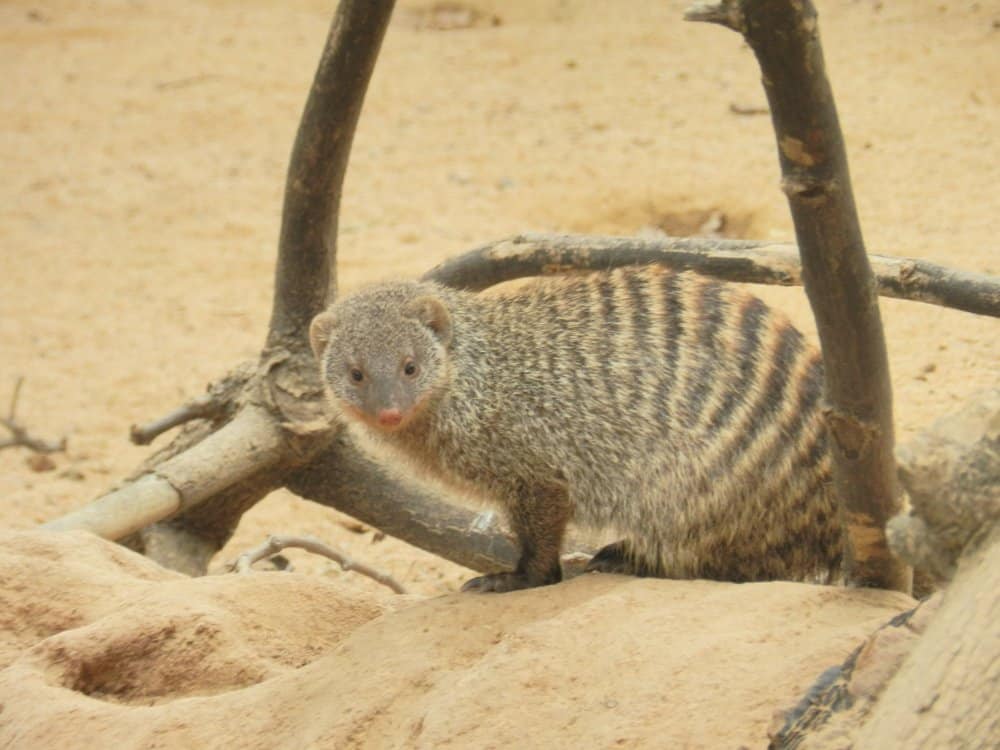
Mongooses rely on their speed and bite to kill while snakes envenomate or crush opponents.
©Millie Bond – Copyright A-Z Animals
Mongoose vs. Snake: Offensive Capabilities
The mongoose has serious offensive capabilities. They have strong claws, a powerful bone-snapping bite, and the agility to move around their prey until they find a weak spot or tire them out.
Snakes tend to be either venomous or constrictors that crush their prey. They are careful predators that strike at opportune moments because they can be vulnerable.
Advantage: Snake
Mongoose vs. Snake: Predatory Behaviors
The mongoose is an ambush predator that may go directly for the kill or tire out its prey before moving in for the final attack. Some species hunt alone, while others hunt in groups to secure a kill.
Snakes can be either ambush predators or pursuit predators.
Both creatures are highly effective, but the snake wins due to its ability to land the first and often fatal strike.
Advantage: Snake
Who Would Win in a Fight Between Mongoose and Snake?
In a fight between a mongoose and a snake, the mongoose would win. This conclusion is based on the average statistics of snakes around the world.
n its native habitat, the mongoose is a direct predator of cobras and other venomous snakes of all sizes, demonstrating its advantage through its ability to avoid strikes and resist venom. King Cobras can measure over 7 feet long and still get killed by a mongoose.
Furthermore, the mongoose would likely kill any constrictor that was not as large as itself, leaving only large constrictor snakes as true threats among all snakes.
To fully explore this battle, condsider the following three scenarios:
- Mongoose vs. venomous snake: mongoose dodges bites and cracks snake’s skull.
- Mongoose vs. constrictor snake: a large constrictor strangles the mongoose to death if it gets too close, or a small constrictor gets bitten, paralyzed, and killed.
- Mongooses vs. constrictor snake: several members of a mongoose species that hunt in groups overwhelm and kill the constrictor snake.
The bottom line is that the mongoose wins in the vast majority of cases.