
Quick Take
- A recently published study reveals that queen conch groupings require a 360-yard (330-meter) buffer to best protect the threatened species.
- Queen conch can hop using its muscular foot.
- Scientists studied queen conch movements off the Florida coast and in the Bahamas as part of the study.
- The study was part of Shedd Aquarium’s Center for Conservation and Research.
For a certain giant saltwater snail species, a new study published in Conservation Biology gave new meaning to the phrase “give me my space.”
Researchers from Chicago’s Shedd Aquarium and the Wells National Estuarine Research Reserve in Maine discovered that queen conchs really do need their space, at least to create optimal conditions for reproduction. The study’s data is a significant step forward for conch conservation.
What Did the Study Reveal?
Queen conch are listed as threatened under the U.S. Endangered Species Act, but conservation managers have limited resources to safeguard these threatened animals. The most-used technique is to implement safety zones around aggregations of queen conchs located throughout Florida and the Caribbean. These zones help minimize disturbances that disrupt breeding. However, conservationists were not sure how large these zones needed to be for maximum efficiency.
This is where the study’s research team came in. Researchers determined that a 360-yard (330 meters) spatial buffer—about the height of the Eiffel Tower—was required around breeding areas to adequately protect and manage the vulnerable aggregations. It was a much larger space than scientists previously believed adequate.
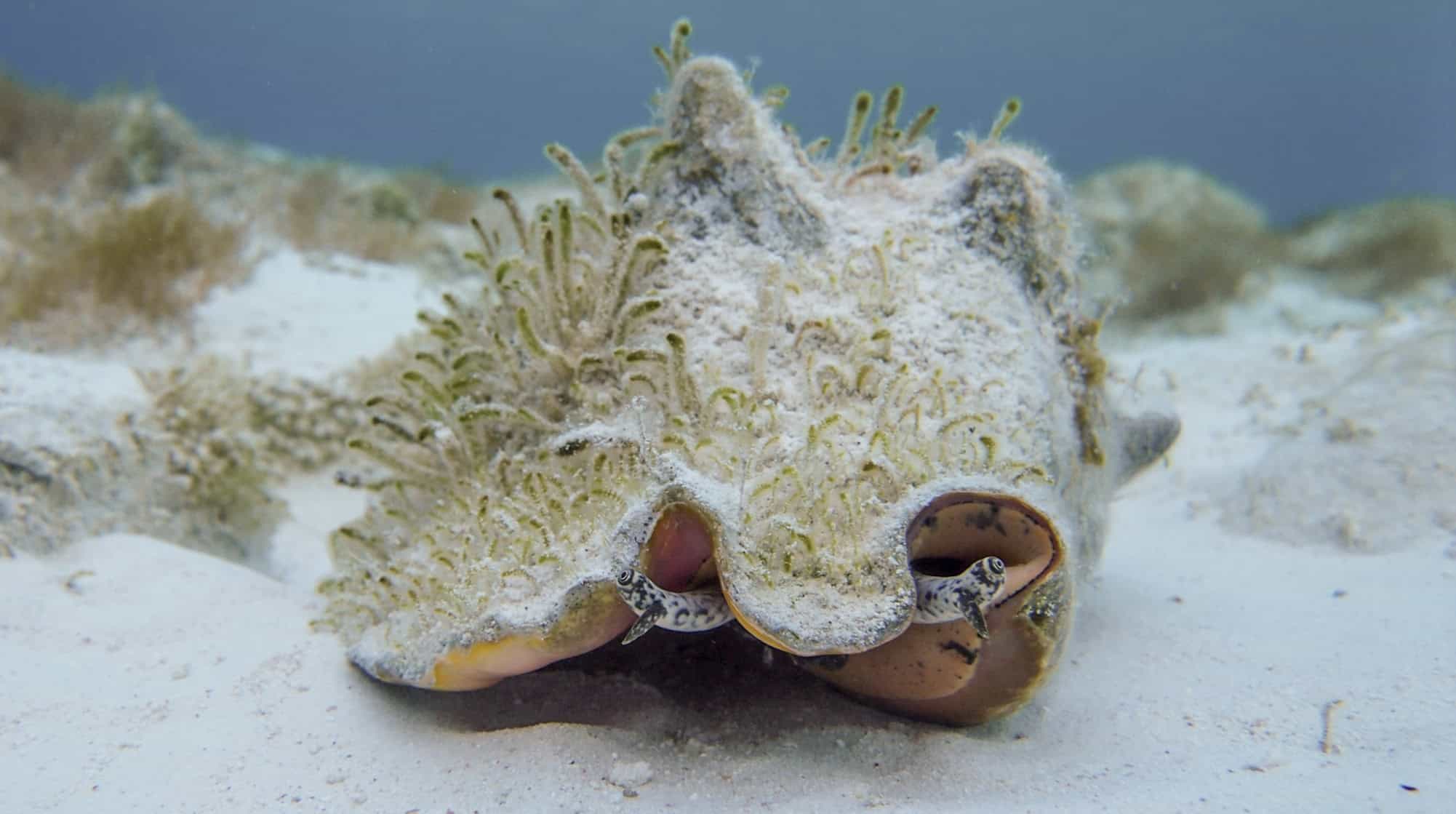
Why do queen conch need such a large buffer zone? Because, unlike many of their snail cousins, queen conch can hop. They use their muscular foot to propel themselves upwards and forwards. Hopping allows the queen conch to cover larger distances than expected. In turn, this increased the radius of the safety zone needed to protect them.
“I have been surveying queen conch for a decade, but the first time I watched a conch hop, it startled me,” said Dr. Andy Kough, a research biologist at Shedd Aquarium in Chicago and lead author of the study. “We wanted to leverage this unique behavior to gather data and help inform conservation efforts, but we needed new tools to do so.”
How Do You Measure a Queen Conch’s Hop?
The research team started on board Shedd’s research vessel, the R/V Coral Reef II. Those onboard included research biologists from Shedd and Maine’s Wells National Estuarine Research Reserve, staff, and volunteers who observed conchs underwater and measured hundreds of individual hops.
The team didn’t rely on visual observations alone. At two sites off the Florida coast, researchers attached biologger devices to 42 conch. These biologgers were custom-made by the team. The biologgers “record when a conch is actively hopping and moving versus staying still,” according to Dr. Ben Gutzler, a scientist at Wells National Estuarine Research Reserve and a co-author of the study.
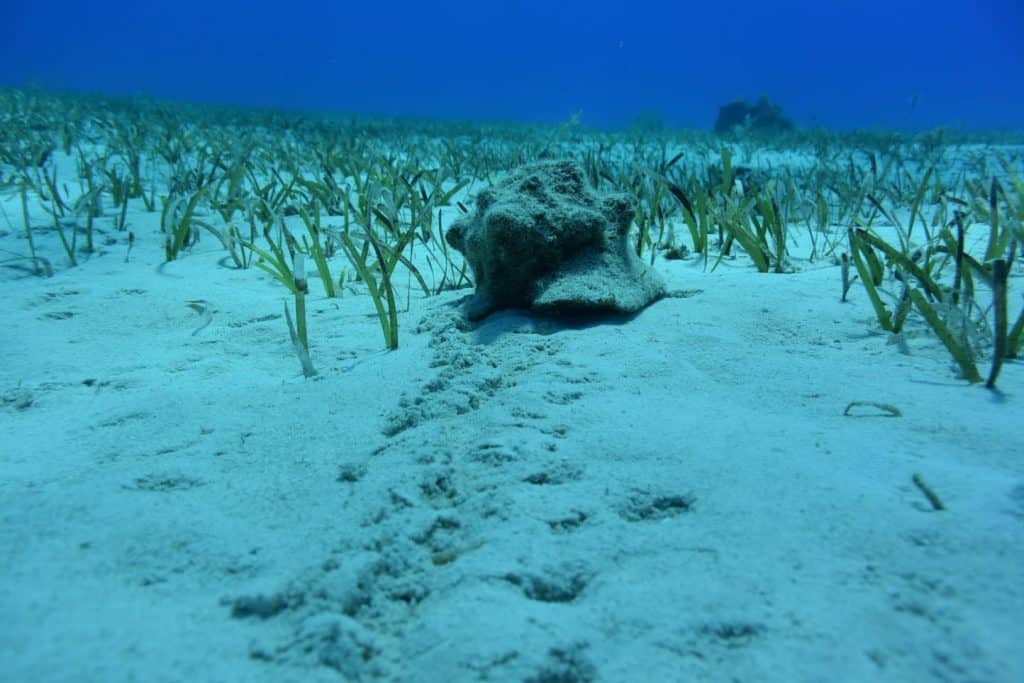
Because they can hop, queen conch move faster and further than other snail species.
The biologgers allowed scientists to track the animals’ movements across diverse habitats and seasons and collect additional data. Meanwhile, in The Bahamas, a separate team of divers was also conducting surveys to map conch distributions over hundreds of miles across the archipelago.
Scientists combined these field observations and data with mathematical models to understand how conch movement impacts aggregation size, where queen conch are typically found, and why their distribution is not consistent across the sea floor.
How This Data Helps Conservation Efforts
The wide distribution of queen conch throughout the Florida Keys, The Bahamas, and other Caribbean islands makes a coordinated, region-wide conservation initiative a challenge. More typically, conch conservation is handled on an island-by-island basis. Efforts and their effectiveness vary widely across the region.
Queen conch are extremely vulnerable to overfishing, making conservation a necessity. They are slow to grow, late to mature, and easy to harvest in shallow waters—their preferred areas for aggregation. Florida has made it illegal to harvest queen conch anywhere in the state, and banned commercial and recreational fishing in the 1980s in response to plummeting conch populations.
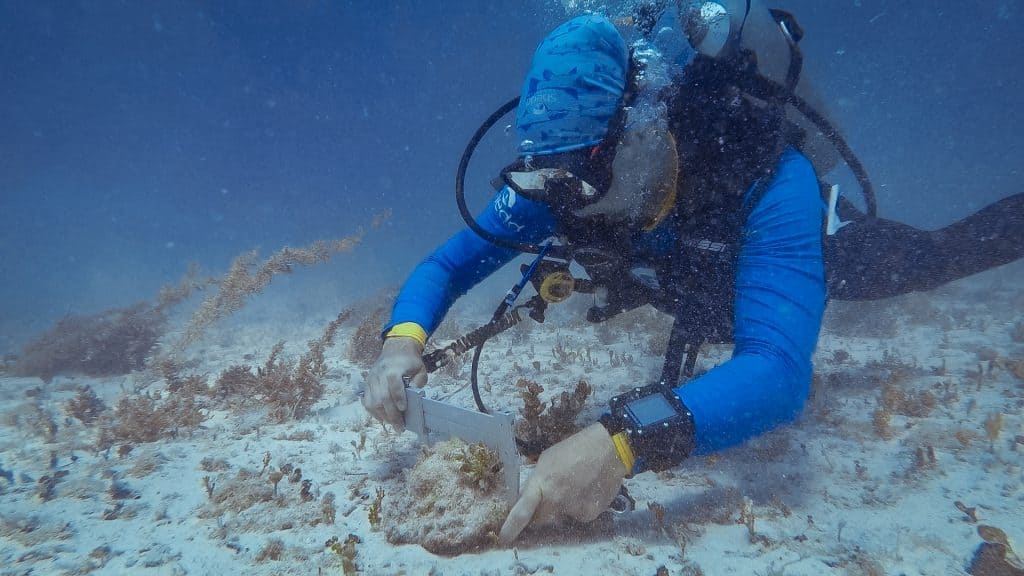
A Shedd Aquarium researcher measures queen conch off the Florida coast.
Other countries have followed suit, but enforcement is a challenge. One solution is the creation of “safe zones” where known queen conch aggregations occur. These zones prevent fishing and harvesting within a set distance from the aggregation. But the adequate distance was uncertain.
The authors of the study recognized that better data on aggregation safe zone sizes would be a helpful conservation tool.
“By combining a variety of research methods, this study determines the minimum space needed to protect breeding aggregations of conch,” said Dr. Kough. “These areas are small enough to be managed locally and quickly, giving resource managers a spatial conservation tool to use in response to dynamic threats such as targeted overfishing or habitat destruction.”
Shedd Aquarium Leads the Way In Marine Conservation
The study is part of Shedd Aquarium’s Center for Conservation and Research, a larger effort to support projects focused on freshwater and saltwater species challenges. Shedd’s floating field station, R/V Coral Reef, is an integral part of studies for field researchers in the Caribbean. But the Center supports studies across the United States and around the world.
The Center has several key focus areas, including reducing plastic pollution, creating and sustaining global fisheries, revitalizing natural habitats changed by human impacts, controlling invasive species, understanding animal responses to environmental changes, and connecting people to nature.
Scientists from the Center conduct research and work with partners to create management strategies to protect endangered and threatened marine species. The Center also offers volunteers a chance to learn more and get involved. The public can participate in community science and stewardship projects, like monitoring fish migrations, tagging sharks, and restoring local habitats. Visitors to the Center can take a behind-the-scenes tour to learn more about the Center’s work and get up close to the species the Center is working to save.