
Quick Take
- Species like bull sharks form stable social networks, choosing preferred companions rather than interacting at random.
- Long-term studies show sharks maintain repeated associations and “cliques,” even reuniting with the same individuals over years.
- These social bonds likely improve survival by reducing conflict, conserving energy, and helping sharks locate food more efficiently.
- The discovery puts sharks alongside many other “once-solitary” species now known to have complex, flexible social lives.
For decades, sharks have been cast as the ultimate solitary predators — cold, instinct-driven “killing machines” that roam the ocean alone. Species like the bull shark (Carcharhinus leucas) were long thought to interact only to mate or compete. But emerging research is dismantling that image, revealing animals with surprisingly complex social lives.
Long-term studies — from more than 8,000 minutes of underwater observation in Fiji to acoustic tracking at Palmyra Atoll — show that sharks don’t move through the ocean in isolation. Instead, they form stable social networks, maintain long-term associations, and actively choose preferred companions while avoiding others. These patterns aren’t random — they appear to function as survival strategies, helping sharks reduce conflict, conserve energy, and even improve foraging success.
This shift mirrors a broader pattern across the animal kingdom. From marsupials to apex predators, species once labeled “solitary” are increasingly understood to rely on flexible, often hidden social systems. And sharks, once thought to be a “lone predator,” are now part of that growing list.
Social Preferences of the “Fiji 184”
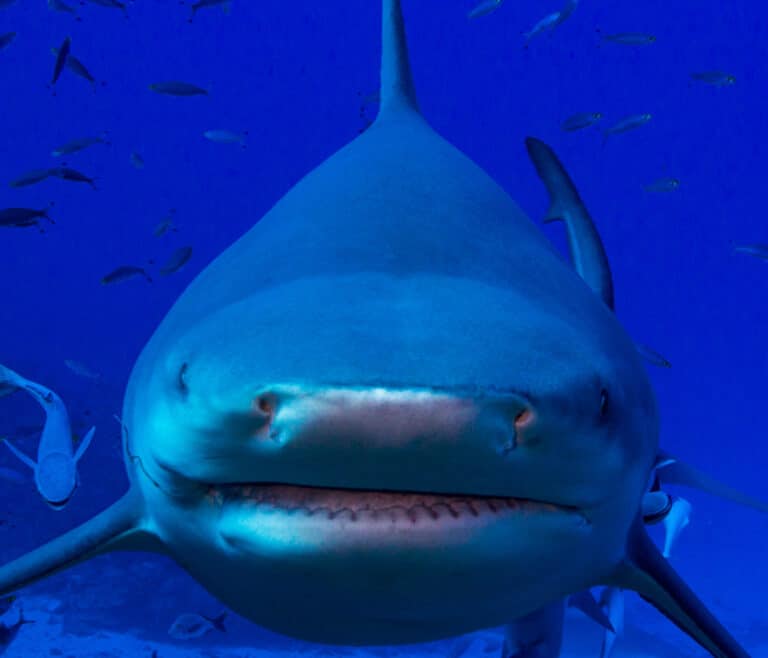
The clearest evidence that sharks have social lives comes from a six-year study at the Shark Reef Marine Reserve in Fiji. Researchers tracked 184 individual bull sharks across 473 dives, documenting consistent, non-random associations.
These findings directly challenge the “lone wolf” stereotype, revealing that bull sharks do not mix at random; instead, they show clear and active social preferences, spending time with specific individuals again and again.
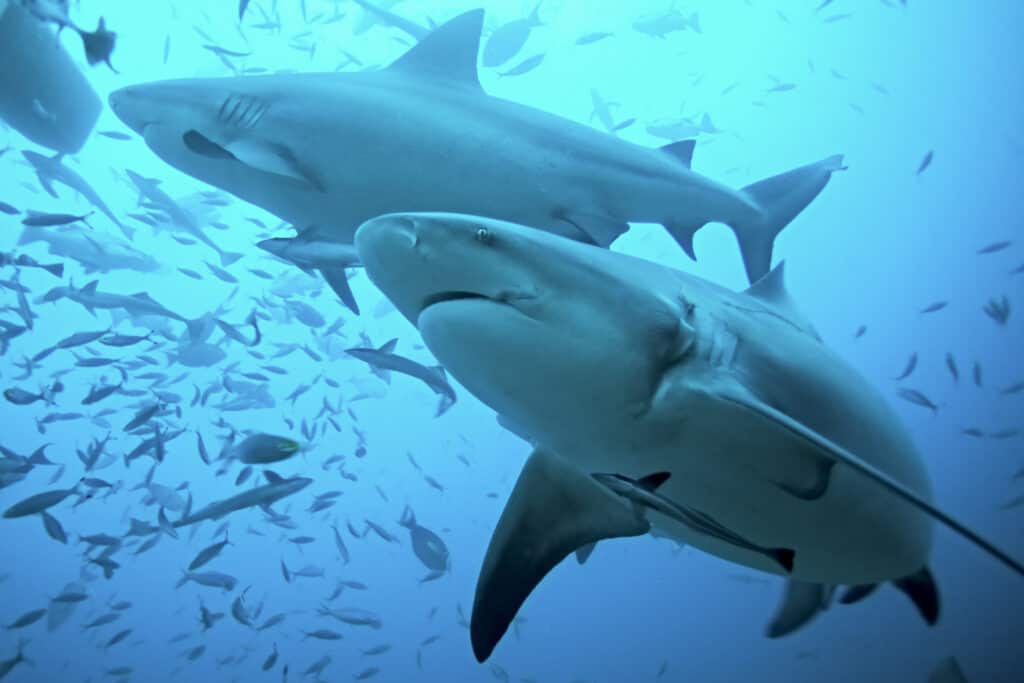
The study involved analyzing six years of data and bull shark observations.
©Martin Prochazkacz/Shutterstock.com
Researchers identified the sharks’ bonds through proximity (individuals intentionally staying within one body length of each another) and synchronized movement (parallel swimming or swimming side-by-side, and lead-follow behavior, where one shark mirrors the movements of another). These repeated interactions suggest a more structured social system than mere chance encounters.
A Shark’s Inner Circle
The study revealed a social system shaped mainly by sex and size. Both males and females preferred associating with females, although males had more total connections, possibly using social integration as protection against aggression. The sharks also tended to associate with others of similar size, reducing competition risk.
These social behaviors shifted significantly with age. Adults formed the core of the network, while sub-adults were more cautious, although sometimes they bonded with older “mentor” sharks. Older individuals were less social, relying on experience and size rather than group benefits.
These patterns suggest sharks use social relationships to minimize conflict and navigate their environment more efficiently, benefiting from a collective intelligence that ensures their long-term survival.
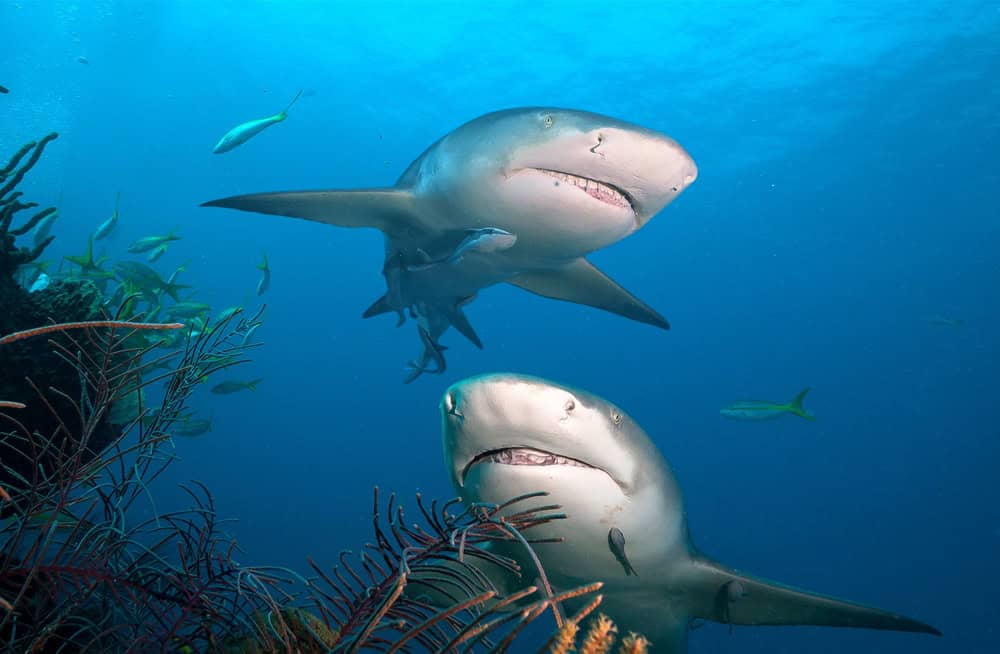
Many shark species are surprisingly social, including scalloped hammerheads, sand tiger sharks, lemon sharks, and even white sharks.
©frantisekhojdysz/Shutterstock.com
Shark “Cliques” and Social Hubs
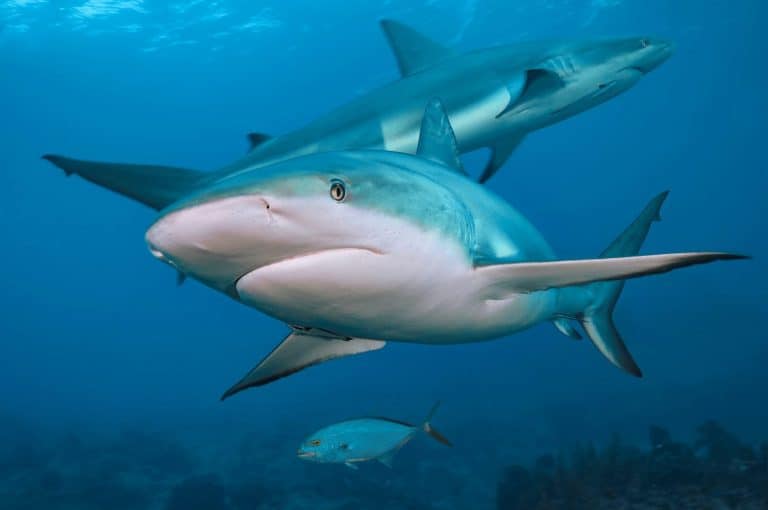
While the Fiji study highlights individual “friendships” of bull sharks, research at Palmyra Atoll provides insights into the long-term stability of shark communities. Using acoustic tags and proximity sensors, scientists tracked grey reef sharks (Carcharhinus amblyrhynchos) over four years and uncovered a fission-fusion system rather than a random collection of mindless, roaming predators.
The study revealed that gray reef sharks balance their need for solitary hunting with a highly consistent home base social life. Their daily routine follows a predictable pattern:
- Daytime fusion: During the day, sharks gather in specific social groups on the reef. They actively choose to associate with certain individuals, forming distinct “cliques.”
- Nighttime fission: At night, the social groups break up and individuals disperse to hunt alone. Interestingly, the same sharks repeatedly regroup in the same locations.
- Predictable reunions: Despite spending the night miles apart in the dark, the same individuals find each other and regroup at the exact same spot on the reef every morning.

Researchers believe that many shark “friendships” are built on sharing information with one another.
©Lewis Burnett/Shutterstock.com
The most surprising discovery was the endurance of these bonds. Rather than being random or fleeting, the research showed that these associations are remarkably stable. Some “friendships” lasted throughout the entire four-year study, with the same pairs reuniting year after year. This consistency reveals a level of site fidelity and social loyalty previously unrecognized in the species.
Why Do Sharks Form Social Groups?
Researchers point to several advantages of forming social groups. For example, groups likely enable information sharing, as sharks may follow more successful individuals to locate food. Groups also reduce the need for constant competition, making them more energy efficient than remaining alone. Additionally, staying in a group provides safety — even apex predators face dangers in the ocean and benefit from predictable social environments.
This level of stability suggests sharks can recognize individuals and remember relationships — abilities once thought unlikely. In fact, this research suggests that shark social structures may be as complex as those found in some birds and mammals. To maintain these long-term bonds, sharks must have the cognitive ability to recognize individuals and remember their social standing and connections.
The Cognitive Side of Shark Sociality
Maintaining long-term associations requires more than instinct. Evidence now suggests sharks possess social memory, allowing them to recognize and remember specific individuals even after being separated for months. Rather than just reacting to their environment by instinct, sharks use a form of cognitive mapping to keep track of their peers. This enables them to identify reliable partners, avoid aggressive competitors, and navigate complex social environments.

Sharks are intelligent animals, capable of long-term memory, learning complex behaviors, forming relationships, and problem solving.
©cbpix/Shutterstock.com
Comparative brain studies also support this behavior. Social shark species show greater development in the telencephalon, a region of the brain associated with decision-making and social behavior. In contrast, more solitary species show less development in this area.
Researchers have also observed that these behaviors are consistent with social learning, reciprocity, and risk reduction. Together, these findings point to a level of cognitive sophistication comparable to many birds and mammals.
The Myth of the “Solitary Animal”
Sharks aren’t the only “solitary animals” that are being reevaluated. Across countless species, animals once labeled as “loners” are revealing hidden social complexity.
For decades, marsupials were categorized as 90% solitary. However, a massive analysis of 65 species published in Proceedings of the Royal Society B suggests this belief incorrect. For instance, the monito del monte (Dromiciops gliroides), a tiny South American marsupial believed to be strictly solitary, forms communal nests with others for warmth.

The monito del monte is one of four marsupial species in Chile.
©Rob Jansen/Shutterstock.com
Even terrestrial apex predators are proving to be more social than once thought. Historically, scientists believed pumas only met for mating. However, research now shows that these big cats exhibit reciprocity and often share prey within structured social networks.
Gloomy octopuses also aggregate and interact at shared sites, and Bush Karoo rats and giant kangaroo rats live in stable, cooperative groups. Even species that forage alone may still rely on social systems for survival, especially in unpredictable environments.
Protecting Social Networks
Recognizing sharks as social animals changes how we protect them. Conservation has traditionally focused on numbers and population size. However, if sharks depend on social networks, then who is removed may matter as much as how many.
Some individuals act as social hubs, connecting others and facilitating information flow. Removing these key sharks — through fishing or habitat disruption — could destabilize entire communities. Removing one of these central figures may cause a decrease in overall hunting efficiency and a reduced ability to adapt to environmental changes.

A group of sharks is typically referred to as a shiver, although some also call it a frenzy or a school.
©wildestanimal/Shutterstock.com
Researchers are now calling for a shift toward “socially-informed conservation,” which prioritizes protecting aggregation sites and meeting spots, preserving stable social groups, and managing populations with social structure in mind.
Seeing Sharks in a New Way
Sharks are not “primitive,” “simple,” or “mindless” predators. Their ability to navigate complex social landscapes, remember peers for years, and learn through observation places them on a cognitive par with many higher vertebrates. By recognizing their complexity and their ability to form relationships, we shift the public perception of sharks away from sinister killers and toward complex, social beings.
Sharks are not primitive outliers. They are part of a broader pattern in evolution: the emergence of sociality as a powerful survival tool. And in the end, their success may depend not just on their teeth — but on their connections.