
Quick Take
- A country's stance on killing predators has less to do with its current laws or economy and far more to do with who colonized it centuries ago. Trace the colonial origins →
- Latin America is more protective of wildlife than the European nations that colonized it, a fact whose explanation is not what you'd expect. Discover why Latin America diverged →
- The Protestant Reformation and Catholic traditions quietly split the world into two opposing camps on wildlife, and that divide still dictates policy today. Explore the Protestant-Catholic split →
- Conservation plans backed by hard science keep failing in certain regions, and the real obstacle has nothing to do with biology. See why science alone falls short →
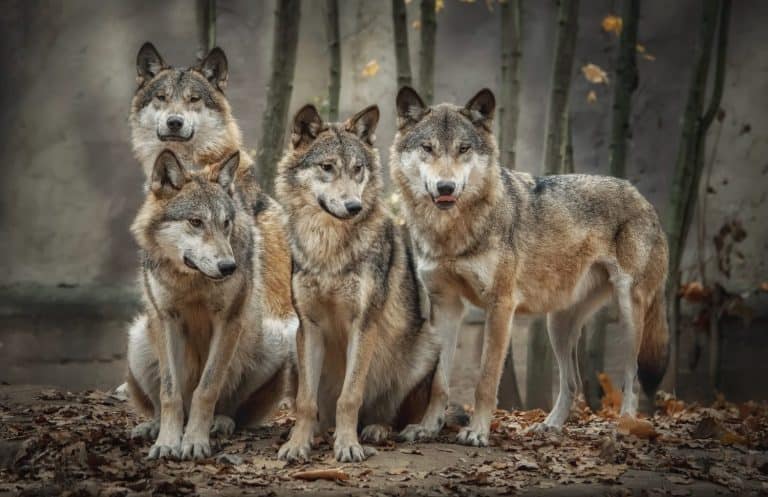
When a mountain lion wanders into a suburban neighborhood, or wolves attack livestock, people’s reactions vary dramatically. Some communities advocate for relocation and coexistence, while others demand immediate removal or even lethal action. For decades, wildlife managers assumed these differences were driven by modern factors like local economics, geography, or government policies. However, a groundbreaking study from Colorado State University (CSU), published in Nature Sustainability, suggests that the roots of these attitudes run much deeper.
Researchers surveyed nearly 18,500 people across 33 countries in Europe and the Americas. They discovered that modern views on wildlife may be heavily shaped by centuries of history — specifically colonialism, religious traditions, and Indigenous cultural influence. Ultimately, these findings suggest that understanding and resolving wildlife conflict today requires looking far beyond the present.
Two Ways of Seeing Wildlife
At the center of the study are two opposing worldviews regarding how humans should interact with wildlife: mutualism and domination.
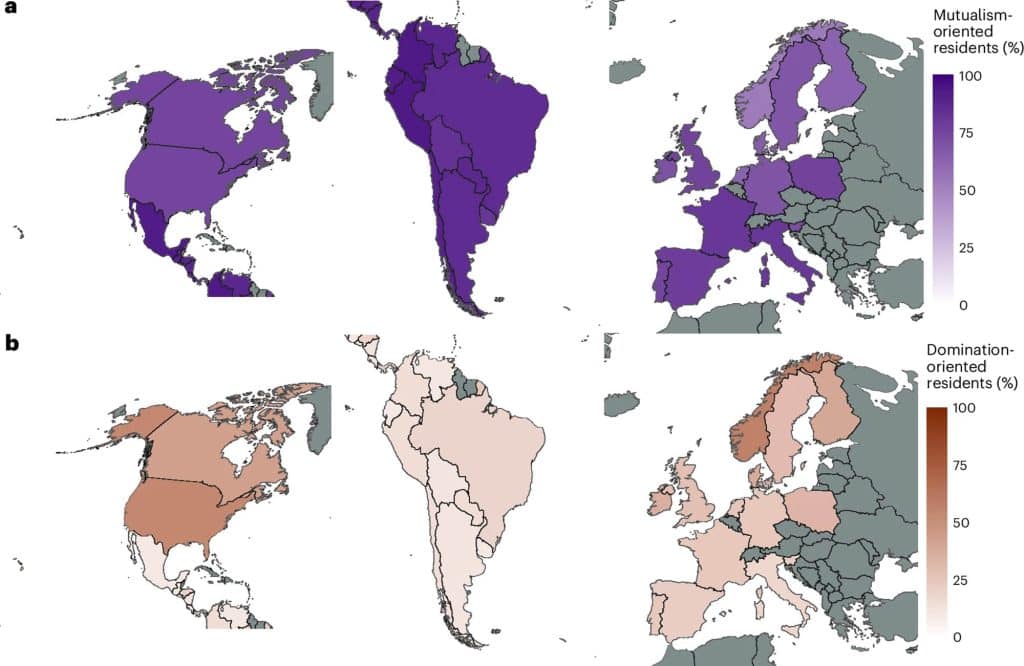
Figure: Distribution of wildlife values across Europe and the Americas. The map illustrates the percentage of mutualism-oriented residents (a) versus domination-oriented residents (b). Image credit: Colorado State University/Manfredo et al.
©Colorado State University/Manfredo et al. – Original
- Mutualism sees wildlife as part of a shared community. People with this view believe animals have inherent value beyond their usefulness to humans. Consequently, they typically support coexistence and non-lethal solutions when wildlife enters human areas.
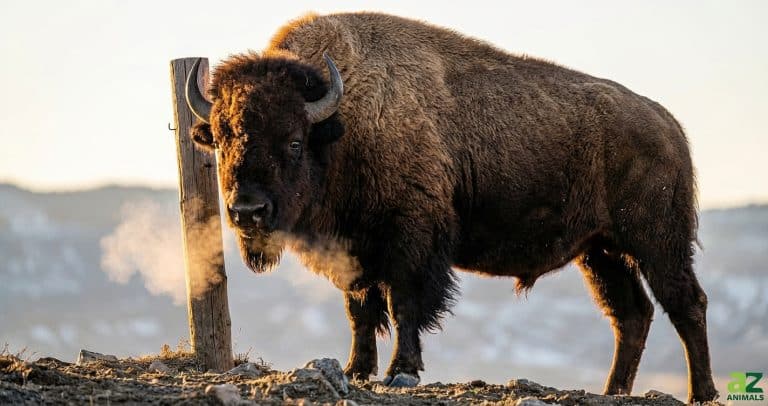
- Domination views wildlife as a resource. People with this perspective tend to see wildlife as something humans need to manage and control. Under this mindset, lethal control is often an acceptable solution when animals threaten people, livestock, or agriculture.
However, these values are not distributed evenly across the globe. The study found that Latin America scored highest in mutualism and lowest in domination. As a result, people in the region were generally less supportive of killing animals except when there was an immediate threat to human safety.
North America and Northern Europe showed stronger domination values. In the United States, for example, lethal control remains a common management tool for addressing conflicts involving predators and other wildlife.
Southern Europe occupied a middle ground, aligning more closely with Latin America’s mutualist outlook than with Northern Europe’s stronger domination orientation.
The Colonial Roots of Modern Attitudes

A community’s tendency to choose lethal eradication over non-lethal relocation is shaped more by deep cultural history than by modern economics or geography.
©010110010101101/Shutterstock.com
The researchers discovered that today’s wildlife values appear to reflect historical colonial structures from centuries ago. Different colonial goals required different relationships with nature, leaving behind distinct cultural legacies.
North America and the British Legacy of Control
In North America, British colonial institutions focused heavily on permanent settlement, agriculture, and rapid development. Building these societies required actively conquering, managing, and reshaping the natural environment. This history created a cultural legacy of human authority over the land. It explains why domination values remain strong in North America today, where people still largely view wildlife through the lens of management, control, and reducing threats to human activity.
Latin America and the Iberian Legacy of Extraction
Spanish and Portuguese colonial institutions were driven primarily by resource extraction — such as mining — rather than widespread permanent settlement and total landscape transformation. Because these systems interacted with the environment to extract wealth rather than fundamentally re-engineer the wilderness, they left a lighter ecological and psychological footprint. This created a deep divergence in how people think about animals centuries later.
A Religious Divide That Still Matters
Religion also plays an important role in how cultural mindsets toward nature developed.
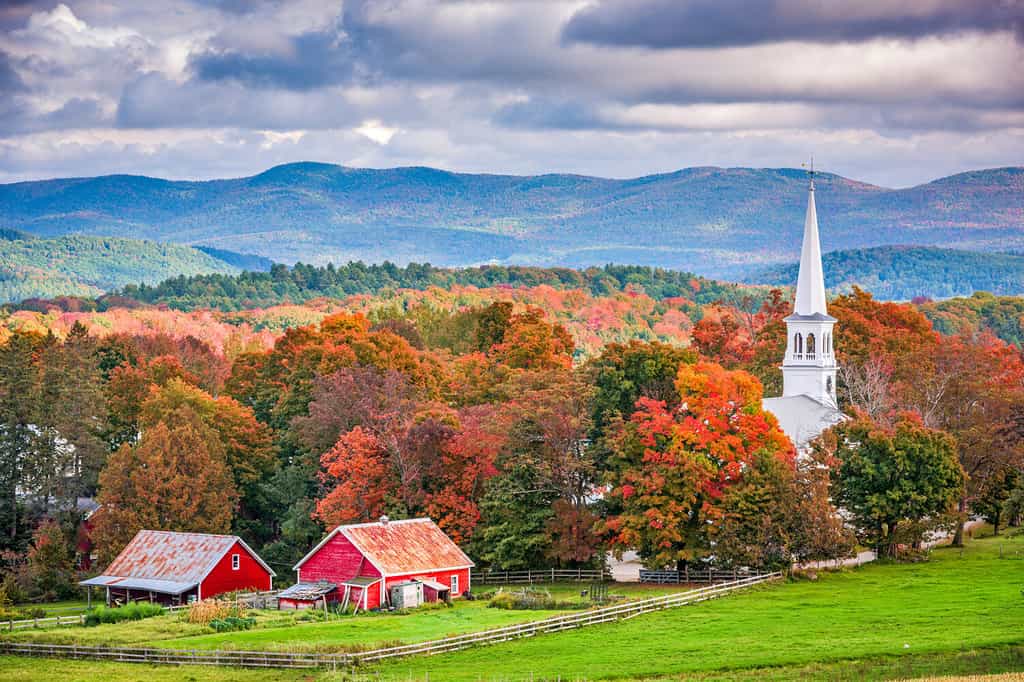
Following the Reformation, Northern European societies heavily embraced ideas of human mastery over nature.
©Sean Pavone/Shutterstock.com
Northern Europe’s Protestant Legacy
The study suggests that the Protestant Reformation helped shape a strong cultural emphasis on human mastery over nature. Over time, this fostered a highly utilitarian approach to the environment. Today, it translates into a tendency toward domination values, where people view wildlife as something to be actively controlled and managed.
Southern Europe’s Catholic Legacy
Southern Europe, which remained predominantly Catholic, followed a different cultural trajectory. Countries in this region maintained a less dominant, less aggressive relationship with nature. Today, this explains why Southern Europe occupies a middle ground between Latin America’s mutualist outlook and Northern Europe’s strict domination mindset.
Why Latin America Stands Apart
One of the study’s most surprising findings is a cultural twist: Latin America is actually more mutualist than Spain and Portugal, the very countries that colonized it. If colonial history were the only factor, Latin American attitudes should perfectly mirror Southern Europe’s middle-ground approach. Instead, Latin America emerged as the most mutualist region in the entire study.

Latin America’s mutualist views are the result of cultural blending over centuries.
©THP Creative/ via Getty Images
Researchers point to the region’s large Indigenous populations as a key factor. At the time of European colonization, Indigenous peoples are estimated to have numbered between 10 million and over 50 million across the Americas. Despite the immense disruptions and devastation of the colonial era, Indigenous cultural traditions and deep connections to the natural world survived. Over centuries, Indigenous perspectives and Iberian traditions blended rather than one completely replacing the other. According to the researchers, this cultural mixing helped create the strong mutualist values seen across much of Latin America today.
Why Conservation Plans Often Fail
The study offers a critical reality check for conservationists: wildlife management is not just a scientific or technical problem — it is a deeply cultural one. Treating wildlife conservation solely as a matter of biological data often leads to policy failure, because cultural values dictate whether local communities will actually accept a plan.
Researchers caution against applying a one-size-fits-all approach to wildlife conservation. A strategy that works perfectly in one country can face intense, gridlocked resistance elsewhere if it clashes with local beliefs about wildlife. For example, a management approach that relies on lethal control to handle predator conflicts may be widely accepted as standard procedure in many regions of the United States. However, in mutualist-leaning regions, that same lethal approach will likely encounter fierce public opposition and fail because it violates the community’s core values.

When wild animals cross into human spaces, regional identity dictates how residents respond.
©WhyNotChannel/Shutterstock.com
To build successful, lasting wildlife policies, conservationists must account for the cultural histories and values of the communities expected to live alongside the animals. Additionally, these values are not completely fixed. Rising education levels, urbanization, and increasing incomes are gradually shifting global populations toward more mutualist perspectives in many areas. However, this cultural evolution happens slowly, moving across generations rather than years.
Looking to the Past to Protect the Future
The study challenges the traditional assumption that present-day circumstances are the sole factor behind modern wildlife management conflicts. Instead, it demonstrates that they are deeply rooted in centuries-old historical, religious, and cultural forces that still shape how communities view the natural world.
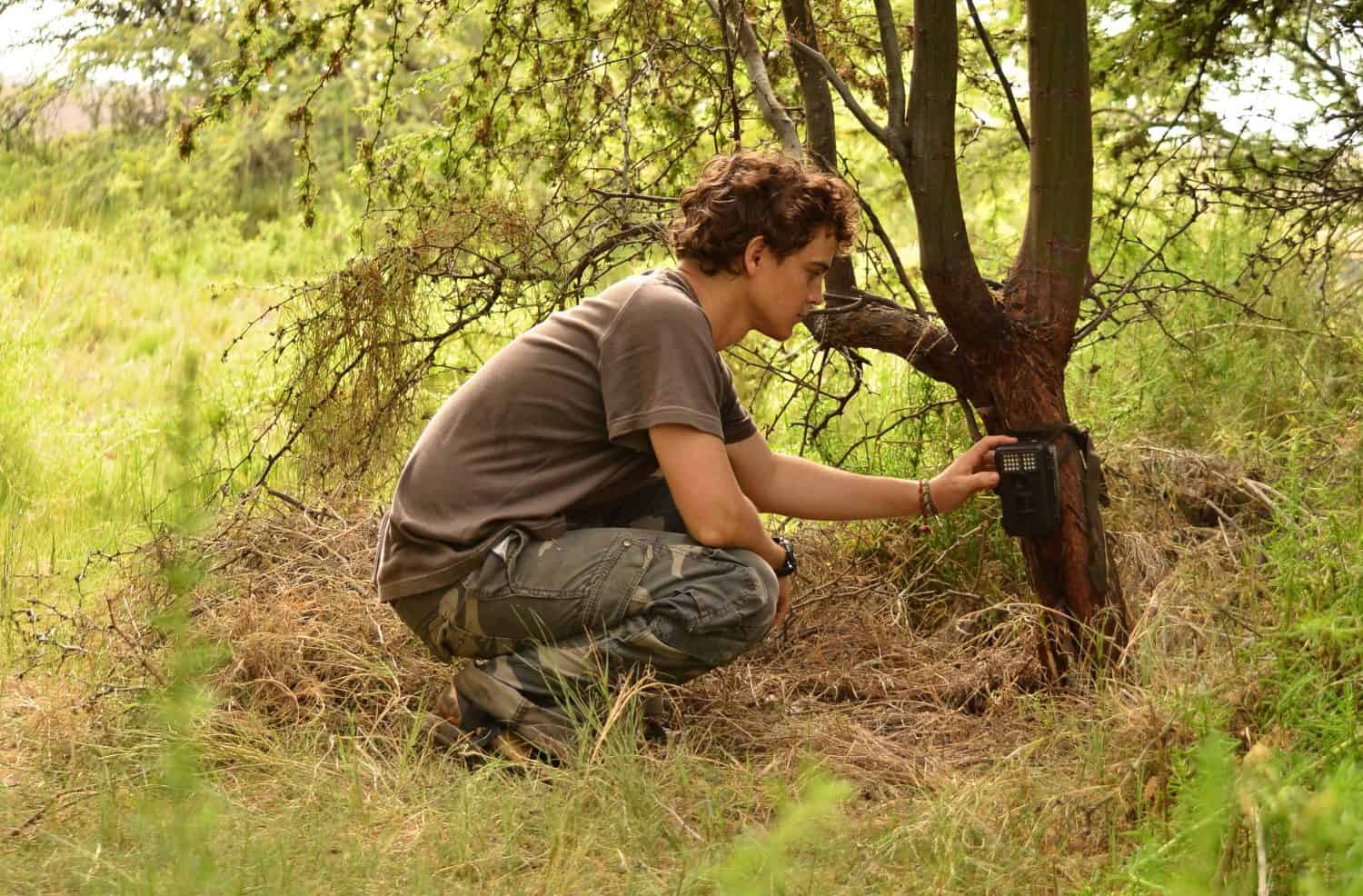
Understanding both the past and present is crucial for successful wildlife conservation.
©AlvaroGO/Shutterstock.com
Ecological science alone is no longer enough for successful wildlife conservation; it also requires an understanding of the historical, religious, and cultural forces that shape how communities view the natural world. When conservation plans ignore those influences, they often fail because they alienate local communities and face intense resistance. But when they work within existing cultural frameworks, they stand a much better chance of succeeding — for both people and wildlife — by building trust and gaining community support. To successfully protect wildlife in the future, we must first understand the deep cultural histories that shaped our present.