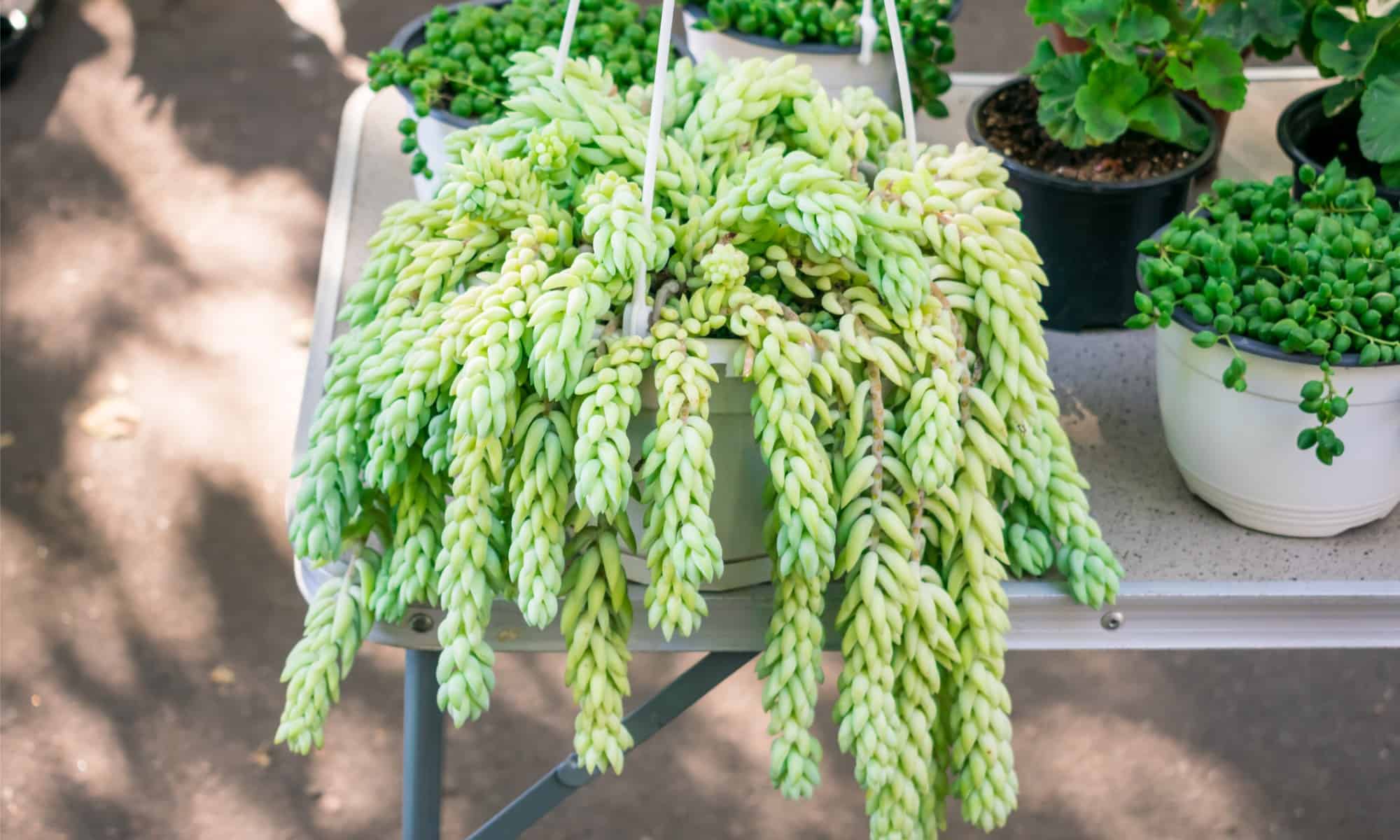

Trailing succulents offer the best of both worlds to plant parents: a unique, aesthetic quality with a low-maintenance nature. Like the string of pearls and the string of dolphins, the donkey tail gets its name from its likeness to its namesake.
In this article, we’ll cover donkey tail succulent care and growth tips and answer some commonly asked questions about this beginner-friendly plant.
Let’s dig in!
Donkey Tail: Origins
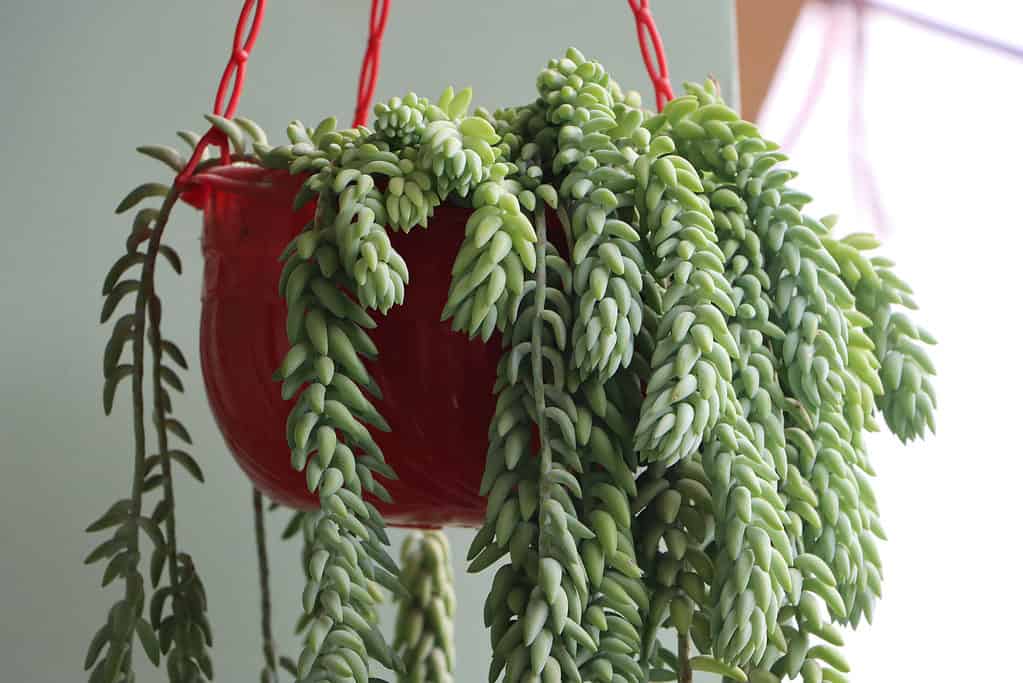
Air plants and some succulents, like Donkey Tail shown here, display well in hanging baskets.
©Pravruti/Shutterstock.com
The donkey tail succulent, scientifically known as Sedum morganianum, is native to Central Mexico.
Donkeys (known locally as the burro) are central to Mexico’s history and culture. The town of Otumba even has annual donkey celebrations to celebrate this stubborn, reliable animal.
As such, it’s no wonder that this plant was named the donkey tail or burro’s tail when discovered in the 1900s. Both the Sedum morganianum and Sedum morganianum ‘Burrito’ have become popular choices for succulent collectors.
Donkey Tail: Appearance
This vining succulent grows with long stems, encompassed by thick clusters of foliage. The plump leaves are ovaline or crescent-shaped, depending on the cultivar, with shades of vibrant green sometimes punctuated by yellow tones.
With proper care, the donkey (or burro’s) tail will produce pink blooms. The trailing vines can reach up to four feet long if left unpruned.
How to Care for a Donkey Tail
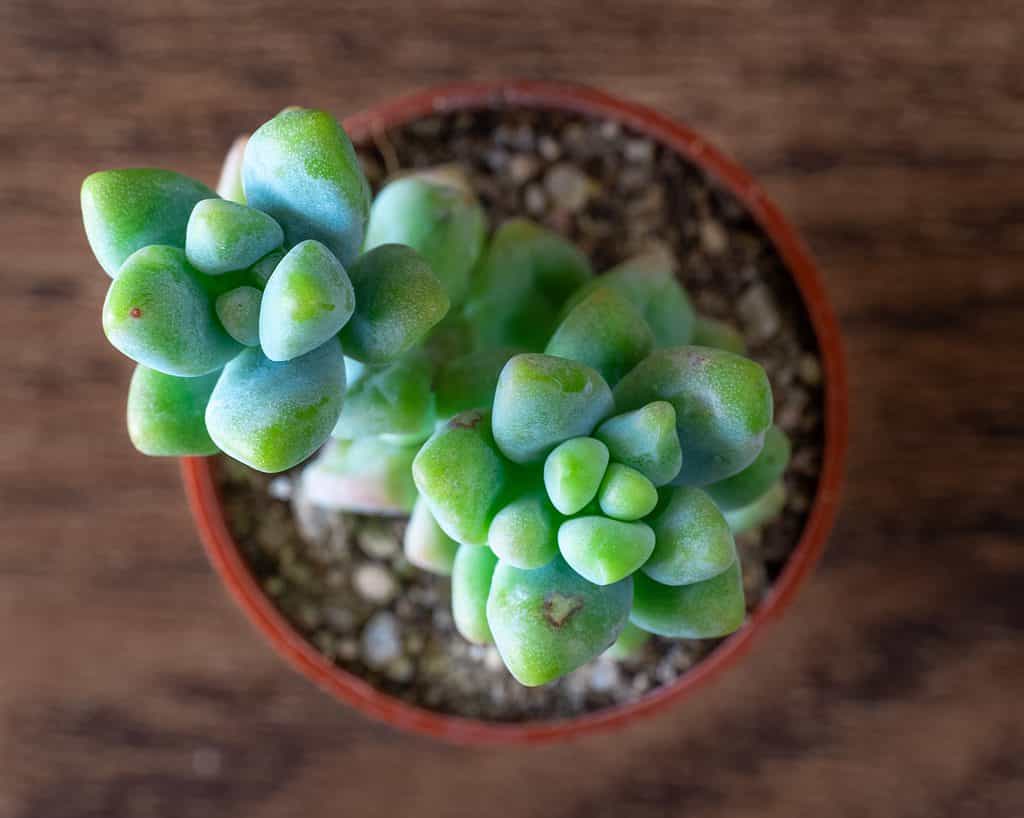
Plant your succulents in well-draining potting mix
©LoCrew/Shutterstock.com
This low-maintenance plant is easy to care for and propagate. It thrives as an indoor plant but will survive outdoors in USDA zones 10-11.
1. Soil Selection
Choose a well-draining succulent soil for your burro’s tail succulent. This drought-resistant plant can also tolerate cactus soil but won’t thrive in regular potting soil.
Like most succulents, the donkey tail is prone to root rot when left to sit in moist soil for a prolonged period. Choose a pot with plenty of drainage holes to prevent this issue.
2. Watering
Let the soil around your donkey tail dry completely before watering. This succulent prefers infrequent deep watering to consistently moist soil.
Reduce watering frequency during the winter months as this succulent enters its dormant period. If you notice the leaves looking less plump or starting to wrinkle, it’s overdue for a drink.
3. Sun Exposure
Like most succulents, the burro’s tail loves the sun. Place this plant in an East or South-facing window where it will get 6-8 hours of sunlight per day. You may need to supplement with a grow light.
If you decide to move your succulent outdoors in the summer, transition gradually. Putting the donkey tail succulent in direct overhead light for extended periods without a transition period could shock and kill it.
4. Maintenance and Care
Trim away dead leaves as needed and monitor your succulent for legginess.
Donkey tails are prone to the same pests as other succulents, including mealy bugs, scale insects, and spider mites.
5. Repotting and Fertilization
Present your donkey tail with a succulent-friendly fertilizer in the spring. Do not fertilize in the fall, as the plant is preparing for dormancy. Unabsorbed nutrients could damage the plant.
Donkey tails do well with a bit of crowding. However, you should repot it if the foliage is getting covered and starts to get leggy every two years for refreshed soil.
How to Propagate a Donkey Tail Succulent
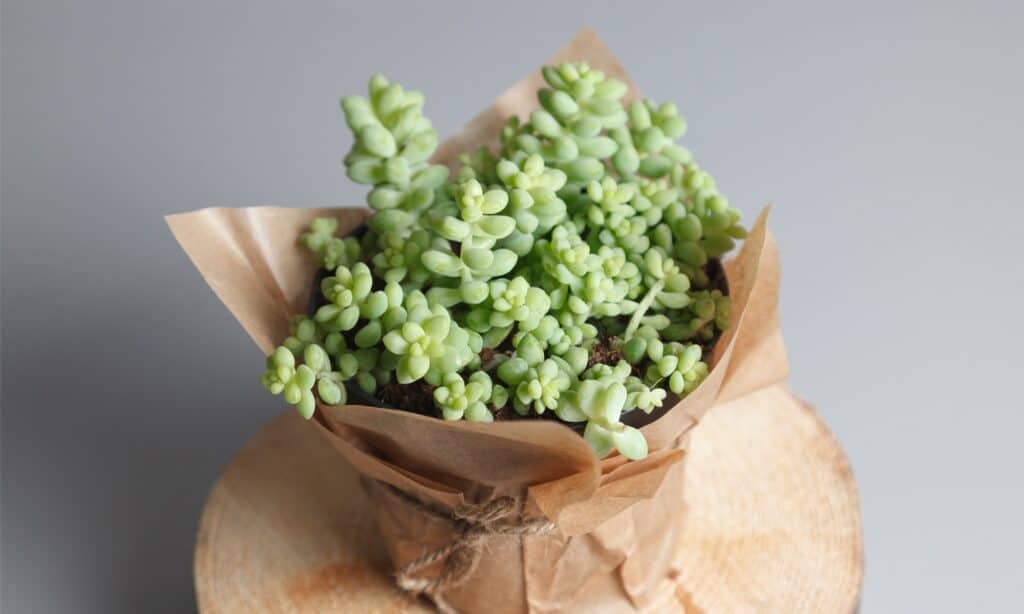
Burro’s tail succulents are easy to propagate and care for.
©iStock.com/fottodk
Donkey tails are incredibly easy to propagate with leaf cuttings.
- Water your donkey tail 2-3 days before propagating at the start of the growing season.
- Gently twist and pull an established leaf away from the vine.
- Place the leaf in a dry area to callous over. This process takes 2-3 days. Your cutting should be out of direct sunlight.
- Moisten some succulent soil and place it in a tray or shallow pot.
- Once calloused over, you can dip the calloused edge of your cutting in rooting hormone and lay it atop the soil. You can place several cuttings in one tray.
- Cover the dipped end with a bit of soil and place the tray in bright, indirect sunlight.
- Mist the soil daily.
- Once roots are established (3-4 weeks), you can transplant to a new pot and give it a full watering.
Leaf cuttings are the best option for growing new burro’s tail plants. Seed growth is finicky and depends on when your succulent blooms. While you can order seeds and try to grow them, it takes a lot of time and effort for minimal results.
When Will My Donkey Tail Bloom?
Donkey tails rarely bloom outside of their native environment. Providing ample sunlight, spring feeding, and top-notch care can encourage blooming on established plants.
Is the Donkey Tail Succulent Rare?
While these are unique, they are neither rare nor endangered.
Are Donkey Tail Succulents Toxic?
According to the ASPCA, these succulents are non-toxic to pets. However, you should put this trailing succulent out of reach of curious critters. The donkey tail may not harm your pets, but a curious cat could harm it!