





Barracuda fish are carnivores that hunt for prey at night. These saltwater fish inhabit warm waters — specifically, tropical and subtropical oceans. Barracuda fish capture their prey in the ocean with quick bursts of speed as fast as 27 mph.
A large, lower jaw and sharp teeth give barracudas a fierce appearance. Some barracudas live in groups called schools, while others live solitary lives. The average lifespan of a barracuda fish is 14 years.
Scientific Name
Wahoo fish and barracuda look very similar
©orifec_a31/Shutterstock.com
Barracuda are classified in the genus Sphyraena. They belong to the Sphyraenidae family and the class of Actinopterygii. Sphyraena is a Latin word that means pike-like, which refers to the thin, narrow body of this fish.
There are 26 species of barracuda, ranging in color and size. Some members of this group include the Great barracuda, Blacktail barracuda, Yellowtail barracuda, and the Pickhandle barracuda.
Here are a few different types of barracuda:
- Great barracuda (Sphyraena sphyraena)
- Yellowtail barracuda
- Obtuse barracuda
- Australian barracuda
- Pickhandle barracuda
- Guachanche barracuda
- Sphyraena japonica
- Northern sennet (Sphyraena arabia)
Evolution and Origins
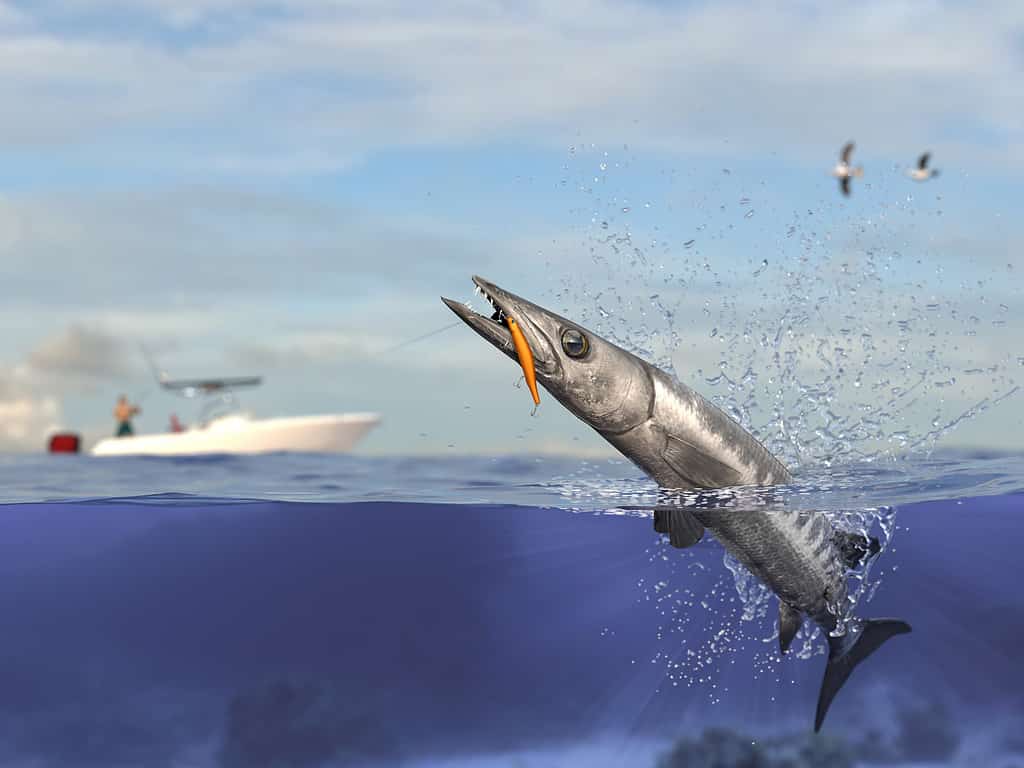
Barracuda fish are great sporting fish for fishermen.
©iStock.com/bbevren
Predatory fish called barracudas live in tropical and subtropical oceans all around the world. Around 70 million years ago, during the Late Cretaceous period, the family Sphyraenidae first appeared. This marks the beginning of the evolutionary history and origins of the barracuda.
Barracudas are a diverse group of animals that have developed over time to suit their unique habitats and prey items.
They have evolved a number of characteristics that make them successful hunters in marine ecology, including a streamlined body, pointed teeth, and superb swimming skills.
Appearance
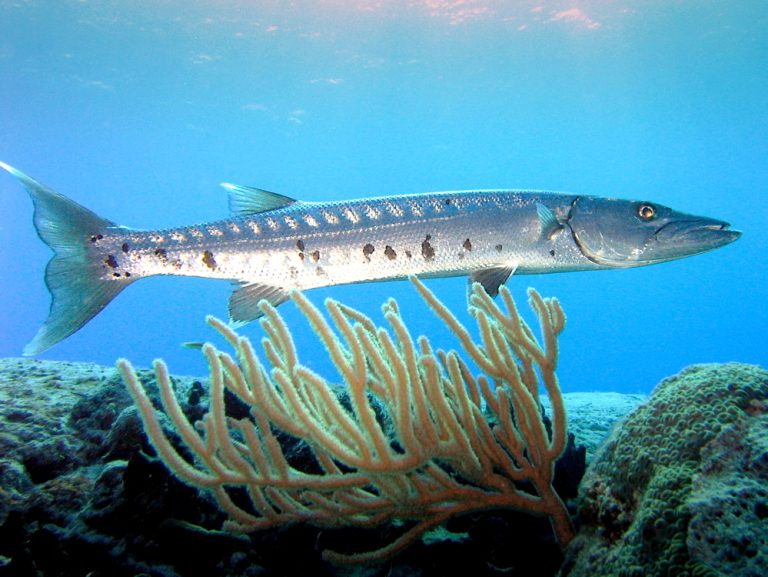
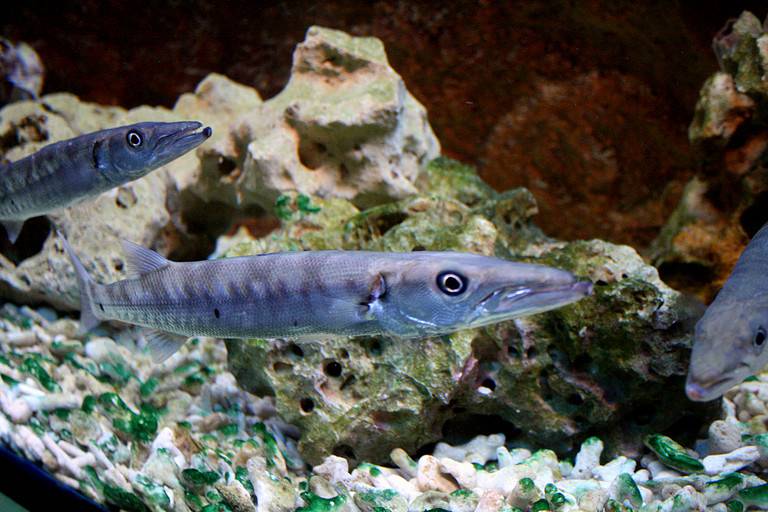
These fish have long, thin bodies that are usually silver in color. Of course, there are some small differences in appearance depending on the type of barracuda you’re studying. A great barracuda is silver with spots, while a Pickhandle barracuda has a line of dark bars running across its silver scales. The coloration of some smaller barracudas protects them from predators as they blend in with the rocks and sand on the ocean floor.
The fish’s thin body allows it to move through the water quickly as well as swim in and out of narrow spaces in a coral reef. The average length of the fish is about two feet. Think of a wooden ruler you may use in school. Line up two of those rulers end to end, and you’re looking at the length of a two-foot barracuda.
The weight range of the average barracuda is 10 to 12 pounds, but some species weigh more than others. For reference, a 12-pound fish weighs about the same as a big can of paint you’d see on the shelf in a home improvement store.
The biggest barracuda on record was caught by Dr. Cyril Fabre in Gabon in 2002. It weighed 102 pounds, 8 ounces, and was 7 feet long! That’s about the same weight as the average 13-year-old human boy.
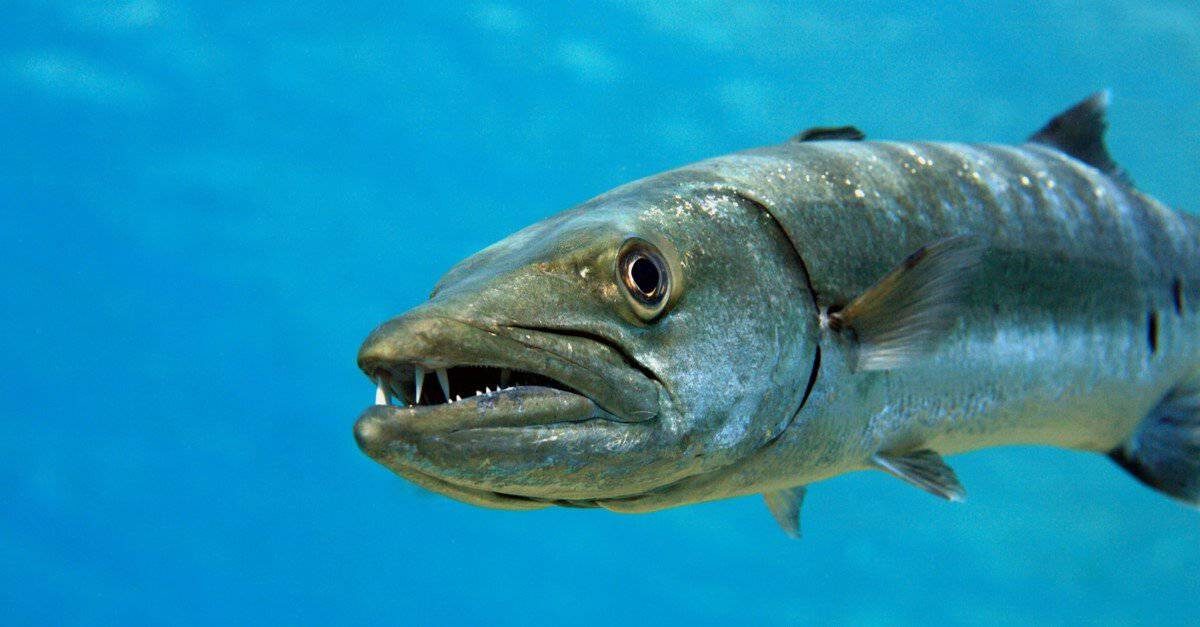
One of the most notable things about this fish is its pointy lower jaw that sticks out as it swims along. It usually has its mouth partially open, revealing dozens of tiny, sharp teeth. Some of these teeth are angled in a forward direction, while others tilt backward inside their mouths. The backward teeth keep small swimming creatures such as anchovies from slipping out of the fish’s mouth. Their teeth are designed to tear and chew their prey.

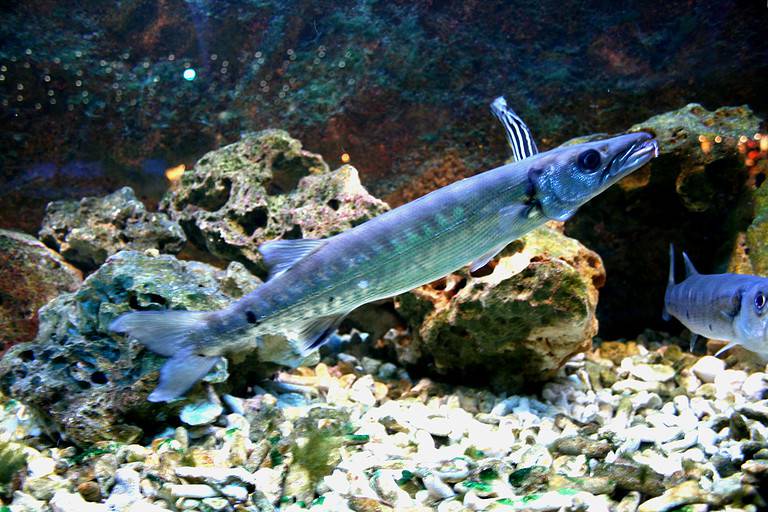
Great barracuda (Sphyraena barracuda) in the Prague Sea Aquarium.
©Karelj, Public domain, via Wikimedia Commons – Original / License
Behavior
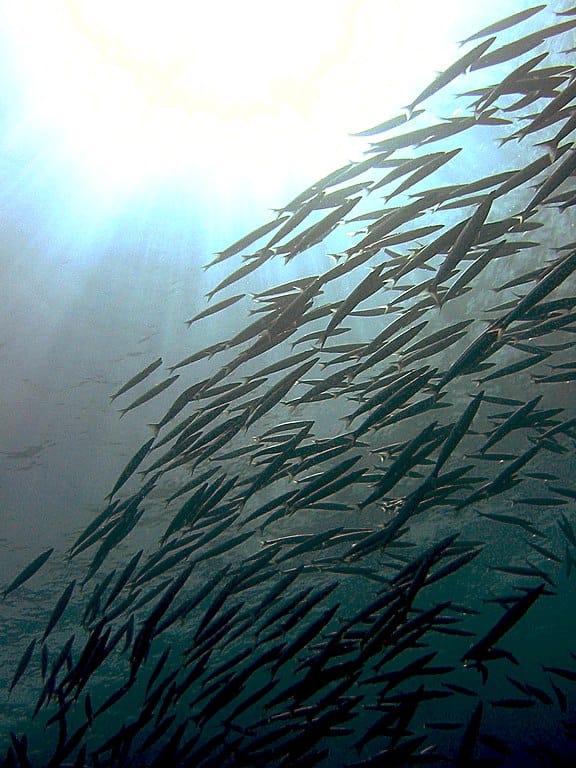
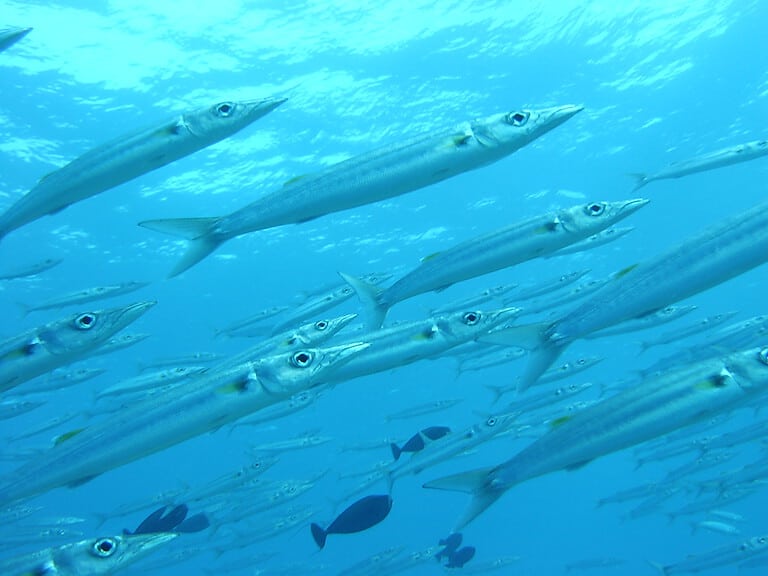
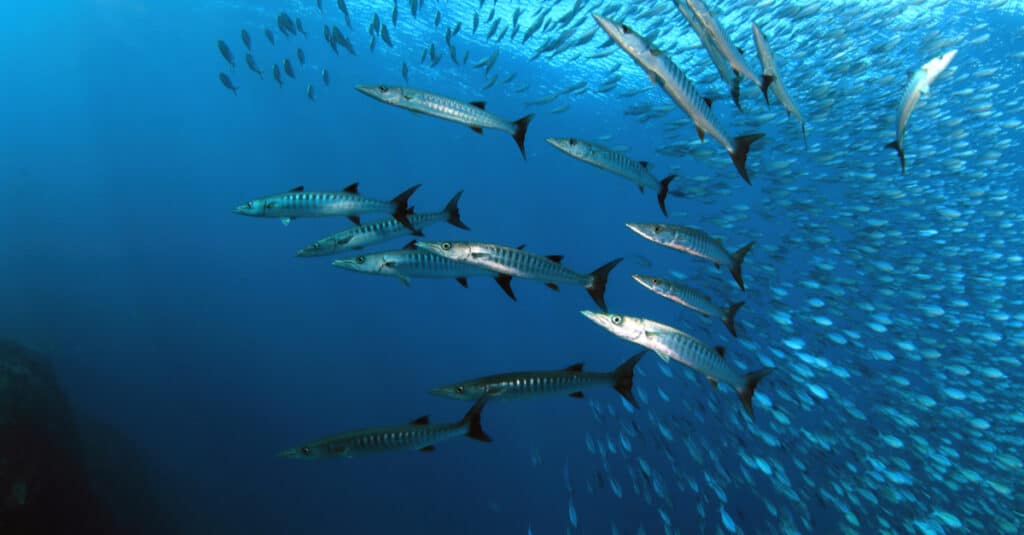
Though most adult barracudas live alone, younger fish live in groups called schools. Schools can sometimes include hundreds of young fish.
Living in such a large group provides protection against predators such as killer whales, dolphins, sharks, or even larger barracudas. A school of young fish moves through the ocean in a tornado-like formation to further confuse predators. Now, that’s cooperation!
These fish are aggressive and can be competitive with other sea creatures when hunting for prey. If a dolphin is going after a herring or mullet, a barracuda may try to get the prey for itself. Barracudas do not shy away from a fight.
They are also scavengers. This means they will eat any parts of prey left behind by another sea creature.
These fish hunt with their eyes more than any of their other senses. They swim around looking for shiny objects moving in their line of sight. When they think they’ve spotted a shiny fish, they speed up and attack. A swimmer or surfer who’s wearing a silver watch or a piece of jewelry may be bitten by a barracuda that has mistaken the shiny jewelry for food. Normally, these fish want to stay clear of humans.
Habitat
These fish live throughout the world in tropical and subtropical oceans, including the western and eastern Atlantic Ocean, the Gulf of Mexico, the Caribbean Sea, and the Red Sea.
They also live around coral reefs, in seagrasses, and in mangroves that are near shore. Their narrow body structure allows them to dart in and out of the holes and crevices in a coral reef. Most of their prey live in and around coral reefs as well.
Smaller fish also use the coral reef as protection from predators. But when they venture out into the open waters of the ocean, they usually swim near the surface and then dive deeper if they spot a predator in the area.
Diet
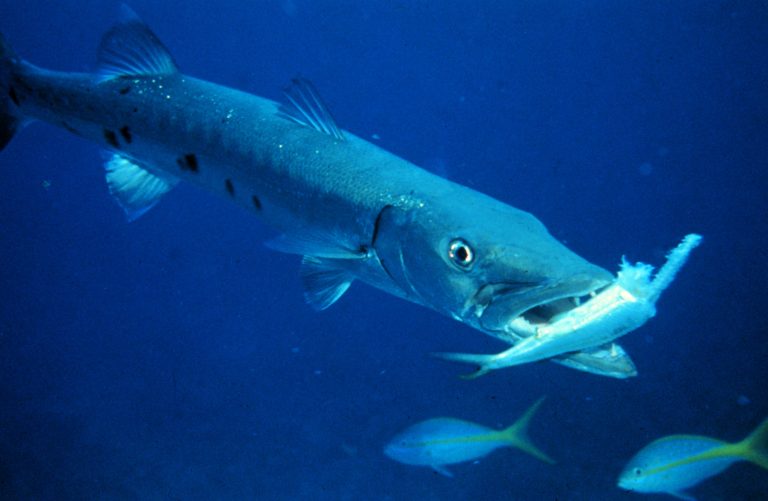
What do these fish eat? They are carnivores eating groupers, grunts, small tuna, anchovies, herring, and more. A barracuda has such powerful jaws that it simply bites a herring or grunt in half.
The larger the species, the larger its prey will be. A great barracuda may go after a large snapper, while a yellowtail barracuda preys on small herring.
Barracudas are usually found in saltwater searching for schools of plankton-feeding fish. Plankton can be difficult to spot, which is why barracudas heavily rely on their eyesight when they go out hunting. When hunting, they are attracted to anything with an intriguing color, reflection, or shape.
These fish hunt at night, eating small prey or tearing into larger swimming creatures with their razor-sharp teeth.
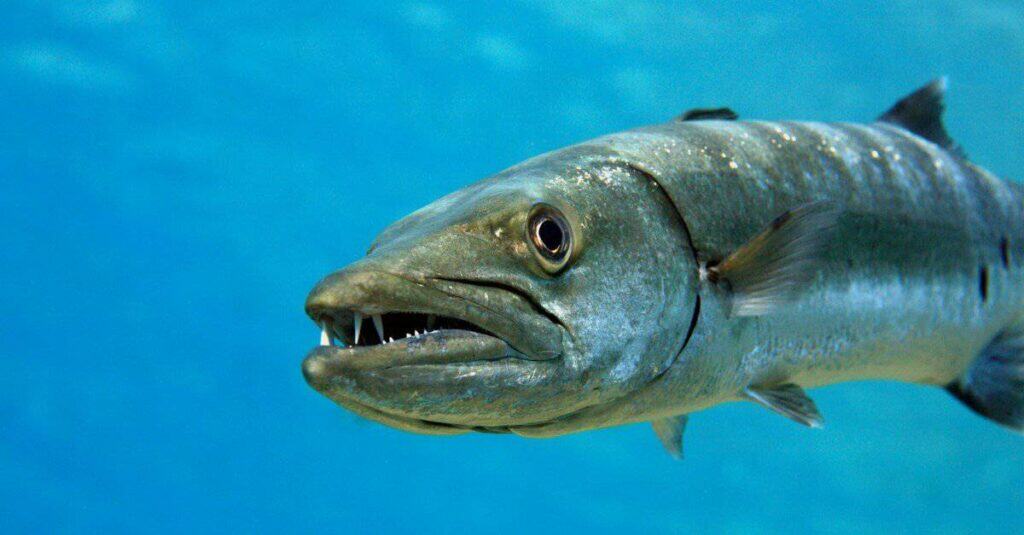
Barracuda swimming in the ocean. Barracudas are adept hunters with few predators because of their speed and size.
©aquapix/Shutterstock.com
Predators and Threats
Predators of these fish include killer whales, sharks, dolphins, and the Goliath grouper. All of these predators can match them in speed and strength.
Larger species, like the great barracuda, have fewer predators than the smaller types, such as yellowtail and blacktail barracudas.
Humans are also a threat to these fish. Humans will hunt barracudas as food and can also accidentally let them become tangled in nets meant for other sea creatures. When they get tangled in a net, they may drown or be discarded.
These fish also deal with some types of parasites as well as different types of pollution in the ocean. Like other sea creatures, they are also put at risk by weather events such as hurricanes. But, despite all of these challenges, they are not at risk for extinction. The official conservation status is Least Concern.
Reproduction, Babies, and Lifespan
It’s believed that these fish spawn, or release their eggs, between the months of April and October each year. Marine biologists are not sure about the exact time period.
Females release eggs and males release sperm into a shallow area of water. A female can release 5,000 to as many as 30,000 eggs! These eggs are very small, and many are likely to be eaten by sea creatures swimming by. By releasing thousands of eggs, a female increases the chances that some will be fertilized and grow into adults.
After the eggs are fertilized by the sperm, they float in the open water until they hatch. Once the eggs hatch, the barracuda larvae look for vegetation to eat. The shallow water provides hiding places and protection against predators. When the larvae grow to be juveniles, they move further out into the ocean to find a home in a coral reef.
Barracuda have an average lifespan of 14 years since they have a limited number of predators and aren’t especially vulnerable to illness or disease. Their ability to dive deep into the ocean and swim at a fast rate can also protect them from humans hunting for barracudas to sell as food.

Barracuda juvenile stage. The standard length of the juvenile great barracuda is twenty millimeters.
©By Smithsonian Institution from United States – Sphyraena barracuda, Juvenile (Great Barracuda), No restrictions, https://commons.wikimedia.org/w/index.php?curid=51392996 – Original / License
Population
Barracudas live in tropical and subtropical bodies of water all over the world. They are categorized as Least Concern by the International Union for the Conservation of Nature (IUCN), and their population is holding steady. Some laws specify how many and what size barracuda a person can capture. These laws have helped maintain the population of this sea creature.
Barracuda Pictures
View all of our Barracuda pictures in the gallery.

How to say Barracuda in ...
Sources
- David Burnie, Dorling Kindersley Animal, The Definitive Visual Guide To The World's Wildlife / Accessed May 24, 2010
- Tom Jackson, Lorenz Books (2007) The World Encyclopedia Of Animals / Accessed May 24, 2010
- David Burnie, Kingfisher The Kingfisher Animal Encyclopedia / Accessed May 24, 2010
- Richard Mackay, University of California Press (2009) The Atlas Of Endangered Species / Accessed May 24, 2010
- David Burnie, Dorling Kindersley (2008) Illustrated Encyclopedia Of Animals / Accessed May 24, 2010
- Dorling Kindersley (2006) Dorling Kindersley Encyclopedia Of Animals / Accessed May 24, 2010