Camel
Camelus dromedarius
 Verified by: AZ Animals Staff
Can survive without water for 10 months!
Advertisement
Camel Scientific Classification
- Kingdom
- Animalia
- Phylum
- Chordata
- Class
- Mammalia
- Order
- Artiodactyla
- Family
- Camelidae
- Genus
- Camelus
- Scientific Name
- Camelus dromedarius
Read our Complete Guide to Classification of Animals.
Camel Conservation Status

Camel Facts
- Prey
- Thorny and Salty Plants, Grass, Grain
- Name Of Young
- Calf
- Group Behavior
- Herd
- Fun Fact
- Can survive without water for 10 months!
- Estimated Population Size
- 20 million
- Biggest Threat
- Drought
- Most Distinctive Feature
- Long, curved neck and large hump
- Other Name(s)
- Dromedary Camel, Arabian Camel, One-Humped Camel, Bactrian camel, Two-humped camel
- Gestation Period
- 390 - 410 days
- Habitat
- Arid environments, like desert and scrubland
- Predators
- Lions, Leopards, Humans
- Diet
- Herbivore
- Average Litter Size
- 1
- Lifestyle
- Diurnal
- Common Name
- Camel
- Number Of Species
- 1
- Location
- Africa, the Middle East, India, China, Mongolia, and Australia
- Slogan
- Can survive without water for 10 months!
- Group
- Mammal
Camel Physical Characteristics
- Color
- Brown
- Black
- Tan
- Cream
- Skin Type
- Hair
- Top Speed
- 40 mph
- Lifespan
- 40 - 50 years
- Weight
- 300kg - 690kg (660lbs - 1,500lbs)
- Length
- 2.2m - 3.5m (7.25ft - 11.5ft)
- Age of Sexual Maturity
- 3 - 5 years
- Age of Weaning
- 4 months





How to Add Us to Google News


Classification and Evolution
The Camel (also known as the Dromedary Camel, the Arabian Camel, and the One-Humped Camel) is a large hoofed animal that is most commonly found in the hot deserts of Northern Africa and the Middle East.
Because of the camel’s resilience and adaptation to some of the harshest environments in the entire world, man domesticated camels thousands of years ago to be used as pack animals and for mounts. One could argue that without the camel, some civilizations and peoples would not have been able to thrive in arid locations.
Beyond helping with transportation, camels have historically been a resource for their meat and milk. Camels also provide two types of wool to be harvested: the outer, coarse layer and the inner, softer layer. Both are desirable for different purposes, and the camel sheds its wool naturally.
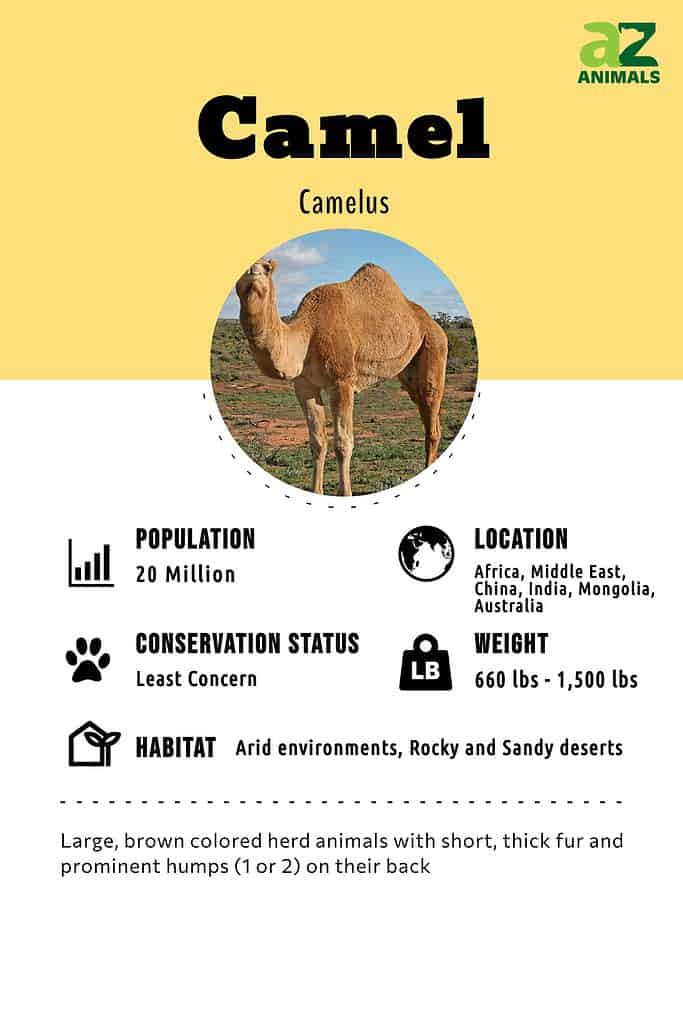
The Camel is one of the most unique mammals on the planet and has adapted perfectly to life in the desert where food and water can often be scarce, and the temperature changes rapidly from the scorching-hot days to the cooler nights. However, although they would have once been found freely roaming the Arabian deserts, they are today extinct from the wild but the domestic population is widespread and numerous.
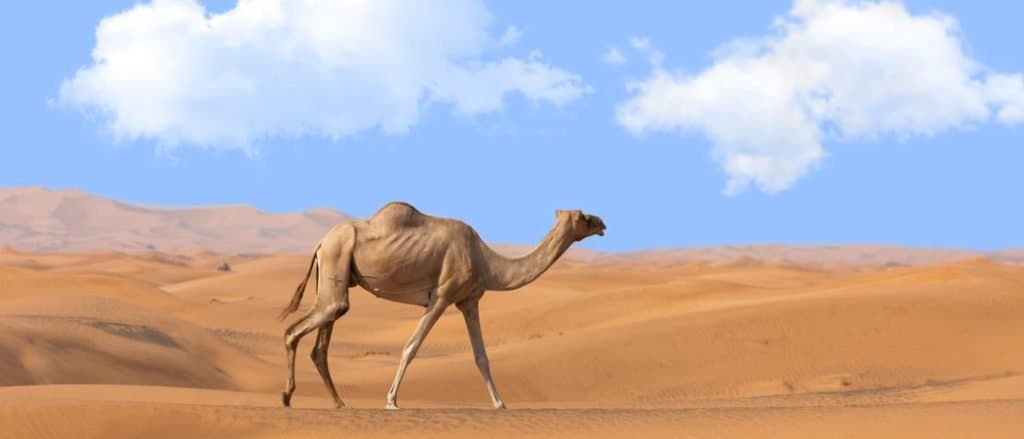
Camels have evolved to thrive in some of the harshest environments, including the desert.
©Black Kings/Shutterstock.com
Anatomy and Appearance
Camels have a number of great adaptations to help them to survive in arid climates.
As mentioned, camels have two layers of fur, which work together to provide protection for the harsh sun during the day and also warmth for cold desert nights. The coloration of camel fur varies from cream to brown.
Camels also have other adaptations to keep their center mass away from the blistering surfaces of their environments. Camels have somewhat long legs to help maintain a distance from the ground. Their chests are also pronounced to keep the abdomen off the ground when crouched.
Even the parts of their body that do touch the ground are specialized to help them survive. Because part of the territory that camels inhabit has a rocky and sharp floor, camel’s feet have developed thick pads to protect against cuts and bruises. In other areas that are not hard but are sandy, camels are able to avoid sinking in the sand by stretching wide their two-toed feet.
Camels’ eyes and noses are also adapted to thrive in arid areas. Long, layered eyelashes help keep out dust from their eyes, and their nostrils are very thin to help keep dust and debris out.
Perhaps most notably, the large, iconic humps of camels store fat (not water!) from which they are able to tap into as an energy source when nutrients and water are not available. This adaptation allows camels to move through harsh environments.
Camels are an animal with multiple stomachs, having three different stomachs that specialize in absorbing as many nutrients as possible from their harsh environment.
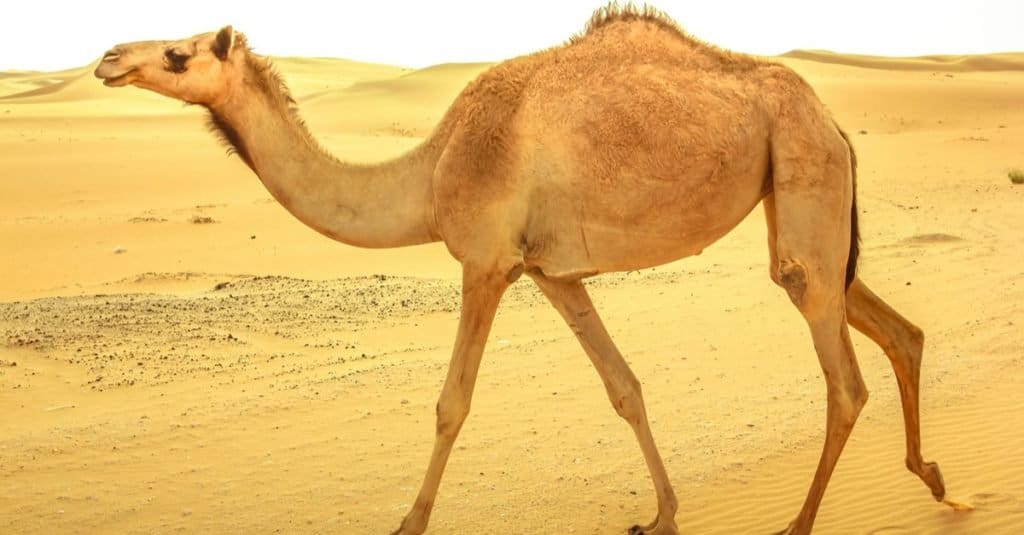
Camels’ thick brown skin helps protect them from the hot and cold days and nights in arid climates.
©Benny Marty/Shutterstock.com
Evolution and History
Similar to the origins of the horse, prehistoric camels are believed to have originated in North America around 40 to 50 million years ago. They were roughly the size of a rabbit. Eventually, they would evolve and migrate to Eurasia. The two-humped, Bactrian camel evolved from the one-humped, dromedary camel about 1 million years ago.
When the camel became domesticated is up for debate, but it was roughly 5,000 years ago! Mankind has been utilizing the awesome adaptions of the camel to help transport goods and people through some of the most uninhabitable terrains on Earth.
Distribution and Habitat
Historically the Camel would have roamed throughout the deserts of Northern Africa, the Middle East and as far into Asia as western India where the surroundings can change from soft, powdery dunes to more hostile and rocky regions. Today, Camels are no longer found in the wild but still exist as domestic animals in these areas and provide both transport and an important source of food for the local people. Their ability to go for so long without both food and water, along with being able to carry heavy loads has meant that they have allowed people to travel further across the desert. Today, millions of domestic Camels exist in the desert along with a feral population that can be found in the deserts of Central Australia.
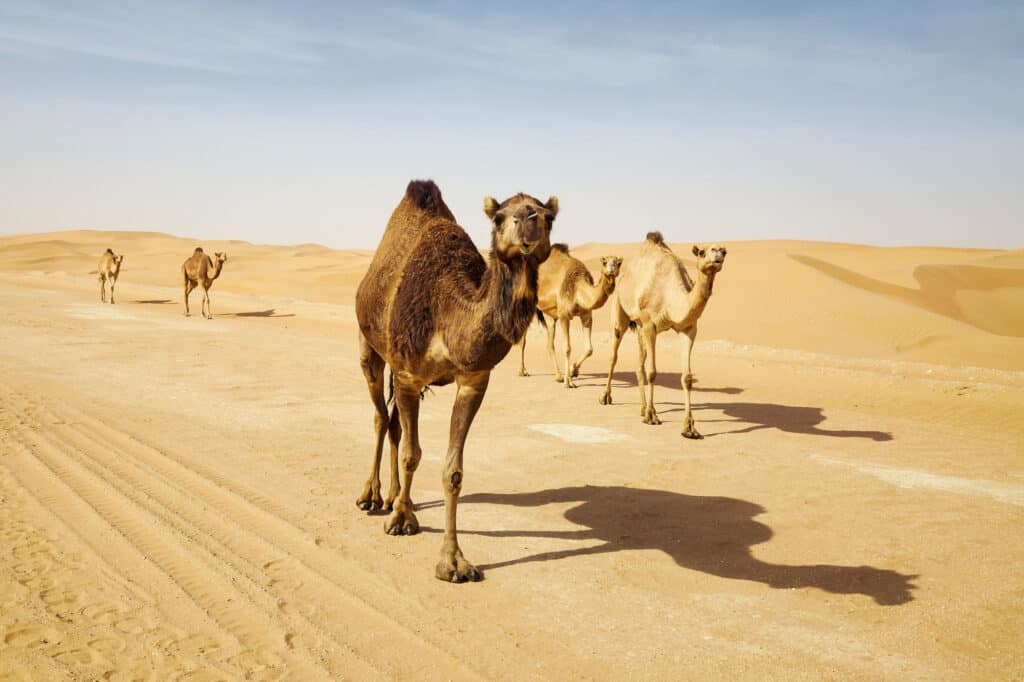
Most camels live as domestic animals, typically in Northern
Africa
, the Middle East, and as far into Asia as western India. There is one wild species of camel and there are many feral camels in the wild.
©iStock.com/Chalabala
3 Types of Camels
- Bactrian Camel – Bactrian camels are found in Central Asia and also in the area of Bactria. These camels are domesticated. While most camels that you see are one-humped, these and the wild version are two-humped! These humps are smaller and more conical than the dromedary hump.
- Dromedary/Arabian Camel – Dromedary camels can be found in the Middle East, South Asia, and the Sahara Desert. They have been brought into Australia and introduced there. They are domesticated. They are the tallest of the camels and have not been wild for almost 2,000 years.
- Wild Bactrian Camel – Wild Bactrian camels are located in Mongolia and northwestern areas of China. This type of camel is actually wild and not domesticated. This is a separate species from the Bactrian camel, and there are roughly 1,000 left on Earth.
Behavior and Lifestyle
Camels inhabit these dry and arid regions in herds that can contain up to 40 individuals and are comprised of females with their young and are led by a single, dominant male. During the breeding season, dominant males protect their harem of females by biting, spitting and leaning on their rival males. Camels rest by lying down and do so by bending their front legs underneath them, followed by the back. They are also known to move in a different way to many mammals by moving both left legs then both the right to make them walk. In order to try and conserve vital moisture in such hostile conditions, Camels have a minimal number of sweat-glands (very few in relation to their large body size), which along with the fact that they will allow their body temperature to rise in the heat, means that they lose water much more slowly than other large mammals.
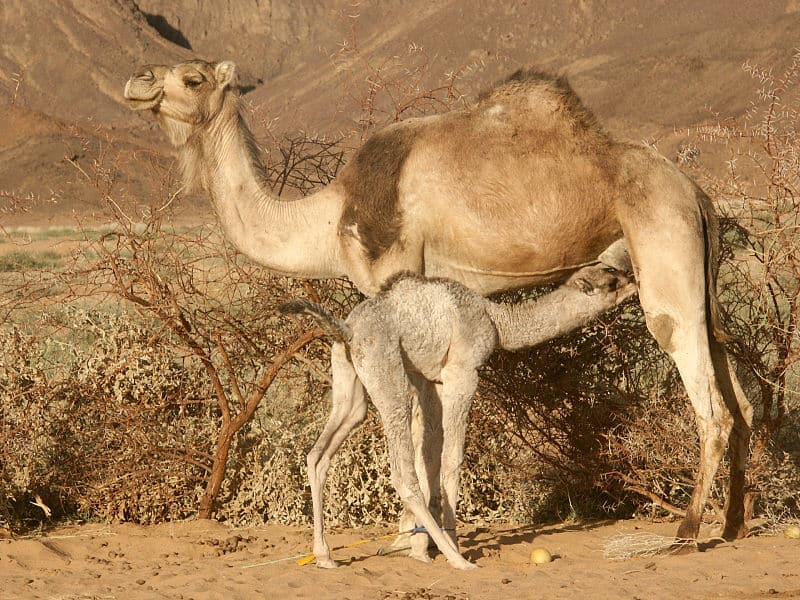
Camel herds are composed of females, calves, and one dominant male.
Reproduction and Life Cycles
Camels are able to breed by the time they are between three and four years old for females and five years old for males, when the dominant male of the herd has breeding rights with the females. Both female and male Camels come into heat during the breeding season which usually lasts between November and March. After a long gestation period that can last for up to thirteen months, the female gives birth to either a single calf or occasionally twins which can already weigh as much as 40kg at birth. Within eight hours the baby camel is able to stand and is then nursed by its mother in the protection of the herd until it is big and strong enough to become independent. Young Camels begin to eat grass when they are between two and three months old and are weaned at roughly four months of age.
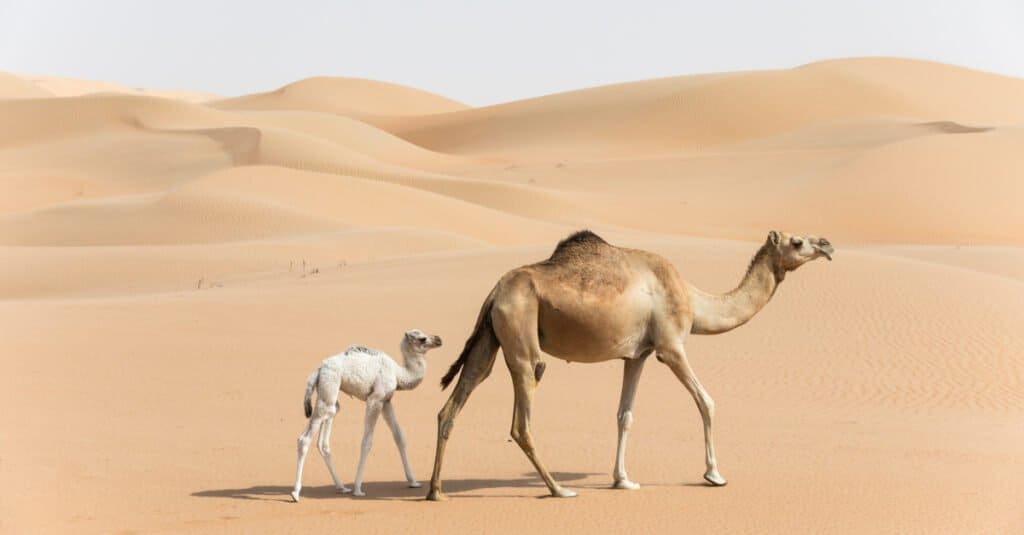
Female camels typically give birth to single calves, yet sometimes they do birth twins.
©Kertu/Shutterstock.com
Diet and Prey
Although the Camel is technically a herbivorous animal their diet is not strictly vegetarian as they are known to chew on bones and eat carrion to supplement their diet. Another adaptation for living in the desert is their split, leathery lip which helps the Camel to eat tough and thorny plants which other animals avoid. They are also known to consume plants that are high in salt which again means there is less competition from other animals for food. One of the most remarkable things about Camels is their ability to store the energy from their food and water as fat in their hump, which means they have a ready supply of energy when food and water are scarce. Camels can lose up to 40% of their body weight before needing to replenish themselves and once a water hole or oasis is found, they can drink around 40 gallons of water in a very short time. For a complete analysis of their diet, give our ‘What Do Camels Eat? Their Diet Explained’ page a read!”
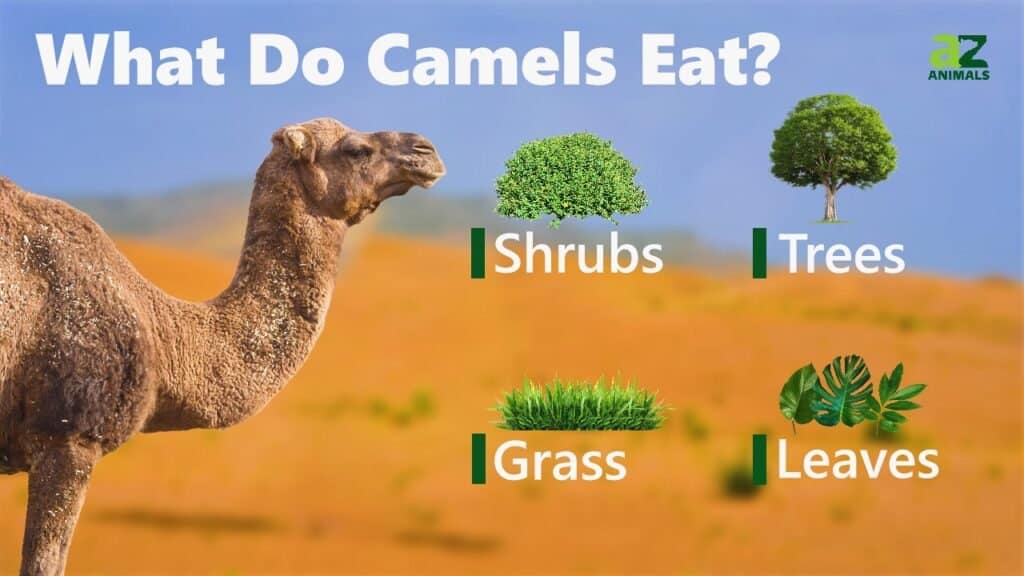
Predators and Threats
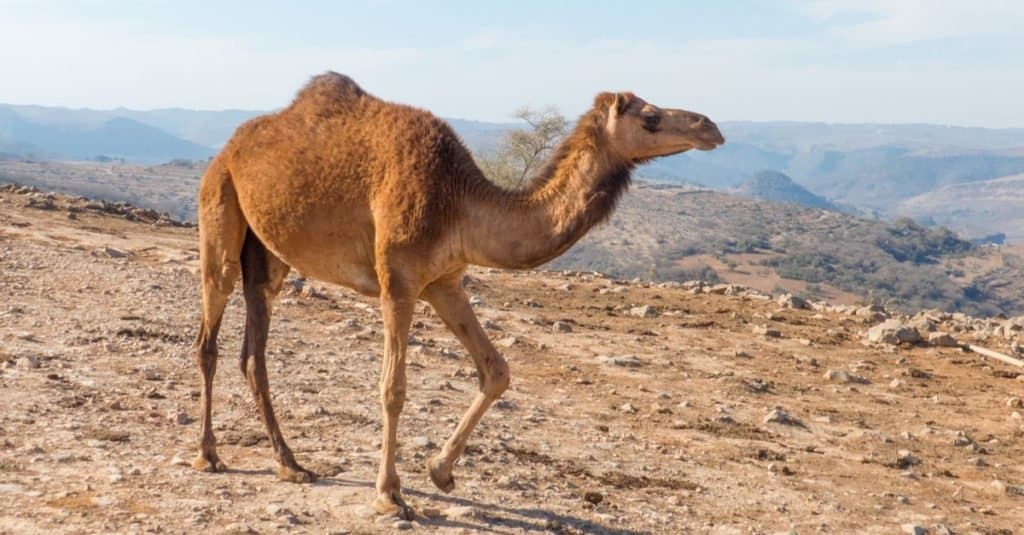
Although they no longer exist in the wild, the large size of the Camel means that it would have had limited predators. Lions and Leopards would have been their most common predators; however, the fact that Camels inhabit hostile, arid regions where very few large, carnivorous mammals can be found means that they would not have been hunted as regularly as other hoofed herbivores. Although they were first domesticated by people more than 5,000 years ago they would have been hunted by them for their meat and hides for longer. Today, although no Camels exist in the true wild their domestic population is high and they are commonly found alongside people from Northern Africa to Western Asia.
While camels have some protection provided by their bite and strong legs, they lived (before domestication) in areas that did not have many natural predators.
©Alexandra Lande/Shutterstock.com
Camel Interesting Facts and Features
Camels are not only hardy, desert animals because they can survive without water for up to 10 months provided they find food, but their relatively slow-paced lifestyle means that they can also travel vast distances (sometimes more than 30km) in just one day, whilst carrying a load that could exceed 200kg. As with a number of other domesticated animals, there are now various different breeds of Camel that have resulted from cross-breeding Camels with Bactrian Camels to produce individuals that are either bigger and stronger to be used as working animals or are incredibly fast. Unlike any other mammal, Camels have unique oval-shaped red blood cells which allow the blood to keep flowing smoothly when the animal becomes dehydrated and the blood thickens.
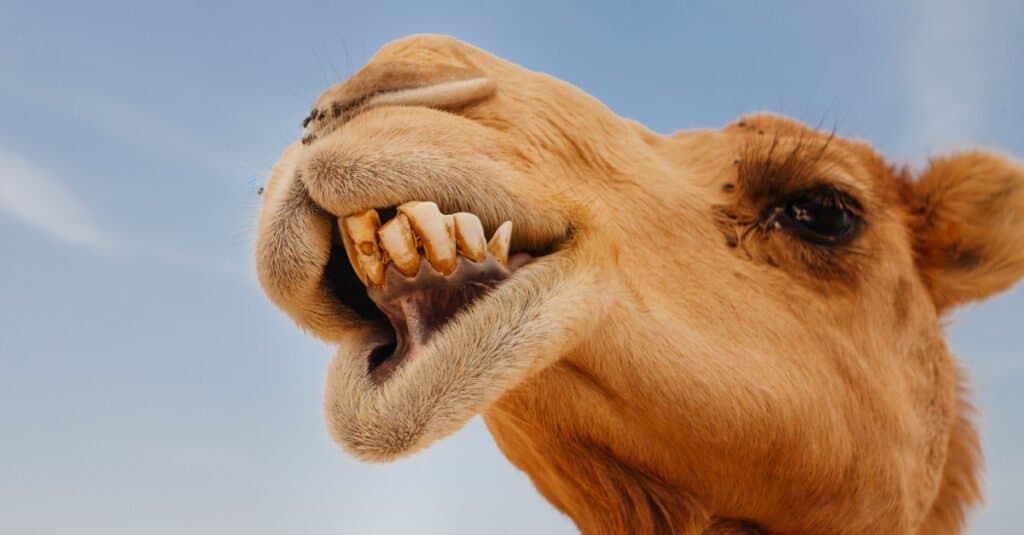
The dromedary camel is capable of drinking 100 L (30 gal.) of water in just 10 minutes and can tolerate water loss equal to over 30% of their body weight.
©Fabian Junge/Shutterstock.com
Relationship with Humans
Camels have been used for thousands of years by people both for transporting goods across the desert and as a good source of milk and meat. Their woolly hair can also be used to make clothing along with their leathery hides. Like other domestic animals, there are now numerous breeds of Camel but not all have been bred for truly practical uses with faster and faster breeds appearing that are then used for Camel racing. Their placid nature though has meant that they can live alongside people and other livestock without hardly any problems.

Camels have been used for millennia to move humans and their goods across vast distances.
©givaga/Shutterstock.com
Conservation Status and Life Today
Today, although the wild Camel population is extinct they are Common as domestic animals throughout much of their natural range and further, with estimates ranging as high as 20 million individuals. In the 1800s, the first Camel was imported into Australia to be used to help people get between places in the vast desert. Since then more and more have followed which has to led there now being a strong feral population that is possibly as high as 1 million Camels roaming the deserts of Central Australia.
More on Camels
- Why Do Camels Have Humps?
- Camel Teeth: Everything You Need to Know
- Camel Poop: Everything You’ve Ever Wanted to Know
How to Add Us to Google News

Camel FAQs (Frequently Asked Questions)
Are Camels herbivores, carnivores, or omnivores?
Camels are Herbivores, meaning they eat plants.
What Kingdom do Camels belong to?
Camels belong to the Kingdom Animalia.
What class do Camels belong to?
Camels belong to the class Mammalia.
What phylum to Camels belong to?
Camels belong to the phylum Chordata.
What family do Camels belong to?
Camels belong to the family Camelidae.
What order do Camels belong to?
Camels belong to the order Artiodactyla.
What type of covering do Camels have?
Camels are covered in Hair.
What genus do Camels belong to?
Camels belong to the genus Camelus.
Where do Camels live?
Camels are found in Africa, the Middle East, India, Mongolia, China, and Australia.
In what type of habitat do Camels live?
Camels live in arid environments, like deserts and scrublands.
What are some predators of Camels?
Predators of Camels include lions, leopards, and humans.
How many babies do Camels have?
The average number of babies a Camel has is 1.
What is an interesting fact about Camels?
Camels can survive without water for 10 months!
What is the scientific name for the Camel?
The scientific name for the Camel is Camelus.
What is the lifespan of a Camel?
Camels can live for 40 to 50 years.
What is a baby Camel called?
A baby Camel is called a calf.
How many species of Camel are there?
There is 3 species of Camel.
What is the biggest threat to the Camel?
The biggest threat to the Camel is drought.
What is another name for the Camel?
Camels are called the dromedary camel, Arabian camel, one-humped camel, Bactrian camel, and two-humped camel.
How many Camels are left in the world?
There are 20 million Camels left in the world.
How fast is a Camel?
A Camel can travel at speeds of up to 40 miles per hour.
What is the difference bewteen a llama and a camel?
The main differences between a llama and a camel are their habitat and range, their ecological adaptations, and their use by humans. Llamas originate from South America after going extinct in North America after the last ice age. They prefer mountainous regions, open plains, and can live in a farm environment. Camels originate from North Africa, the Middle East, and well into Asia and India. Only a tiny population is found in the wild, and they prefer deserts, open scrublands, and arid environments. Llamas have specialized feet with soft, sensitive bottoms, allowing them to be incredibly sure-footed and cause less damage to their native habitat. Additionally, they have heightened levels of hemoglobin in their blood to help them get oxygen in the extreme elevations they can sometimes live. Camels are quite famous for their adaptations. Among them are large, flat feet to stop from sinking in the sand, thick top fur to protect from the sun, and localized fat stores (hump) to help with heat loss.
How to say Camel in ...
Thank you for reading! Have some feedback for us? Contact the AZ Animals editorial team.
Sources
- David Burnie, Dorling Kindersley (2011) Animal, The Definitive Visual Guide To The World's Wildlife
- Tom Jackson, Lorenz Books (2007) The World Encyclopedia Of Animals
- David Burnie, Kingfisher (2011) The Kingfisher Animal Encyclopedia
- Richard Mackay, University of California Press (2009) The Atlas Of Endangered Species
- David Burnie, Dorling Kindersley (2008) Illustrated Encyclopedia Of Animals
- Dorling Kindersley (2006) Dorling Kindersley Encyclopedia Of Animals
- David W. Macdonald, Oxford University Press (2010) The Encyclopedia Of Mammals
- Camel Reproduction, Available here: http://www.veterinaryworld.org/Vol.2%20No.2%20Full%20Text/Reproduction%20in%20Camel.pdf
- Camel Breeds, Available here: http://www.camelphotos.com/camel_breeds.html