




C
Species Profile

Camel

Camelus

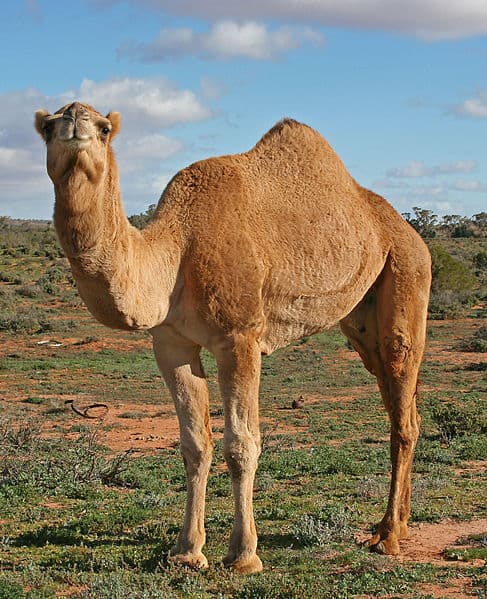
Humps of fat, miles of grit
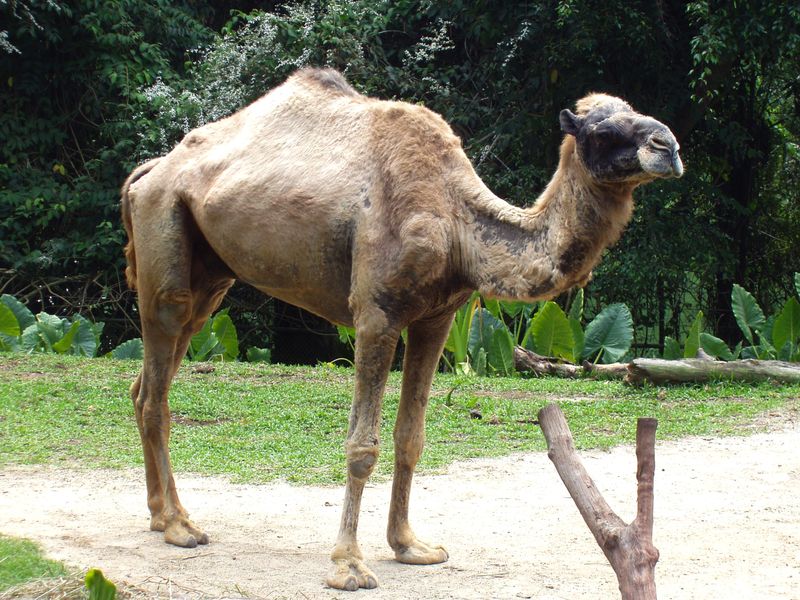
Daderot - Public Domain

Camel Distribution

Click a location to explore more animals from that region

Invasive Species
Loading map...

Size Comparison

Human 5'8"
Camel 6 ft 3 in

Camel is 1.1x the height of an average human.

At a Glance

Genus Overview This page covers the Camel genus as a group. Stats below are general traits shared across the genus.
Also Known As Ship of the desert, Desert ship, Beast of burden, Humped beast, Jamal (Arabic), Oont (Hindi/Urdu), Deve (Turkish), Camello (Spanish)
Diet Herbivore
Activity Diurnal+
Lifespan 25 years
Weight 1000 lbs
Status Not Evaluated
Did You Know?

Camelus includes three living species: one-humped dromedary (C. dromedarius), two-humped domestic Bactrian (C. bactrianus), and the wild camel (C. ferus).

Scientific Classification

Genus Overview "Camel" is not a single species but represents an entire genus containing multiple species.

Camels (genus Camelus) are large camelids adapted to arid and semi-arid environments, characterized by specialized fat-storage humps, efficient water conservation, and endurance for long-distance travel with loads.

Kingdom
Animalia
Phylum
Chordata
Class
Mammalia
Order
Artiodactyla
Family
Camelidae
Genus
Camelus

Distinguishing Features

  • One or two humps (fat storage) depending on species
  • Broad, padded feet for sand and rough substrates
  • Closable nostrils and long eyelashes to reduce sand intake
  • Highly efficient water use and tolerance of dehydration
  • Thick coat especially in Bactrian camels for cold climates

Physical Measurements

Males and females differ in size

Height
♂ 6 ft 7 in (5 ft 11 in – 7 ft 7 in)
♀ 5 ft 11 in (5 ft 3 in – 6 ft 7 in)
Length
♂ 10 ft 2 in (8 ft 6 in – 11 ft 10 in)
♀ 10 ft 6 in (8 ft 6 in – 13 ft 1 in)
Weight
♂ 1,543 lbs (882 lbs – 1.1 tons)
♀ 992 lbs (661 lbs – 1,433 lbs)
Tail Length
♂ 1 ft 6 in (1 ft 2 in – 1 ft 10 in)
♀ 1 ft 6 in (1 ft 2 in – 1 ft 10 in)
Top Speed
40 mph
Sprint ~50–65 km/h

Appearance

Primary Colors
Secondary Colors
Skin Type Camels have thick, tough skin with hard calluses on chest and knees for kneeling. Coats: short hair on one-humped, long wool on two-humped. Nose and skin cut water loss; broad padded feet suit sand.
Distinctive Features
  • Genus-level body size range (smallest to largest across Camelus): shoulder height roughly ~1.7-2.3 m; head-body length ~2.3-3.5 m; adult mass commonly ~300-1,000+ kg (domestic animals can be especially heavy).
  • Humps are fat-storage structures: one-humped camels (dromedaries) vs two-humped camels (Bactrian and wild camels). Hump size varies with nutrition/season and can shrink/lean when fat reserves are used.
  • Long legs and a narrow, elevated body profile reduce heat gain from hot ground; broad, two-toed, splayed feet with large pads improve travel on sand and soft substrates while also handling rocky steppe/desert terrain.
  • Head adaptations to aridity: long eyelashes, hairy ear openings, and closable/valved nostrils help block sand and dust; robust lips and a tough oral lining allow browsing of thorny, salty, or abrasive plants.
  • Physiological arid-land specializations shared across the genus: strong dehydration tolerance, efficient kidneys/concentrated urine, dry feces, flexible body temperature regulation, and rapid rehydration when water becomes available.
  • Diet/ecology generalization: predominantly browsers/grazers depending on locality and season; able to utilize salty/brackish water and halophytic plants more than many other large mammals. Variation exists with habitat (hot deserts vs cold deserts/steppe).
  • Social/behavioral generalization: typically live in groups (female/young groups and male-associated dynamics); composition and stability vary by habitat, human management (domestic herds), and season. Adult males may become more solitary or territorial during rut.
  • Lifespan across the genus: commonly ~30-50 years (often longer in managed/domestic settings than in fully wild conditions, where hazards and resource limitation can reduce average lifespan).
  • Human association (domesticated members): long history of domestication and use for transport/packing, riding, milk, meat, hides, and fiber (especially thick Bactrian wool). Human selection has increased color variation and body build diversity in domestic stocks.

Sexual Dimorphism

Moderate sexual dimorphism across Camelus: males average larger and heavier with more pronounced neck/shoulder musculature, especially during rut; the degree varies by species, population, nutrition, and domestic breeding/management.

♂
  • Typically larger body mass and height; heavier neck and forequarters (most evident in rut).
  • Behavioral dimorphism during rut: increased aggression/territoriality, scent marking, and display behaviors; in dromedaries, males may evert an inflatable soft-palate organ (dula) as a display.
  • Often more prominent head/neck "bulk" and thicker-looking coat in some lines; rut-related skin/neck gland activity can be more noticeable (species/population dependent).
  • Humps may appear more massive in well-fed adult males, though hump size is strongly influenced by condition rather than sex alone.
♀
  • Generally smaller and lighter, with a less bulky neck/forequarter profile.
  • Typically less aggressive and less prone to rut-associated display behaviors; often central to stable group structures with young in freer-ranging contexts.
  • Humps can be smaller on average, but variation overlaps widely with males and is strongly driven by nutrition, pregnancy/lactation, and season.

Did You Know?

Camelus includes three living species: one-humped dromedary (C. dromedarius), two-humped domestic Bactrian (C. bactrianus), and the wild camel (C. ferus).

Their humps store fat (not water), providing energy when forage is scarce; hump size can shrink during hard times.

Camels can drink very large volumes quickly after dehydration, then go days without water depending on conditions.

They have oval red blood cells, which helps blood keep flowing during dehydration and allows rapid rehydration without cells bursting.

Bactrian camels are cold-desert specialists (e.g., Central Asian steppe/desert), while dromedaries are built for hot deserts-same genus, different climate extremes.

Wild camels (C. ferus) are among the rarest large mammals and are listed as Critically Endangered; they face threats including habitat pressures and hybridization with domestic camels.

Camel milk has deep cultural and economic importance across North Africa, Arabia, and Central Asia; camels also provide meat, leather, and (especially in Bactrians) valuable fiber.

Unique Adaptations

  • Fat-storage humps: one hump (dromedary) vs two humps (Bactrian and wild camels) concentrates energy reserves and reduces insulating fat over the rest of the body-helpful for heat management and long fasts.
  • Extreme water economy: they can tolerate substantial dehydration, reduce water loss, and rebound quickly when water becomes available; capacity and limits vary with temperature, workload, and species.
  • Nasal adaptations: complex nasal passages help reclaim moisture from exhaled air; nostrils can narrow/close in dust and sandstorms.
  • Desert-proof feet: broad, splayed, cushioned feet distribute weight on sand and soft substrates; performance differs somewhat between dunes and rocky steppe.
  • Tough mouthparts: thick, leathery lips and robust oral tissues help them browse thorny shrubs and coarse plants.
  • Insulating coat diversity: dromedaries tend to have shorter coats suited to heat, while Bactrian camels grow very heavy winter coats for cold deserts; wild camels also show strong seasonal coat shifts.
  • Physiology for heat/cold swings: they can allow body temperature to fluctuate more than many mammals, reducing the need for sweating and conserving water-useful across both hot deserts and cold, arid regions.

Interesting Behaviors

  • Long-distance, energy-saving travel: Camelus species commonly move in steady, economical gaits suited to migration, herding, and caravan routes; typical travel patterns vary with season and pasture.
  • Social structure: often found in small groups (females with young; bachelor males), though domestic herds can be much larger; group size and cohesion vary by husbandry and habitat.
  • Browsing and grazing flexibility: they feed on grasses, herbs, and woody shrubs; many populations readily eat thorny or salty plants other livestock avoid, with diets shifting by region and season.
  • Thermoregulation by timing: many camels concentrate feeding/travel in cooler hours and rest during heat or intense cold; exact daily rhythms differ between hot deserts (dromedaries) and cold deserts (Bactrians/wild camels).
  • Rut behavior (notably in males): seasonal breeding can bring dramatic displays-necking, vocalizations, scent-marking, and heightened aggression; intensity and timing vary across species and management.
  • Defensive displays: spitting (often regurgitated stomach contents), kicking, and loud calls are common across the genus, especially when threatened or stressed.
  • Kneeling to be loaded: domestic camels are trained to kneel for packing and riding; tolerance and responses vary widely by individual temperament and handling.

Cultural Significance

Across North Africa, Arabia, and Central Asia, Camelus camels (dromedaries and Bactrians) have carried people and goods, given milk, meat, fiber, and wool, and stood for endurance, wealth, and hospitality. Wild camel (C. ferus) needs protection in the Gobi.

Myths & Legends

The She-Camel (Camelus) of the prophet Salih (Qur'anic tale): a miracle camel sent as a sign to a people, given a God-given share of water; harming it becomes the story's moral turning point.

Aesop's fable "The Camel and Jupiter" (also known as "The Camel and Zeus"): a camel complains about lacking horns; the request is rebuked, teaching about discontent and overreaching.

Rudyard Kipling's "How the Camel Got His Hump" (Just So Stories): a literary-origin tale explaining the camel's hump as a consequence of refusing to work-an enduring modern folkloric-style story told widely to children.

Biblical and Near Eastern storytelling traditions frequently use camels as wealth-and-journey motifs (e.g., caravan imagery in patriarchal narratives), reflecting their long-standing role as symbols of mobility and prosperity in desert societies.

In Bedouin and Arabian stories and poems, the camel is shown as a loyal travel companion and a sign of a family's honor and hospitality - its stamina and calmness shape the family's reputation.

Central Asian and Mongolian oral tales and epics commonly place Bactrian camels in the role of steadfast caravan animals crossing perilous steppe and desert routes, where endurance and sure-footedness enable survival and reunion.

Conservation Status

NE Not Evaluated

Has not yet been evaluated against the criteria.

Population Stable

You might be looking for:

Dromedary (Arabian camel)

55%

Camelus dromedarius

Single-humped domesticated camel adapted to hot deserts of North Africa and Southwest Asia; widely introduced elsewhere.

Bactrian camel

30%

Camelus bactrianus

Two-humped domesticated camel adapted to cold arid regions of Central Asia.

View Profile

Wild Bactrian camel

15%

Camelus ferus

Critically endangered wild two-humped camel of parts of northwest China and Mongolia; distinct from domesticated Bactrian camels.

Life Cycle

Birth 1 calf
Lifespan 25 years

Lifespan

In the Wild
15–40 years
In Captivity
20–50 years

Reproduction

Mating System Polygyny
Social Structure Harem Based
Breeding Pattern Seasonal
Fertilization Internal Fertilization
Birth Type Internal_fertilization

Camels (Camelus, e.g., dromedary and Bactrian) are mostly polygynous. In seasonal ruts, males compete, form harems, and try to guard many females. Females are induced ovulators. Domestic breeding can change patterns. Mothers care for calves; no cooperative breeding.

Behavior & Ecology

Social Herd Group: 10
Activity Diurnal, Crepuscular, Cathemeral
Diet Herbivore Halophytic shrubs such as saltbush (Atriplex spp.) and other salty/desert-adapted browse (preference varies by region and species).

Temperament

Generally social and tolerant within familiar groups; individuals often show clear dominance hierarchies expressed through posture, displacement, and ritualized contests (e.g., neck wrestling/"necking"), with reduced escalation when space allows.
Temperament varies strongly with sex, season, and management: adult males can become highly aggressive and unpredictable during rut (increased biting, chasing, and dominance challenges), while females with young may be more defensive.
Behavioral flexibility is high across the genus: activity and sociability shift with heat load, water availability, forage dispersion, and human handling (from relatively calm pack/working animals to more wary, reactive wild individuals).

Communication

Low-frequency grunts and moans used in close-range social contact and handling contexts
Groans/complaint calls and loud calls associated with agitation, separation, or restraint
Rutting-season vocalizations by males (e.g., bubbling/gurgling or resonant calls) used in dominance and mate-related contexts
Calf contact calls and distress calls that elicit maternal attention
Body postures and visual signals (neck carriage, head position, ear orientation, tail movement) used for threat, submission, and spacing
Ritualized physical interactions (necking, chest/shoulder pushing) that often function as assessment rather than immediate fighting
Olfactory signaling: sniffing, flehmen-like responses, and scent cues; males may increase scent marking and use secretions/urine-related cues during breeding contexts
Spitting/regurgitation-based threat display and biting/kicking as escalation behaviors, more frequent during high arousal or competition
Close-contact behaviors such as nose-to-nose investigation and following, supporting cohesion in moving groups

Habitat

Biomes:
Desert Hot Desert Cold Temperate Grassland Savanna Mediterranean Alpine
Terrain:
Plains Plateau Valley Hilly Rocky Sandy
Elevation: Up to 13123 ft 4 in

Ecological Role

Large-bodied desert/steppe herbivores (grazers-browsers) that shape vegetation structure and resource distribution in arid landscapes.

Vegetation regulation through browsing and grazing (influencing shrub/grass balance) Seed dispersal via dung (endozoochory) and movement across long distances Nutrient cycling and redistribution through dung/urine deposition across sparse habitats Soil disturbance and microhabitat creation via trampling and trail formation, affecting infiltration and plant establishment Supporting desert food webs as substantial herbivore biomass (varying predator/competitor interactions by region)

Diet Details

Other Foods:
Desert and steppe grasses Forbs and herbaceous annuals Woody browse Salt-tolerant plants Dry plant material Bark, twigs and desert shrubs

Human Interaction

Domestication Status

Domesticated

Camels in genus Camelus include domesticated dromedary camels and domestic Bactrian camels, and the wild Bactrian camel. Dromedaries were tamed around 3,000–4,000 years ago near the Arabian Peninsula; Bactrian camels in Central Asia about 4,000–5,000 years ago. Domestics spread on trade routes like the Silk Road. Wild Bactrians are rare and in conservation, with some conflicts near people.

Danger Level

Moderate
  • Trauma from size and strength: bites, kicks, stomping, crushing, and knock-down injuries (risk increases during rut in males and around calves in females)
  • Handling/management hazards: restraint, loading, transport, and veterinary procedures can trigger defensive or aggressive behavior
  • Spitting (mostly regurgitated stomach contents rather than saliva) causing eye/skin irritation and secondary infection risk
  • Zoonotic and occupational health risks in husbandry systems (e.g., brucellosis in some regions; MERS-CoV associated with dromedaries; other enteric/respiratory pathogens depending on context)
  • Road and property hazards where camels roam or are herded near traffic (vehicle collisions)

As a Pet

Not Suitable as Pet

Legality: Legality varies by country or state. Camels (Camelus) are often treated as livestock where kept on farms, but may be classed as exotic animals elsewhere, needing permits, enclosures, transport papers, vet care, and zoning limits.

Care Level: Expert Only

Purchase Cost: $1,000 - $20,000
Lifetime Cost: $30,000 - $150,000

Economic Value

Uses:
Transport (pack, riding, draught) Food production Fiber and hides Agriculture support (manure/fuel) Sport and tourism Cultural and ceremonial uses
Products:
  • milk (fresh and fermented; varies by region and husbandry system)
  • meat
  • hair/fiber (especially from Bactrian-type coats; variable quality and yield)
  • leather/hides
  • manure (fertilizer; sometimes dried as fuel)
  • transport services and cart/pack labor
  • tourism rides/trekking experiences
  • racing and show animals

Relationships

Related Species 7

Dromedary camel Camelus dromedarius Shared Genus
Domestic Bactrian camel
Domestic Bactrian camel Camelus bactrianus Shared Genus
Wild Bactrian camel Camelus ferus Shared Genus
Llama
Llama Lama glama Shared Family
Guanaco Lama guanicoe Shared Family
Alpaca
Alpaca Vicugna pacos Shared Family
Vicuna
Vicuna Vicugna vicugna Shared Family

Ecological Equivalents 4

Animals that fill a similar ecological role in their ecosystem

Arabian oryx Oryx leucoryx Shares a hot-desert grazing/browsing niche and extreme water- and heat-management strategies (reduced water dependence; tolerance of high temperatures), though it lacks camel-style fat-storage humps and differs in digestive physiology.
Addax
Addax Addax nasomaculatus Desert antelope adapted to sparse forage and low free-water availability. Overlaps with Camelus in arid and semi-arid habitats and in reliance on drought-tolerant plants, but is generally more specialized to sandy deserts.
Onager
Onager Equus hemionus Occupies steppe and cold-desert systems, notably in Central Asia, with long-distance ranging for patchy water and forage. Has landscape-level movement ecology similar to Bactrian and wild camels, but as a hindgut fermenter it differs in diet processing.
Dorcas gazelle Gazella dorcas Co-occurs in arid regions and feeds on sparse browse and forbs with limited drinking; overlaps with camels where both exploit scattered vegetation, although gazelles are smaller-bodied and more predation-sensitive.

Types of Camel

3

Explore 3 recognized types of camel

Dromedary camel Camelus dromedarius
Domestic Bactrian camel Camelus bactrianus
Wild Bactrian camel Camelus ferus

Classification and Evolution

The Camel (also known as the Dromedary Camel, the Arabian Camel, and the One-Humped Camel) is a large hoofed animal that is most commonly found in the hot deserts of Northern Africa and the Middle East.

Because of the camel’s resilience and adaptation to some of the harshest environments in the entire world, man domesticated camels thousands of years ago to be used as pack animals and for mounts. One could argue that without the camel, some civilizations and peoples would not have been able to thrive in arid locations.

Beyond helping with transportation, camels have historically been a resource for their meat and milk. Camels also provide two types of wool to be harvested: the outer, coarse layer and the inner, softer layer. Both are desirable for different purposes, and the camel sheds its wool naturally.
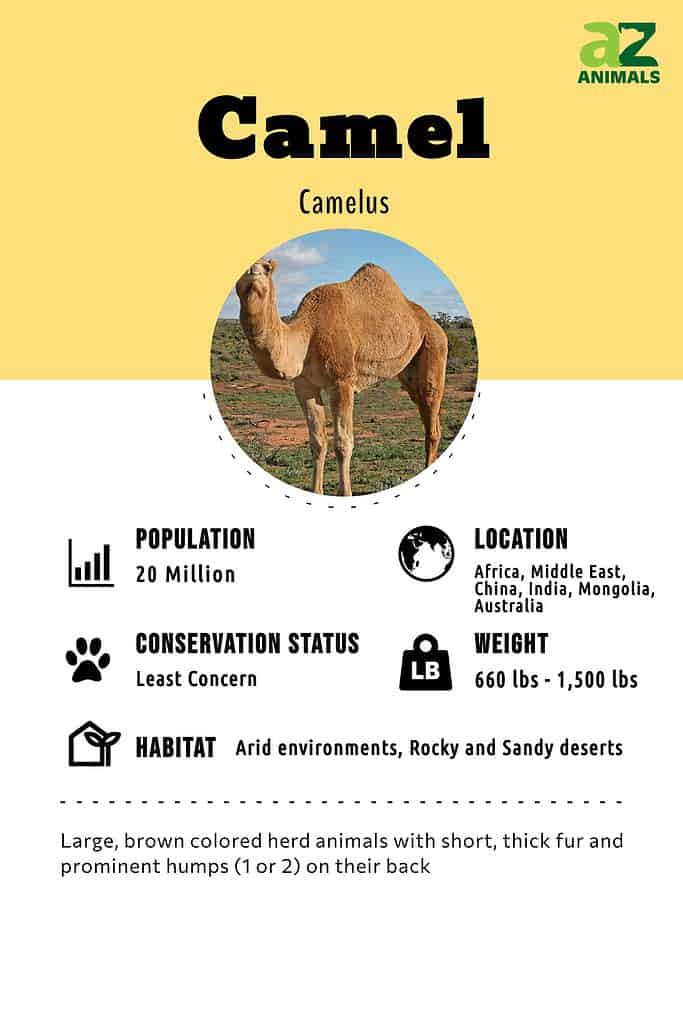
The Camel is one of the most unique mammals on the planet and has adapted perfectly to life in the desert where food and water can often be scarce, and the temperature changes rapidly from the scorching-hot days to the cooler nights. However, although they would have once been found freely roaming the Arabian deserts, they are today extinct from the wild but the domestic population is widespread and numerous.
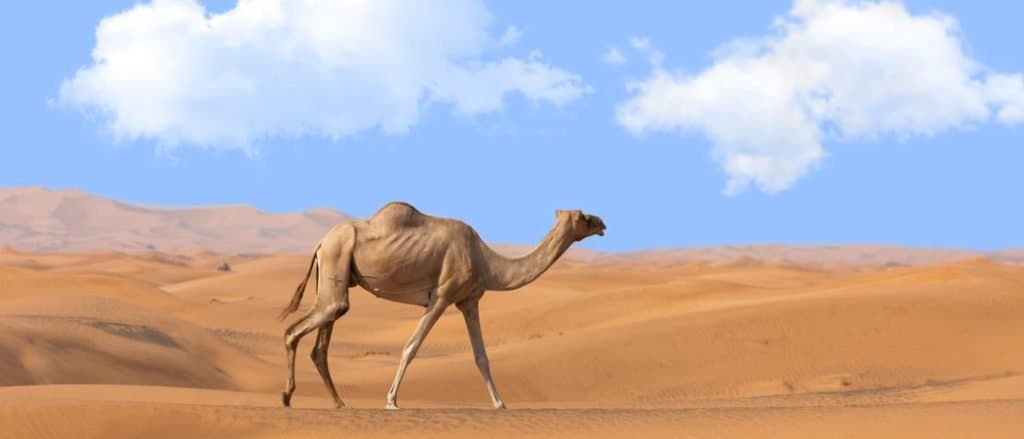
Animals in Djibouti

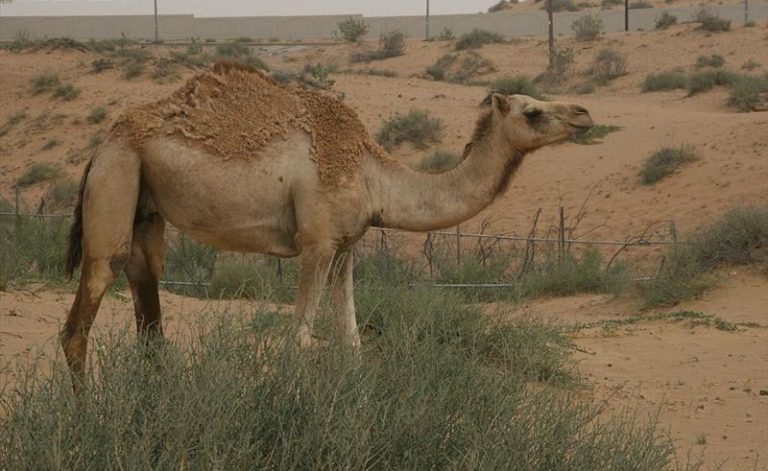
Camels have evolved to thrive in some of the harshest environments, including the desert.

Anatomy and Appearance

Camels have a number of great adaptations to help them to survive in arid climates.

As mentioned, camels have two layers of fur, which work together to provide protection for the harsh sun during the day and also warmth for cold desert nights. The coloration of camel fur varies from cream to brown.

Camels also have other adaptations to keep their center mass away from the blistering surfaces of their environments. Camels have somewhat long legs to help maintain a distance from the ground. Their chests are also pronounced to keep the abdomen off the ground when crouched.

Even the parts of their body that do touch the ground are specialized to help them survive. Because part of the territory that camels inhabit has a rocky and sharp floor, camel’s feet have developed thick pads to protect against cuts and bruises. In other areas that are not hard but are sandy, camels are able to avoid sinking in the sand by stretching wide their two-toed feet.

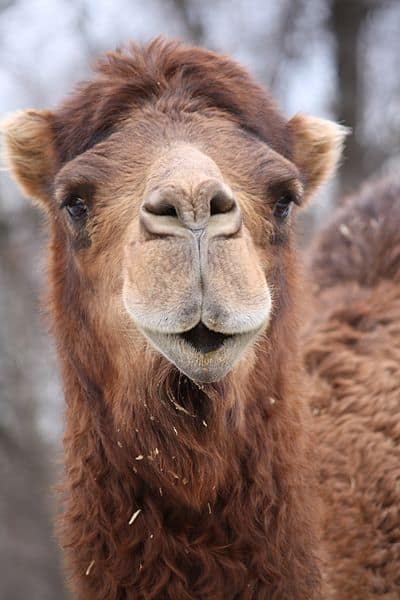
Camels’ eyes and noses are also adapted to thrive in arid areas. Long, layered eyelashes help keep out dust from their eyes, and their nostrils are very thin to help keep dust and debris out.

Perhaps most notably, the large, iconic humps of camels store fat (not water!) from which they are able to tap into as an energy source when nutrients and water are not available. This adaptation allows camels to move through harsh environments.

Camels are an animal with multiple stomachs, having three different stomachs that specialize in absorbing as many nutrients as possible from their harsh environment.
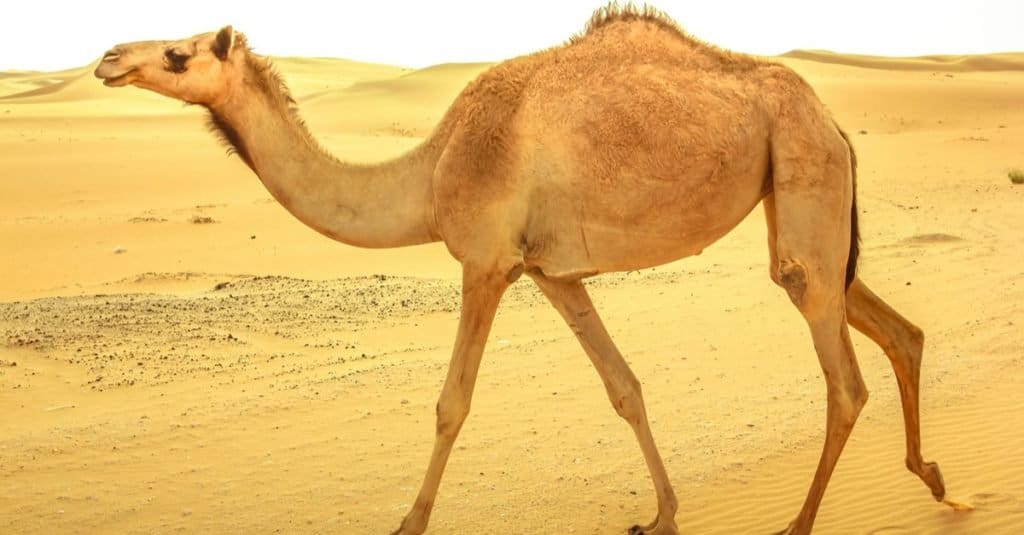
Amazing Desert Animals: Dromedary Camel

Camels’ thick brown skin helps protect them from the hot and cold days and nights in arid climates.

Evolution and History

Similar to the origins of the horse, prehistoric camels are believed to have originated in North America around 40 to 50 million years ago. They were roughly the size of a rabbit. Eventually, they would evolve and migrate to Eurasia. The two-humped, Bactrian camel evolved from the one-humped, dromedary camel about 1 million years ago.

When the camel became domesticated is up for debate, but it was roughly 5,000 years ago! Mankind has been utilizing the awesome adaptions of the camel to help transport goods and people through some of the most uninhabitable terrains on Earth.

Distribution and Habitat

Historically the Camel would have roamed throughout the deserts of Northern Africa, the Middle East and as far into Asia as western India where the surroundings can change from soft, powdery dunes to more hostile and rocky regions. Today, Camels are no longer found in the wild but still exist as domestic animals in these areas and provide both transport and an important source of food for the local people. Their ability to go for so long without both food and water, along with being able to carry heavy loads has meant that they have allowed people to travel further across the desert. Today, millions of domestic Camels exist in the desert along with a feral population that can be found in the deserts of Central Australia.
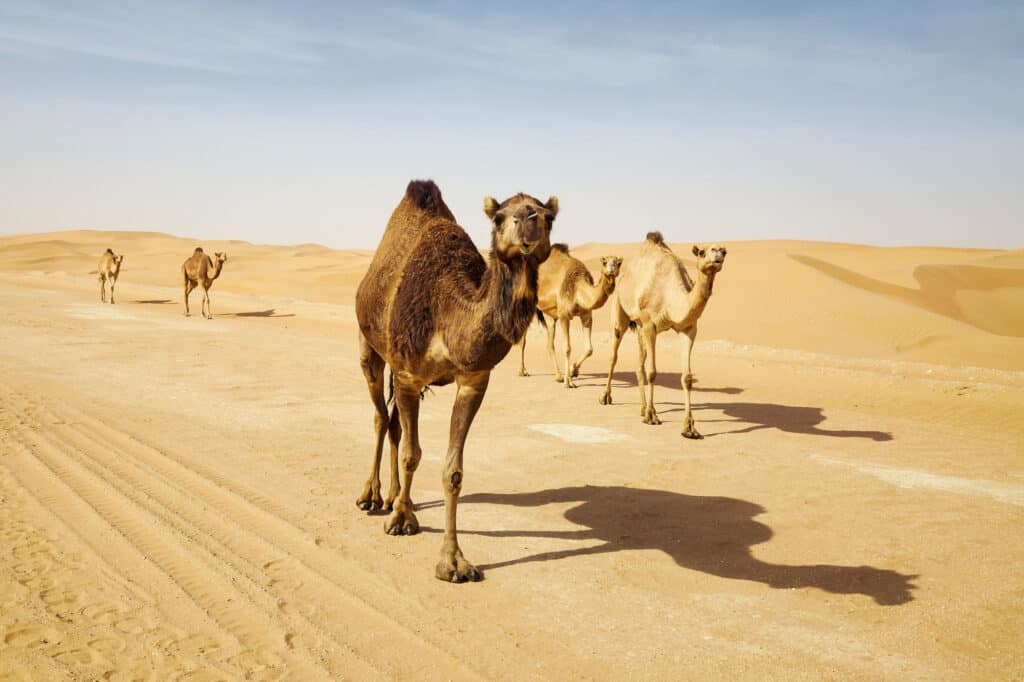
camels

Most camels live as domestic animals, typically in Northern Africa, the Middle East, and as far into Asia as western India. There is one wild species of camel and there are many feral camels in the wild.

3 Types of Camels

  • Bactrian Camel – Bactrian camels are found in Central Asia and also in the area of Bactria. These camels are domesticated. While most camels that you see are one-humped, these and the wild version are two-humped! These humps are smaller and more conical than the dromedary hump.
  • Dromedary/Arabian Camel – Dromedary camels can be found in the Middle East, South Asia, and the Sahara Desert. They have been brought into Australia and introduced there. They are domesticated. They are the tallest of the camels and have not been wild for almost 2,000 years.
  • Wild Bactrian Camel – Wild Bactrian camels are located in Mongolia and northwestern areas of China. This type of camel is actually wild and not domesticated. This is a separate species from the Bactrian camel, and there are roughly 1,000 left on Earth.

Behavior and Lifestyle

Camels inhabit these dry and arid regions in herds that can contain up to 40 individuals and are comprised of females with their young and are led by a single, dominant male. During the breeding season, dominant males protect their harem of females by biting, spitting and leaning on their rival males. Camels rest by lying down and do so by bending their front legs underneath them, followed by the back. They are also known to move in a different way to many mammals by moving both left legs then both the right to make them walk. In order to try and conserve vital moisture in such hostile conditions, Camels have a minimal number of sweat-glands (very few in relation to their large body size), which along with the fact that they will allow their body temperature to rise in the heat, means that they lose water much more slowly than other large mammals.
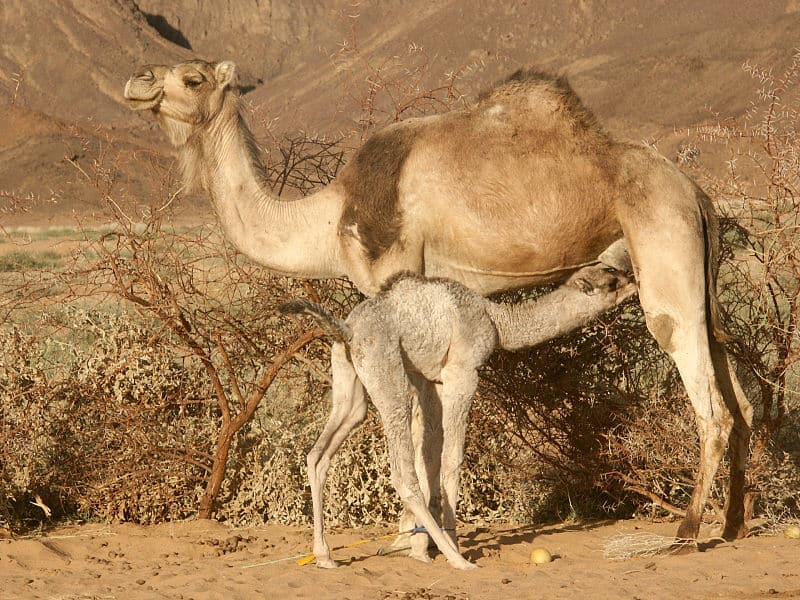
Camel herds are composed of females, calves, and one dominant male.

Reproduction and Life Cycles

Camels are able to breed by the time they are between three and four years old for females and five years old for males, when the dominant male of the herd has breeding rights with the females. Both female and male Camels come into heat during the breeding season which usually lasts between November and March. After a long gestation period that can last for up to thirteen months, the female gives birth to either a single calf or occasionally twins which can already weigh as much as 40kg at birth. Within eight hours the baby camel is able to stand and is then nursed by its mother in the protection of the herd until it is big and strong enough to become independent. Young Camels begin to eat grass when they are between two and three months old and are weaned at roughly four months of age.
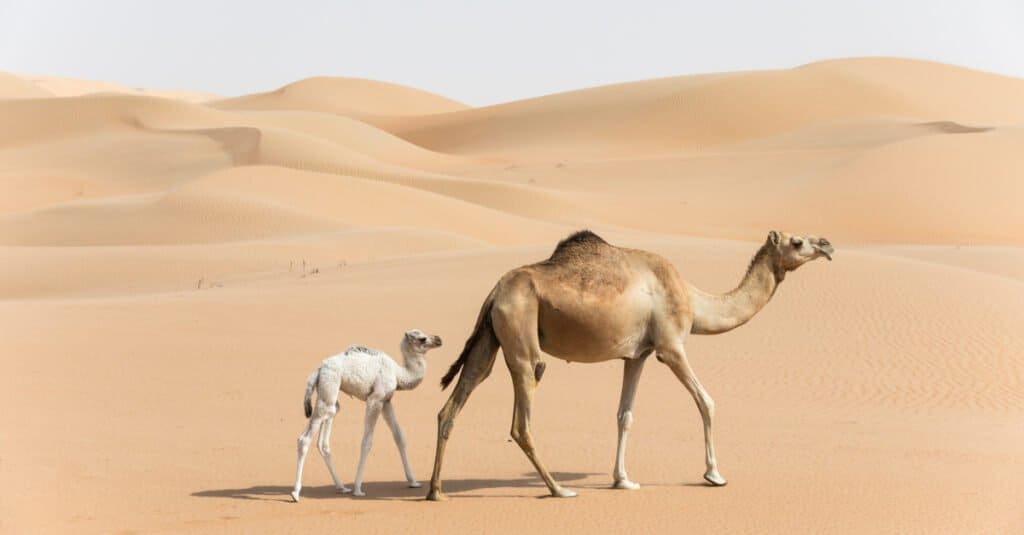
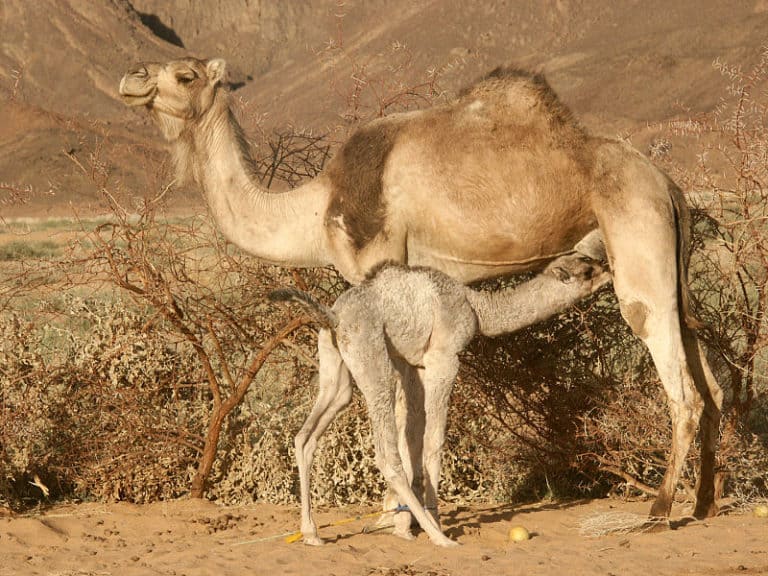
baby camel and mother

Female camels typically give birth to single calves, yet sometimes they do birth twins.

Diet and Prey

Although the Camel is technically a herbivorous animal their diet is not strictly vegetarian as they are known to chew on bones and eat carrion to supplement their diet. Another adaptation for living in the desert is their split, leathery lip which helps the Camel to eat tough and thorny plants which other animals avoid. They are also known to consume plants that are high in salt which again means there is less competition from other animals for food. One of the most remarkable things about Camels is their ability to store the energy from their food and water as fat in their hump, which means they have a ready supply of energy when food and water are scarce. Camels can lose up to 40% of their body weight before needing to replenish themselves and once a water hole or oasis is found, they can drink around 40 gallons of water in a very short time. For a complete analysis of their diet, give our ‘What Do Camels Eat? Their Diet Explained’ page a read!”
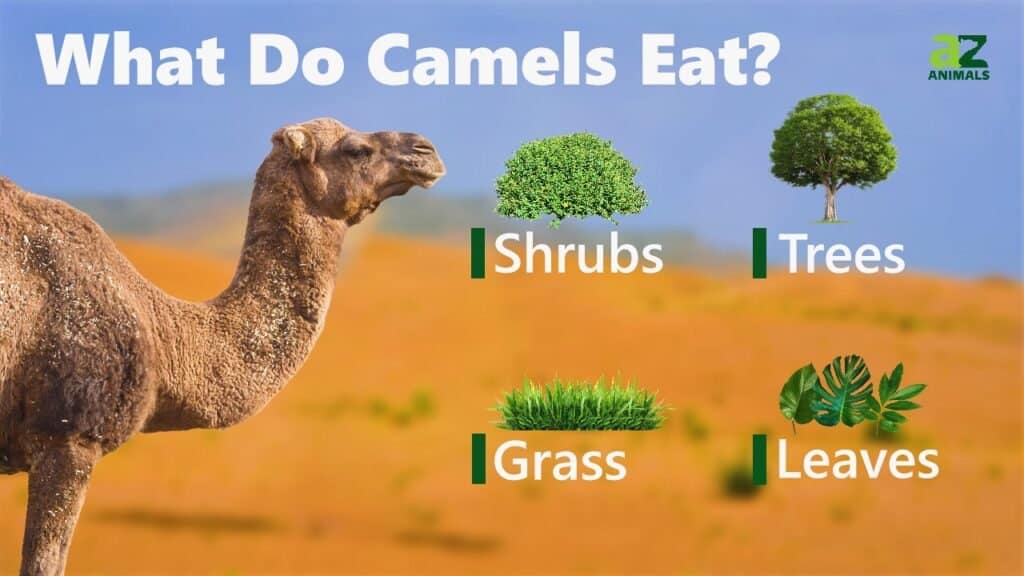
What Do Camels Eat
A camel is an opportunistic feeder that will eat anything, even thorny bushes.

Predators and Threats

Although they no longer exist in the wild, the large size of the Camel means that it would have had limited predators. Lions and Leopards would have been their most common predators; however, the fact that Camels inhabit hostile, arid regions where very few large, carnivorous mammals can be found means that they would not have been hunted as regularly as other hoofed herbivores. Although they were first domesticated by people more than 5,000 years ago they would have been hunted by them for their meat and hides for longer. Today, although no Camels exist in the true wild their domestic population is high and they are commonly found alongside people from Northern Africa to Western Asia.
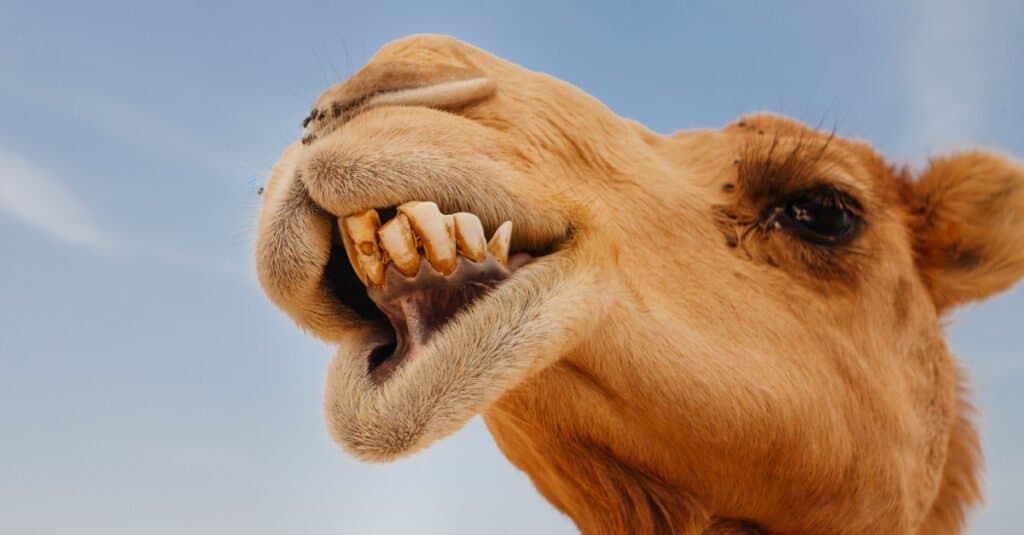
Camel Teeth

While camels have some protection provided by their bite and strong legs, they lived (before domestication) in areas that did not have many natural predators.

Camel Interesting Facts and Features

Camels are not only hardy, desert animals because they can survive without water for up to 10 months provided they find food, but their relatively slow-paced lifestyle means that they can also travel vast distances (sometimes more than 30km) in just one day, whilst carrying a load that could exceed 200kg. As with a number of other domesticated animals, there are now various different breeds of Camel that have resulted from cross-breeding Camels with Bactrian Camels to produce individuals that are either bigger and stronger to be used as working animals or are incredibly fast. Unlike any other mammal, Camels have unique oval-shaped red blood cells which allow the blood to keep flowing smoothly when the animal becomes dehydrated and the blood thickens.
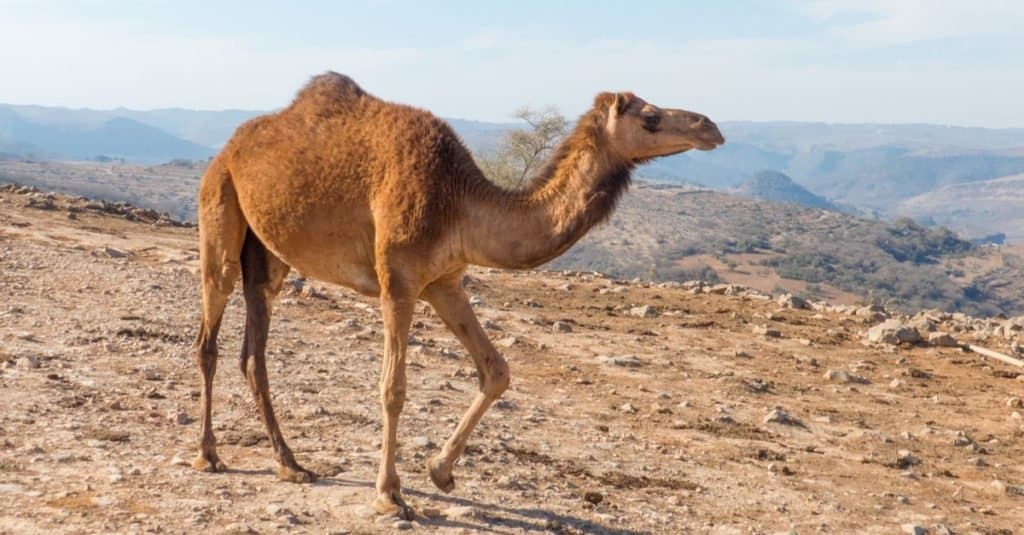
Tallest Animals: Dromedary Camel

The dromedary camel is capable of drinking 100 L (30 gal.) of water in just 10 minutes and can tolerate water loss equal to over 30% of their body weight.

Relationship with Humans

Camels have been used for thousands of years by people both for transporting goods across the desert and as a good source of milk and meat. Their woolly hair can also be used to make clothing along with their leathery hides. Like other domestic animals, there are now numerous breeds of Camel but not all have been bred for truly practical uses with faster and faster breeds appearing that are then used for Camel racing. Their placid nature though has meant that they can live alongside people and other livestock without hardly any problems.

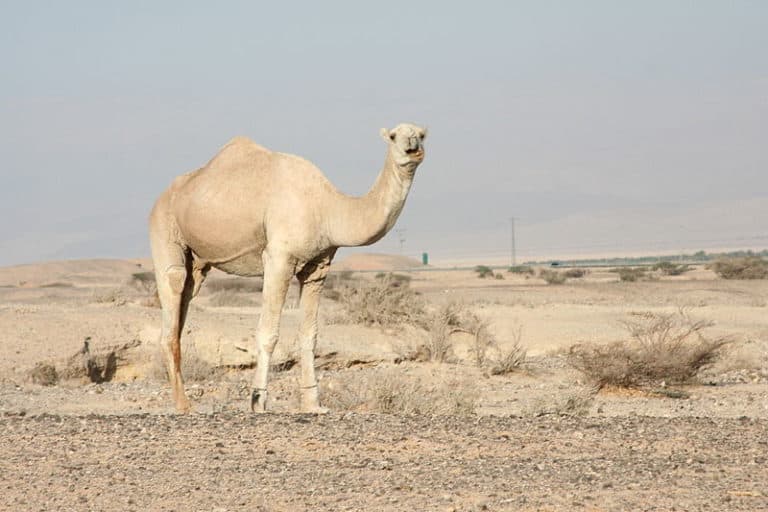
Camels in sandy desert

Camels have been used for millennia to move humans and their goods across vast distances.

Conservation Status and Life Today

Today, although the wild Camel population is extinct they are Common as domestic animals throughout much of their natural range and further, with estimates ranging as high as 20 million individuals. In the 1800s, the first Camel was imported into Australia to be used to help people get between places in the vast desert. Since then more and more have followed which has to led there now being a strong feral population that is possibly as high as 1 million Camels roaming the deserts of Central Australia.

More on Camels

  • Why Do Camels Have Humps?
  • Camel Teeth: Everything You Need to Know
  • Camel Poop: Everything You’ve Ever Wanted to Know
View all 392 animals that start with C
How to say Camel in ...
Catalan
Camell
Czech
Velbloud
German
Altweltkamele
English
Camel
Spanish
Cameluses
Esperanto
Kamelo
Finnish
Kameli
French
Chameau
Galician
Camelo
Croatian
Deve starog svijeta
Hebrew
גמל
Hungarian
Teve
Italian
Dromedario
Japanese
ラクダ
Latin
Camelus
Dutch
Kamelen
English
Kamel
Polish
Wielbłąd
Portuguese
Camelus
Swedish
Kamel
Turkish
Deve
Vietnamese
Lạc đà
Chinese
骆驼

Sources

  1. David Burnie, Dorling Kindersley (2011) Animal, The Definitive Visual Guide To The World's Wildlife / Accessed November 10, 2008
  2. Tom Jackson, Lorenz Books (2007) The World Encyclopedia Of Animals / Accessed November 10, 2008
  3. David Burnie, Kingfisher (2011) The Kingfisher Animal Encyclopedia / Accessed November 10, 2008
  4. Richard Mackay, University of California Press (2009) The Atlas Of Endangered Species / Accessed November 10, 2008
  5. David Burnie, Dorling Kindersley (2008) Illustrated Encyclopedia Of Animals / Accessed November 10, 2008
  6. Dorling Kindersley (2006) Dorling Kindersley Encyclopedia Of Animals / Accessed November 10, 2008
  7. David W. Macdonald, Oxford University Press (2010) The Encyclopedia Of Mammals / Accessed November 10, 2008
  8. Camel Reproduction / Accessed November 10, 2008
  9. Camel Breeds / Accessed November 10, 2008
Heather Ross

About the Author

Heather Ross

Heather Ross is a secondary English teacher and mother of 2 humans, 2 tuxedo cats, and a golden doodle. In between taking the kids to soccer practice and grading papers, she enjoys reading and writing about all the animals!

Thank you for reading! Have some feedback for us?


Camel FAQs (Frequently Asked Questions)

Camels are Herbivores, meaning they eat plants.