Indian Palm Squirrel
Funambulus Palmarum
 Verified by: AZ Animals Staff
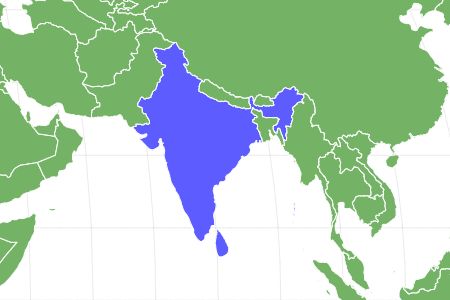
Natively found in parts of India and Sri Lanka!
Advertisement
Indian Palm Squirrel Scientific Classification
- Kingdom
- Animalia
- Phylum
- Chordata
- Class
- Mammalia
- Order
- Rodentia
- Family
- Sciuridae
- Genus
- Funambulus
- Scientific Name
- Funambulus Palmarum
Read our Complete Guide to Classification of Animals.
Indian Palm Squirrel Conservation Status
Indian Palm Squirrel Facts
- Main Prey
- Eggs, Fruit, Insects
- Habitat
- Thick forest and tropical jungles
- Predators
- Human, Snakes, Wildcats
- Diet
- Omnivore
- Average Litter Size
- 3

 © iStock.com/Utopia_88
View all of the Indian Palm Squirrel images!



How to Add Us to Google News


Considered sacred in India, this Indian squirrel species has become an invasive threat in countries like Australia
It’s not just cows that are considered sacred in India. In Hindu texts, a powerful deity named Lord Rama was building a bridge over the sea to help him find his kidnapped wife when a squirrel helped by moving tiny pebbles to the construction area. When Rama thanked the squirrel by petting its back, his fingers left stripes.
Today, Indian palm squirrels have considered sacred to many Indians thanks to that story. However, it’s also become an invasive species that threatens new habitats far from India’s borders.
Incredible Palm Squirrel Facts!
Indian Palm Squirrel is
different from other squirrels because it doesn’t hibernate.
©iStock.com/Utopia_88
- The Indian Palm Squirrel escaped from the Perth Zoo in Australia and rapidly began expanding across the city’s suburbs. While its population in Australia peaked at over 1,000, it’s believed that fewer than 10 survive as an invasive species in Australia today.
- The Indian Palm squirrel is different from other squirrels because it doesn’t hibernate.
- The species is known for its distinctive three stripes across its back. However, it’s far from the only squirrel species in India with unique markings. For example, the Indian giant squirrel is known to have a “rainbow coat!”
Scientific Name and Classification
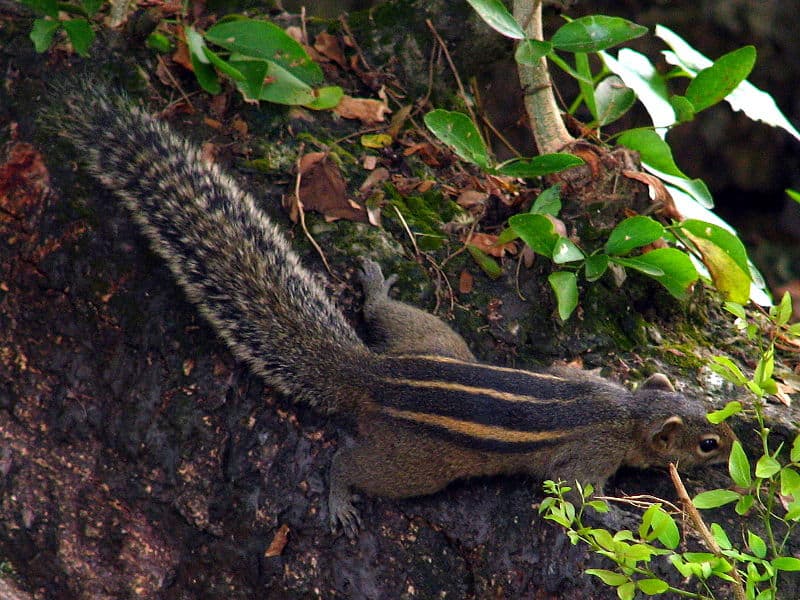
Three-striped palm squirrel (Funambulus palmarum) in Panadura, Sri Lanka
The squirrel’s scientific name is Funambulus palmarum. Funambulus is Latin for the tightrope walker, which describes the squirrel’s agility. Palmarum means that it is of palm trees. Another name for the squirrel is the three-striped palm squirrel.
Because of its stripes, the Indian Palm Squirrel looks very much like a large chipmunk, but chipmunks belong to an entirely different genus.
List of Indian Palm Squirrel Sub-Species
While there are over 40 different species of squirrels in India, and about 280 different species of squirrels in the entire world there are only four subspecies of Indian Palm Squirrels.
These include the following:
- Funambulus palmarum bellaricus (Wroughton, 1916)
- Funambulus palmarum palmarum (Linnaeus, 1766)
- Funambulus palmarum brodiei (Blyth, 1849)
- Funambulus palmarum robertsoni (Wroughton, 1916)
Evolution and Origins
The earliest known fossilized squirrels that have been found to date are from the Eocene epoch. Among other living rodent families, the squirrels are most closely related to the mountain beaver as well as the dormice.
The Indian Palm Squirrel was artificially introduced in the last century, to several other areas of the world such as Australia although they originated in Asia.
Appearance and Behavior
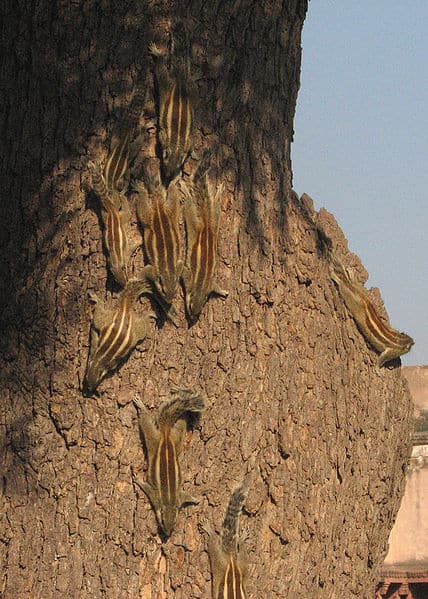
Young squirrels are lighter in color than adults, and sometimes albino squirrels are born.
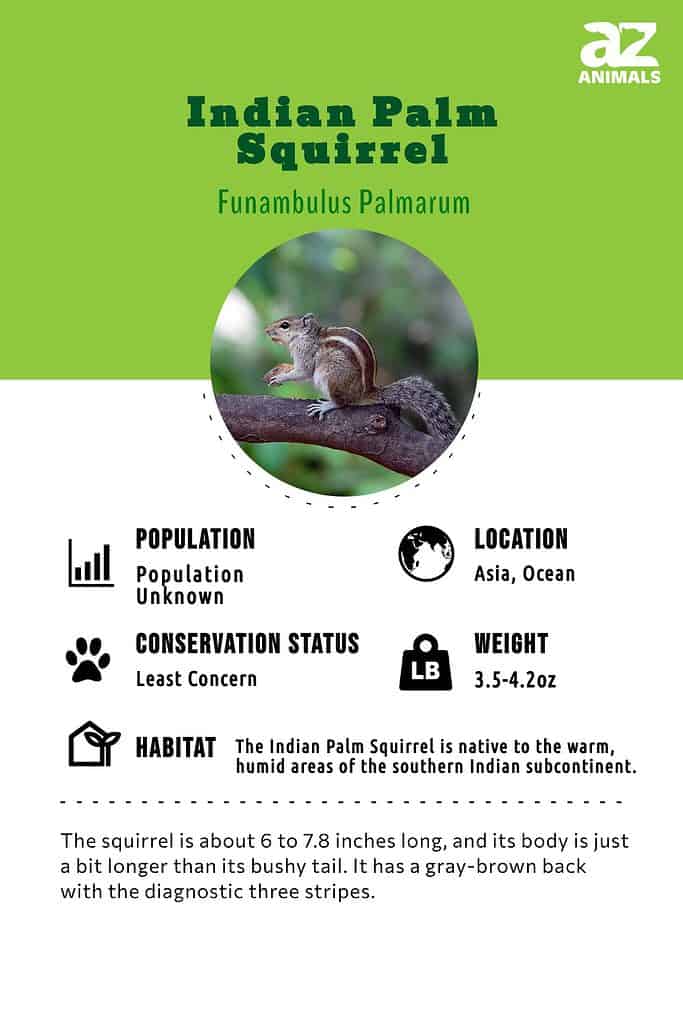
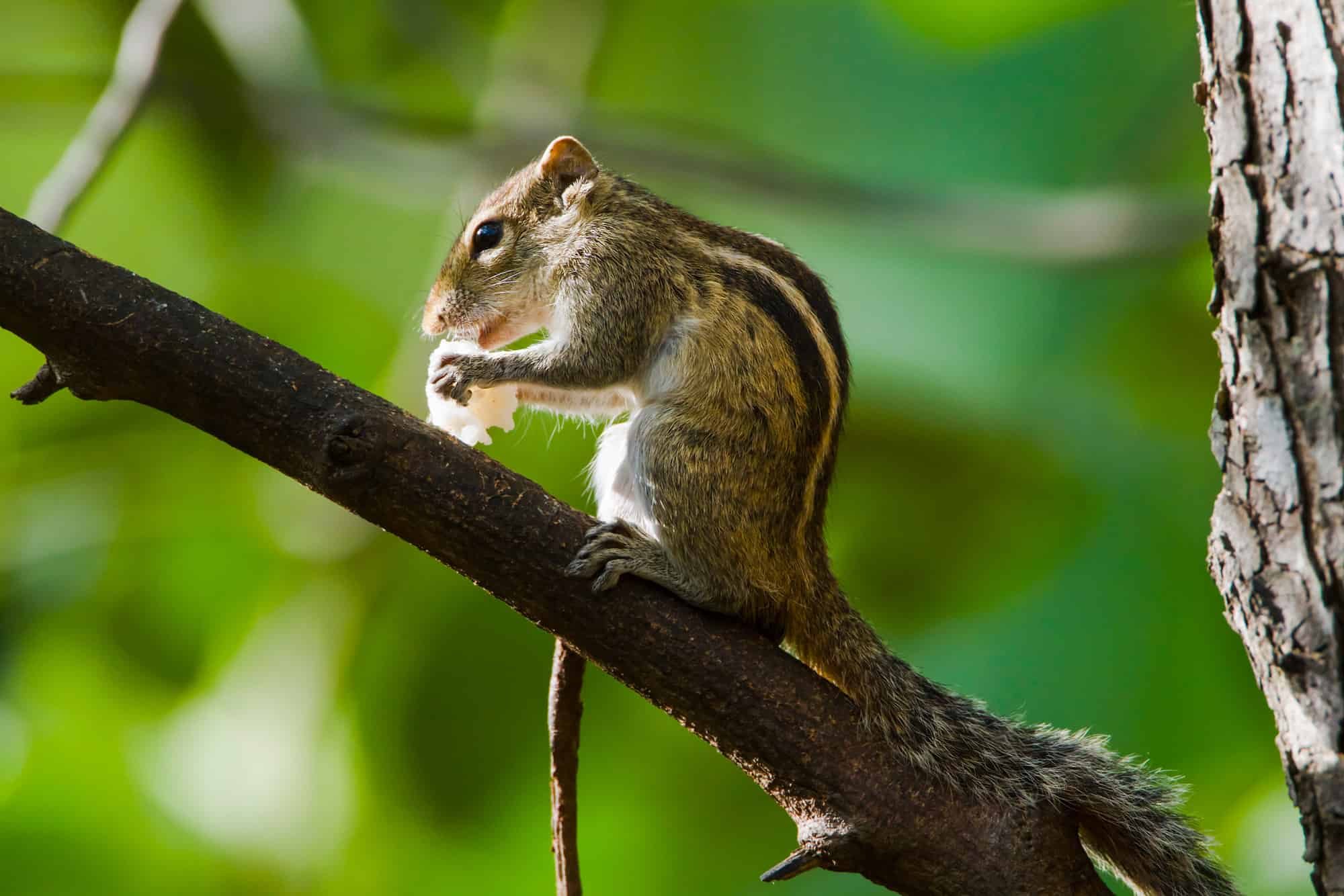
The squirrel is about 6 to 7.8 inches long, and its body is just a bit longer than its bushy tail. It has a gray-brown back with the diagnostic three stripes. Interestingly, these stripes can even be seen on newborn squirrels even before they grow fur.
Young squirrels are lighter in color than adults, and sometimes albino squirrels are born. These are squirrels that lack the pigment that gives other squirrels their color, so their fur is white, and their eyes are red.
The middle of the three stripes runs from the squirrel’s head to its tail, but the outer stripes begin at the squirrel’s front legs and stop at its hind legs. The belly is cream-colored, and the tail has long black and white fur. The texture of the fur overall is soft and silken. The Indian Palm Squirrel has tiny, triangular ears and large dark eyes found on the sides of its head. This gives the squirrel nearly 360-degree vision and helps it avoid predators.
An average Indian Palm Squirrel weighs about 3.5 to 4.2 ounces (100 to 120 grams) and is surprisingly fast for its size. It can run about 10 miles per hour (16 km/hr). They not only have whiskers on their faces, like cats but have them on their legs. These whiskers give the squirrel a superb sense of touch.
The Indian Palm Squirrel has four toes on each of their paws, including a rudimentary thumb. The paws have claws that help the squirrel climb, and the ankles on its back legs can rotate 180 degrees. This helps it go down a tree or telephone pole head first because its back paws are able to firmly grip the wood.
A squirrel is a type of rodent, so its teeth keep growing. Gnawing on its food keeps its teeth, especially two pairs of long front teeth called incisors, a reasonable size and keeps them healthy. The typical arrangement of teeth is two pairs of incisors that gnaw their food, and cheek teeth that grind their food. There’s a big gap between the incisors and cheek teeth called the diastema.
Squirrel Habitat
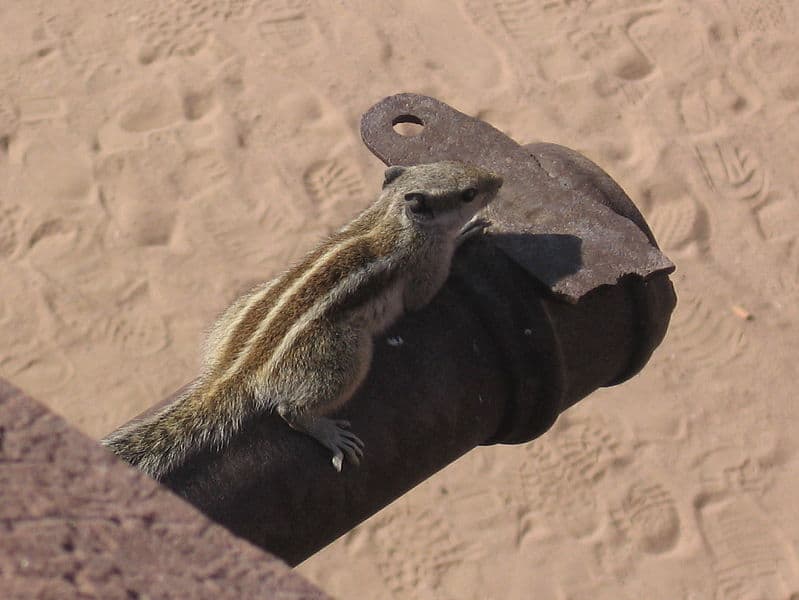
An Indian Palm Squirrel at the Mehrangarh Fort in Jodhpur, India.
©SmokeySteve – Public Domain
The Indian Palm Squirrel is native to the warm, humid areas of the southern Indian subcontinent. It nests at the top of the trees found there, and not just palm trees.
The nest of a squirrel is called a dray and is woven from grass. Instead of hibernating during the winter, the Indian Palm Squirrel just stays in its nest until the day grows warm enough for it to emerge. If it must, the squirrel will even live in a house.
Squirrel Diet
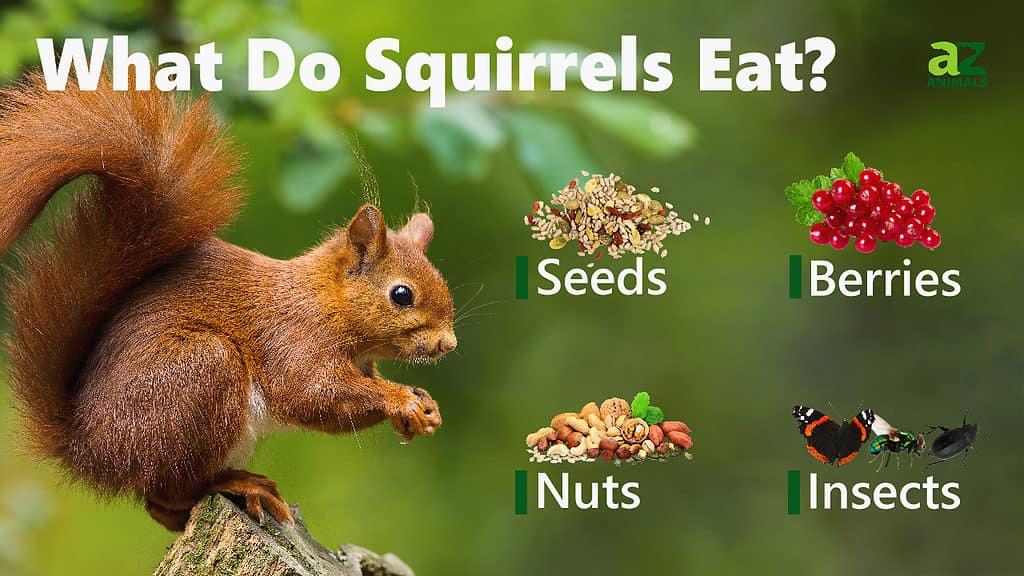
The squirrel is an omnivore. This means it will eat just about anything though it prefers fruit and nuts. In India, palm squirrels prefer crops such as nuts, sugarcane, grapes, mangoes, and apples.
In addition, Indian palm squirrels won’t hesitate to eat crops as well as eggs and even chicks found on poultry farms. This makes them especially dangerous as an invasive species. On the other hand, it eats insects such as caterpillars that also damage crops.
In its natural habitat, the Indian Palm Squirrel will eat other, smaller mammals such as mice, small reptiles, insects, and birds as well as fruit, nuts, eggs, and seeds. Like humans, squirrels can’t digest cellulose.
Because the squirrel is revered in India, people also feed it. As a result, some Indian Palm Squirrels have become quite tame and come to expect handouts from human friends.
Like many other types of squirrels, the Indian Palm Squirrel is fairly aggressive when it comes to protecting its cache of food and will see off any other animal that tries to pilfer it. It’s a busy and noisy animal and gives off a distinctive chipping alarm call when it senses danger.
Squirrel Predators and Threats
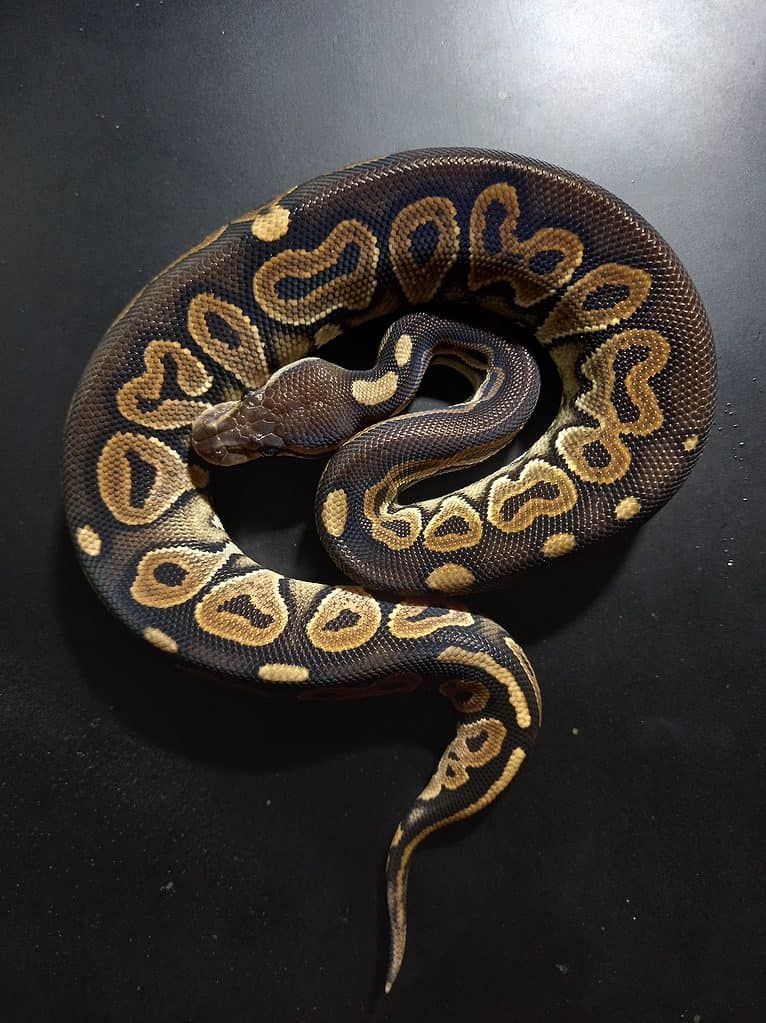
Cinnamon ball pythons are beautiful snakes with very little yellow coloration.
©M.Frog/Shutterstock.com
Because it is small, Indian palm squirrels are favored prey for any sort of carnivore, including mammals like wild cats, birds such as hawks or eagles, and reptiles such as snakes. Outside of India, humans do hunt and kill Indian Palm Squirrels, especially in those regions where they have become invasive.
In Western Australia, after Indian palm squirrels escaped from the Perth Zoo, an exclusion zone was set up around the Perth area to prevent the spread of Indian palm squirrels. However, after they continued escaping, a pest control program was put in place to limit their numbers.
Reproduction, Babies, and Lifespan
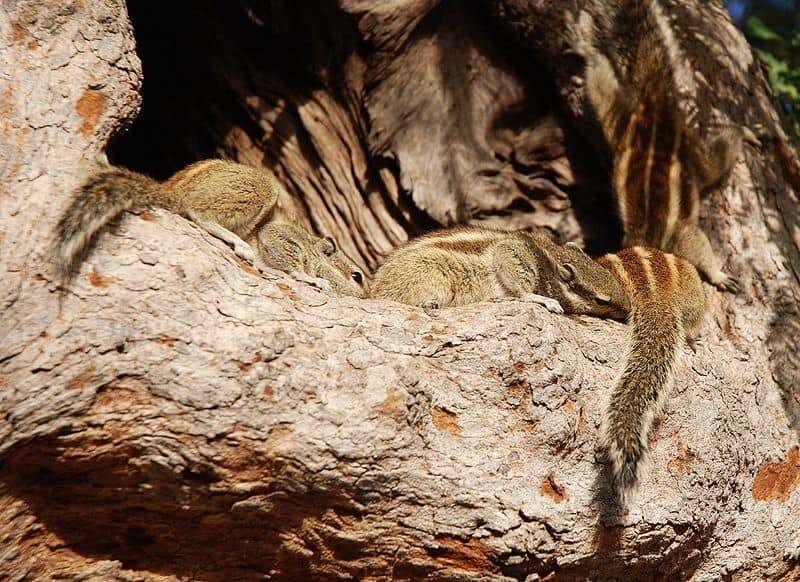
Indian Palm Squirrels are solitary, and they only come together to mate in the fall.
©Thomas Schoch / CC BY-SA 3.0 – License
Indian Palm Squirrels are solitary, and they only come together to mate in the fall. They chase each other, and the males have a mating call. The male’s sense of smell can tell him if the female is ready to mate.
Only the mother cares for the babies. She gives birth after a pregnancy of 34 days to two or three babies. They are born blind and hairless. They are weaned after 10 weeks and are ready to reproduce when they are nine months old. A male squirrel is a buck, the female is a doe, and the baby is a pup, kitten, or kit.
Indian Palm Squirrels live about two to four years, though like many squirrels most who live in the wild die during their first year. The oldest Indian Palm Squirrel lived to be about five and a half years old.
Population: How many Indian Palm Squirrels are Left?
Biologists don’t really know how many Indian Palm Squirrels live in the wild, but it is a very abundant animal, and its population trend is moving upward. The species is classified as “Least Concern.” However, in environments where the squirrel has been introduced to
View all 39 animals that start with I How to Add Us to Google News


Indian Palm Squirrel FAQs (Frequently Asked Questions)
What other Indian squirrels are there beyond the Indian palm squirrel?
There’s another squirrel species found across India that looks very similar to the Indian palm squirrel. It’s named the Northern palm squirrel, and its defining characteristic is that it has five stripes across its back (compared to the Indian palm squirrel’s three).
In addition, India is also home to the Indian giant squirrel, or Malabar giant squirrel. This species of squirrel can weigh about 15 times more than the Indian palm squirrel and measure up to three feet (1 meter) in length! The Indian giant squirrel has a coat that can appear “rainbow” with heavy amounts of magenta, deep blues, and a tail with an orange tip.
Are Indian Palm Squirrels herbivores, carnivores, or omnivores?
Indian Palm Squirrels are Omnivores, meaning they eat both plants and other animals.
What Kingdom do Indian Palm Squirrels belong to?
Indian Palm Squirrels belong to the Kingdom Animalia.
What phylum do Indian Palm Squirrels belong to?
Indian Palm Squirrels belong to the phylum Chordata.
What class do Indian Palm Squirrels belong to?
Indian Palm Squirrels belong to the class Mammalia.
What family do Indian Palm Squirrels belong to?
Indian Palm Squirrels belong to the family Sciuridae.
What order do Indian Palm Squirrels belong to?
Indian Palm Squirrels belong to the order Rodentia.
What genus do Indian Palm Squirrels belong to?
Indian Palm Squirrels belong to the genus Funambulus.
What type of covering do Indian Palm Squirrels have?
Indian Palm Squirrels are covered in Fur.
In what type of habitat do Indian Palm Squirrels live?
Indian Palm Squirrels live in thick forests and tropical jungles.
What do Indian Palm Squirrels eat?
Indian Palm Squirrels eat eggs, fruit, and insects.
What are some predators of Indian Palm Squirrels?
Predators of Indian Palm Squirrels include humans, snakes, and wildcats.
How many babies do Indian Palm Squirrels have?
The average number of babies an Indian Palm Squirrel has is 3.
What is an interesting fact about Indian Palm Squirrels?
Indian Palm Squirrels are natively found in parts of India and Sri Lanka!
What is the scientific name for the Indian Palm Squirrel?
The scientific name for the Indian Palm Squirrel is Funambulus Palmarum.
What is the lifespan of an Indian Palm Squirrel?
Indian Palm Squirrels can live for 2 to 4 years.
How fast is an Indian Palm Squirrel?
An Indian Palm Squirrel can travel at speeds of up to 10 miles per hour.
Thank you for reading! Have some feedback for us? Contact the AZ Animals editorial team.
Sources
- David Burnie, Dorling Kindersley (2011) Animal, The Definitive Visual Guide To The World's Wildlife
- Tom Jackson, Lorenz Books (2007) The World Encyclopedia Of Animals
- David Burnie, Kingfisher (2011) The Kingfisher Animal Encyclopedia
- Richard Mackay, University of California Press (2009) The Atlas Of Endangered Species
- David Burnie, Dorling Kindersley (2008) Illustrated Encyclopedia Of Animals
- Dorling Kindersley (2006) Dorling Kindersley Encyclopedia Of Animals
- David W. Macdonald, Oxford University Press (2010) The Encyclopedia Of Mammals
- Queensland Department of Agriculture and Fisheries, Available here: https://www.daf.qld.gov.au/__data/assets/pdf_file/0006/169656/IPA-Palm-Squirrel-Risk-Assessment.pdf
- Ann Jones, Available here: https://www.abc.net.au/news/2017-07-07/the-rise-and-fall-of-perths-palm-squirrel-pest-population/8683784