

P
Species Profile

Pink Fairy Armadillo

Chlamyphorus truncatus

The pink "sand-swimmer" of Argentina
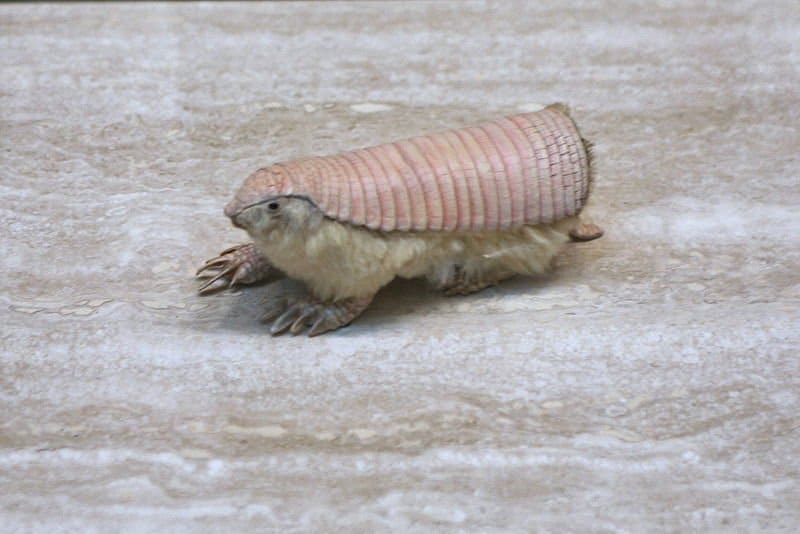
Cliff / CC BY 2.0

Pink Fairy Armadillo Distribution

Click a location to explore more animals from that region

Endemic Species
Loading map...

At a Glance

Wild Species
Also Known As pichiciego, pichi ciego, pichi-ciego
Activity Nocturnal+
Lifespan 7 years
Weight 0.12 lbs
Did You Know?

Size: head-body length ~9-11.5 cm; tail ~2-3 cm; mass commonly reported ~0.09-0.12 kg (Redford & Eisenberg 1992; Nowak 1999).

Scientific Classification

A tiny, highly specialized fossorial (burrowing) armadillo with a pale pink, flexible carapace and reduced vision, adapted to loose sandy soils; among the least-seen mammals in South America.

Kingdom
Animalia
Phylum
Chordata
Class
Mammalia
Order
Cingulata
Family
Chlamyphoridae
Genus
Chlamyphorus
Species
truncatus

Distinguishing Features

  • Very small body size (often cited as the smallest extant armadillo)
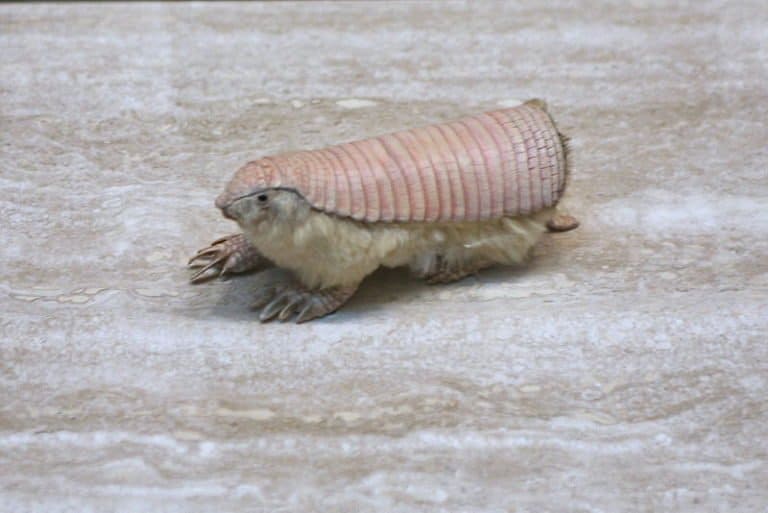
  • Pale pink carapace and skin, with the armor attached along the midline and a fringed margin over the sides
  • Strong foreclaws and extremely rapid burrowing behavior
  • Short, truncated-looking tail relative to many other armadillos

Physical Measurements

Length
5 in (4 in – 6 in)
Weight
0 lbs (0 lbs – 0 lbs)
Tail Length
1 in (1 in – 1 in)

Appearance

Primary Colors
Secondary Colors
Skin Type Keratinized osteoderm carapace over skin; underside thin, soft skin with dense silky fur; reduced external pinnae and small eyes typical of fossorial mammals.
Distinctive Features
  • Adult size: total length ~12-15 cm; mass commonly ~0.09-0.12 kg (Nowak 1999; Redford & Eisenberg 1992).
  • Carapace is characteristically pale pink and flexible; composed of multiple transverse bands enabling tight turns while burrowing.
  • Posterior vertical 'butt' shield is firmly attached to the pelvis (a key diagnostic trait of Chlamyphorus).
  • Extremely enlarged foreclaws (notably the third digit) and powerful forelimbs for rapid digging and 'sand-swimming' in loose dunes/soils.
  • Eyes are very small with reduced vision; ear openings are small-both consistent with a largely subterranean lifestyle.
  • Dense, silky ventral fur reduces abrasion and likely helps prevent sand infiltration during burrowing.
  • Range-linked appearance: often dust-coated from dry, sandy soils of central Argentina (Mendoza-La Pampa region reported in field accounts/IUCN).
  • Unlike the greater fairy armadillo (Calyptophractus retusus), the pink fairy armadillo (Chlamyphorus truncatus) is much smaller, paler pink, has a smoother, more delicate shell and very fine belly fur.

Did You Know?

Size: head-body length ~9-11.5 cm; tail ~2-3 cm; mass commonly reported ~0.09-0.12 kg (Redford & Eisenberg 1992; Nowak 1999).

It can disappear underground in seconds, moving through sand with a swimming motion powered by oversized foreclaws (field accounts summarized in Nowak 1999; IUCN species account).

Its dorsal shield is attached to the body mainly by a thin membrane along the midline, making the "armor" unusually flexible compared with most armadillos (Nowak 1999).

Range is extremely restricted: endemic to central Argentina, recorded primarily in loose sandy soils/dunes of provinces such as Mendoza and nearby areas (IUCN Red List: Chlamyphorus truncatus).

It is far smaller than the greater fairy armadillo (Calyptophractus retusus), which is a much larger, heavier Chlamyphoridae species of the Gran Chaco/Andean foothills region.

Captive survival is typically very poor; published and keeper reports frequently note death within days to months, and reliable wild longevity data are lacking (IUCN; Nowak 1999).

Conservation status is uncertain because encounters are so rare; the IUCN has treated the species as data-deficient in recent assessments due to limited population information (IUCN Red List).

Unique Adaptations

  • Flexible, pale-pink carapace with a soft attachment along the back (membrane connection), allowing tight maneuvering through sand compared with more rigidly armored armadillos (Nowak 1999).
  • Powerful, enlarged foreclaws (especially the central digits) specialized for rapid excavation and sand propulsion-key to its "swimming" locomotion.
  • Reduced eyes/vision consistent with a life spent underground; relies heavily on tactile and possibly olfactory cues in burrows.
  • Compact tail and posterior shield that can help brace/anchor the body while digging and while backing or turning in tight sandy spaces (functional interpretations in standard species accounts).
  • Dense ventral fur (unusual among armadillos) that helps insulate against temperature swings in shallow sand layers and reduces abrasion while moving through loose grains.

Interesting Behaviors

  • Fossorial "sand-swimming": advances by digging with the forefeet and using the body to flow through loose substrate rather than maintaining open tunnels for long.
  • Rapid self-burial: when alarmed, it dives into sand head-first, quickly covering its back until only the surface looks undisturbed.
  • Strong preference for specific substrate: activity is closely tied to very loose, dry sandy soils; compact or clay-rich ground can limit movement and burrow construction.
  • Mostly solitary and elusive: individuals are usually encountered alone; sightings are often incidental (e.g., after rains or soil disturbance) rather than via regular surface activity.
  • Nocturnal/crepuscular tendency reported: many observations occur at night or low light, consistent with reduced vision and a burrowing lifestyle (summarized in mammal references such as Nowak 1999).

Cultural Significance

Locally in Argentina people call the pink fairy armadillo (Chlamyphorus truncatus) names meaning "pink armadillo" and "little blind one." It is seen as very rare and shy, with little broader folklore, and hard to keep alive in captivity.

Myths & Legends

Early naturalists gave Chlamyphorus truncatus the English name "fairy armadillo" because its tiny size and pink shell made it seem like a fairy-tale creature, a history noted in works like Nowak 1999.

Rural Argentine stories call the Pink fairy armadillo (Chlamyphorus truncatus) the 'ghost of the dunes,' saying it disappears into sand and is more often glimpsed than really seen; formal folktales are rare.

Pink fairy armadillo (Chlamyphorus truncatus): museums and biologists often say most knowledge comes from a few specimens and lucky finds, making it seem one of South America's least-seen mammals in IUCN reports.

Conservation Status

DD Data Deficient

Not enough data to assess extinction risk.

Population Unknown

Protected Under

  • Argentina: National Law 22.421 (Conservation of Wildlife / Fauna Conservation)
  • Provincial wildlife regulations in Argentina that restrict capture and hunting of native fauna

Life Cycle

Birth 1 pup
Lifespan 7 years

Lifespan

In the Wild
5–9 years
In Captivity
1–1460 years

Reproduction

Mating System Data Deficient
Social Structure Solitary
Breeding Pattern Transient
Fertilization Internal Fertilization
Birth Type Internal_fertilization

Species-specific mating behavior is poorly documented. Pink fairy armadillos are strongly solitary and fossorial; mating is presumed to occur via brief encounters with no pair bond. As in most armadillos, females likely rear offspring alone without helpers.

Behavior & Ecology

Social Solitary (no stable group name) Group: 1
Activity Nocturnal, Crepuscular
Diet Insectivore Ants and termites (especially larvae)
Seasonal Hibernates

Temperament

Extremely secretive and disturbance-sensitive; typically flees by rapid 'swimming' through loose sand.
Highly fossorial specialist of loose sandy soils; spends most time underground, rarely seen surface-active.
Foraging is primarily subterranean, focused on small invertebrates (especially ants/larvae) in sandy substrates.
Thermally constrained; activity can shift toward crepuscular hours during cooler conditions (IUCN species account).
Reported adult size: head-body length ~12-15 cm; tail ~2-3 cm; mass ~0.09-0.12 kg (Nowak 1999; IUCN).
Longevity is poorly documented; wild lifespan unknown, and captive survival is often only days-weeks due to stress/temperature sensitivity (IUCN).

Communication

No well-described natural call repertoire; handled individuals reported to emit soft squeaks/grunts Field reports summarized in IUCN
Olfaction likely primary: scent cues for mate-finding/territory, as in other cingulates Direct data limited
Tactile contact during brief mating/maternal association; otherwise minimal direct social signaling due to solitary lifestyle.
Substrate-borne cues (vibrations) are plausible during underground movement, but not formally quantified for this species.

Habitat

Biomes:
Desert Cold Temperate Grassland
Terrain:
Plains Sandy
Elevation: Up to 4921 ft 3 in

Ecological Role

Soil-invertebrate predator and burrowing ecosystem engineer in arid/semi-arid sandy habitats.

regulation of ant/termite and other soil-insect populations bioturbation and soil aeration through digging enhanced nutrient mixing and microhabitat creation via burrow formation

Diet Details

Main Prey:
Other Foods:
Plant matter

Human Interaction

Domestication Status

Wild

Pink fairy armadillo (Chlamyphorus truncatus) is fully wild and not domesticated, endemic to central Argentina. It is tiny (about 9–12 cm body), a solitary, burrowing mammal active at night and dusk that eats underground insects (especially ants and termite larvae). It is highly sensitive to capture, survives poorly in captivity, and faces rare, mostly incidental human interactions and conservation concern.

Danger Level

Low
  • Minor scratches/punctures from claws if handled
  • Stress-related mortality in the animal during handling/capture (primary welfare risk; not a direct human danger)
  • General wild-mammal considerations: potential ectoparasites and zoonotic agents are possible but not specifically documented as a major risk for this species

As a Pet

Not Suitable as Pet

Legality: Pink fairy armadillo (Chlamyphorus truncatus) is generally not legal as a pet: capture and keeping are usually banned or strictly controlled in Argentina without permits, and international trade is also restricted.

Care Level: Expert Only

Purchase Cost:
Lifetime Cost: $5,000 - $30,000

Economic Value

Uses:
Minimal direct economic value Non-consumptive value (biodiversity/heritage) Scientific/educational value (rare, specialized mammal)
Products:
  • None established for legal commerce (no recognized sustainable products)
  • Occasional illicit novelty/pet demand (not a legitimate product stream)

Relationships

Predators 5

Pampas fox Lycalopex gymnocercus
Geoffroy's cat Leopardus geoffroyi
Culpeo Lycalopex culpaeus
Crested caracara Caracara plancus
Barn owl
Barn owl Tyto furcata

Related Species 5

Greater fairy armadillo Calyptophractus retusus Shared Family
Pichi
Pichi Zaedyus pichiy Shared Family
Screaming hairy armadillo Chaetophractus vellerosus Shared Family
Southern three-banded armadillo Tolypeutes matacus Shared Family
Giant armadillo
Giant armadillo Priodontes maximus Shared Family

Ecological Equivalents 4

Animals that fill a similar ecological role in their ecosystem

Greater fairy armadillo Calyptophractus retusus Closely analogous ecologically to a highly fossorial fairy armadillo adapted to loose soils; both are specialized diggers that spend most of their time underground and are rarely observed aboveground.
Mendocino tuco-tuco Ctenomys mendocinus Shares the same broad habitat context (central-west Argentina) and a burrowing, sandy-soil niche. Both are subterranean/semifossorial mammals that rely on extensive digging and live in loose, friable soils.
Southern marsupial mole Notoryctes typhlops Convergent evolution for sand-burrowing: reduced external eyes and vision, compact body form, and extreme fossoriality in loose sands, though in Australia rather than South America.
Burrowing owl
Burrowing owl Athene cunicularia Not a taxonomic relative but an ecological 'co-user' of open, sandy or steppe systems with burrow dependence; illustrates shared reliance on friable soils and subterranean refuges in similar landscapes.

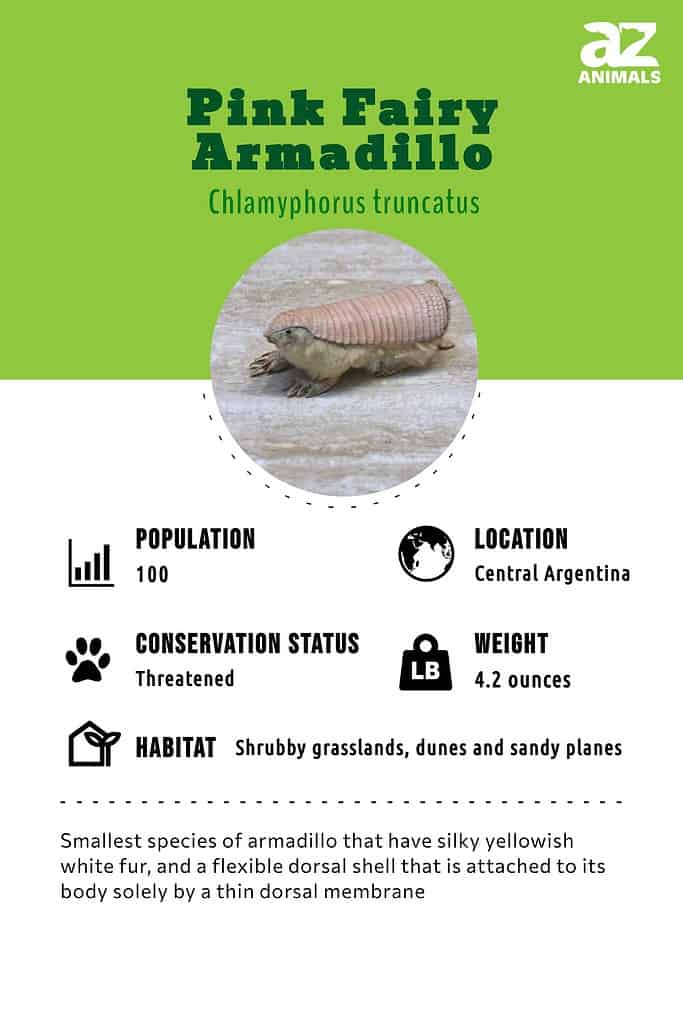
 “The smallest known species of armadillo”

Also known as the Pichiciego, the pink fairy armadillo is the smallest known species of armadillo. It lives in the sandy plains and dry grasslands of central Argentina and other parts of South America. Unique adaptations like an aerodynamic body shape, smooth dorsal shell, and sharp claws mean this creature is able to completely bury itself in the sand in a matter of seconds and then navigate underground with ease. Similar to a mole, the pink fairy armadillo will spend the vast majority of its life underground. It is also nocturnal, only emerging ocassionally at night to find food.
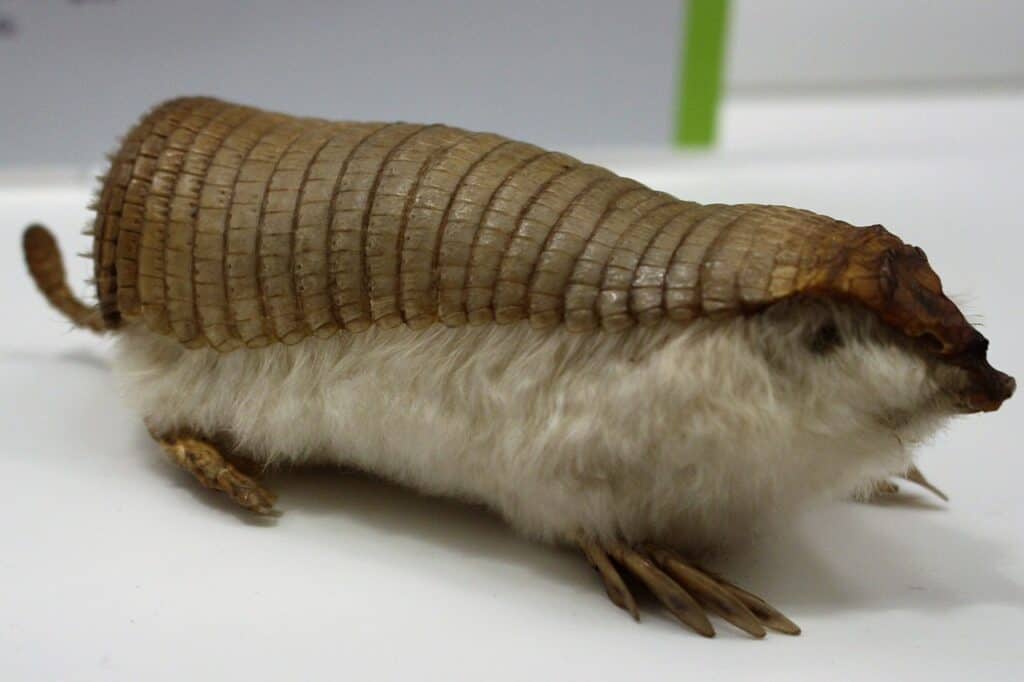
Pink Fairy Armadillo (Chlamyphorus truncatus)

The amazing pink fairy armadillo looks like a blend of different animals.

4 Amazing Pink Fairy Armadillo Facts

  • Pumps blood through its shell to regulate body temperature!
  • At approximately 13cm in length, it is so small it can fit in your hand! 
  • Also known as ‘the sand swimmer’ because of how quickly and easily they can navigate underground!
  • The only armadillo species whose dorsal shell is not completely attached to its body!

Scientific Name

The Pink Fairy Armadillo’s scientific name is Chlamyphorus truncatus. The animal is also known as ‘the sand swimmer’ because of their uncanny ability to burrow and navigate underground. The animal is named for the uniquely pink color of its protective armor. The first known published description of the pink fairy armadillo was by Richard Harlan in 1825. 

Evolution

While not much is familiar in the history of the pink fairy armadillo because of their rare and elusive nature, it is known that the armadillo species originates from South America where it is thought to have an ancient relative dating back more than 60 million years, although the first actual armadillo-type animal is believed to have evolved around 32 million years ago. This mammal was able to make its way to Central and North America when the continents combined. It is believed that this smallest mammal was a result of an adaptation to their environmental changes paired with their subterranean lifestyle.

Types Of

There are only two known living species of the fairy armadillo. The pink fairy armadillo (Chlamyphorus truncatus) and the greater fairy armadillo (Chlamyphorus retusus). Because they have a shared common ancestry, the greater fairy armadillo, also known as the chacoan armadillo, has similar traits, characteristics, and personalities. They are both thought to be extremely elusive, rare and sightings are few and far between.
Appearance And Behavior
Funny Animal Names

Like other armadillos, pink fairy armadillos have a shell (carapace), but it’s softer, thinner, and more flexible and covers about half their body.

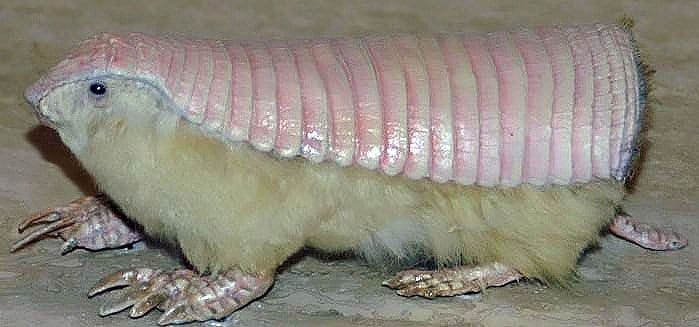
At only 120g and approximately 13cm in length, the pink fairy armadillo is the smallest armadillo species. It is also extremely elusive, spending most of its life beneath the ground. It is also nocturnal, only emerging at night to gather food. Similar to other fossorial species, the pink fairy has claws on its front legs used for digging, a fusiform body shape, and minimal eye size. It also has a carapace (protective shell). Their shell of armor is light pink in color and contains 24 total bands. The shell forms a blunt end due to an extra vertical plate at the end of the shell. In total, this mammal has 28 teeth. These are all the same shape and have no enamel.

Unlike other armadillo species, the pink fairy armadillo has no visible ears and an additional large plate on the back of their head. Uniquely, the fairy armadillo’s shell is not primarily used for protection. Instead, the main function is for thermoregulation. The armadillo can flush the blood vessels in its shell (hence the pink color), and adjust its body temperature. If the armadillo exposes more of its blood to the cool air it can lower its temperature. Inversely, draining the shell allows the animal to better retain heat. Their shell is also not entirely attached to its body. A thin membrane runs along the creature’s spinal column for attachment.

Due to their low basal metabolic rates, pink fairy armadillos have a low body temperature and a high thermal conductance. Their metabolic rate is up to 60 percent lower than what is generally expected for a mammal of that body mass. This allows the them to help maintain its body temperature while in its burrow. Smaller creatures generally always have a tougher time retaining body heat due to their higher surface-area-to-volume ratio. This is why larger animals tend to live in colder environments while smaller animals are more often found in desert environments.
Habitat

Pink fairy armadillos can be found in the deserts and dry scrub lands of central Argentina and other parts of South America. Found primarily in the Neotropical regions of Mendoza, Buenos Aires, San Luis, La Pampa, and San Juan, the pink fairy armadillo’s geographic range is limited to areas in the east because of heavy rainfall in other regions. Because they tunnel only 6 inches below the surface, even modest rainfall can result in flooded burrows. Due to climate change and adverse conditions, it is predicted that the current population is low. The animal has been found from 1,500m in elevation all the way down to sea level.

Diet

The Pink Fairy Armadillo is an omnivore. Their diet mainly consists of ants, but occasionally also snails, plant matter, and worms. The creature often builds complex tunnel systems within close proximity to ant hills, and primarily emerges to gather food during the nighttime.

Predators & Threats

The most common predator for pink fairy armadillos are domestic dogs and cats. Because the armored shell on the animal’s back offers minimal protection, the creature often retreats underground as a primary defense mechanism. Humans can be deadly to the pink fairy armadillo in a number of ways. The animal often falls prey to vehicles while attempting to cross a road. Also, if a pink fairy armadillo is taken in as a pet, it will likely become overwrought with stress and be unable to adapt to the artificial diet provided to them. It is estimated that more than 95 percent of pink fairy armadillos that fall into captivity die within eight days of being captured. Because pink fairy armadillos tunnel so close to the surface, converting their natural habitats to farmland or grazing areas for cattle, their tunnel systems can damage quickly.

According to the research that has been gathered, the population of the pink fairy armadillo continues to decrease, resulting in the animal being listed as a threatened species since 1970.

Reproduction, Babies, And Lifespan

The pink fairy armadillo leads a solitary life except during mating. A female generally gives birth to a single young during a mating cycle. The baby armadillo’s shell is soft at birth and will only become entirely hardened once it has grown into an adult.

The males have no external testicles and the females have two nipples. When mating, males will monitor the female and approach her. The male will then touch the female’s dorsal area, which results in the female wagging her tail. The male will proceed by sniffing the female and maintaining proximity.

There have been no long-term studies conducted on the pink fairy armadillo lifespan. In captivity, the longest life span noted has been four years. Most of these animals die only a few days after being taken in. Younger pink fairy armadillos have the lowest chance of survival in captivity, while adult females have the best chance of survival.

View all 247 animals that start with P

Sources

  1. David Burnie, Dorling Kindersley (2011) Animal, The Definitive Visual Guide To The World's Wildlife / Accessed March 19, 2010
  2. Tom Jackson, Lorenz Books (2007) The World Encyclopedia Of Animals / Accessed March 19, 2010
  3. David Burnie, Kingfisher (2011) The Kingfisher Animal Encyclopedia / Accessed March 19, 2010
  4. Richard Mackay, University of California Press (2009) The Atlas Of Endangered Species / Accessed March 19, 2010
  5. David Burnie, Dorling Kindersley (2008) Illustrated Encyclopedia Of Animals / Accessed March 19, 2010
  6. Dorling Kindersley (2006) Dorling Kindersley Encyclopedia Of Animals / Accessed March 19, 2010
  7. David W. Macdonald, Oxford University Press (2010) The Encyclopedia Of Mammals / Accessed March 19, 2010
A-Z Animals Staff

About the Author

A-Z Animals Staff

AZ Animals is a growing team of animals experts, researchers, farmers, conservationists, writers, editors, and -- of course -- pet owners who have come together to help you better understand the animal kingdom and how we interact.
Connect:

Thank you for reading! Have some feedback for us?


Pink Fairy Armadillo FAQs (Frequently Asked Questions)

The pink fairy armadillo is an omnivore. Ants act as this animal’s primary source of food, though they are also known to forage on plant matter, worms, and snails. The pink fairy armadillo uses its digging abilities to burrow into ant colonies and sometimes forages for small insects above land at night.