
Quick Take
- One black beetle on this list can pull over a thousand times its own body weight, a feat that makes it the strongest insect on Earth. Meet the strongest insect →
- A tiny beetle found across North America secretes a chemical so potent it can blister human skin and kill livestock, yet most people wouldn't recognize it on sight. See the dangerous secretion →
- One species tracks forest fires from miles away, and this ability is central to how it survives. Discover the fire-sensing beetle →
- Some of these beetles use horns, mandibles, or acrobatic stunts in ways that have nothing to do with what you'd expect. See mandibles used for wrestling →
With over 400,000 identified species of beetles in the insect order Coleoptera, scientists estimate that there could be anywhere from 0.9 to 2.1 million, with a mean estimate of around 1.5 million. From red ladybugs (Coccinellidae) to the green June bug (Cotinis nitida), beetles come in a rainbow of colors, but the vast majority are black or earth tones. Continue reading to discover 10 different types of black beetles, including their size, distribution, and what makes them unique.
Cedar Beetle
The cedar beetle (Sandalus niger), also known as the cicada parasite beetle, is a fascinating insect native to North America, particularly in the Eastern United States. These beetles typically measure just under an inch long.

Female cedar beetles are black with sawtooth antennae.
©Ezume Images/Shutterstock.com
Females feature uniform black, elongated bodies with shorter, saw-toothed antennae. Male cedar beetles vary from light brown to black and are recognized by their dramatic, highly developed feathery or fan-like antennae.
What makes the cedar beetle truly unique is its parasitic behavior. Cedar beetle larvae act as parasitoids on cicada nymphs, slowly feeding on the host’s fluids in a specialized process called hypermetamorphosis.
White-spotted Sawyer Beetle
The white-spotted sawyer beetle (Monochamus scutellatus) is a wood-boring longhorn beetle native to North America, ranging transcontinentally across the north and extending south through the Appalachians, the Rockies, and California. It is easily identified by its long black to dark brown body, highlighted by a single, distinct white spot located exactly where its wing covers meet. These beetles measure between 0.6 and 1.2 inches in length.

The male white-spotted sawyer beetle has long antennae.
©valleyboi63/Shutterstock.com
The male white-spotted sawyer has sweeping, multi-jointed antennae that can measure up to twice its overall body length. Females possess shorter antennae and subtle white mottling across their wings. White-spotted sawyer beetles possess an extraordinary ability to detect the chemical signatures of forest fires and distressed trees from miles away, allowing them to rapidly colonize freshly weakened wood and play a vital role in accelerating forest decomposition.
American Rhinoceros Beetle
The American rhinoceros beetle (Xyloryctes jamaicensis) is distributed across the Eastern and Central United States. These insects are 1 to 1.5 inches long and have a convex body coated in a glossy, dark reddish-brown to nearly black exoskeleton. Male American rhinoceros beetles have a single, large, backward-curved horn on their head, similar to a rhinoceros, which they use to battle rival males for mating rights. Females completely lack this horn.
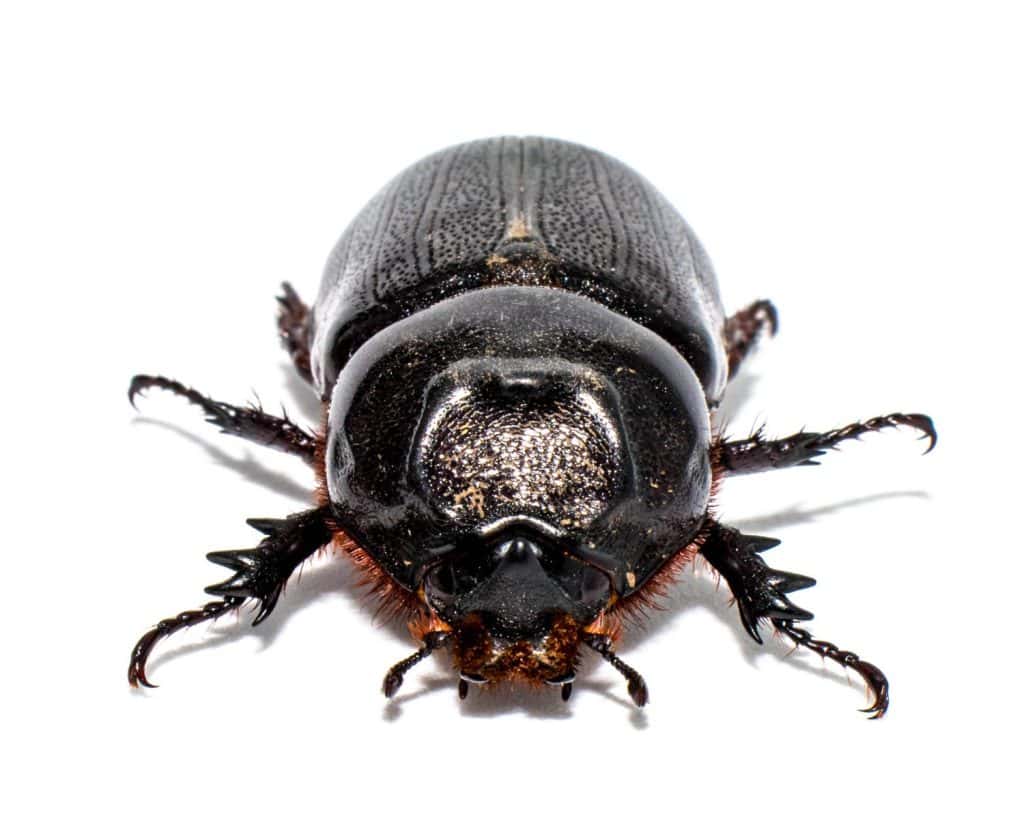
Female American rhinoceros beetles do not have the signature horn.
©slothful/Shutterstock.com
Scarites Ground Beetle
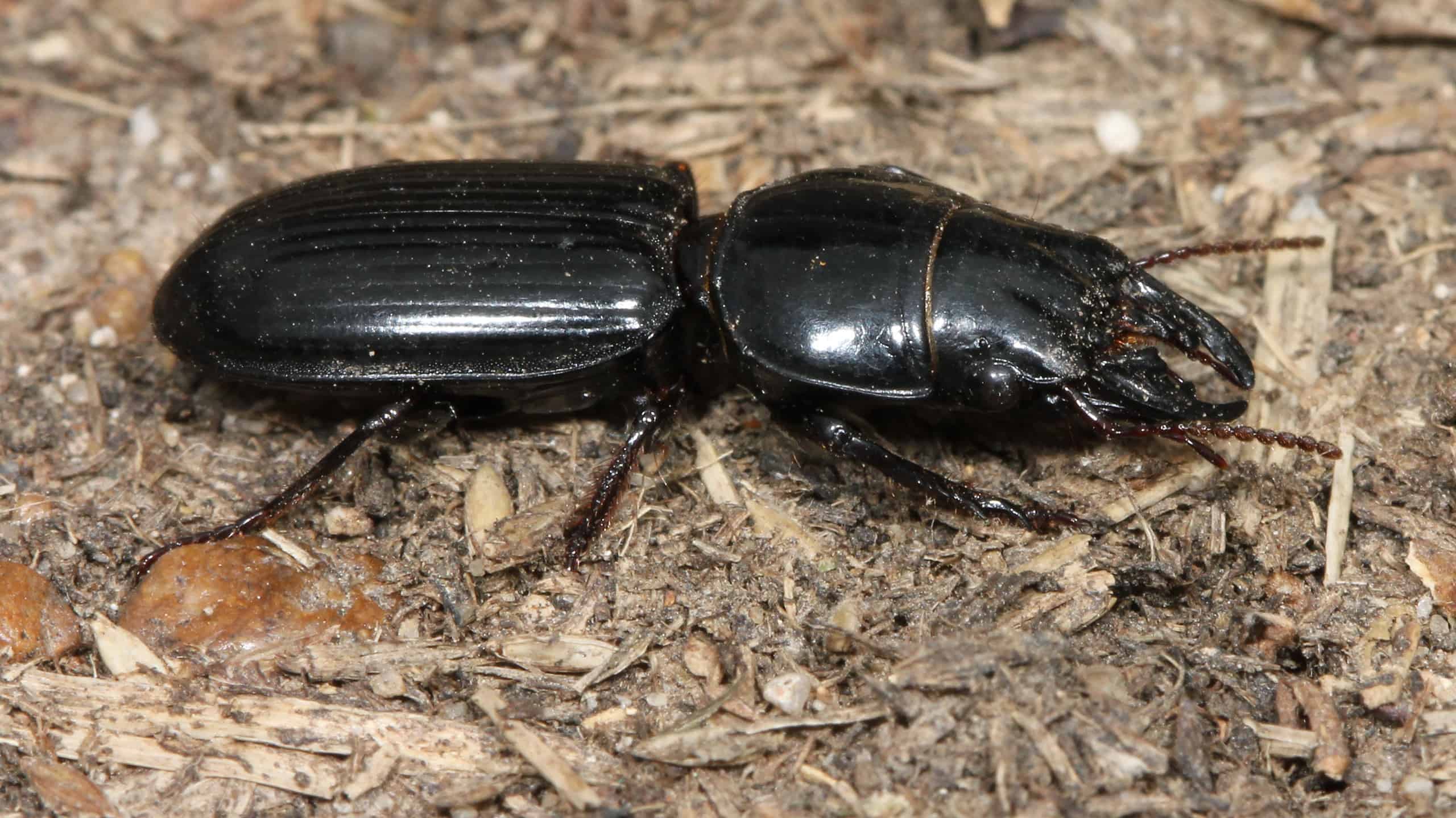
The Scarites ground beetle (Scarites subterraneus) is a predatory insect widely distributed across North America, Central America, and the Caribbean.

Ground beetles are a glossy black color, with very small pincers on their front that overlap when closed, rather than snapping directly together.
©Dmitry Fch/Shutterstock.com
These beetles have a solid, glossy black exoskeleton, an elongated body, and a wide, flat head. When startled, the Scarites ground beetle exhibits a unique defensive behavior in which it plays dead by stiffening its body and tucking in its limbs.
Obscure Darkling Beetle
The obscure darkling beetle (Eleodes obscura), also known as the dusky or striated darkling beetle, is an insect native to Western North America, with a broad geographic distribution spanning from south-central British Columbia, Washington, and Oregon down to Northern Mexico, and stretching eastward into Nebraska, Kansas, and Texas.
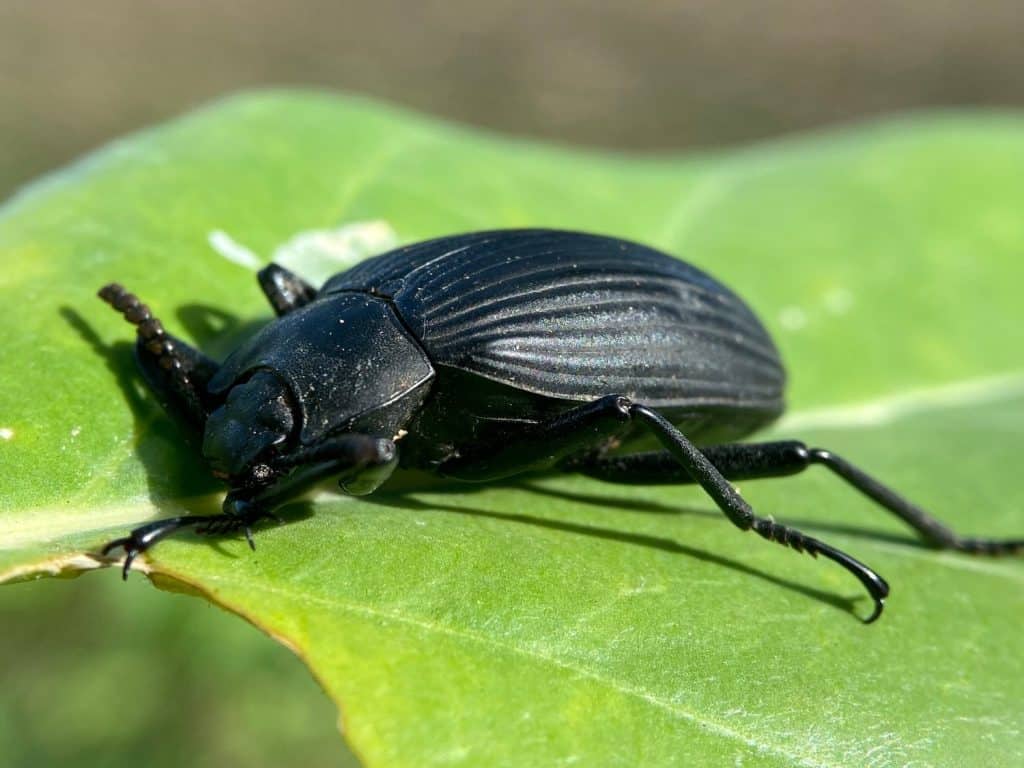
Obscure darkling beetles are widely distributed throughout North America.
©Kandrah/Shutterstock.com
The obscure darkling beetle features a dull, matte black exoskeleton characterized by distinctively grooved wing covers (elytra). The obscure darkling beetle typically grows to approximately one inch in length. When threatened by a predator, it performs a dramatic, acrobatic defense, standing on its head to point its abdomen into the air — a warning posture used to spray a highly effective, foul-smelling chemical secretion at its attacker.
Hermit Flower Beetle
The hermit flower beetle (Osmoderma eremicola) is a large scarab beetle native to North America, distributed from Southern Canada across the Midwestern and Eastern United States down to Georgia.
Characterized by its glossy black, flat-topped appearance, adult hermit flower beetles typically measure about one inch long. Its genus name, Osmoderma, translates to smelly skin, which relates to its distinct defense mechanism: when handled or threatened, hermit flower beetles emit a pungent, highly noticeable odor.

Hermit flower beetles are shy, most of the time trying to stay out of the way.
©Richard Velayo/Shutterstock.com
Black Blister Beetle
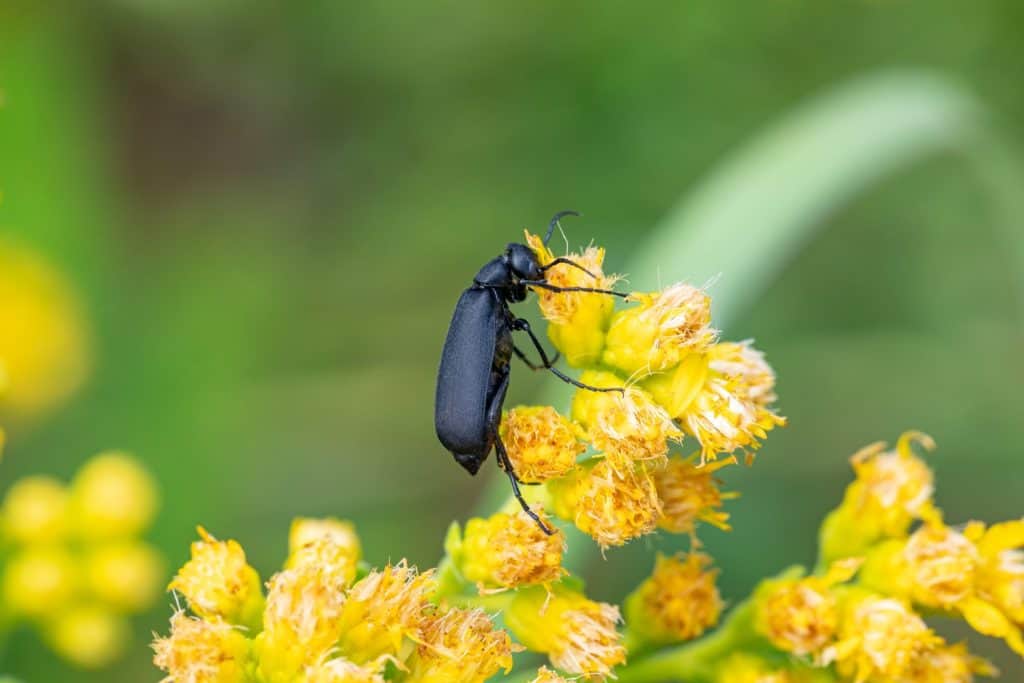
The black blister beetle (Epicauta pennsylvanica) is one of the few types of beetles that can actually hurt people. These black beetles are not very large, only measuring between 0.2 and 0.7 inches long.
©J.J. Gouin/Shutterstock.com
Black blister beetles are widespread throughout North America and secrete a toxic chemical called cantharidin, which can cause severe skin irritation, including painful blisters on contact with human skin. Beyond skin irritation, this compound poses a severe and often lethal threat to livestock, particularly horses, if livestock accidentally ingest these beetles.
Bull-headed Dung Beetle
The bull-headed dung beetle (Onthophagus taurus) is a small, oval-shaped insect native to the Mediterranean and Europe that has since been widely introduced to Australia and parts of North America. It measures 0.31 to 0.39 inches long and has a shiny black or reddish-brown exterior.
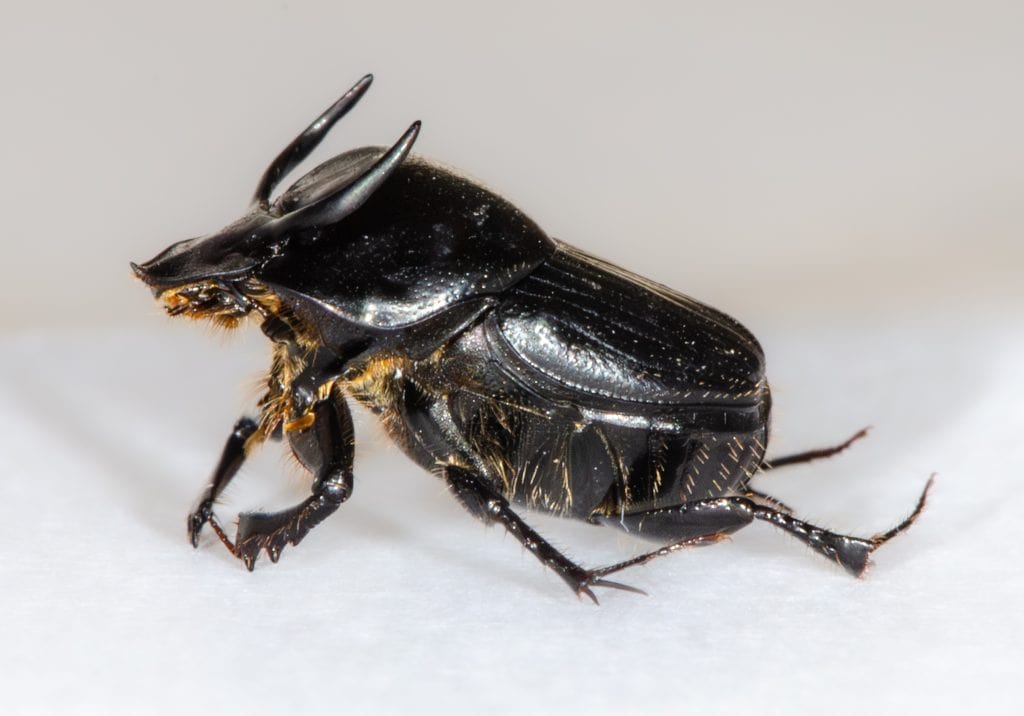
Male bull-headed dung beetles have horns that resemble those of a bull.
Male bull-headed dung beetles have long, sweeping horns resembling those of a bull, while females and juvenile males lack or have minimal horns. Bull-headed dung beetles are the strongest insect on Earth, capable of pulling over one thousand times their body weight.
Antelope Beetle
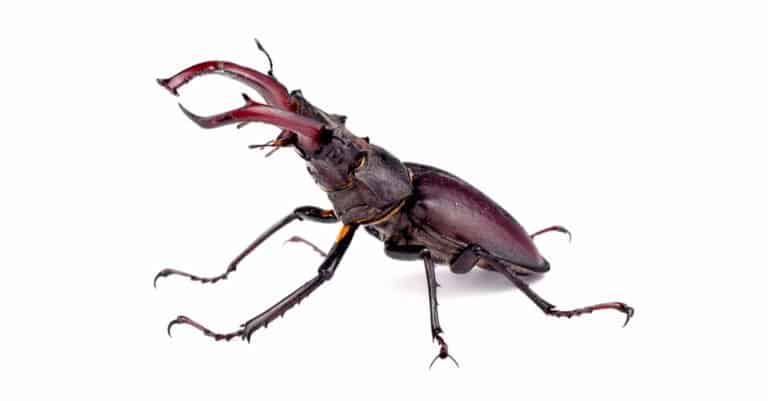
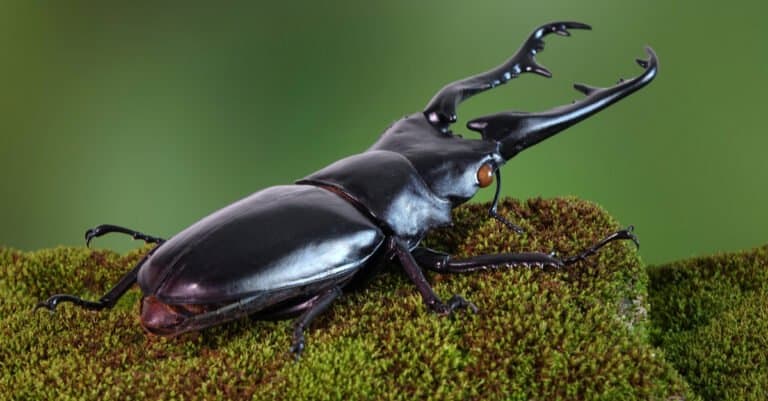
The antelope beetle (Dorcus parallelus) is endemic to North America, distributed across the Eastern United States and Canada. These beetles have a uniformly black or dark brown exoskeleton with a wide, rectangular, and relatively smooth head.

Measuring up to about an inch long, antelope beetles are quite large.
©Studio Caramel/Shutterstock.com
Antelope beetles are medium-sized for beetles, measuring up to 1.0 inch in length. Male antelope beetles have large, pincer-like jaws that are twice as long as those of females. These unique mandibles, which visually resemble the curved horns of a pronghorn antelope, are not used for eating, but rather serve as tiny wrestling weapons for males to battle rivals over territory and mating rights.